
Nouns in English grammar are the essential anchor points of clear communication. Without them, we wouldn’t be able to name who we are, where we are going, or what we are thinking. Whether you are texting a friend, drafting an essay, or ordering food, you rely on nouns constantly to turn basic thoughts into meaningful sentences.
Think of nouns as the anchor points of the English language. Without them, we wouldn’t be able to talk about who we are, where we are going, or what we are thinking. Whether you are texting a friend, writing an essay, or ordering food, you are using nouns constantly. They are, quite literally, the building blocks of communication.
🎁 Free Printable Worksheet
Practise as you learn! Download the FREE Nouns Worksheet (PDF) and complete the exercises while reading this lesson.
📥 Download the FREE Articles Worksheet
👉 Want full practice? Explore our complete Level 1–6 Grammar Worksheets:
English Grammar Worksheets (Level 1–6) – 150+ Printable Exercises with Answers
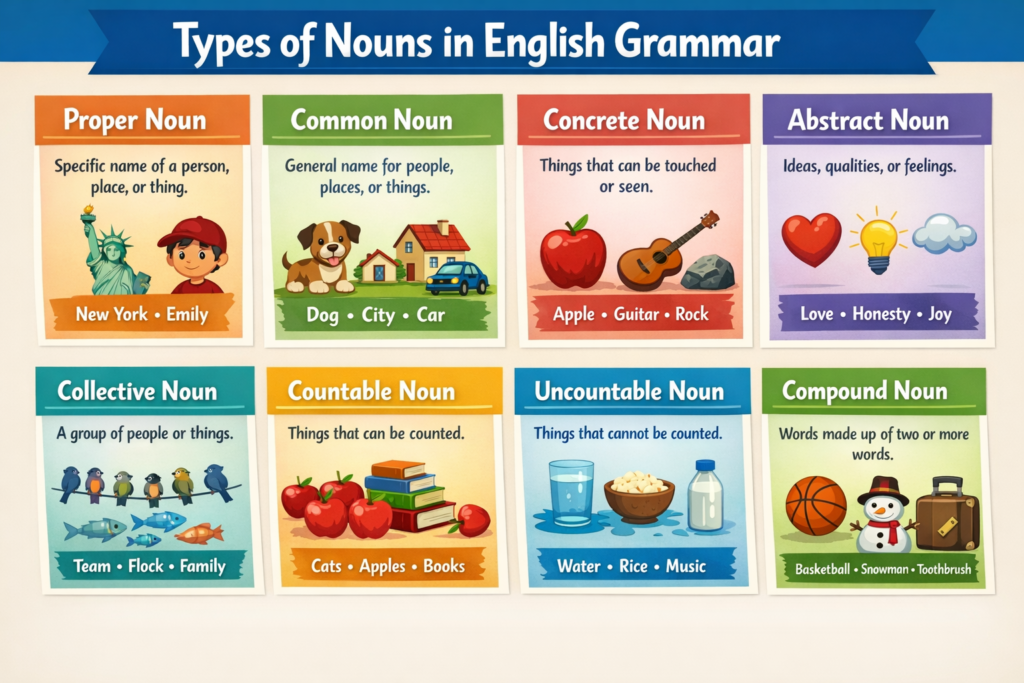
Table of Contents
What Is a Noun?
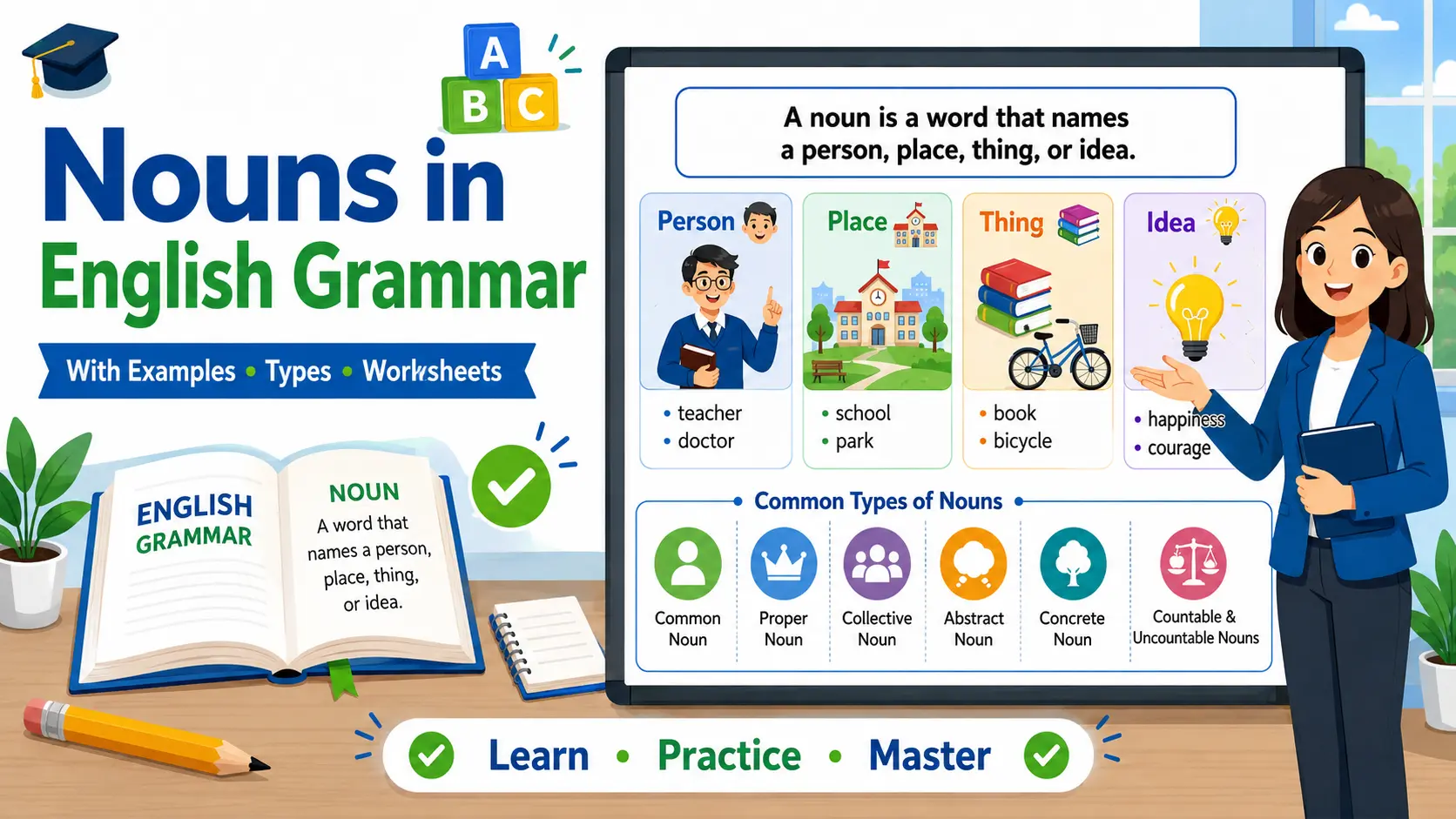
A noun is a word that names a person, place, thing, or idea.
Examples:
- Person: teacher, John, doctor
- Place: school, Malaysia, park
- Thing: book, car, phone
- Idea: happiness, freedom, love
👉 Example sentence:
The teacher gave the student a book.
Types of Nouns
1. Common Nouns
These are general names of people, places, or things.
Examples: dog, city, teacher
2. Proper Nouns
These are specific names and always start with a capital letter.
Examples: Ali, Kuala Lumpur, Malaysia
3. Concrete Nouns
Things you can see, touch, hear, smell, or taste.
Examples: apple, chair, music
4. Abstract Nouns
Ideas, feelings, or concepts you cannot touch.
Examples: love, happiness, courage
5. Countable Nouns
Nouns you can count.
Examples: one book, two cars
6. Uncountable Nouns
Nouns you cannot count individually.
Examples: water, sugar, information
7. Collective Nouns
Collective nouns refer to a group or collection of individuals, animals, or things functioning as a single unit.
- Examples: team, family, committee, class, audience, flock, herd.
- Sentence Example: “The committee agreed on the project proposal.”
8. Compound Nouns
Compound nouns are formed by combining two or more individual words to create a new noun with a distinct meaning.
- Single Word: toothpaste, bedroom, sunfish.
- Hyphenated Word: check-in, dry-cleaning, mother-in-law.
- Separated Words: solar panel, high school, bus stop.
9. Possessive Nouns
Possessive nouns show ownership by adding an apostrophe and an -s. For a complete guide on possessive mechanics and apostrophe rules, consult the Purdue OWL Possessives Guide.
- Singular Possessive: “The teacher’s lesson plan.”
- Plural Possessive: “The students’ test results.”
👉 Learn more here:
https://learnenglishgrammar.org/parts-of-speech/
Examples of Nouns in Sentences
- The boy is playing in the park.
- She has a beautiful voice.
- Malaysia is a wonderful country.
- Honesty is the best policy.
Syntactic Functions of Nouns in Sentences
In English grammar, a noun doesn’t just name something—it performs specific jobs within a sentence depending on its position relative to verbs and prepositions.
| Noun Function | Definition | Example Sentence |
| Subject | Performs the main action of the sentence | “The engineer designed the solar system.” |
| Direct Object | Directly receives the action of the verb | “She wrote an article.” |
| Indirect Object | Receives the direct object (answers to/for whom) | “The teacher gave the student a book.” |
| Object of Preposition | Follows a prepositional word | “They walked into the classroom.” |
| Subject Complement | Renames or describes the subject after a linking verb | “Mr. Lee is a quantity surveyor.” |
A noun performs specific grammatical roles depending on its position relative to verbs and prepositions. You can explore a complete breakdown of noun functions on the Cambridge Dictionary Nouns Guide.
How to Identify a Noun
Ask yourself:
- Is it a person? (teacher, doctor)
- Is it a place? (school, city)
- Is it a thing? (table, phone)
- Is it an idea? (love, happiness)
If yes, it is probably a noun.
Common Mistakes with Nouns
- Incorrect plural forms (childs → children)
- Missing capital letters for proper nouns
- Confusing countable and uncountable nouns
Mistake 1: Irregular Plural Noun Errors
- ❌ Incorrect: “The childs played in the park, and the mans watched.”
- ✔️ Correct: “The children played in the park, and the men watched.”
- Pedagogical Reason: Many basic nouns change their root vowels or add special suffixes instead of adding -s or -es (child -> children, man -> men, tooth -> teeth, mouse -> mice).
Mistake 2: Misplacing Apostrophes in Possessive Nouns
- ❌ Incorrect: “The cat chased it’s tail.”
- ✔️ Correct: “The cat chased its tail.”
- Pedagogical Reason: Its (no apostrophe) is the possessive pronoun, whereas it’s is the contraction for “it is” or “it has.”
Mistake 3: Failing to Capitalize Proper Nouns
- ❌ Incorrect: “We visited kuala lumpur last tuesday.”
- ✔️ Correct: “We visited Kuala Lumpur last Tuesday.”
- Pedagogical Reason: Specific names of cities, countries, days of the week, and months are proper nouns and must always begin with capital letters.
Mistake 4: Pluralizing Uncountable Nouns
- ❌ Incorrect: “He gave me three valuable advices.”
- ✔️ Correct: “He gave me three valuable pieces of advice.”
- Pedagogical Reason: Uncountable abstract nouns cannot take an -s suffix; use measurement/partitive phrases (pieces of, items of) to express quantity.
👉 Improve further:
https://learnenglishgrammar.org/adverbs-in-english-grammar/
Free Noun Worksheet (Practice Now)
Want to improve your English grammar with real practice?
You can download a FREE sample worksheet to see how our system works:
👉 Get your free worksheet here:
https://learnenglishgrammar.org/free-sample/
- Easy-to-follow exercises
- Instant AutoTick answers
- Perfect for students, parents, and self-learning
Upgrade to Full Grammar Worksheets (Level 1–6)
Ready to take your English to the next level?
Our complete worksheet package includes Level 1 to Level 6, designed step-by-step for learners of all levels.
- Structured learning from beginner to advanced
- Hundreds of practice questions
- Instant AutoTick answers
- Ideal for students, parents, and teachers
Why Learning Nouns Is Important
Understanding nouns helps you:
- Write better sentences
- Speak more clearly
- Improve overall grammar accuracy
Consistent practice is the key to mastering English grammar.
🎁 Free Printable Worksheet
Enjoyed this lesson on Nouns? Reinforce what you’ve learned with our FREE printable worksheet. Perfect for students, teachers, parents, tutors, and self-learners.
✅ Printable PDF
✅ Detailed answer key with explanations
✅ Perfect for self-study or classroom use
External Reference
For more detailed explanations, you can also visit:
https://www.grammarly.com/blog/nouns/
At the end of the day, mastering nouns isn’t about being perfect—it’s about building confidence. When you know your nouns, your writing flows better, your speech becomes clearer, and you can express exactly what is on your mind. Grammar doesn’t have to feel like a chore, and with a little bit of steady practice, it actually becomes second nature.
Interactive Practice Exercise: Test Your Noun Mastery
Identify the noun types or correct noun forms for each of the following sentences.
- (Proper vs. Common) Identify the proper noun in this sentence: “My family plans to visit Kuala Lumpur next summer.”
- (Countable vs. Uncountable) Choose the correct word: “He asked the instructor for some __________ (advice / advices) regarding his grammar.”
- (Abstract vs. Concrete) Is the bold word concrete or abstract? “Her honesty was appreciated by the entire team.”
- (Collective Nouns) Fill in the blank with the appropriate collective noun: “A __________ of seagulls flew over the beach.”
- (Plural Noun Forms) What is the correct plural form of the word analysis?
- (Possessive Nouns) Choose the correct possessive form: “We are reviewing the __________ (contractor’s / contractors) Extension of Time application.”
- (Countable vs. Uncountable) Choose the correct option: “She bought three __________ (furnitures / pieces of furniture) for the new office.”
- (Plural Irregular Nouns) What is the correct plural form of hypothesis?
- (Plural Possessives) Choose the correct form: “The __________ (teachers / teachers’) lounge is undergoing renovations.”
- (Compound Nouns) Identify the compound noun in this sentence: “He adjusted the position of the solar cooker before noon.”
Answer Key & Detailed Pedagogical Explanations
- Kuala Lumpur — Proper nouns specify particular names of places, people, or organizations and must always be capitalized.
- advice — Advice is an uncountable mass noun; it never takes a plural -s ending.
- Abstract — Honesty refers to an intangible quality or concept that cannot be experienced through the physical senses.
- flock — Flock is the standard collective noun used for groups of birds.
- analyses — Nouns of Greek origin ending in -is form their plural by changing to -es.
- contractor’s — Singular possessive nouns require an apostrophe followed by an -s (contractor’s).
- pieces of furniture — Furniture is an uncountable noun. To quantify it, use a measure phrase like pieces of.
- hypotheses — Like analysis, the irregular plural of hypothesis changes -is to -es.
- teachers’ — For regular plural nouns ending in -s, place the apostrophe after the -s to show joint possession.
- solar cooker — A compound noun formed by combining two words to describe a single specific object.
FAQ
What is a noun in simple words?
Think of a noun as a “naming word.” If you can see it, touch it, visit it, or even just feel it in your heart, it’s a noun! It’s simply the word we use to identify any person, place, thing, or idea.
What are 5 everyday examples of nouns?
You use them constantly without even realizing it! Five great examples are teacher (a person), Malaysia (a place), book (a thing), and happiness or honesty (ideas).
What are the main types of nouns?
Nouns wear a few different hats depending on how they are used. The main ones you will run into are common and proper, concrete and abstract, and countable and uncountable nouns. Don’t worry—they sound fancy, but they are very easy to spot once you get the hang of it!
Why are nouns important?
Without nouns, our sentences would completely fall apart. They act as the anchor of your sentence, telling the listener exactly who or what is doing the action. Simply put, you can’t tell a good story without them!
What is the difference between concrete and abstract nouns?
Concrete nouns represent physical objects that can be perceived using your five senses (sight, sound, touch, taste, smell), such as water, music, or apples. Abstract nouns represent non-physical ideas, qualities, emotions, or conditions that cannot be physically touched, such as courage, time, justice, or sadness.
Are days of the week and months considered nouns?
Yes! Days of the week (Monday, Friday) and months of the year (January, August) are proper nouns because they are specific names for distinct time periods. As proper nouns, they must always be capitalized.