
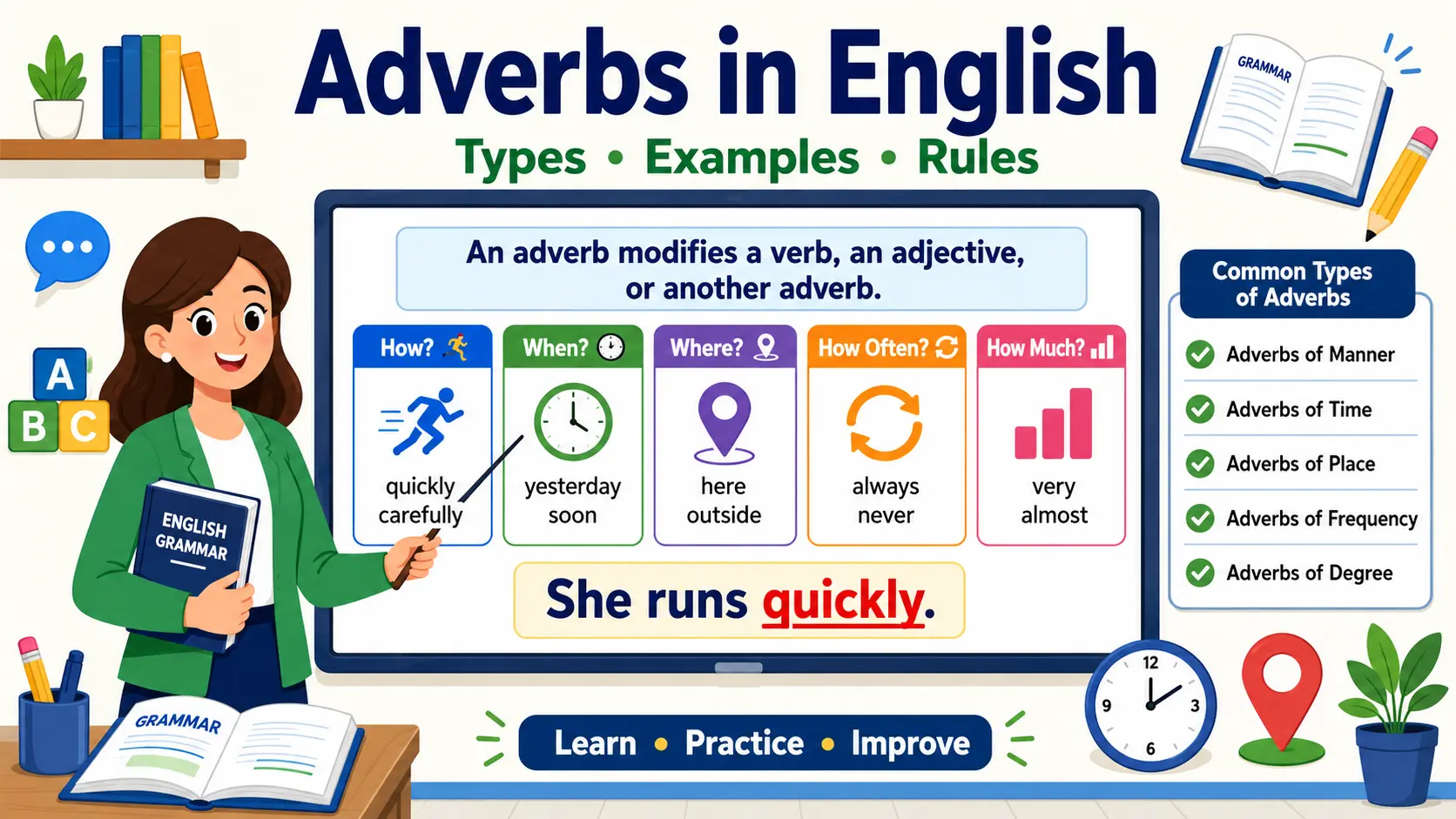
Adverbs in English are words that describe verbs, adjectives, or other adverbs. They help explain how, when, where, or how often something happens. In this guide, you will learn the types of adverbs, clear examples, and simple rules to improve your grammar.
If you want to improve your English, learning adverbs is essential. They make your sentences clearer, more detailed, and more natural.
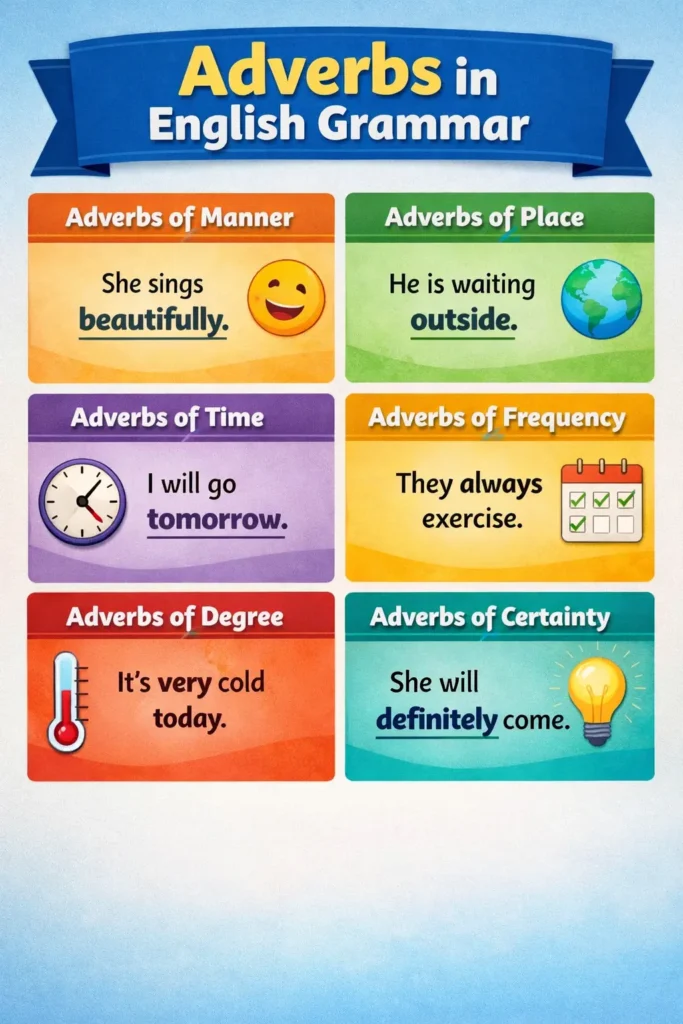
Think of adverbs as the seasoning of the English language. Without them, our sentences get the job done, but they can feel a bit bland and robotic. If you say, “I walked into the room,” your listener gets the basic facts, but they miss out on the actual story. Did you stomp in angrily, slip in quietly, or rush in excitedly? By adding just one well-chosen adverb, you instantly change the entire mood of the sentence, painting a vivid picture in the reader’s mind without needing a whole string of extra words.
📥 Get Your Free Grammar Worksheet Sample
Download your FREE grammar worksheet sample here:
https://learnenglishgrammar.org/free-sample
✔ Easy-to-follow exercises
✔ Auto-marking answers
✔ Perfect for students and self-learning
Table of Contents
What is an Adverb in English Grammar?
An adverb in English grammar is a word that describes or modifies:
- a verb
- an adjective
- another adverb
👉 Examples of adverbs:
- She runs quickly.
- He is very tall.
- She speaks quite softly.
How Adverbs Modify Adjectives & Other Adverbs
Many beginners assume adverbs only modify action verbs, but they also adjust the intensity of adjectives and other adverbs. For instance, in the phrase “The solar energy test was exceptionally successful,” the adverb exceptionally modifies the adjective successful. When modifying another adverb, such as in “He solved the grammar puzzle surprisingly quickly,” the adverb surprisingly tells us the degree of speed.
When modifying another adverb, the adverb tells us the degree of intensity. You can explore a detailed grammar breakdown of adverbs modifying adjectives on the Cambridge Dictionary Adverb Reference
Pedagogical Insight / Classroom Tip
From an ESL teaching perspective, learning how adverbs modify non-verbs is the secret to moving beyond simple basic sentences. It allows students to express subtle degrees of emotion, certainty, and precision in both academic writing and daily conversations.
Types of Adverbs in English Grammar
Understanding the types of adverbs helps you use them correctly in sentences.
1. Adverbs of Manner (How)
Adverbs of manner describe how an action happens.
Examples:
- He drives carefully.
- She sings beautifully.
- They worked hard.
👉 Most adverbs of manner end in -ly
2. Adverbs of Time (When)
Adverbs of time tell us when something happens.
Examples:
- I will call you later.
- She arrived yesterday.
- We are leaving soon.
3. Adverbs of Place (Where)
Adverbs of place show where something happens.
Examples:
- The children are playing outside.
- Come here.
- He looked everywhere.
4. Adverbs of Frequency (How Often)
Adverbs of frequency describe how often something happens.
Examples:
- I always wake up early.
- She often reads books.
- They rarely go out.
👉 Common adverbs of frequency:
always, usually, often, sometimes, rarely, never
5. Adverbs of Degree (How Much)
Adverbs of degree show intensity or level.
Examples:
- I am very happy.
- The movie was too long.
- She almost finished her work.
Position of Adverbs in English Sentences
The position of adverbs in English grammar depends on their type.
After the verb
- She sings beautifully
Before the main verb
- He always eats breakfast
Beginning of the sentence
- Yesterday, we went shopping
Advanced Placement Rules
Adverb placement depends heavily on the specific type of adverb used. Adverbs of manner typically follow the main verb or direct object (“She read the instructions carefully”). Adverbs of frequency, on the other hand, sit directly before the main verb but after the auxiliary verb or verb “to be” (“He is always punctual”). Placing an adverb in the wrong slot can instantly make a sentence sound unnatural to native speakers.
Adverb Type
| Adverb Type | Standard Placement | Example Sentence |
| Manner | After verb or object | She answered the question politely. |
| Frequency | Before main verb / After ‘to be’ | They rarely miss a scheduled lesson. |
| Degree | Directly before modified word | The worksheet was quite simple. |
How to Form Adverbs
Most adverbs are formed by adding -ly to adjectives.
Examples:
- quick → quickly
- happy → happily
- slow → slowly
Spelling rules:
- easy → easily
- careful → carefully
- good → well (irregular)
Spelling Conversion Rules for -ly
While adding -ly to an adjective is the most common path, specific spelling patterns apply when base words end in vowels or consonants. For adjectives ending in a consonant + -y (like easy or heavy), drop the -y and replace it with -ily (easily, heavily). For words ending in -le (like gentle or simple), replace the -e with -y (gently, simply). Adjectives ending in -ic (like basic) require -ally (basically).
Tricky Irregular & Flat Adverbs
Watch out for “flat adverbs”—words that share the exact same form as their adjectives without taking an -ly suffix. Words like fast, hard, late, and early fall into this category. Saying “He ran fastly” is a common grammatical error; the correct form is always “He ran fast.” Additionally, take care with hard vs. hardly: hardly means “barely” or “almost not at all,” which completely changes your intended meaning.
It is also incredibly easy to get tripped up by adverbs, even for native speakers. We have all heard someone say they did “good” on a test when they really meant they did “well,” or struggled with exactly where to drop a word like “always” or “almost” in a sentence so it does not sound awkward. If you have ever felt a bit confused by these subtle placement rules, you are definitely not alone—it is one of the most common hurdles in English grammar.
Common Adverb Mistakes
Pedagogical Reason: Too carries a negative connotation meaning “excessive to a fault” (too hot to drink). Use very or so when expressing high degree in a positive sense.
Mistake 1: Using Adjectives Instead of Adverbs to Modify Actions
❌ Incorrect: He runs quick.
✔️ Correct: He runs quickly.
Pedagogical Reason: Action verbs describe how something is done and require an adverb ending in -ly (quickly), not an adjective (quick).
Mistake 2: Confusing “Good” (Adjective) with “Well” (Adverb)
❌ Incorrect: She did good on her grammar exam.
✔️ Correct: She did well on her grammar exam.
Pedagogical Reason: Good is an adjective that describes nouns (a good student), while well is an adverb that modifies action verbs (did well).
Mistake 3: Misplacing “Very” Directly Before Main Action Verbs
❌ Incorrect: I very like this grammar lesson.
✔️ Correct: I really like this grammar lesson. (or “I like this grammar lesson very much”)
Pedagogical Reason: The intensifier very modifies adjectives (very good) or other adverbs (very quickly), but cannot modify main action verbs directly. Use really or place very much at the end of the sentence.
Mistake 4: Creating Double Negatives with Hard Negative Adverbs
❌ Incorrect: I can’t hardly hear the speaker.
✔️ Correct: I can hardly hear the speaker.
Pedagogical Reason: Adverbs like hardly, barely, and scarcely already carry a negative meaning. Pairing them with negative auxiliary verbs (can’t, doesn’t) creates an ungrammatical double negative.
Mistake 5: Misplacing the Restrictive Adverb “Only”
❌ Incorrect: She only has one hour to finish the test. (when meaning time)
✔️ Correct: She has only one hour to finish the test.
Pedagogical Reason: Place only directly before the exact word or phrase it restricts (the number/time limit) to prevent confusion in sentence meaning.
Mistake 6: Adding “-ly” to Adverbs That Share Their Adjective Form
❌ Incorrect: He drove fastly to make the meeting on time.
✔️ Correct: He drove fast to make the meeting on time.
Pedagogical Rule: Words like fast, hard, and late function as both adjectives and adverbs without adding -ly. (Fastly is not a standard English word).
Mistake 7: Confusing “Hard” and “Hardly”
❌ Incorrect: She studied hardly for the final exam.
✔️ Correct: She studied hard for the final exam.
Pedagogical Reason: Hard means putting in great effort, whereas hardly means “almost not at all.” Using hardly completely reverses your intended meaning.
Mistake 8: Using Adverbs After Linking Verbs
❌ Incorrect: The soup tastes deliciously.
✔️ Correct: The soup tastes delicious.
Pedagogical Reason: Linking verbs (taste, smell, feel, look, seem) connect the subject to a predicate adjective describing state, not an action adverb.
Mistake 9: Misplacing Frequency Adverbs in Auxiliary Verb Phrases
❌ Incorrect: She has completed always her assignments on time.
✔️ Correct: She has always completed her assignments on time.
Pedagogical Rule: Frequency adverbs (always, never, usually) must sit between the auxiliary verb (has) and the main verb (completed).
Mistake 10: Using “Too” Instead of “Very” or “So” for Positive Qualities
❌ Incorrect: The new classroom design is too beautiful!
✔️ Correct: The new classroom design is very beautiful! (or “so beautiful!”)
Linking Verbs vs. Action Verbs
A major reason students make errors with adverbs is confusing linking verbs with action verbs. Sensory verbs like look, smell, taste, sound, and feel act as linking verbs when describing a subject’s state, requiring an adjective rather than an adverb. For example, “The food tastes delicious” is correct because delicious describes the food. Writing “The food tastes deliciously” is incorrect because the food itself is not performing the physical action of tasting!
Adverbs vs Adjectives
Understanding adverbs vs adjectives is very important.
- Adjective → describes a noun
- Adverb → describes a verb
Examples:
- She is a fast runner
- She runs fast
You can also learn about adjectives in English to better understand how words describe nouns.
Interactive Practice Exercise: Adverbs Mastery
Choose the correct option for each sentence:
- She speaks __________ to the class. (soft / softly)
- He is a __________ learner when studying new grammar rules. (quick / quickly)
- They __________ late for the morning meeting. (always are / are always)
- The baby is sleeping __________ in the next room. (quiet / quietly)
- Our team performed exceptionally __________ during yesterday’s presentation. (good / well)
- I can __________ hear the speaker over the noise in the auditorium. (hardly / hard)
- The soup smells __________ after simmering for two hours. (delicious / deliciously)
- She has __________ finished her assigned tasks for the week. (already / completed already)
- The solar technicians worked __________ to complete the installation before sunset. (hard / hardly)
- This contract is __________ complex for us to review without a lawyer. (too / very)
Answer Key & Detailed Pedagogical Explanations
- Answer 1: softly — Action verbs (speaks) require an adverb ending in -ly to describe how the action is performed.
- Answer 2: quick — Quick is an adjective modifying the noun learner (describing the person, not the action).
- Answer 3: are always — Adverbs of frequency (always) sit directly after the verb “to be” (are always).
- Answer 4: quietly — Quietly is an adverb modifying the continuous action verb (is sleeping).
- Answer 5: well — Well is the adverb form modifying the verb performed (good is an adjective).
- Answer 6: hardly — Hardly means “barely” or “almost not at all,” which fits the context of hearing difficulty.
- Answer 7: delicious — Sensory linking verbs (smells) connect the subject to a predicate adjective (delicious), not an adverb.
- Answer 8: already — Mid-position adverbs sit between the helper verb (has) and the main verb (finished).
- Answer 9: hard — Hard acts as an adverb meaning with great effort, whereas hardly means barely.
- Answer 10: too — Use too when expressing an excessive degree that causes a problem or limitation.
📘 English Grammar Worksheets (Full Collection)
5. The teacher explained the concept __________ so everyone understood. (clear / clearly)
6. David is an __________ talented English student. (extremely / extreme)
7. They arrived __________ for the afternoon lecture. (late / lately)
8. This soup smells __________. (wonderful / wonderfully)
Detailed Explanations Block:
- Answer 5: clearly — Modifies the action verb explained (Adverb of Manner).
- Answer 6: extremely — Modifies the adjective talented (Adverb of Degree).
- Answer 7: late — Flat adverb modifying the verb arrived. (Lately means “recently”).
- Answer 8: wonderful — Smells is a linking verb here, requiring the predicate adjective wonderful.
Get Free Sample
By learning adverbs in English, you can make your sentences clearer, more detailed, and more natural.
The good news is that mastering adverbs is mostly about recognizing patterns rather than memorizing endless lists of exceptions. Once you get a feel for how they change the speed, tone, and direction of your thoughts, using them becomes second nature. Whether you are writing a professional email or just trying to sound more natural in casual conversation, getting a solid grip on these flexible little words is one of the fastest ways to level up your English skills.
Conjunctive Adverbs (Connecting Ideas)
Conjunctive adverbs transition your reader smoothly between two independent clauses or sentences. They show relationships like cause and effect, contrast, or addition. Common examples include however, therefore, meanwhile, furthermore, and consequently.
- Example: “The student studied the adverb rules diligently; therefore, she passed the test easily.”
- Punctuation Tip: When joining two independent clauses in a single sentence, use a semicolon before the conjunctive adverb and a comma after it.
Frequently Asked Questions (FAQs)
What exactly does an adverb do in a sentence?
Think of an adverb as a helper word that gives more color and context. It modifies (describes) a verb, an adjective, or even another adverb. It answers the questions that keep a story interesting: How did it happen? When did it happen? Where did it happen? How often? Or to what degree?
Do all adverbs end in “-ly”?
Not at all! While many adverbs of manner are formed by adding “-ly” to an adjective (like quickly or happily), some of the most common adverbs look completely different. Words like fast, hard, well, yesterday, always, and very are all adverbs, but they don’t have an “-ly” in sight.
How can I tell the difference between an adjective and an adverb?
It all comes down to what word they are whispering secrets about. Adjectives only describe nouns (people, places, or things—like a “beautiful song”). Adverbs describe actions, states, or intensities (like singing “beautifully“). If it tells you what kind of object it is, it’s an adjective. If it tells you how an action is being done, it’s an adverb.
Where should I put an adverb in a sentence?
Adverbs are highly flexible, which is why they can be tricky! Their position usually depends on their type. Adverbs of manner usually go after the action verb (She ran quickly). Adverbs of frequency usually sit before the main verb (He always forgets his keys). If you want to emphasize when or where something happened, you can even pop them right at the beginning of the sentence ( Yesterday, we went to the beach).
What are the 5 types of adverbs?
The 5 main types of adverbs are:
Adverbs of manner
Adverbs of time
Adverbs of place
Adverbs of frequency
Adverbs of degree