
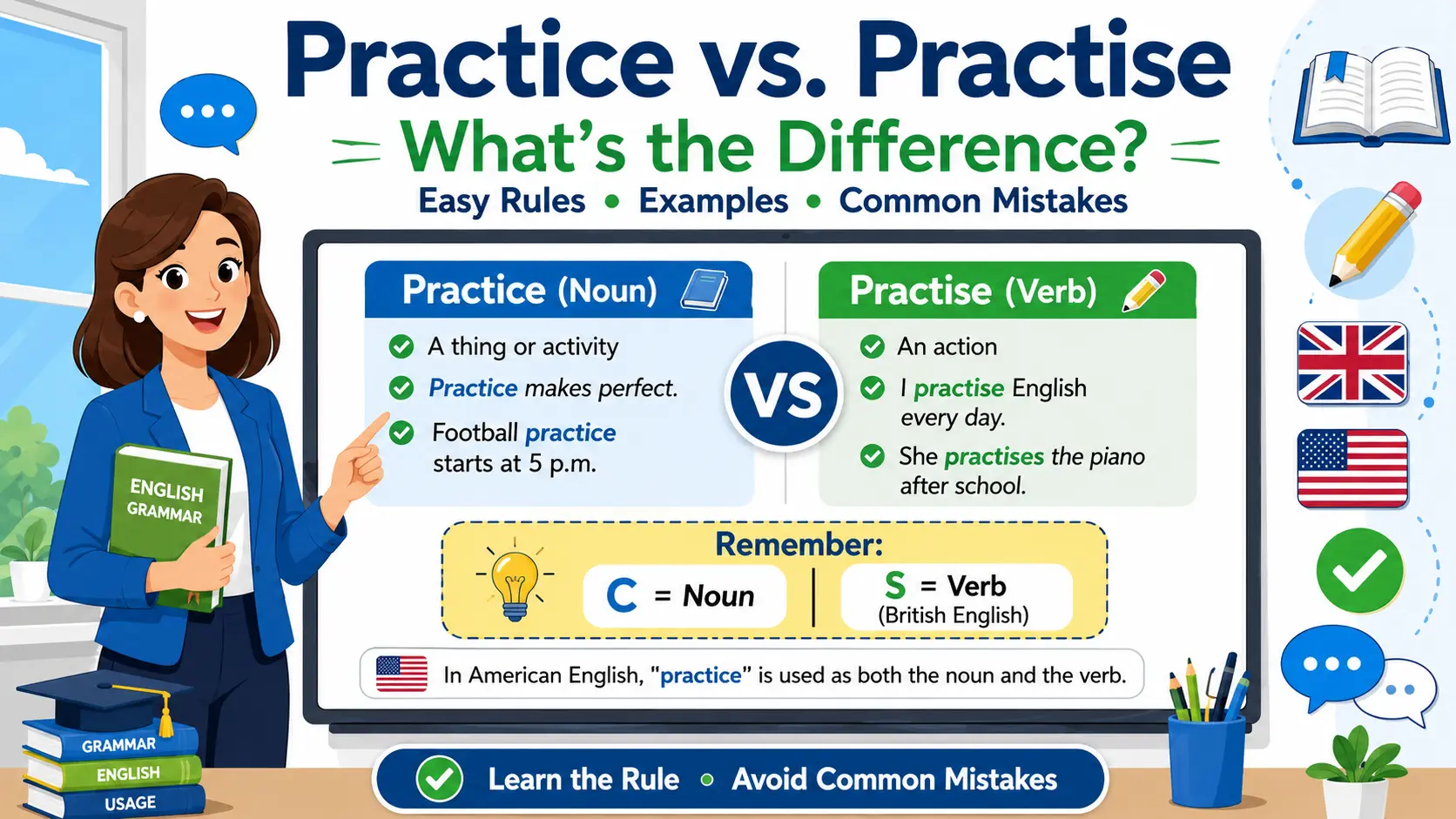
The difference between practice vs. practise is one of the most common spelling questions in English. Although the words sound identical, they are used differently in British English and American English. Trust me, I’ve been there. It’s one of those linguistic trapdoors in the English language where you find yourself typing a word, looking at it, deleting it, and typing it the other way, only for both versions to look completely wrong.
This is easily one of the most common spelling hiccups out there. Because the two words sound identical and share the exact same DNA when it comes to meaning, it is incredibly easy to trip up.
The confusion becomes even greater because British English and American English decided to shake hands on two completely different sets of rules.
In this guide, we are going to demystify this pair once and for all. You’ll learn the difference between practice and practise, when to use which, a foolproof memory trick, and some real-world examples to make sure you never have to second-guess yourself again.
Table of Contents
Why Do People Confuse Practice vs. Practise?
At its core, both words refer to the exact same concept: improving a skill through repetition. Whether you’re mastering the guitar, learning a language, or perfecting your sourdough bread, you are engaging in this concept. Because they sound identical aloud, many writers naturally assume they are interchangeable.
However, if you cross the Atlantic, a strict grammatical dividing line appears. In British English (and Australian, Canadian, and New Zealand English), they have entirely different jobs:
In American English, meanwhile, someone decided to make life a whole lot simpler. The distinction completely disappears because practice is used for both the noun and the verb.
Understanding who your audience is—and whether you’re writing in British or American English—is the ultimate secret to choosing the correct spelling.
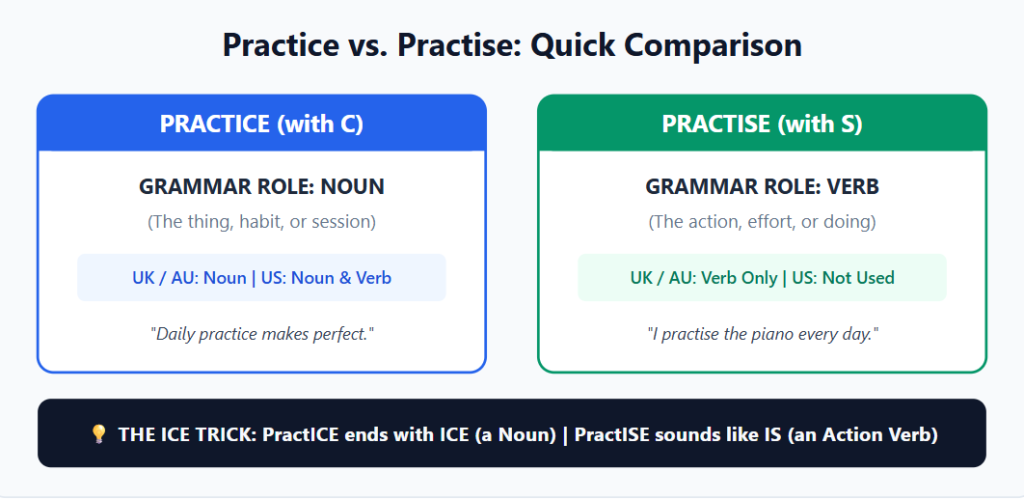
The Etymological Connection (Latin to Middle English):
To understand why this spelling split exists, we have to look back at the history of the English language. Both words derive from the Old French word practiquer and the Medieval Latin practicare, which meant “to perform, execute, or exercise.” When the words entered Middle English in the 14th century, English scholars borrowed the traditional Latin convention of using -ice for nouns and -ise for verbs. Over time, while British English preserved this structural pattern, American English streamlined it into a single universal form.
When the words entered Middle English in the 14th century, scholars followed traditional Latin conventions; You can learn more about their history in the Oxford English Dictionary Etymology Guide.
Similar Noun/Verb Pairs in English:
The practice/practise split isn’t an isolated quirk; it belongs to a whole group of noun-verb pairs in British English that follow the exact same -ce (noun) vs. -se (verb) rule. Recognizing these matching pairs makes it far easier to remember the system as a whole:
- Advice (noun) vs. Advise (verb) -> “He gave me good advice” / “I advise you to study.”
- Device (noun) vs. Devise (verb) -> “A smart device” / “To devise a new plan.”
- Licence (noun) vs. License (verb) -> “A driver’s licence” / “The council licensed the shop.”
Recognizing these matching pairs makes it far easier to remember the system, much like understanding the directional rules in our Borrow vs. Lend guide.
Practice (Noun)
A noun is a person, place, thing, or idea. When you use practice as a noun, you are talking about the concept, the habit, the session, or the business itself. Think of it as the tangible thing you are doing.
Examples
- Daily practice improves your English. (The habit)
- Piano practice requires patience. (The session)
- Good writing comes with regular practice. (The concept)
- It is common practice to remove your shoes before entering a house. (The custom/tradition)
- She recently opened her own dental practice. (The business)
A Personal Confession: When I was learning to play the piano as a kid, my teacher used to scrawl “More practice needed!” in my notebook. I used to hate seeing that word because it meant more time sitting on a bench scales-testing. But grammatically? She nailed it. It was a noun—a “thing” I had to do.
Practise (Verb)
A verb is an action word. In British English, practise means the actual act of doing something repeatedly to get better at it. It is the physical motion, the effort, the doing.
Examples
- I practise English every evening.
- She practises the piano after school.
- We practised for the presentation yesterday.
- They are practising their football skills.
Notice that in every single one of these sentences, practise is the engine. It’s the action being performed by the subject.
English Grammar Worksheets with AutoTick™
✔ AutoTick™ Secure Answer Checking System
✔ Step-by-step instructions
✔ Answer keys with clear explanations
✔ Password-protected marking (prevents cheating)
Grammatical Inflections and Tense Formations (Adding -ed and -ing)
Understanding how to add verb endings like -ed (past tense) and -ing (present continuous) is where many writers get tripped up, especially when switching between regional dialects.
| Dialect | Base Noun Form | Base Verb Form | Past Tense (Verb) | Present Participle (Verb) |
| British English | practice | practise | practised | practising |
| American English | practice | practice | practiced | practicing |
British English Rules for Tenses:
Because practise is the verb, all action-based suffixes attaching to past or ongoing actions must keep the -s-:
- Correct (UK Past): “She practised her presentation for two hours.”
- Correct (UK Continuous): “They are practising their grammar exercises.”
- ❌ Incorrect (UK): “She practiced her presentation…”
American English Rules for Tenses:
Since American English uses practice for everything, suffixes attach directly to the -c- form:
- Correct (US Past): “She practiced her presentation for two hours.”
- Correct (US Continuous): “They are practicing their grammar exercises.”
Practice vs. Practise: British vs. American English
If you’re writing for an American audience, or you grew up using American textbooks, you can breathe a sigh of relief. The spelling practise with an ‘s’ basically doesn’t exist in the US.
The spelling practice is the undisputed heavyweight champion, pulling double duty as both the noun and the verb.
Examples
- I practice English every day. (Verb)
- She practices the piano. (Verb)
- Daily practice helps students improve. (Noun)
- They practiced before the competition. (Verb)
An Easy Way to Remember (The “Ice” Trick)
If you are writing in British English, you don’t need to panic about remembering parts of speech every time you type. I learned a brilliant little memory trick years ago that completely saved my writing, and I still use it today.
Look at the endings of the words:
- PractICE ends with -ICE (which is a noun, a thing).
- PractISE ends with -ISE (which sounds like the beginning of Is, an action/verb).
Think of it like this: Ice is a noun; Practice is a noun.
Once you lock that “ice” connection into your brain, choosing the correct spelling becomes second nature.
The “Advice vs. Advise” Swap Trick:
If you ever get stuck testing whether a sentence requires a noun or a verb in British English, try replacing the word with advice or advise. Because advice (noun) and advise (verb) are pronounced differently (“iss” vs “ize”), your ear will instantly spot which one fits.
- Test Sentence: “I need to (practice/practise) my speech.”
- Try with advice: “I need to advice my speech.” (Sounds wrong!)
- Try with advise: “I need to advise my speech.” (Makes grammatical sense as an action verb!).
- Conclusion: Since advise (verb) fits, you need practise with an s.
The Alphabetical Trick:
Think of the letters in the alphabet: C comes before S. In grammar, Noun comes before Verb in alphabetical order. Therefore:
- C (Noun) comes before S (Verb).
- PractICE = Noun
- PractISE = Verb
Continue Your English Learning
If you enjoyed this lesson on Practice vs. Practise, why not continue improving your grammar skills?
- 📥 Download our FREE Sample Worksheet to experience our printable exercises and AutoTick instant-marking system.
- 📚 Explore our Premium English Grammar Worksheets for hundreds of practice questions covering all grammar topics.
Common Mistakes
The biggest trap writers fall into is accidentally mixing British and American spellings within the same piece of writing. It confuses readers and makes the copy look a bit messy.
Incorrect (British English)
- ❌ I practice the guitar every day.
- ✅ I practise the guitar every day.
- ❌ Daily practise makes perfect.
- ✅ Daily practice makes perfect.
- ❌ She owns a medical practise.
- ✅ She owns a medical practice.
Incorrect (American English)
- ❌ They practise basketball every weekend.
- ✅ They practice basketball every weekend.
Contextual Nuances: Professional & Legal Terminology
Beyond standard everyday usage, the word practice carries special legal, medical, and professional meanings that require specific care in formal writing:
- Medical and Legal Businesses: A doctor’s office, law firm, or veterinary clinic is referred to as a practice (noun) in both British and American English (“She works at a multi-partner dental practice“).
- Code of Practice / General Practice: Standardized rules within an industry are called a “code of practice“ (noun).
- Practising Attorney / Practising Physician (UK): In British English, when using the adjective/participle form to describe a working professional, use the -s- spelling (“He is a practising barrister in London”). In American English, stick to the -c- form (“He is a practicing attorney in New York”).
Practice vs. Practise Comparison
| British English | American English |
| practice (noun) | practice (noun) |
| practise (verb) | practice (verb) |
This table summarises the key difference. If you’re writing for an international audience, the best thing you can do is make an executive decision: pick either British or American English, and stick to it consistently throughout your entire document.
Mini Quiz
Let’s test your memory! Choose the correct answer based on the rules we just covered.
1. I ______ English every evening. (British English)
- A. practice
- B. practise
- Answer: B (It’s an action, so we need the verb!)
2. Daily ______ makes perfect.
- A. practice
- B. practise
- Answer: A (It’s a thing, so we need the noun.)
3. She opened a veterinary ______.
- A. practice
- B. practise
- Answer: A (A business or office is always a noun.)
4. We ______ before the school concert. (British English)
- A. practise
- B. practice
- Answer: A (An action that happened in the past.)
5. Which spelling is used as both the noun and the verb in American English?
- A. practise
- B. practice
- Answer: B
If you found this guide helpful, you may also like our articles on Fewer vs. Less, Affect vs. Effect, and Its vs. It’s. These guides explain other commonly confused English words with simple rules, clear examples, and practical tips to help you write with confidence.
If you’re learning English grammar, you may also enjoy our guide to Nouns in English Grammar and Verbs in English Grammar.
Download our FREE Sample Worksheet to experience our printable exercises and AutoTick instant-marking system.
Final Thoughts
At the end of the day, the difference between practice and practise is a lot less intimidating than it looks at first glance.
Learning tiny distinctions like this might feel like pedantic grammar police stuff, but it genuinely elevates your writing. Whether you’re polishing a resume, firing off an important business email, or writing an essay, nailing these little details shows incredible attention to detail.
Like anything else in life, getting comfortable with grammar takes time. But with a little regular practice—and by remembering when to practise—you’ll be navigating this like a pro in no time!
Frequently Asked Questions
Is “practise” a real word?
Yes, absolutely! It is the correct and official verb spelling used by millions of English speakers across the UK, Australia, New Zealand, South Africa, and beyond.
Is “practice” always correct?
Not everywhere. If you are writing for a British audience and you are using the word as an action (a verb), using “practice” is technically a spelling error.
Why does American English only use “practice”?
Back in the 19th century, a man named Noah Webster (the guy behind Webster’s Dictionary) wanted to simplify English spelling for Americans. He dropped a lot of letters (like the ‘u’ in colour) and streamlined words like practice so people didn’t have to juggle two spellings.
Which spelling should I use?
Look at your environment. If your school, employer, or clients are based in the US, stick to practice for everything. If you’re writing for a British or international audience, keep them separate. The golden rule is simply to remain consistent.