
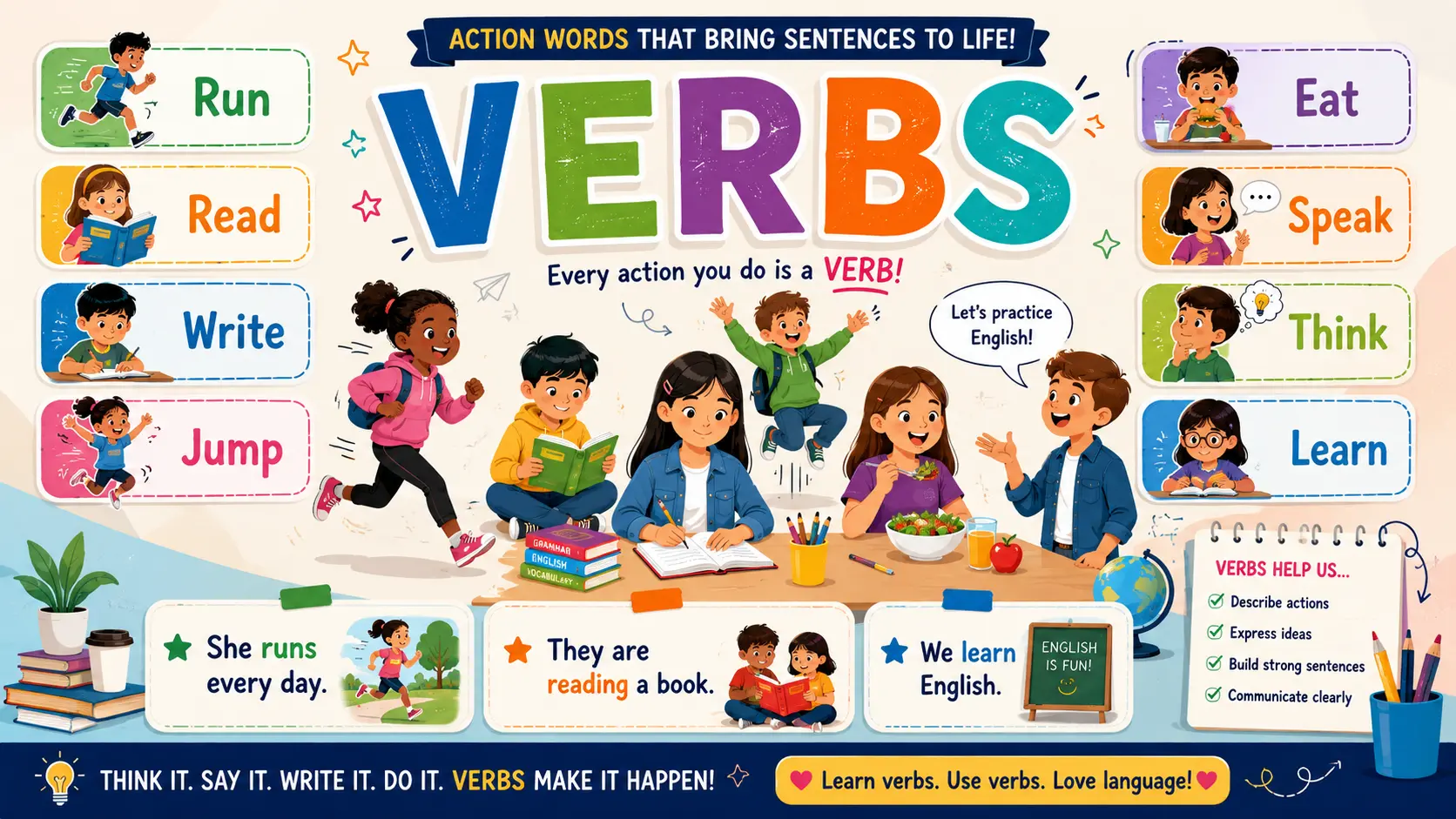
Verbs in English grammar are essential for forming sentences. A verb describes an action, state, or occurrence. Without verbs, a sentence is incomplete.
For example:
- She runs every day.
- They are happy.
Every sentence must contain at least one verb, which makes verbs one of the most important parts of English grammar.
Think of verbs as the engine under the hood of your sentences. When I first started diving deep into grammar, I used to think nouns were the stars of the show because they name all the interesting people and places. But without a verb, those nouns are just sitting there, parked. The moment you add a verb, everything sparks to life. It’s the difference between just staring at a picture of a car and actually hitting the gas pedal on a highway.
Table of Contents
What Is a Verb?
A verb is a word that shows:
- Action (run, eat, write)
- State (is, are, seem)
- Occurrence (happen, become)
Examples:
The weather became cold.
He writes a letter.
She is a teacher.
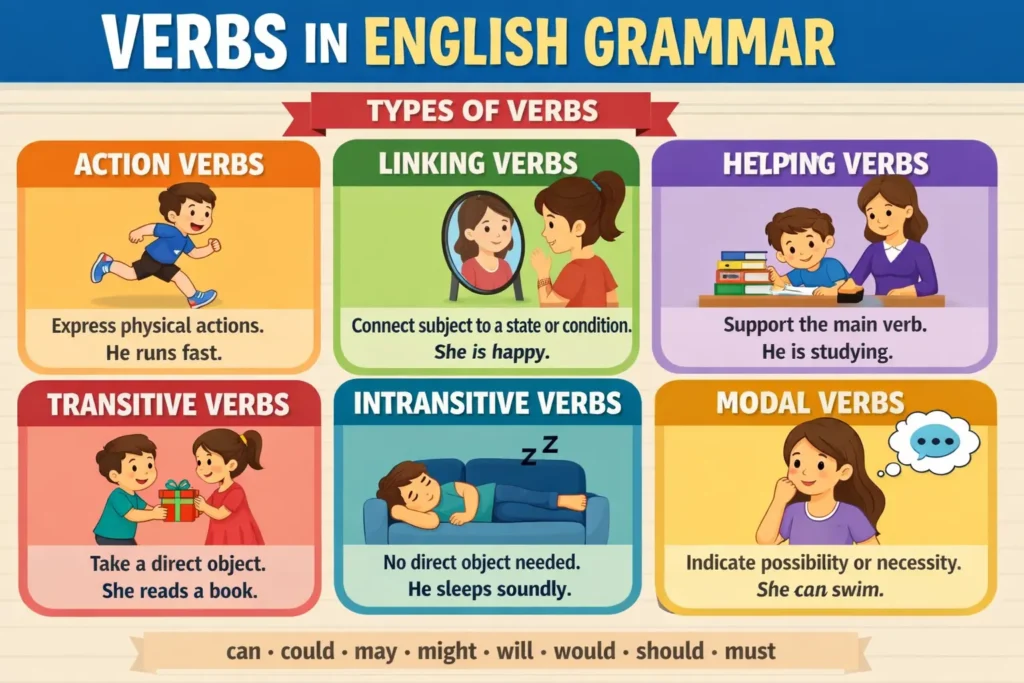
Types of Verbs in English Grammar
Understanding the different types of verbs in English grammar will help you use them correctly.
1. Action Verbs
Action verbs describe what someone does.
Examples:
- run
- eat
- speak
- play
👉 Sentence:
- She runs every morning.
2. Linking Verbs
Linking verbs connect the subject to more information.
Common linking verbs:
- is, am, are, was, were
👉 Sentence:
- He is happy.
3. Helping Verbs (Auxiliary Verbs)
Helping verbs support the main verb.
Examples:
- is, have, do, will
👉 Sentence:
- She is running fast.
- They have finished their work.
4. Transitive and Intransitive Verbs
Verbs are also classified by whether they require an object to complete their meaning:
- Transitive Verbs: Must take a direct object. Without an object, the sentence feels incomplete.
- Example: “She bought a new book.” (Asking “bought what?” yields “a new book”).
- Intransitive Verbs: Express a complete action without needing a direct object.
- Example: “The baby cried loudly.” (No object is receiving the action of crying).
5. Modal Auxiliary Verbs
Modal verbs are specialized helping verbs that express necessity, possibility, permission, or ability. They never change form and are always followed by a base verb.
- Common Modals: can, could, may, might, must, shall, should, will, would.
- Sentence Example: “You must review the safety guidelines before operating the solar cooker.”
6. Stative vs. Dynamic Verbs
- Dynamic Verbs: Describe physical or mental activities that have a distinct start and finish (run, build, write). They can be used in both simple and continuous tenses.
- Stative Verbs: Express states of being, emotions, senses, or ownership (know, love, understand, belong). They are almost never used in continuous (-ing) tenses.
- ❌ Incorrect: “I am knowing the answer.”
- ✔️ Correct: “I know the answer.”
Verb Types Master Reference Chart
| Verb Category | Core Function / Purpose | Key Examples | Example Sentence |
| Action (Dynamic) | Expresses physical/mental action | run, jump, think, create | “They built a solar oven.” |
| Linking | Connects subject to a predicate noun/adjective | is, seem, become, appear | “The test seems easy.” |
| Auxiliary (Helping) | Assists main verb to form tenses/moods | is, have, do, will | “She has finished her essay.” |
| Modal | Shows ability, permission, or likelihood | can, must, should, might | “We should start the meeting.” |
| Transitive | Requires a direct object | buy, send, read, write | “He sent an email.” |
| Intransitive | Does not take a direct object | sleep, arrive, smile, laugh | “The guests arrived on time.” |
Examples of Verbs in English Grammar
| Verb | Example Sentence |
|---|---|
| run | She runs every day |
| eat | They eat lunch together |
| write | He writes neatly |
| speak | She speaks clearly |
The Five Principal Forms of English Verbs
To navigate tenses effectively, every English verb operates across five core principal forms:
Plaintext
Base Form (V1) -> Past Simple (V2) -> Past Participle (V3) -> Present Participle (V4) -> 3rd Person Singular (V5)Base Form (Infinitive / V1): The root dictionary form (walk, go, write).
Simple Past (V2): Used for completed past events (walked, went, wrote).
Past Participle (V3): Paired with have/has/had for perfect tenses or be for passive voice (walked, gone, written).
Present Participle (V4 / “-ing”): Combined with be verbs for continuous tenses (walking, going, writing).
Third-Person Singular Present (V5 / “-s/-es”): Used in simple present tense with he, she, or it (walks, goes, writes)
Every English verb operates across principal forms. For a comprehensive list of irregular verb forms, consult the Purdue OWL Irregular Verbs Chart
Common Verb Mistakes & How to Fix Them
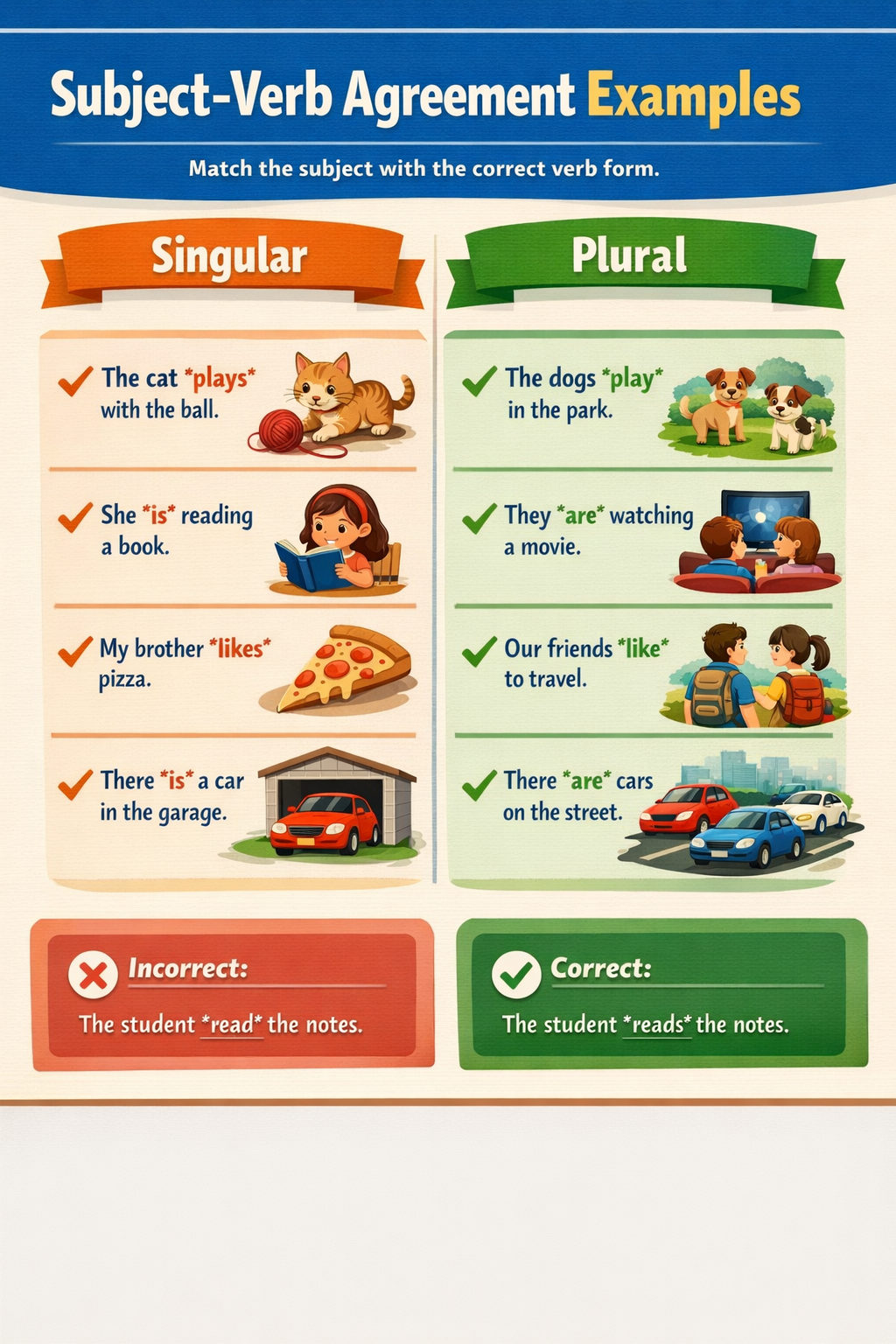
Mistake 1: Subject-Verb Agreement Errors with Singular and Plural Subjects
❌ Incorrect: He go to school. / They is playing. / She have a book.
✔️ Correct: He goes to school. / They are playing. / She has a book.
Pedagogical Reason: The verb must always agree with its subject in number and person. Singular subjects (he, she, it) require third-person singular verb forms (goes, is, has), while plural subjects (they) require plural forms (are).
Mistake 2: Regular vs. Irregular Verb Confusion in the Past Tense
❌ Incorrect: He knowed the answer, so he brang his workbook.
✔️ Correct: He knew the answer, so he brought his workbook.
Pedagogical Reason: Irregular verbs do not follow the standard -ed pattern for past tenses (e.g., know → knew, bring → brought) and must be learned through direct practice.
Mistake 3: Unnecessary Tense Shifts Within a Single Narrative
❌ Incorrect: Yesterday, she walked into the room and starts laughing.
✔️ Correct: Yesterday, she walked into the room and started laughing.
Pedagogical Reason: Verb tenses must remain consistent throughout a sentence or story unless the timeframe of the actions explicitly changes.
Mistake 4: Inserting “To” After Modal Auxiliary Verbs
❌ Incorrect: I must to go now. / She can to speak three languages.
✔️ Correct: I must go now. / She can speak three languages.
Pedagogical Reason: Modal auxiliary verbs (must, can, should, might, could) are always followed directly by a bare infinitive verb without the preposition to.
Mistake 5: Splitting Infinitives unnecessarily in Formal Writing
❌ Incorrect: We need to carefully inspect the document.
✔️ Correct: We need to inspect the document carefully.
Pedagogical Rule: While split infinitives are common in informal speech, placing adverbs after the verb phrase maintains cleaner structure in standard academic and business writing.
Mistake 6: Using the Base Verb Instead of the Past Participle in Perfect Tenses
❌ Incorrect: She has wrote three detailed reports this week.
✔️ Correct: She has written three detailed reports this week.
Pedagogical Rule: Perfect tenses (have, has, had) strictly require the past participle form of the verb (written), not the simple past form (wrote).
Mistake 7: Confusing Transitive and Intransitive Pair Verbs (Raise/Rise, Lay/Lie)
❌ Incorrect: Please lie your pen on the desk and rise your hand.
✔️ Correct: Please lay your pen on the desk and raise your hand.
Pedagogical Reason: Transitive verbs (lay, raise) require a direct object, while intransitive verbs (lie, rise) do not take a direct object.
Mistake 8: Using Stative Verbs in Continuous Progressive Forms
❌ Incorrect: I am believing that this strategy will work.
✔️ Correct: I believe that this strategy will work.
- ❌ Incorrect: “Yesterday, she walked into the room and starts laughing.”
- ✔️ Correct: “Yesterday, she walked into the room and started laughing.”
- Pedagogical Reason: Keep verb tenses consistent throughout a narrative unless the timeframe of the actions explicitly shifts.
👉 These mistakes are often related to subject verb agreement.
How to Use Verbs Correctly
To use verbs correctly:
✔ Match verb with subject (singular/plural)
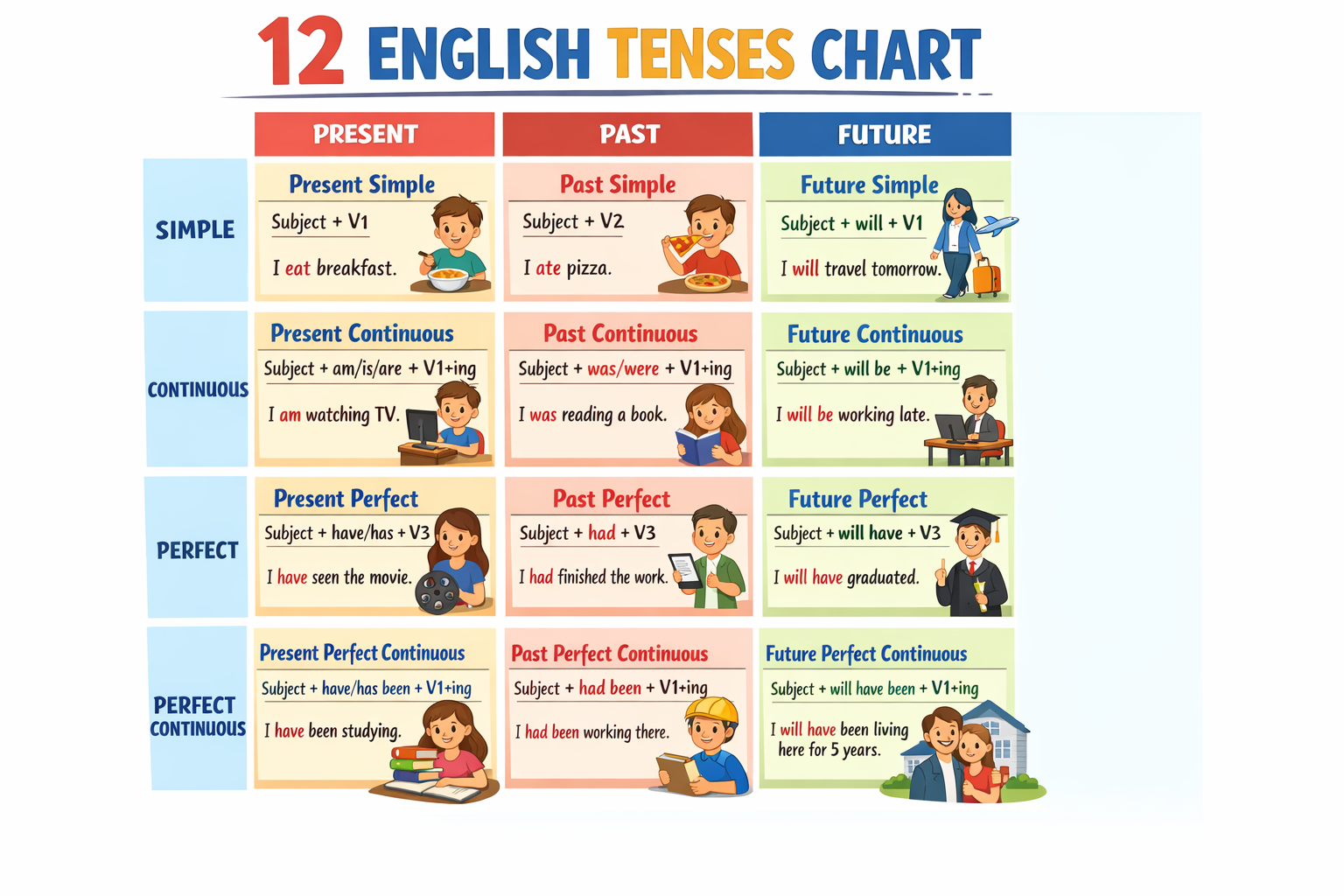
✔ Use the correct tense
✔ Check helping verbs carefully
👉 Learn more in our Subject Verb Agreement Rules guide.
🎯 Practise Verbs with a Free Worksheet
Understanding verbs is easier with practice.
👉 Try our free English grammar worksheet with auto-marking:
https://learnenglishgrammar.org/free-sample
✔ Instant score
✔ Answers included
✔ Clear explanations
✔ Suitable for students, teachers, and parents
This helps learners improve quickly and check their answers immediately.
🚀 Get Full English Grammar Worksheets (Levels 1–6)
If you want structured learning:
👉 Explore our full worksheet collection:
https://learnenglishgrammar.org/
✔ Step-by-step levels
✔ Covers all grammar topics
✔ Perfect for classroom and home learning
Related Grammar Topics
To improve further, explore:
You can also refer to explanations from the British Council on this subject
Interactive Practice Exercise: Test Your Knowledge
Identify the correct verb form or category for each sentence:
- The solar installer __________ (finish) the inspection an hour ago. (finished / finishes)
- Neither of the students __________ (have) a pencil. (has / have)
- She has __________ (write) three guides on English tenses this month. (wrote / written)
- Identify the verb type in: “The curry smells delicious.” (Action / Linking)
- They cannot __________ (to leave / leave) the room until the alarm stops.
- Look! The water in the kettle __________ (boil) right now. (boils / is boiling)
- Please __________ (lay / lie) the legal contract on the conference room table.
- By the time the manager arrived, the team __________ (already / complete) the report. (already completed / had already completed)
- Identify the verb type in: “He kicked the ball across the field.” (Transitive / Intransitive)
- If it rains tomorrow, we __________ (cancel) the outdoor site visit. (cancel / will cancel)
Answer Key & Detailed Pedagogical Explanations
Answer 10: will cancel — The main result clause in a First Conditional structure uses the simple future (will cancel), while the if-clause takes the simple present.
Answer 1: finished — Simple past tense required due to the specific past time marker (an hour ago).
Answer 2: has — Singular indefinite pronoun neither takes a singular verb form (has).
Answer 3: written — Present perfect tense requires the past participle form (written) following the auxiliary has.
Answer 4: Linking Verb — Smells acts as a bridge connecting the subject (curry) to the sensory predicate adjective (delicious) rather than describing an action.
Answer 5: leave — The modal auxiliary cannot strictly takes a bare infinitive without the preposition to.
Answer 6: is boiling — Action happening live at the moment of observation (Signal words: Look! / right now).
Answer 7: lay — Lay is a transitive verb requiring a direct object (the legal contract), whereas lie is intransitive.
Answer 8: had already completed — Past perfect tense (had completed) shows an action finished prior to another past event (the manager arrived).
Conclusion
Verbs in English grammar are a key part of every sentence. By understanding their types and using them correctly, you can improve your writing and speaking skills.
Mastering verbs isn’t about memorizing a dry list of rules just to pass a test; it’s about unlocking the confidence to say exactly what you mean. There is a real sense of achievement when a tricky sentence structure finally “clicks” and flows naturally. Be patient with yourself as you practice, celebrate the small wins, and remember that every mistake is just a stepping stone to smoother communication.
Start with the basics, avoid common mistakes, and practise regularly using worksheets to master verbs faster.
Frequently Asked Questions (FAQs)
What are verbs in English grammar?
Verbs are the ultimate engine of the English language; they are words that describe an action (what we do), a state (how we exist), or an occurrence (what happens around us). Every complete thought requires a verb because it anchors the subject to reality. Without them, we would just have a list of people, places, and things doing absolutely nothing.
What are the main types of verbs?
While the English language has thousands of verbs, they generally fall into three foundational categories that every learner should know:
Action Verbs: These represent physical or mental activity, such as run, eat, write, or think.
Linking Verbs: These don’t show action but instead act as a bridge, connecting the subject to a description. Common examples include is, are, was, and seem (e.g., “The sky is blue”).
Helping Verbs (Auxiliary Verbs): These work alongside a main verb to change the tense or mood of the sentence, such as have, do, will, or is (e.g., “She is running”).
Why are verbs important in a sentence?
Verbs are important because they give a sentence its pulse and direction. They tell the reader exactly what the subject is doing, feeling, or becoming. From a grammatical standpoint, a sentence simply cannot exist without a verb; without one, you are left with a sentence fragment that leaves the listener hanging and confuses your message.
What is an example of a verb in a sentence?
A clear example of a verb in action is:
She runs every morning.
In this sentence, the word “runs” is the action verb. It tells us the exact physical activity the subject (“She”) is performing, instantly turning a simple noun into a lively, descriptive routine.
What are common mistakes with verbs?
The most frequent stumbles for language learners usually involve subject-verb agreement—making sure singular subjects match singular verbs, and plural subjects match plural verbs. For instance, many people mistakenly write or say:
❌ He go to school instead of the correct version: He goes to school.
❌ They is playing instead of the correct version: They are playing.
Another common trap is mixing up tenses or using the wrong helping verb, such as saying “She have a book” instead of the correct “She has a book.”
How can I improve my use of verbs?
The secret to mastering verbs comes down to consistent, high-quality practice. You can accelerate your progress by intentionally studying tenses, paying close attention to subject-verb agreement rules, and reading as much as possible to see how native speakers use verbs in context. To test your skills in real-time, you can also try our free grammar worksheet with auto-marking, which provides instant feedback so you can correct mistakes on the spot.
👉 You can also try our free grammar worksheet with auto-marking to practise verbs more effectively.