
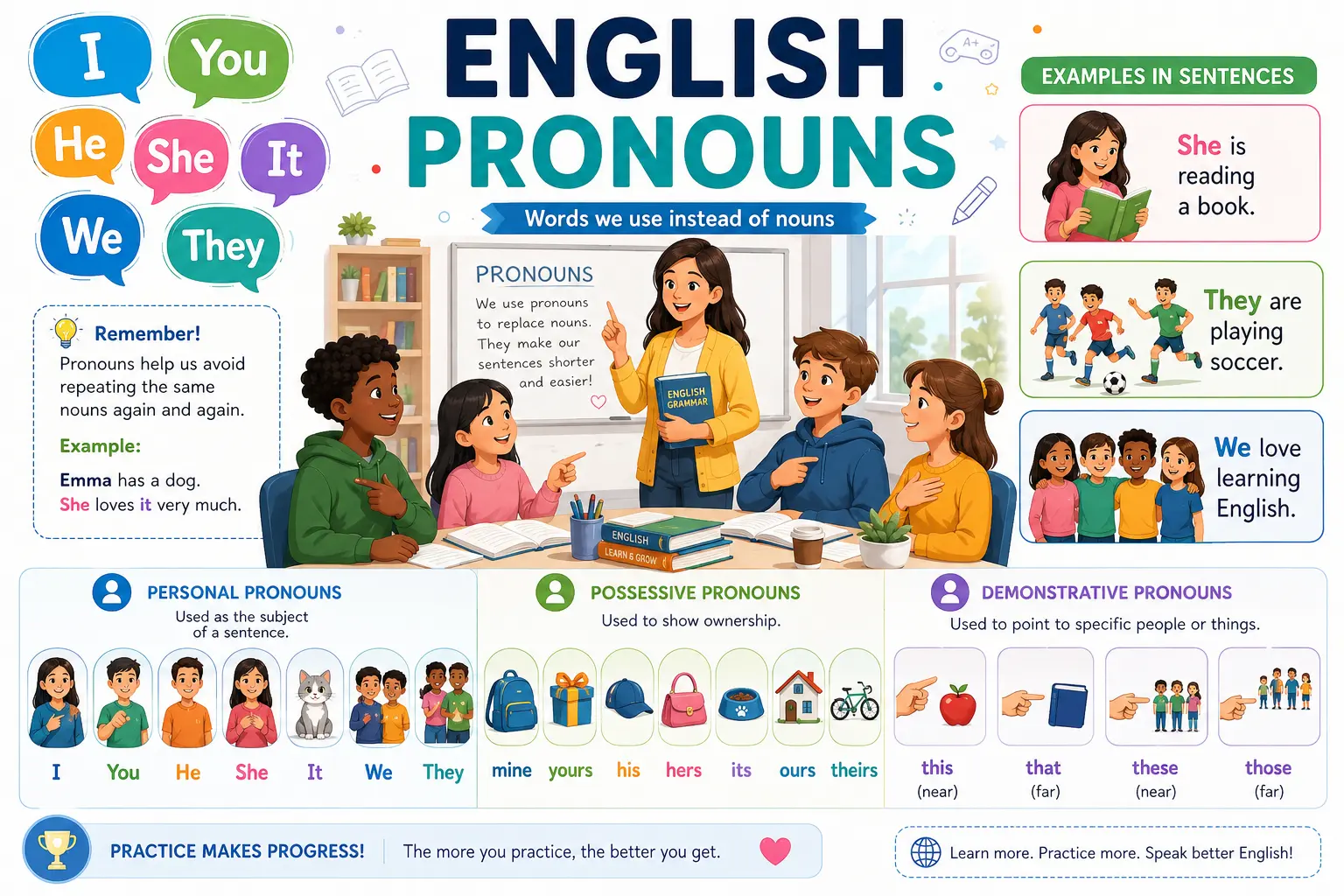
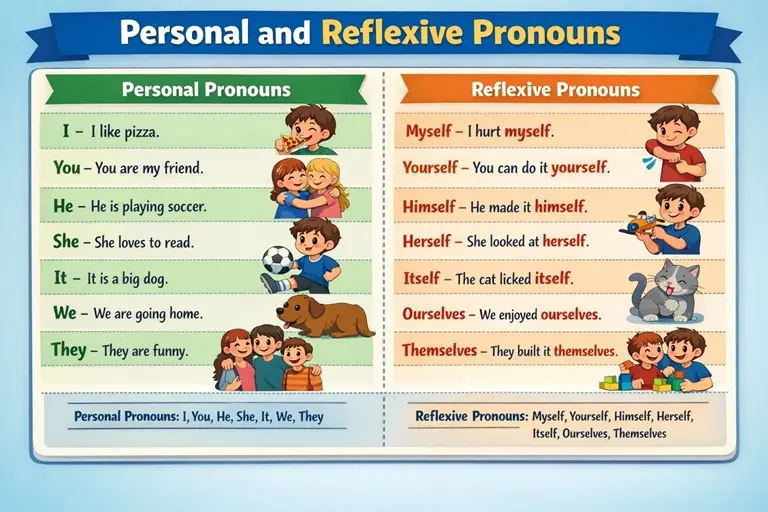
Learn pronouns in English grammar with simple explanations, examples, and easy rules. Covers personal and reflexive pronouns clearly.
In English grammar, pronouns are words that replace nouns in a sentence. They help avoid repetition and make sentences clearer and easier to understand.
This lesson explains pronouns in English grammar, focusing on personal pronouns and reflexive pronouns (sometimes called reflective pronouns).
If you have ever listened to someone tell a story where they repeated a person’s name in every single sentence, you know exactly how exhausting repetitive language can be. We have all been there—whether you are a student trying to make your essays flow better or a teacher searching for a way to break this down without inducing a collective yawn from the classroom. Pronouns are the unsung heroes here; they are the secret to making English sound natural, fluid, and comfortable.
Table of Contents
🎁 Free Printable Worksheet
Practice as you learn! Download the FREE Pronouns Worksheet (PDF) and complete the exercises while reading this lesson.
🎁 Free Sample Worksheet (See How It Works)
Curious how these worksheets work? Try a free sample to see the format, structure, and AutoTick feature in action.
👉 [Download Free Sample Worksheet]
This sample uses a prepositions topic, but the same format is used for all grammar topics, including pronouns.
What Are Pronouns?
A pronoun is a word used instead of a noun.
Example:
- John is my friend. He is very kind.
Instead of repeating “John,” we use the pronoun he.
Types of Pronouns in English
- Personal pronouns
- Reflexive pronouns
- Possessive pronouns
- Demonstrative pronouns
- Relative Pronouns
- Relative pronouns connect a clause or phrase to a noun or pronoun. They introduce relative clauses that provide essential or extra information about the subject.
- Examples: who, whom, whose, which, that.
- Sentence Example: “The engineer who designed the solar inverter spoke at the seminar.”
Relative pronouns connect a clause or phrase to a noun or pronoun. You can review a complete guide on relative clause structure on the Cambridge Dictionary Relative Pronouns Guide
- Indefinite Pronouns
- Indefinite pronouns refer to non-specific people, places, or things.
- Singular Examples: everyone, somebody, anything, nobody, each.
- Plural Examples: both, few, many, several.
- Sentence Example: “Everyone is welcome to join the grammar webinar.”
- Interrogative Pronouns
- Interrogative pronouns are used specifically to ask questions.
- Examples: who, whom, whose, what, which.
- Sentence Example: “Which of these worksheets do you prefer?”
Pronoun Types Master Reference Chart
| Pronoun Category | Function / Role | Primary Examples | Example Sentence |
| Subject Pronouns | Performs the action | I, you, he, she, it, we, they | “She reviews the data daily.” |
| Object Pronouns | Receives the action | me, you, him, her, it, us, them | “The guide helped us immensely.” |
| Possessive Pronouns | Shows ownership (replaces noun) | mine, yours, his, hers, ours, theirs | “The printed worksheet is mine.” |
| Reflexive Pronouns | Action reflects onto subject | myself, yourself, himself, itself, ourselves | “He taught himself HTML.” |
| Demonstrative | Points out specific items | this, that, these, those | “These are my project logs.” |
| Indefinite | Refers to general entities | someone, anything, few, all | “Something went wrong.” |
Personal Pronouns
Personal pronouns refer to specific people or things. They change depending on the subject or object in a sentence.
Subject Pronouns
Used as the subject of a sentence.
- I
- You
- He
- She
- It
- We
- They
Examples:
- I am learning English.
- She is my teacher.
- They are playing outside.
Object Pronouns
Used as the object of a verb or preposition.
- me
- you
- him
- her
- it
- us
- them
Examples:
- The teacher helped me.
- I saw him yesterday.
- She gave them the books.
Possessive Pronouns vs. Possessive Adjectives (A Classic Confusion):
Many English learners confuse possessive pronouns with possessive adjectives because both express ownership. However, they perform completely different jobs in a sentence:
- Possessive Adjectives (Must precede a noun):my, your, his, her, its, our, their.
- Example: “This is my grammar book.” (my modifies the noun book).
- Possessive Pronouns (Stand completely alone, replacing the noun):mine, yours, his, hers, its, ours, theirs.
- Example: “This grammar book is mine.” (mine replaces the entire noun phrase my book).
Reflexive Pronouns (Reflective Pronouns)
Reflexive pronouns are used when the subject and the object of the sentence are the same person or thing.
They end in -self or -selves.
List of Reflexive Pronouns
- myself
- yourself
- himself
- herself
- itself
- ourselves
- yourselves
- themselves
Uses of Reflexive Pronouns
1. When the Subject and Object Are the Same
Examples:
- I taught myself English.
- She hurt herself.
- They prepared themselves for the test.
2. For Emphasis
Reflexive pronouns can be used to emphasize the subject.
Examples:
- I did it myself.
- The teacher herself explained the lesson.
Reflexive vs. Intensive Use Breakdown:
When a -self / -selves word is used for emphasis (as shown in point 2), grammarians officially refer to it as an intensive pronoun.
- Reflexive (Essential to meaning): If you remove the pronoun, the sentence becomes incomplete.
- “He cut himself while cooking.” $\rightarrow$ (Removing himself leaves “He cut”, which makes no sense).
- Intensive (Optional emphasis): If you remove the pronoun, the sentence remains grammatically whole.
- “The owner himself signed the agreement.” $\rightarrow$ (Removing himself leaves “The owner signed the agreement”, which is still complete).
Key Differences
When I was first mastering these rules, reflexive pronouns always felt a bit stylistic, but they are actually incredibly practical. Think of them as a grammatical mirror. If the person doing the action is looking right back at themselves as the receiver of that action, you need that “-self” ending. It takes a little practice to get used to the rhythm, but once it clicks, it completely changes how confident you feel when speaking.
| Personal Pronouns | Reflexive Pronouns |
|---|---|
| Replace nouns | Refer back to the subject |
| Used as subject or object | Used when subject = object |
| Example: he, she, they | Example: himself, herself |
Common Pronoun Mistakes & How to Fix Them
- Mistake 1: Using Object Pronouns as Sentence Subjects
- ❌ Incorrect: Me went to school.
- ✔️ Correct: I went to school.
- Pedagogical Reason: Always use a subject pronoun (I, he, she, we, they) when the pronoun performs the main action of the sentence. Reserve object pronouns (me, him, her, us, them) for receiving actions or following prepositions.
- Mistake 2: Pluralizing Reflexive Pronouns Incorrectly
- ❌ Incorrect: She did it herselfs.
- ✔️ Correct: She did it herself.
- Pedagogical Reason: Singular reflexive pronouns end in -self (myself, yourself, himself, herself, itself). Plural reflexive pronouns end in -selves (ourselves, yourselves, themselves). Forms like “herselfs” or “theirselves” do not exist in English grammar.
- Mistake 3: Overusing Reflexive Pronouns in Place of Object Pronouns
- ❌ Incorrect: He gave the book to myself.
- ✔️ Correct: He gave the book to me.
- Pedagogical Reason: Reflexive pronouns (myself) should only be used when the subject and the object of the sentence are the exact same person (“I taught myself how to program”). When receiving an item from someone else, use the standard object pronoun (me).
- Mistake 4: Subject-Verb Misagreement with Singular Indefinite Pronouns
- ❌ Incorrect: Everyone are ready for the test.
- ✔️ Correct: Everyone is ready for the test.
- Pedagogical Reason: Indefinite pronouns ending in -body, -one, or -thing (everyone, somebody, anything) refer to individuals in a collective group. Grammatically, they are singular and strictly require singular verbs (is, has, does).
- Mistake 5: Adding Apostrophes to Personal Possessive Pronouns
- ❌ Incorrect: The dog wagged it’s tail, and the victory is our’s.
- ✔️ Correct: The dog wagged its tail, and the victory is ours.
- Pedagogical Reason: Personal possessive pronouns (its, ours, yours, theirs, hers) never take an apostrophe. Writing it’s is always a contraction meaning “it is” or “it has”.
- Mistake 6: Using Pronouns Without Clear Antecedents (Vague Reference)
- ❌ Vague: When Sarah met Jane, she was very nervous. (Who was nervous? Sarah or Jane?)
- ✔️ Clear: Sarah was very nervous when she met Jane.
- Pedagogical Reason: A pronoun must always refer back to a crystal-clear antecedent (the specific noun it replaces). If a sentence introduces two nouns of the same gender or number, rephrase the sentence so the reader isn’t left guessing.
🚀 Get All English Grammar Worksheets (Levels 1–6)
Learn topics like pronouns, prepositions, tenses, and more with structured worksheets designed for step-by-step improvement.
✔ Includes answers with clear explanations
✔ Covers all major grammar topics
✔ Same format as the free sample
👉 [Get Instant Access to Worksheets]
Tips to Remember
- Use subject pronouns as the subject (I, he, she, they)
- Use object pronouns after verbs or prepositions (me, him, them)
- Use reflexive pronouns when the subject and object are the same
At the end of the day, grammar rules can feel a bit rigid when you just see them stacked up in a list, but pronouns are genuinely on your side to make communication easier. Don’t worry if you mix up an object and a subject pronoun every now and then—even native speakers stumble over these when they are talking fast! Be patient with yourself as you practice, because every small adjustment makes your English sound that much more natural.
🎁 Free Printable Worksheet
Enjoyed this lesson on Pronouns? Reinforce what you’ve learned with our FREE printable worksheet.
✅ Printable PDF
✅ Detailed answer key with explanations
✅ Perfect for self-study or classroom use
Choose the correct pronoun form for each sentence:
- My brother and __________ (I / me) built a solar water heater last summer.
- The manager gave the project assignments to John and __________ (me / myself).
- The cat washed __________ (itself / it’s self) after eating.
- Are these safety glasses __________ (your / yours)?
- Neither of the applicants has submitted __________ (their / his or her) portfolio yet.
- She did not want any help, so she completed the report __________ (herself / her).
- __________ (Who / Whom) should I address this letter to?
- The committee reached __________ (its / their) decision after two hours.
Answer Key & Detailed Explanations:
- I — Subject pronoun needed because My brother and I perform the action (built).
- me — Object pronoun needed following the preposition to.
- itself — Reflexive pronoun for singular non-human subject (the cat).
- yours — Possessive pronoun standing alone at the end of the clause.
- his or her — Singular possessive form agreeing with the singular indefinite pronoun neither.
- herself — Intensive pronoun used for emphasis (completed it herself).
- Whom — Object pronoun required because it is the object of the preposition to.
- its — Singular possessive pronoun referring to the collective noun committee functioning as a single unit.
Conclusion
Pronouns are an important part of English grammar. Personal pronouns help replace nouns, while reflexive pronouns refer back to the subject or add emphasis.
By understanding how to use these pronouns correctly, you can form clearer and more natural English sentences.
Related Grammar Lessons
To continue learning English grammar, explore these related lessons:
•Parts of Speech in English
• Subject Verb Agreement Rules
• Countable vs Uncountable Nouns
• Common Grammar Mistakes
These lessons will help you improve your grammar skills step by step.
FAQ
What is the primary job of a pronoun in English?
At its core, a pronoun acts as a grammatical substitute. It is a word used to replace a noun (or a noun phrase) once that noun has already been introduced. Its primary job is to prevent your writing and speech from sounding repetitive, choppy, and unnatural.
Why do people get confused between “me” and “I”?
This is one of the most common stumbles in the English language! The confusion happens because I is a subject pronoun (the person doing the action) and me is an object pronoun (the person receiving the action).
The trick: If you aren’t sure which one to use when pairing yourself with someone else (e.g., “John and [I/me] went to the store”), take the other person out of the sentence. You would say “I went to the store,” not “Me went to the store,” which means “John and I went to the store” is correct.
Is it ever correct to use “myself” instead of “me” or “I”?
You should only use myself if you have already used I as the subject of that exact same sentence (e.g., “I bought myself a coffee”). A very common professional mistake is saying something like, “Please email the report to John or myself.” Because “I” didn’t start the sentence, it should simply be, “Please email the report to John or me.”.
Can “it” be used as both a subject and an object pronoun?
Yes! Unlike words like he (subject) and him (object), the pronoun it is unique because it keeps the exact same form whether it is performing the action or receiving it.
As a subject: It is a beautiful day.
As an object: I threw the ball and the dog caught it.
Are “reflexive” and “reflective” pronouns the same thing?
Yes, though reflexive is the official grammatical term you will find in standard textbooks. Some learners and teachers informally refer to them as reflective pronouns because they act like a mirror—reflecting the action back onto the person who started it.