Its vs it’s is one of the most common grammar mistakes in English. Many learners confuse these words because they look similar and sound the same.
If you’ve ever stared at your screen for a full minute, hovering your thumb over the backspace key while trying to figure out which one to use, please don’t feel bad. You are definitely not alone. Even native English speakers who write for a living find themselves pausing at this exact spot. It’s one of those tiny quirks of the language that is designed to trick our brains.
However, its vs it’s have completely different meanings and uses. Understanding the difference will help you write more clearly and avoid common errors. Once you get the hang of it, you’ll feel a lot more confident every time you hit send on an email or turn in an essay.
👉 Download your free grammar worksheets here:
https://learnenglishgrammar.org/free-sample/
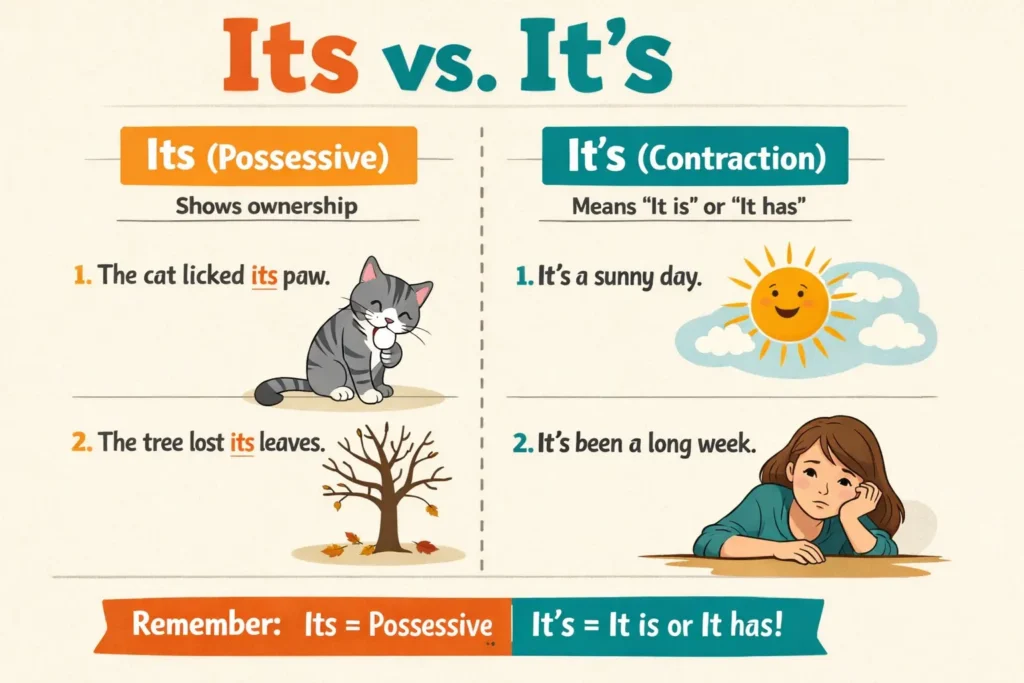
Table of Contents
🟢 What Is “Its”?
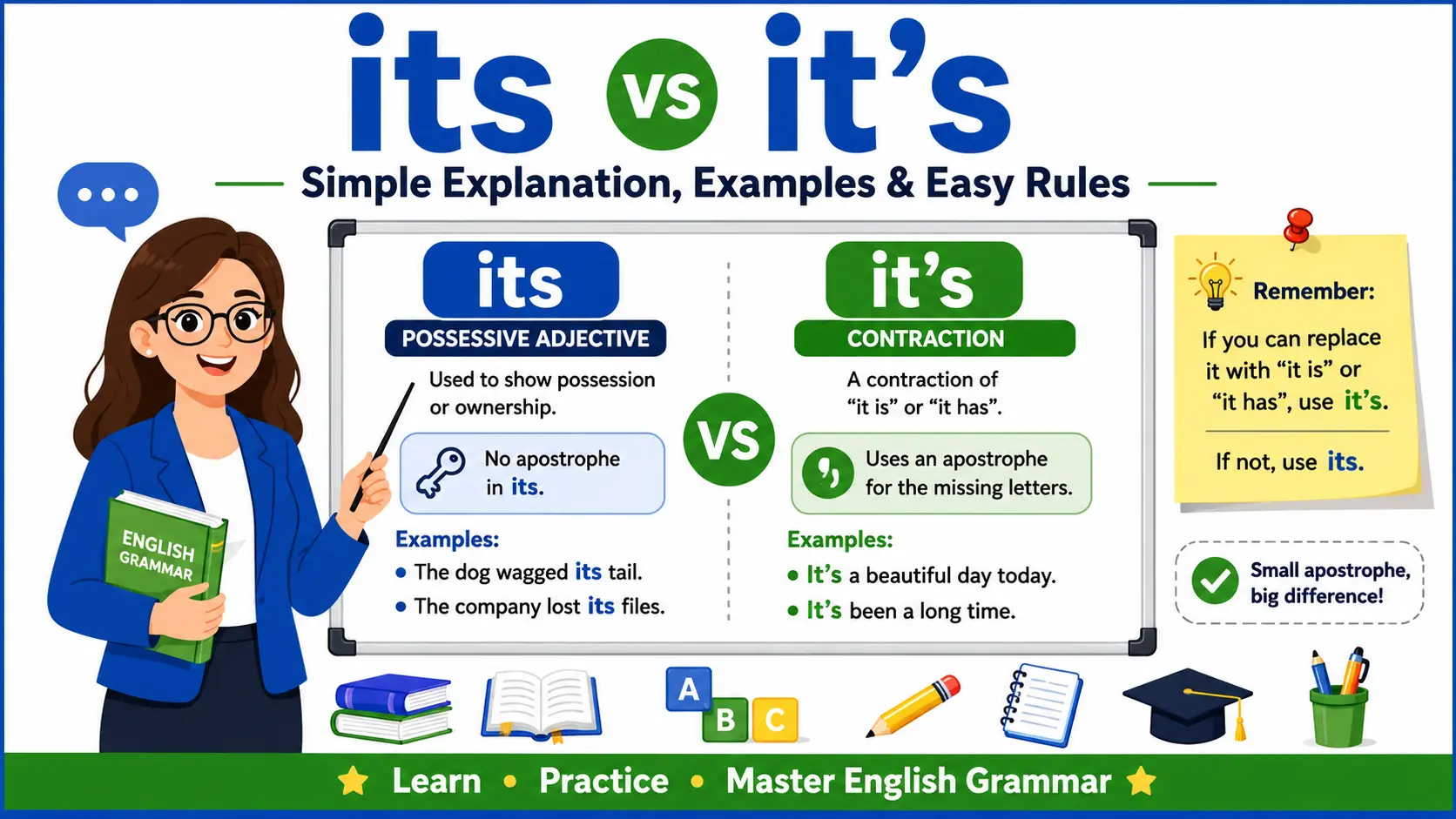
Its is a possessive adjective. It shows that something belongs to a thing, animal, or idea.
Think of it as the word “his” or “her,” but for objects, nature, or animals. Just like you would say “his jacket,” you use “its” to show ownership for things that aren’t human.
Examples:
- The dog wagged its tail.
- The company changed its policy.
- The tree lost its leaves.
In these sentences, its shows possession.
🟢 Its vs It’s Examples
Its:
- The car lost its color.
- The bird built its nest.
It’s:
- It’s very hot today.
- It’s going to rain later.
Possessive Pronouns vs. Contractions Comparison Chart
| Word Category | Possessive Form (No Apostrophe) | Example Sentence | Contraction Form (Has Apostrophe) | Meaning & Example |
| 3rd Person Neutral | Its | “The tree shed its leaves.” | It’s | It is / It has: “It’s raining today.” |
| 3rd Person Male | His | “He lost his wallet.” | He’s | He is / He has: “He’s running late.” |
| 3rd Person Female | Hers | “The decision was hers.” | She’s | She is / She has: “She’s finished.” |
| 2nd Person | Yours | “Is this umbrella yours?” | You’re | You are: “You’re welcome.” |
| 3rd Person Plural | Theirs | “The prize is theirs.” | They’re | They are: “They’re coming over.” |
🟢 Simple Trick to Remember
Use this easy test:
👉 Replace it’s with “it is” or “it has.”
✔ If the sentence still makes sense → use it’s
❌ If not → use its
Example:
It’s cold today
→ It is cold today ✔
The cat licked its paws
→ The cat licked it is paws ❌
So the correct word is its.
🟢 Key Differences Between Its and It’s
| Its | It’s |
|---|---|
| Possessive adjective | Contraction |
| Shows ownership | Means “it is” or “it has” |
| No apostrophe | Has an apostrophe |
To find out more usage notes and examples comparing possessive ‘its’ with contraction ‘it’s’, consult the Oxford Learner’s Dictionaries Its vs It’s Reference
Common Mistakes in Its vs It’s
Many learners confuse its vs it’s because possessive nouns usually use an apostrophe. However, “its” does not use an apostrophe, while “it’s” is a contraction of “it is” or “it has.” Remembering this rule can help you avoid mistakes.
Mistake 1: Writing “Its’” with a Trailing Apostrophe
- ❌ Incorrect: “The company updated its’ terms of service.”
- ✔️ Correct: “The company updated its terms of service.”
- Pedagogical Reason: Non-native speakers often assume its’ is the plural possessive form (like cats’). However, its’ does not exist in English; its already serves as the complete possessive form for singular and collective neutral nouns.
Mistake 2: Confusing “It’s” (It Has) with Simple Past Actions
- ❌ Incorrect: “Its been three days since the solar panel arrived.”
- ✔️ Correct: “It’s been three days since the solar panel arrived.”
- Pedagogical Reason: When it’s is followed by a past participle (been, seen, done), it stands for it has in the Present Perfect Tense, requiring the apostrophe.
Mistake 3: Misusing Possessive “Its” with Human Subjects
- ❌ Incorrect: “The student lost its textbook in the library.”
- ✔️ Correct: “The student lost his (or her / their) textbook in the library.”
- Pedagogical Reason: Its is reserved exclusively for inanimate objects, concepts, animals, or collective organizations. Human subjects take gendered or gender-neutral personal possessive pronouns (his, her, their).
Here are 6 additional, high-frequency mistakes to expand your Common Mistakes in Its vs It’s section, following the exact WordPress formatting and pedagogical breakdown shown on your screen:
Mistake 4: Using “It’s” Before Nouns to Show Possession
- ❌ Incorrect: “The cat licked it’s paw after eating.”
- ✔️ Correct: “The cat licked its paw after eating.”
- Pedagogical Reason: This is the single most common mistake in written English. Learners add an apostrophe out of habit because possessive nouns take apostrophes (“the dog’s tail”). However, its is a possessive pronoun, and possessive pronouns (his, hers, ours, its) never take an apostrophe.
Mistake 5: Writing “Its” When Meaning “It Is” at the Start of a Sentence
- ❌ Incorrect: “Its raining heavily outside this morning.”
- ✔️ Correct: “It’s raining heavily outside this morning.”
- Pedagogical Reason: When starting a sentence that describes weather, time, or distance using a dummy subject (it) paired with the verb is, you must use the contraction it’s.
Mistake 6: Confusing “Itself” with “It’s Self”
- ❌ Incorrect: “The system automatically resets it’s self every night.”
- ✔️ Correct: “The system automatically resets itself every night.”
- Pedagogical Reason: The reflexive pronoun itself is a single, compound word written without any spaces or apostrophes. Splitting it into “it’s self” incorrectly adds the verb is into the pronoun.
Mistake 7: Misinterpreting “It’s” in Passive Voice Structures
- ❌ Incorrect: “Its believed that the new policy will improve efficiency.”
- ✔️ Correct: “It’s believed that the new policy will improve efficiency.”
- Pedagogical Reason: In formal or academic writing, impersonal passive phrases rely on the contraction it’s (it is believed, it is said, it is expected). Using its leaves the sentence without a main verb.
Mistake 8: Using “Its” to Replace “It Has” Before a Noun
- ❌ Incorrect: “Its got a very bright display screen.”
- ✔️ Correct: “It’s got a very bright display screen.”
- Pedagogical Reason: In conversational English, it’s got is a contraction for it has got. Because it represents the auxiliary verb has, the apostrophe is required.
Mistake 9: Placing Apostrophes After the S (“Its’”)
- ❌ Incorrect: “The two solar panels lost its’ efficiency over time.”
- ✔️ Correct: “The two solar panels lost their efficiency over time.”
- Pedagogical Reason: Writers often try to form a plural possessive by putting an apostrophe after the s (its’). The form its’ does not exist in the English language. Additionally, if the subject is plural (solar panels), use the plural possessive pronoun their.
🟢 Why This Mistake Happens
The confusion between its vs it’s happens because they are homophones—words that sound the same but have different meanings and spellings.
Also, many possessive words use an apostrophe (like John’s), but its does not, which makes it confusing. Our brains are hardwired to see an apostrophe and think “ownership,” so it takes a little bit of conscious effort to unlearn that specific habit for this one word. Be patient with yourself while your brain adjusts to the rule!
Honestly, the fact that you are here reading this and putting in the effort to improve says a lot about your dedication. Grammar isn’t about being inherently perfect; it’s just about building muscle memory. Think of these rules like riding a bike—at first, you have to consciously think about every single balance adjustment, but eventually, your brain just handles it automatically. Give yourself permission to make a few mistakes along the way. Every writer you admire has stumbled over these exact same three letters at some point in their journey, and mastering it is just a matter of a little bit of mindful practice.
Practice Exercise: Test Your Knowledge
Choose the correct word (its or it’s) for each gap:
- __________ time to review the monthly site performance report.
- The smartphone fell, but __________ glass screen did not shatter.
- __________ been raining heavily since early this morning.
- The local business changed __________ operating hours for the holiday.
- Do you know if __________ going to be sunny tomorrow?
- The vacuum tube solar cooker reached __________ peak temperature in twenty minutes.
- __________ clear that learning grammar takes regular practice.
- The dog chased __________ own tail around the yard.
- I think __________ best to double-check your code before publishing.
- The contract has lost __________ validity due to the missing signature.
Answer Key & Explanations:
- It’s — Contraction for It is time.
- its — Possessive adjective showing the screen belongs to the smartphone.
- It’s — Contraction for It has been (Present Perfect Tense).
- its — Possessive adjective modifying the hours of the business.
- it’s — Contraction for it is going to be.
- its — Possessive adjective showing the temperature belongs to the cooker.
- It’s — Contraction for It is clear.
- its — Possessive adjective modifying the dog’s tail.
- it’s — Contraction for it is best.
- its — Possessive adjective showing validity belongs to the contract.
🟢 Improve Faster (Worksheets)
👉 Get full grammar worksheets here:
https://learnenglishgrammar.org/worksheets/
These include:
- Practice exercises
- Answer keys
- Simple explanations
🟢 Learn More Grammar Topics
👉 Your vs You’re
https://learnenglishgrammar.org/your-vs-youre/
👉 Their vs There vs They’re
https://learnenglishgrammar.org/their-vs-there-vs-theyre/
👉 Subject-Verb Agreement Rules
https://learnenglishgrammar.org/subject-verb-agreement-rules/
🟢 External Reference
For more explanation, visit:
https://www.grammarly.com/blog/its-vs-its/
👉 Download your free sample worksheets now:
https://learnenglishgrammar.org/free-sample
Frequently Asked Questions
What is the primary difference between “its” and “it’s”?
The easiest way to tell them apart is to look at their jobs in a sentence. “Its” (without an apostrophe) is a possessive word used to show that something belongs to an animal, object, or concept (e.g., “The smartphone lost its charge”). On the flip side, “it’s” (with an apostrophe) is a contraction, which is just a grammar shortcut for writing “it is” or “it has” (e.g., “It’s starting to make sense now”).
Why doesn’t possessive “its” have an apostrophe?
This is exactly why so many people get confused! Normally, we use an apostrophe to show ownership, like “Sarah’s car” or “the dog’s bone.” However, “its” is a personal pronoun, just like his, hers, yours, ours, and theirs. Notice how none of those words use an apostrophe to show possession? “Its” follows that exact same rule. The apostrophe is saved exclusively for contractions.
Is “its’” ever a correct word?
No, “its’” (with an apostrophe at the very end) is completely incorrect and is not a real word in the English language. People sometimes mistakenly write it because they are trying to apply the rule for plural possessive nouns (like “the boys’ basketball”). Because “it” is singular and already has a dedicated possessive form (“its”), adding an apostrophe at the end is never necessary.
How can I double-check my writing to ensure I used the right one?
The absolute best method is the “Read-Aloud Test.” Whenever you see the word in your sentence, read it out loud as “it is.”
If you write, “It’s a beautiful afternoon,” and read it as “It is a beautiful afternoon,” it sounds perfectly correct. Keep the apostrophe!
If you write, “The camera broke it’s lens,” and read it as “The camera broke it is lens,” it sounds awkward and wrong. Remove the apostrophe!
When should I avoid using “it’s” in my writing?
While “it’s” is perfectly fine for text messages, emails, blog posts, and everyday conversation, you should generally avoid using it (and other contractions) in formal academic essays, professional research papers, or legal documents. In formal writing, it is usually better to write out the full words “it is” or “it has” to maintain a professional tone. However, the possessive “its” is perfectly fine to use anywhere!