

Table of Contents
Introduction to Subject-Verb Agreement Rules and Regulations
Subject-verb agreement is one of the most important rules in English grammar. It means the verb must match the subject in number (singular or plural) and person.
A singular subject takes a singular verb, while a plural subject takes a plural verb.
Let’s be honest: English grammar can feel like a game where the rules keep changing when you aren’t looking. We’ve all been there—staring at a sentence we just wrote, wondering why it looks completely right but sounds slightly “off.” Subject-verb agreement is usually the culprit behind that nagging feeling. It’s the invisible glue holding our sentences together, and while it sounds simple in theory, it’s surprisingly easy to trip over when you’re caught up in the flow of writing.
👉 Want full practice? Explore our complete Level 1–6 Grammar Worksheets:
English Grammar Worksheets (Level 1–6)
What Is Subject-Verb Agreement?
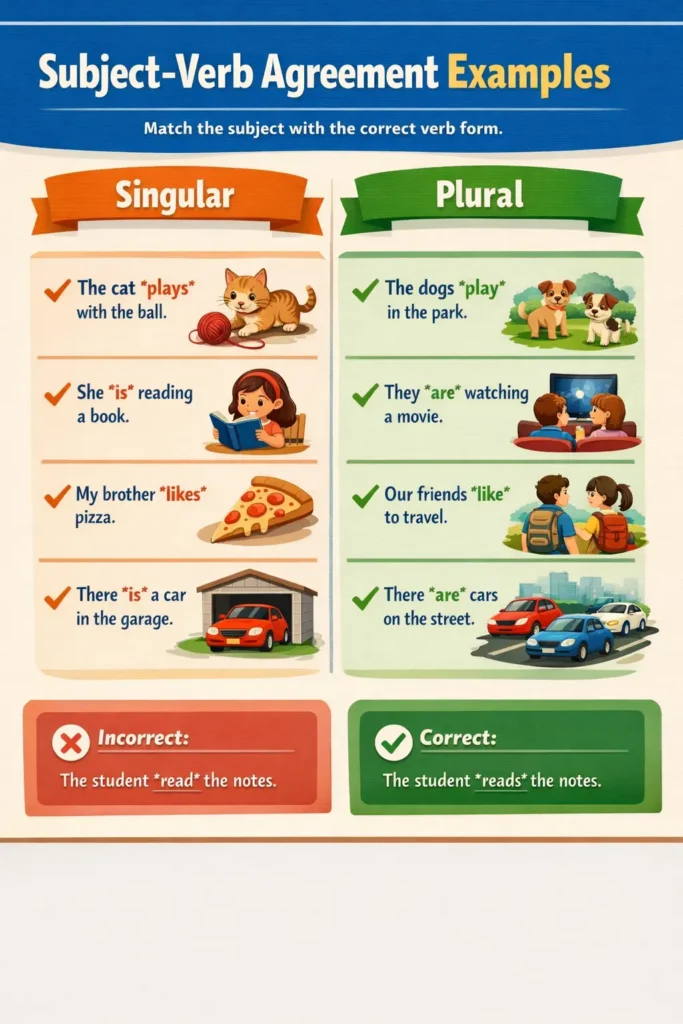
Subject-verb agreement ensures that the subject and verb in a sentence match correctly.
Examples:
- She writes every day.
- They write every day.
In the first sentence, she is singular, so the verb is writes.
In the second sentence, they is plural, so the verb is write.
Basic Rule of Subject-Verb Agreement
The most important rule is simple:
- Singular subject → singular verb
- Plural subject → plural verb
More examples:
- The dog runs fast.
- The dogs run fast.
The Present Tense “-s” Paradox
One common stumbling block for English language learners is the “S-Paradox.” In English, adding an “s” to a noun usually makes it plural (one dog $\rightarrow$ two dogs). However, adding an “s” to a present-tense verb makes it singular (he runs, she walks, it works). Understanding that a singular verb takes an -s while a plural verb drops the -s is essential for building a rock-solid grammatical foundation.
Person and Pronoun Agreement
Subject-verb agreement also depends on “person” (first, second, or third person). Third-person singular pronouns (he, she, it) always require singular verbs (She studies). First-person (I, we) and second-person (you) pronouns take plural verb forms in the present tense, with the notable exception of “I am” and “I was”.
Rule 1: Subjects Joined by “And”
When two subjects are joined by and, they usually take a plural verb.
Examples:
- Tom and Jerry are friends.
- The teacher and the student are talking.
Rule 2: Subjects Joined by “Or” or “Nor”
When subjects are joined by or or nor, the verb agrees with the subject closest to it.
Examples:
- Either the teacher or the students are coming.
- Either the students or the teacher is coming.
The Proximity Rule & Compound Subjects
This specific guideline is often called the Rule of Proximity. When alternative subjects are linked by either…or, neither…nor, or simply or, your eyes should skip straight to the subject sitting closest to the verb. If that closest subject is plural, use a plural verb; if it is singular, use a singular verb.
- Example: “Neither the manager nor the assistants were available.” (Assistants is plural and closest to the verb, so we use were).
Rule 3: Indefinite Pronouns
Some pronouns are always singular and take singular verbs.
Examples of singular indefinite pronouns:
- everyone
- someone
- anyone
- nobody
- each
Examples in sentences:
- Everyone likes music.
- Someone is knocking at the door.
Singular vs. Plural vs. Variable Indefinite Pronouns
Indefinite pronouns do not refer to a specific person or thing, making them tricky for writers. While words ending in -one, -body, or -thing are strictly singular, other indefinite pronouns like both, few, many, and several are always plural (“Both are correct”). Furthermore, variable pronouns like all, any, more, most, none, and some depend entirely on the noun in the prepositional phrase that follows them (“Some of the pie is gone” vs. “Some of the pies are gone”).
| Indefinite Pronoun Category | Pronouns Included | Verb Type | Example Sentence |
| Always Singular | everyone, nobody, each, someone | Singular | Each of the items is tested. |
| Always Plural | both, few, many, several | Plural | Several of the students are present. |
| Variable (SANAM) | some, all, none, any, most | Depends on Noun | All of the water is clear. / All of the bytes are saved. |
Rule 4: Collective Nouns
Collective nouns such as team, family, or group are usually treated as singular.
Examples:
- The team is playing well.
- The family lives in Kuala Lumpur.
British vs. American Usage & Individual Action
Collective nouns (committee, audience, staff, team) represent a single unit made up of multiple members. In standard American English, collective nouns almost always take a singular verb when operating as a unified group (“The committee meets on Tuesdays”). However, if the members of the group are acting individually or holding differing opinions, a plural verb is used (“The committee disagree among themselves on the budget”). British English frequently allows plural verbs for collective groups as well.
Rule 5: Words Between Subject and Verb
Sometimes other words appear between the subject and the verb. These do not affect agreement.
Example:
- The box of books is on the table.
👉 The subject is box, not books.
Rule 6: Titles and Names
Titles of books, movies, or organizations are usually treated as singular.
Example:
- The Chronicles of Narnia is a famous book series.
I used to think I had this completely down until I started writing longer essays and got tangled up in sentences with lots of extra details. It’s incredibly easy for your brain to get tricked by a plural word that sneaks in right before the verb, making you forget what the actual subject was in the first place. If you’ve ever written something like “The box of chocolates are gone” (guilty as charged!), don’t beat yourself up—it’s one of the most natural mistakes in the world, and it happens to all of us.
Rule 7: Expressions of Quantity and Fractions
When using fractional expressions (such as half of, a majority of, 30 percent of), the verb agrees with the noun that follows the preposition of.
- Example: “Two-thirds of the structure was damaged.” (Structure is singular).
- Example: “Two-thirds of the solar panels were installed.” (Panels is plural).
Rule 8: Inverted Sentence Order (“There is” / “There are”)
In sentences beginning with there is or there are, the subject follows the verb. There is never the actual subject of a sentence.
- Example: “There is a single error in the document.”
- Example: “There are five questions remaining on the quiz.”
Rule 9: “The Number of” vs. “A Number of”
This is a classic grammar rule: “The number” is singular and focuses on a single total, while “a number” is plural and means “several.”
- Example: “The number of registered participants is growing.”
- Example: “A number of participants have already registered.”
Common Subject-Verb Agreement Mistakes to Avoid
Pedagogical Reason: Quantities of time, money, distance, or measurement are considered single total units and require a singular verb.
Mistake 1: Dropping Third-Person Singular “-s” or “-es” in Habits
❌ Incorrect: She go to school every day.
✔️ Correct: She goes to school every day.
Pedagogical Reason: Singular subjects (he, she, it) require a singular verb ending in -s or -es when using the Present Simple Tense.
Mistake 2: Getting Distracted by Intervening Prepositional Phrases
❌ Incorrect: The list of items are on the desk.
✔️ Correct: The list of items is on the desk.
Pedagogical Reason: The head noun of the sentence is list (singular), not items (plural). Ignore modifying prepositional phrases (of items) when matching the subject to the verb.
Mistake 3: Treating Compound Subjects Joined by “And” as Singular
❌ Incorrect: The teacher and the student is attending the workshop.
✔️ Correct: The teacher and the student are attending the workshop.
Pedagogical Reason: Two or more subjects connected by and form a plural compound subject, requiring a plural verb form (are).
Mistake 4: Misinterpreting Indefinite Pronouns (“Everyone”, “Each”, “Somebody”)
❌ Incorrect: Everyone in the classroom are ready for the test.
✔️ Correct: Everyone in the classroom is ready for the test.
Pedagogical Rule: Singular indefinite pronouns (e.g., everyone, everybody, each, someone, nobody) take singular verbs despite referring to a group of people.
Mistake 5: Matching Verbs to Nearby Nouns in “Either… Or” Structures
❌ Incorrect: Either the manager or the assistants is responsible.
✔️ Correct: Either the manager or the assistants are responsible.
Pedagogical Rule: When subjects are joined by either… or / neither… nor, the verb must agree with the subject closest to it (assistants $\rightarrow$ are).
Mistake 6: Treating Plural-Sounding Nouns of Mass/Measurement as Plural
❌ Incorrect: Ten miles are a long distance to walk in the heat.
✔️ Correct: Ten miles is a long distance to walk in the heat.
Prepositional Phrases & Intervening Words
Errors like “The list of items are…” happen because of prepositional phrases (of items, along with the team, as well as the director). These modifying phrases sit between the subject and the verb to add descriptive detail, but they never change the grammatical number of the main subject. Words like along with, as well as, and together with act like prepositions, not conjunctions (and).
- Incorrect: “The main author, as well as his assistants, are presenting today.”
- Correct: “The main author, as well as his assistants, is presenting today.”
How to Avoid Mistakes
- Identify the real subject
- Ignore words between subject and verb
- Check if the subject is singular or plural
- Practice regularly
👉 Learn more in our guide:
https://learnenglishgrammar.org/nouns-in-english-grammar/
👉 Improve your writing with:
https://learnenglishgrammar.org/adverbs-in-english-grammar/
Free Subject-Verb Agreement Worksheet
Want to improve your grammar with real practice?
Download a FREE worksheet sample:
👉 Get your free worksheet here:
https://learnenglishgrammar.org/free-sample/
- Easy-to-follow exercises
- Instant AutoTick answers
- Perfect for students, parents, and self-learning
Upgrade to Full Grammar Worksheets (Level 1–6)
Ready to master English grammar step by step?
Our complete worksheet package includes Level 1 to Level 6, suitable for all learners.
- Structured learning system
- Hundreds of practice questions
- Instant answers
- Great for exam preparation
👉 View full worksheet package:
English Grammar Worksheets (Level 1–6)
At the end of the day, mastering these rules isn’t about scoring perfectly on a test; it’s about making sure your ideas come across exactly the way you want them to. Grammar shouldn’t feel like a chore or a barrier that keeps you from sharing your voice. With a little bit of steady practice, these rules will start to feel less like rigid instructions and more like second nature, giving you the confidence to write and speak without second-guessing yourself.
Why Subject-Verb Agreement Is Important
Correct subject-verb agreement helps you:
- Write clear and correct sentences
- Speak confidently
- Avoid common grammar mistakes
It is a key foundation in learning English grammar.
By mastering these subject verb-agreement rules, you can write clearer and more accurate English sentences.
External Reference
For more detailed explanations, visit:
https://www.grammarly.com/blog/subject-verb-agreement/
FAQ About Subject-Verb Agreement
What is subject-verb agreement in simple terms?
Think of it as teamwork between words. It is the grammatical rule stating that the subject (the person or thing doing the action) and the main verb (the action itself) must match in number. If you have one subject, you need a singular verb. If you have multiple subjects, you need a plural verb.
What are some tricky exceptions to the basic rule?
While the basic rule is straightforward, English loves exceptions! Some of the trickiest include:
– Collective nouns: Words like family, team, or staff look plural because they contain multiple people, but they usually take a singular verb (e.g., “The team is winning”).
– Indefinite pronouns: Words like everyone or anybody sound like they are about a lot of people, but grammatically, they are strictly singular (e.g., “Everyone loves Fridays”).
– The word “Each”: No matter how many plural words follow it, each always demands a singular verb (e.g., “Each of the students has a book”).
Why do so many people make mistakes with subject-verb agreement?
The biggest culprit is “intervening phrases”—extra details that sneak in between the subject and the verb. Your brain naturally wants to match the verb to the word closest to it. For example, in the sentence “The bouquet of yellow roses smells beautiful,” your brain sees the plural word roses right next to the verb and wants to say smell. It takes a conscious pause to remember that the real subject is the singular bouquet.
Does subject-verb agreement apply to past tense verbs?
For most verbs, no. In the past tense, the verb stays the same regardless of whether the subject is singular or plural (e.g., “She walked” and “They walked”). However, the major exception is the verb to be. You must still choose between was (singular) and were (plural) (e.g., “He was late” vs. “They were late”).
How can I quickly double-check my own writing for these mistakes?
The easiest trick is to mentally cross out everything between the main subject and the verb. Strip the sentence down to its bare bones. Instead of reading, “The primary goal of the new company policies is to save time,” read it as “The goal is…” If the bare-bones sentence sounds right, your agreement is correct!
Does subject-verb agreement apply to modal auxiliary verbs?
No. Modal verbs like can, could, may, might, must, shall, should, will, and would do not change form based on the subject. Whether your subject is singular or plural, the modal verb stays the same (e.g., “He can cook” and “They can cook”).
How do gerunds (-ing words used as nouns) affect agreement?
When a gerund or a gerund phrase acts as the subject of a sentence, it always takes a singular verb. For example, in “Solar cooking saves electricity,” the subject is the action of cooking (singular), not the cookers themselves.