Table of Contents
Introduction to Conjunctions in English Grammar
Think of conjunctions as the unsung heroes of smooth communication. Without them, our speech and writing would feel incredibly choppy—like a robot reading a dry list of facts. In this guide, we are going to break down exactly how these little words act as bridges between your thoughts, making your English sound natural, fluid, and confident.
Conjunctions in English grammar are words that connect ideas, sentences, or clauses. In this guide, you will learn the different types of conjunctions, including coordinating, subordinating, and correlative conjunctions, with clear examples.
Conjunctions are one of the most important parts of English grammar. They help us connect words, phrases, and sentences smoothly.
In this guide, you will learn what conjunctions are, their types, and how to use them correctly with simple examples.
Free Printable Worksheet
Practise as you learn! Download the FREE Conjunctions Worksheet (PDF) and complete the exercises while reading this lesson.
📘 What Are Conjunctions in English Grammar?
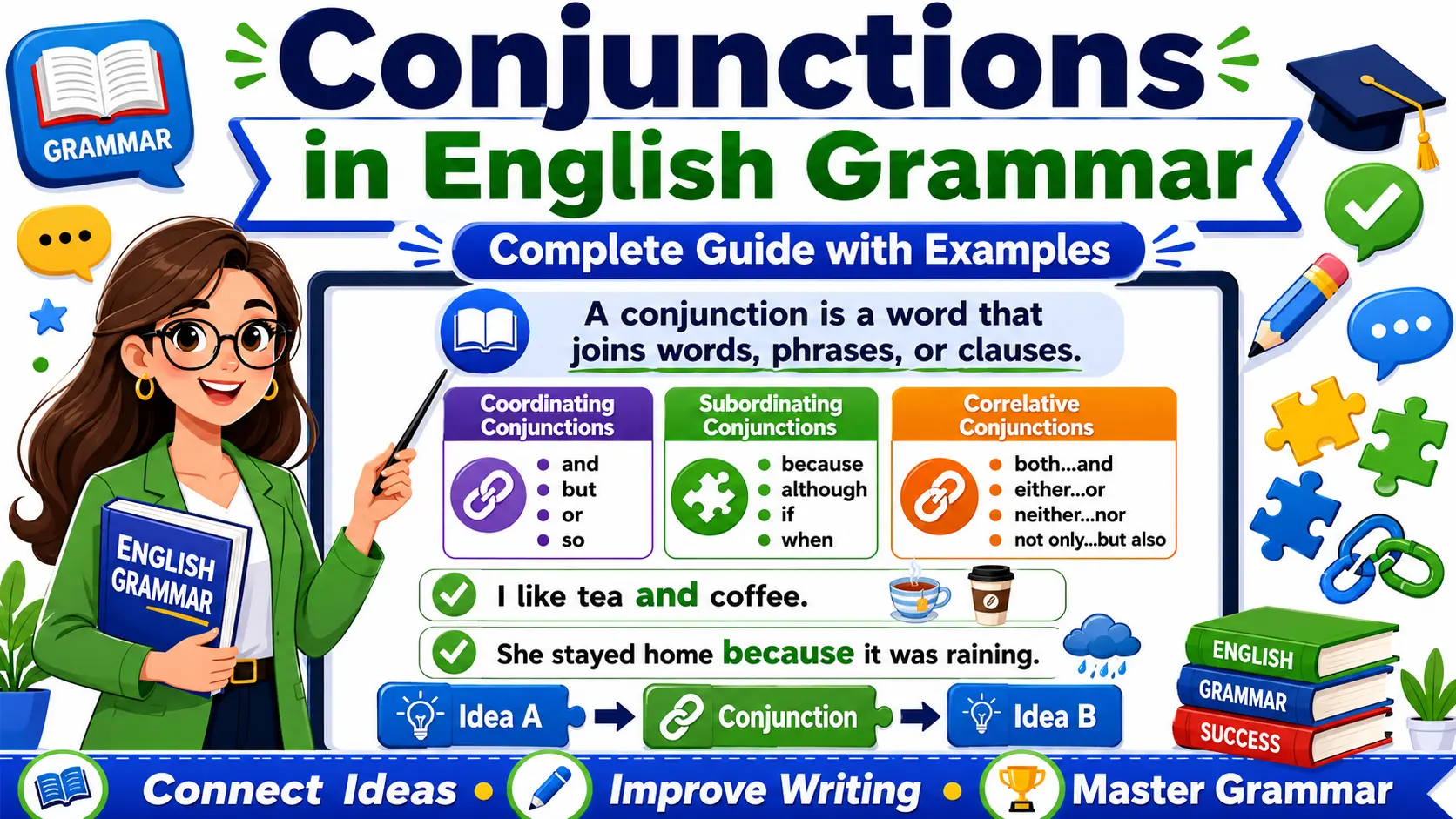
A conjunction is a word that joins two or more words, phrases, or sentences.
Examples:
- I like tea and coffee.
- She was tired but she continued working.
- I stayed home because it was raining.
👉 Words like and, but, because, or are conjunctions.
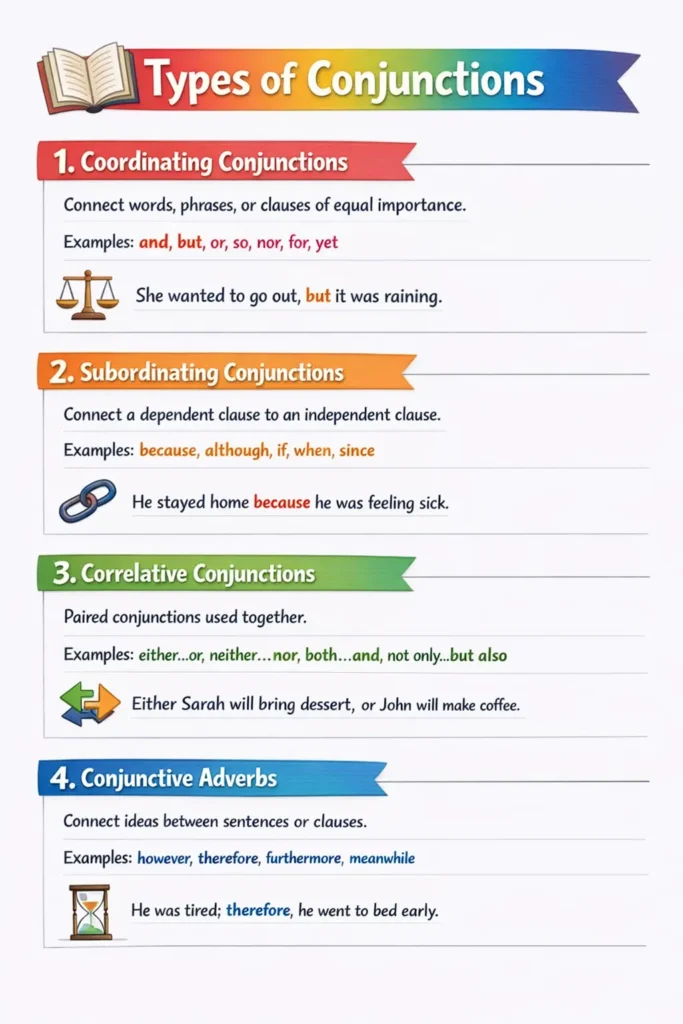
📚 Types of Conjunctions in English Grammar
Correlative conjunctions (either…or, neither…nor)There are three main types of conjunctions in English:
Coordinating conjunctions (and, but, or)
Subordinating conjunctions (because, although, if)
Conjunctions Overview Chart
| Conjunction Type | Function / Purpose | Primary Examples | Example Sentence |
| Coordinating | Connects words, phrases, or equal clauses | FANBOYS (for, and, nor, but, or, yet, so) | “I studied hard, so I passed.” |
| Subordinating | Connects dependent clause to independent clause | because, although, if, unless, while, since | “Although it rained, we went out.” |
| Correlative | Tag-team pairs joining parallel elements | either…or, neither…nor, not only…but also | “Not only is he smart, but also kind.” |
| Conjunctive Adverb | Shows logical transitions between thoughts | however, therefore, consequently, moreover | “He was ill; therefore, he stayed home.” |
1️⃣ Coordinating Conjunctions (With Examples)
These join words or sentences of equal importance.
Common coordinating conjunctions:
- For
- And
- Nor
- But
- Or
- Yet
- So
👉 (Tip: Remember FANBOYS)
Examples:
- I want to go out, but it is raining.
- She likes apples and oranges.
- You can stay here or leave now.
The FANBOYS Acronym Breakdown:
- F – For: Introduces a reason or cause (“He slept early, for he was exhausted”).
- A – And: Adds information or joins similar ideas (“She reads books and writes blogs”).
- N – Nor: Used to present a second negative idea (“He does not drink coffee, nor does he eat meat”).
- B – But: Introduces contrast or an exception (“The proposal was long, but it was thorough”).
- O – Or: Presents an alternative or choice (“You can pay by cash or credit card”).
- Y – Yet: Introduces a surprising contrast (similar to but) (“The test was difficult, yet everyone passed”).
- S – So: Shows a result or outcome (“The battery was dead, so the car wouldn’t start”).
Coordinating conjunctions join words, phrases, or independent clauses of equal grammatical rank. You can review a complete breakdown of coordinating conjunction rules on the Cambridge Dictionary Conjunctions Guide
2️⃣Subordinating Conjunctions (With Examples)
These connect a main clause with a dependent clause.
Common subordinating conjunctions:
- Because
- Although
- If
- When
- While
- Since
Examples:
- I stayed home because I was sick.
- Although he was tired, he finished his work.
- Call me when you arrive.
3️⃣ Correlative Conjunctions
These work in pairs to join words or phrases.
Common pairs:
- Either…or
- Neither…nor
- Both…and
- Not only…but also
Examples:
- Either you come now or you stay here.
- Both John and Mary are coming.
- Not only is he smart, but also hardworking.
4. Conjunctive Adverbs (Transition Words)
Conjunctive adverbs connect two independent clauses or sentences by showing cause and effect, sequence, contrast, or emphasis. Unlike coordinating conjunctions, they require specific punctuation (a semicolon before and a comma after when joining clauses in one sentence).
- Common Examples: however, therefore, moreover, nevertheless, consequently, meanwhile.
- Sentence Example: “The weather was terrible; however, the solar experiment was a complete success.”
Connecting Daily Routines: Conjunctions in the Present Simple
To see conjunctions in action, explore the Present Simple Tense. We rely on this tense to talk about daily habits and routines, using conjunctions to turn fragmented thoughts into smooth sentences. For example, instead of two separate sentences (“I wake up at 7:00 AM. I drink coffee”), a simple conjunction connects them seamlessly: “I wake up at 7:00 AM and drink coffee.
Example 1: Connecting Two Sequential Actions (and)
- Fragmented: “She finishes her homework at 5:00 PM. She goes for a jog.”
- Seamless: “She finishes her homework at 5:00 PM and goes for a jog.”
Example 2: Connecting Contrast or Options (but / or)
- Fragmented: “He reads the morning news. He does not check his work emails.”
- Seamless: “He reads the morning news but does not check his work emails.”
Punctuation Rules for Conjunctions
Using correct punctuation with conjunctions is one of the most frequently tested areas in English exams and professional writing.
- 1. The Independent Clause Rule (FANBOYS Comma):Place a comma before a coordinating conjunction only when it joins two complete sentences (independent clauses) that could stand alone.
- With Comma: “The sun was shining, but a cold wind was blowing.”
- No Comma: “The sun was shining and warming the room.” (No new subject after and).
- 2. The Subordinating Clause Position Rule:
- If the subordinating clause comes FIRST, place a comma after it:“Because the weather was hot*, we stayed indoors.”*
- If the main clause comes FIRST, no comma is usually needed:“We stayed indoors because the weather was hot.”
- 3. Parallelism with Correlative Conjunctions:The grammatical structures following both parts of a correlative pair must match (noun + noun, verb + verb, or phrase + phrase).
- ❌ Unbalanced: “She is not only talented, but also plays piano well.”
- ✔️ Balanced: “She is not only talented, but also hard-working.”
⚠️ Common Mistakes with Conjunctions
Avoid these mistakes:
❌ Using too many conjunctions in one sentence
✔ Keep sentences clear and simple
❌ Incorrect pairing
✔ Use correct pairs (e.g., either…or)
❌ Missing commas
✔ Use comma before coordinating conjunction when joining sentences
Correct: I was tired, but I continued working.
❌ I like tea and also coffee
✅ I like tea and coffee
❌ Because he was tired, so he slept
✅ Because he was tired, he slept
Subject-Verb Misagreement with Correlative Pairs
- ❌ Incorrect: “Neither the teacher nor the students was present.”
- ✔️ Correct: “Neither the teacher nor the students were present.”
- Pedagogical Reason: When using either…or or neither…nor, the verb must agree with the subject closest to it (students is plural $\rightarrow$ were).
Confusing “Unless” in Negative Conditions
- ❌ Incorrect: “You won’t pass the exam unless you don’t study.”
- ✔️ Correct: “You won’t pass the exam unless you study.”
- Pedagogical Reason: Unless already means “if not.” Adding another negative creates an ungrammatical double negative.
Starting Sentences with Coordinating Conjunctions in Formal Writing
- While starting a sentence with And or But is common in informal blogging and speech, academic and professional writing prefers transition words like Furthermore, However, or In addition.
✍️ Practice Exercises
Choose the correct conjunction or fill in the blank:
- You can have __________ the soup __________ the salad with your meal. (either…or / neither…or)
- She missed the bus; __________, she arrived late for the morning meeting. (however / consequently)
- __________ I was tired, I finished writing the report. (Because / Although)
- He speaks English fluently, __________ he has lived in London for five years. (for / but)
- Neither the manager nor his assistants __________ informed about the schedule change. (was / were)
Answer Key & Detailed Explanations:
were — Verb agrees with the nearest subject (assistants, plural).
either…or — Correct correlative tag-team pair for choosing between two options.
consequently — Conjunctive adverb showing cause-and-effect relationship following a semicolon.
Although — Subordinating conjunction expressing contrast placed at the beginning of the sentence.
for — Coordinating conjunction introducing a reason (for means because in formal contexts).
🎯 Quick Summary
- Conjunctions connect words and sentences
- There are 3 main types:
- Coordinating
- Subordinating
- Correlative
- They improve sentence flow and clarity
🎁 Want to Practice More?
Improve faster with structured worksheets:
👉 [Download English Grammar Worksheets]
👉 [Try Free Sample]
📘 Learn More
👉 Start from the main guide:[Complete English Grammar Guide]
👉 Learn basics: [Parts of Speech]
🧠 Why Conjunctions Are Important in English Grammar
Conjunctions play an important role in English grammar because they help connect ideas and make sentences more natural and fluent. Without conjunctions, sentences would sound short, repetitive, and unnatural.
For example:
- I like tea. I like coffee. ❌
- I like tea and coffee. ✅
By using conjunctions correctly, you can:
- Combine short sentences into longer, meaningful ones
- Show relationships between ideas (contrast, cause, choice)
- Improve both writing and speaking skills
Learning how to use conjunctions effectively will make your communication clearer and more professional.
🎁 Free Printable Worksheet
Enjoyed this lesson on Conjunctions? Reinforce what you’ve learned with our FREE printable worksheet. Perfect for students, teachers, parents, tutors, and self-learners.
✅ Printable PDF
✅ Detailed answer key with explanations
✅ Perfect for self-study or classroom use
❓ Frequently Asked Questions
What are conjunctions in English grammar?
They are words used to connect sentences or ideas.
What are the main types of conjunctions?
What actually counts as a conjunction in English?
Simply put, conjunctions are “bridge words.” Their entire job is to glue words, phrases, or whole sentences together so your thoughts flow smoothly instead of sounding choppy and broken up.
Why are conjunctions important?
They help make sentences clearer and more connected..
What is an example of a conjunction?
Examples of conjunctions include and, but, or, because, although, and if.
What are the three main types I need to know?
You can break them down into three easy categories:
Coordinating (The Linkers): Words like and, but, and or that connect equal ideas.
Subordinating (The Explainers): Words like because, although, and since that introduce a reason, time, or condition.
Correlative (The Pairs): Two-word tag teams like either…or and neither…nor.
Do I always need a comma before a conjunction?
Not always! You only need a comma before a coordinating conjunction (FANBOYS) if it is connecting two complete sentences that could stand alone. For example: “I wanted to go, but it was raining.” If you are just joining two words, leave the comma out: “I like tea and coffee.”
What is the most common mistake to avoid?
“Double-booking” your conjunctions! People often accidentally use two in the same sentence when they only need one. For example, never say: “Because it was raining, so I stayed home.” Pick one and stick to it: “Because it was raining, I stayed home.”
!