
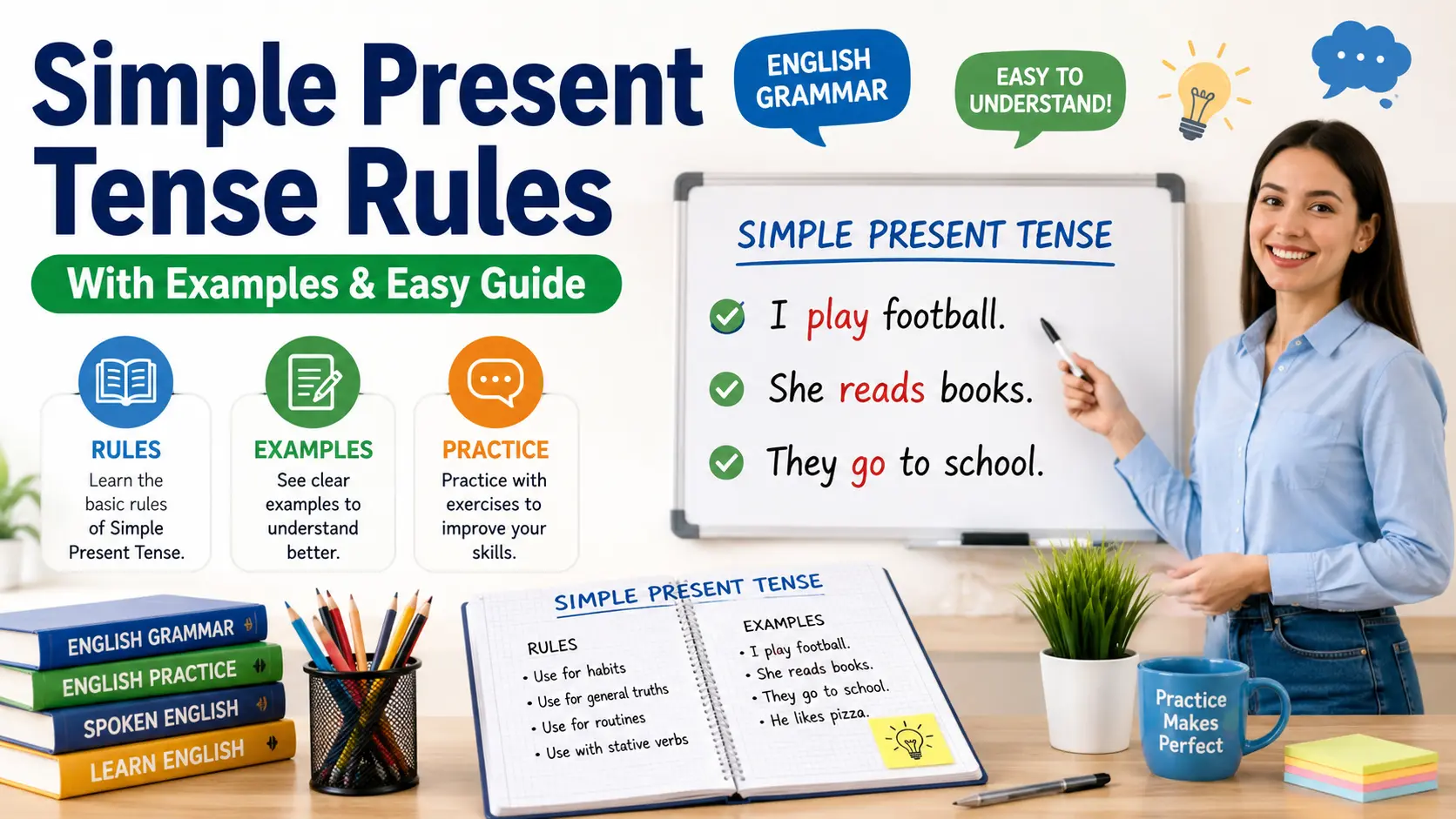
The simple present tense rules are one of the most important parts of English grammar.
They help you describe habits, general truths, and daily actions clearly and correctly.
By learning the simple present tense rules, you can speak and write English more clearly and confidently.
Let’s be honest: grammar rules can sometimes feel like a chore to memorize. You might worry about making a silly mistake or freezing up mid-sentence trying to remember where to put an “-s”. But think of the simple present tense less like a strict school rule and more like your ultimate baseline tool. It’s the tense you’ll use most often when introducing yourself, ordering food, or chatting about your hobbies. Once you get the hang of it, everything else in English gets a whole lot easier.
Table of Contents
🎁 Try a Free Grammar Worksheet (See How It Works)
Want to practise the simple present tense with instant feedback?
👉 🎁 Download Free Grammar Worksheet Sample
✔ Includes AutoTick answer system
✔ Instant marking
✔ Perfect for beginners
🧠 What is the Simple Present Tense?
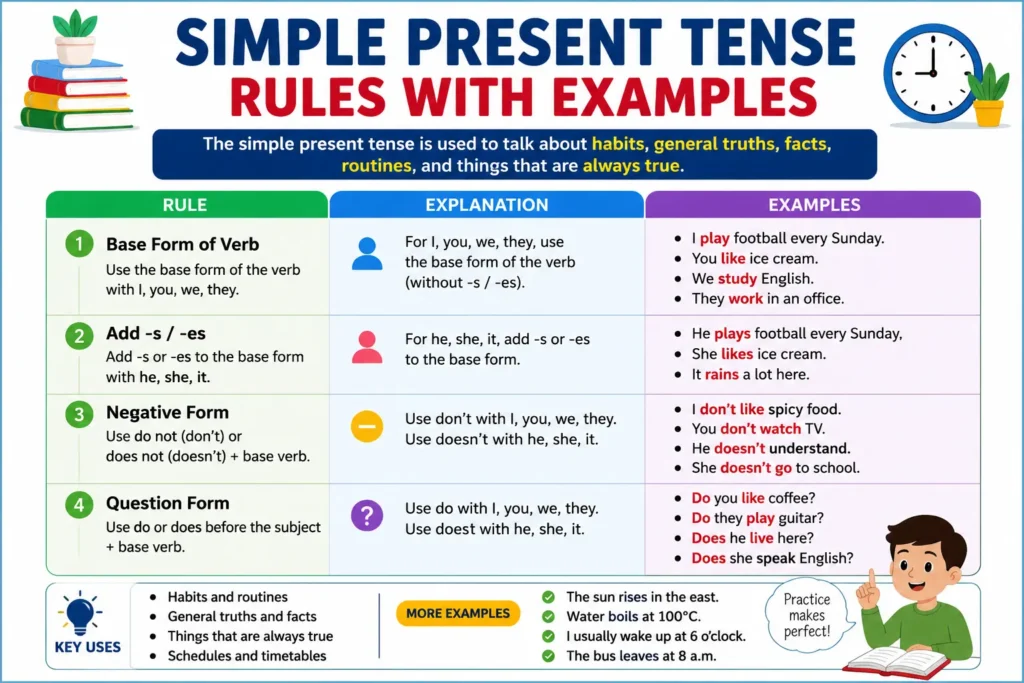
The simple present tense describes actions that:
- happen regularly
- are always true
- are part of daily routines
📌 When to Use the Simple Present Tense
✅ 1. Habits and Daily Routines
We use it for actions that happen regularly.
Examples:
- She wakes up at 7 a.m.
- I drink coffee every morning
- They play football after school
✅ 2. General Facts and Truths
Used for things that are always true.
Examples:
- The sun rises in the east
- Water boils at 100°C
- Birds fly in the sky
✅ 3. Permanent Situations
Used for long-term or permanent situations.
Examples:
- She works at a bank
- They live in Malaysia
- He speaks English very well
4. Scheduled Future Events (Timetables & Calendars)
We frequently use the simple present tense to discuss official, scheduled events in the near future. This includes public transport schedules, movie showtimes, flight departures, and official calendar events.
- Examples: “The train leaves at 8:00 a.m. tomorrow morning.” / “The new academic term starts next Monday.”
5. Instructions, Directions, and Recipes
When giving step-by-step instructions or describing a process, the simple present tense creates direct, easy-to-follow directions.
- Examples: “First, you mix the flour and sugar. Then, you add two eggs.” / “Walk straight for two blocks, then turn left.”
✏️ Simple Present Tense Structure
✔ Affirmative Sentences
Structure:
- Subject + base verb
Examples:
- I read books
- They study English
✔ Third Person Singular (Important Rule)
For he, she, it, add -s or -es to the verb.
Now, if there is one rule in this tense that trips up almost everyone—even people who have been speaking English for years—it is the dreaded third-person singular rule. When you are talking about yourself (I) or a group (they), the verb stays simple. But the second he, she, or it walks into the room, the verb needs a little extra decoration in the form of an -s or -es. It feels a bit unnatural at first, but with a tiny bit of practice, your brain will start picking up the rhythm automatically.
Examples:
- He reads every day
- She writes emails
- The dog runs fast
✔ Negative Sentences
Structure:
- Subject + do/does not + base verb
Examples:
- I do not like coffee
- She does not eat meat
- They do not watch television
✔ Questions
Structure:
- Do/Does + subject + base verb
Examples:
- Do you like music?
- Does she play the piano?
- Do they live here?
Wh- Question Formation (Information Questions)
To ask for specific information (like time, place, or reason), place a question word (where, when, why, what, how) at the very beginning of the sentence structure:
Question Word + Do/Does + Subject + Base Verb
- Examples: “Where do you work?” / “What time does the class start?” / “Why do they study so late?”
The Special Case: Verb “To Be” (Non-Action Sentences)
The verb to be (am, is, are) does not use auxiliary verbs (do/does) for negatives or questions. Instead, it changes form completely based on the subject pronoun:
| Subject | Affirmative | Negative | Question |
| I | I am ready. | I am not late. | Am I right? |
| He / She / It | She is a teacher. | He is not at home. | Is it open? |
| You / We / They | They are happy. | We are not tired. | Are you here? |
🔤 Spelling Rules (He / She / It)
➕ Add -s
- play → plays
- read → reads
➕ Add -es
(verbs ending in s, sh, ch, x, o)
- watch → watches
- go → goes
- fix → fixes
🔁 Change y → ies
(consonant + y)
- study → studies
- carry → carries
Consonant vs. Vowel + Y Rule Breakdown:
A common area where students lose marks in exams is knowing when to use -s or -ies with verbs ending in -y. If a vowel (a, e, i, o, u) comes before the y, simply add -s (e.g., enjoy → enjoys, stay → stays). However, if a consonant comes before the y, change the y to -ies (e.g., fly → flies, worry → worries).
Another important exception is the irregular verb have, which changes to has with third-person singular subjects: She has two dogs.
📝 More Examples of Simple Present Tense
- She teaches English
- They work together
- He drives to work every day
- We study grammar in class
Adverbs of Frequency & Time Markers
Certain time expressions act as clear signals that a sentence requires the simple present tense. These “trigger words” indicate how regularly an action takes place.
- Adverbs of Frequency (Placed BEFORE the main verb):always, usually, often, sometimes, rarely, never.
- Sentence Example: “She always prepares her lesson plan on Sunday night.”
- Time Expressions (Placed at the END of the sentence):every day, every week, once a month, on Fridays, in the morning.
- Sentence Example: “We review our financial logs every Friday.”
Common Simple Present Tense Mistakes & How to Fix Them
- Mistake 1: Dropping Third-Person Singular “-s” or “-es” in Affirmative Sentences
- ❌ Incorrect: She go to school every day.
- ✔️ Correct: She goes to school every day.
- Pedagogical Reason: Singular third-person subjects (he, she, it) strictly require an -s or -es suffix added to the base verb when describing habits or routines.
- Mistake 2: Using “Don’t” Instead of “Doesn’t” for Singular Subjects
- ❌ Incorrect: He don’t like coffee.
- ✔️ Correct: He doesn’t like coffee.
- Pedagogical Reason: Negative sentences with third-person singular subjects require the auxiliary negative form doesn’t (does not), whereas don’t is reserved for I, you, we, and they.
- Mistake 3: Double Marking the Third-Person “-s” in Negative Sentences
- ❌ Incorrect: She doesn’t likes tea.
- ✔️ Correct: She doesn’t like tea.
- Pedagogical Reason: The auxiliary verb does already carries the third-person marker (-es). The main action verb that follows must return to its clean base form.
- Mistake 4: Using Present Continuous for Permanent States or Long-Term Facts
- ❌ Incorrect: I am living in Kuala Lumpur all my life.
- ✔️ Correct: I live in Kuala Lumpur.
- Pedagogical Reason: Permanent states, lifelong conditions, and universal facts require the Simple Present Tense. Continuous forms (am living) indicate short-term, temporary living arrangements.
- Mistake 5: Adding Auxiliary “Do/Does” to Affirmative Statements
- ❌ Incorrect: She does work at the clinic every day. (unless emphasizing)
- ✔️ Correct: She works at the clinic every day.
- Pedagogical Reason: Standard positive statements in the Simple Present Tense do not use helper verbs like do or does. Conjugate the main verb directly.
- Mistake 6: Forgetting the Base Verb After “Do/Does” in Questions
- ❌ Incorrect: Does he plays football on weekends?
- ✔️ Correct: Does he play football on weekends?
- Pedagogical Rule: In question structures, the helper verb does handles the third-person singular agreement, leaving the main verb in its unchanged base form.
- Mistake 7: Misplacing Frequency Adverbs (“Always”, “Usually”, “Often”)
- ❌ Incorrect: She goes always to the market on Friday.
- ✔️ Correct: She always goes to the market on Friday.
- Pedagogical Rule: Frequency adverbs sit directly before main action verbs (always goes), but directly after the verb to be (“She is always punctual”).
- Mistake 8: Misapplying Spelling Rules for Verbs Ending in “-y”
- ❌ Incorrect: He studys English grammar every evening.
- ✔️ Correct: He studies English grammar every evening.
- Pedagogical Reason: When a verb ends in a consonant + -y (study, try, fly), change the -y to -i and add -es (studies). If it ends in a vowel + -y (play, enjoy), simply add -s (plays).
🚀 Practise Simple Present Tense (Improve Faster)
Reading is helpful — but practice is what makes you improve fast.
👉 🚀 Get Full English Grammar Worksheets (Levels 1–6)
✔ Covers all grammar topics
✔ Step-by-step learning
✔ Instant AutoTick answers sheets
🎁 Not Ready Yet? Try the Free Sample
👉 🎁 Download Free Sample Worksheet
🔗 Related Grammar Lessons
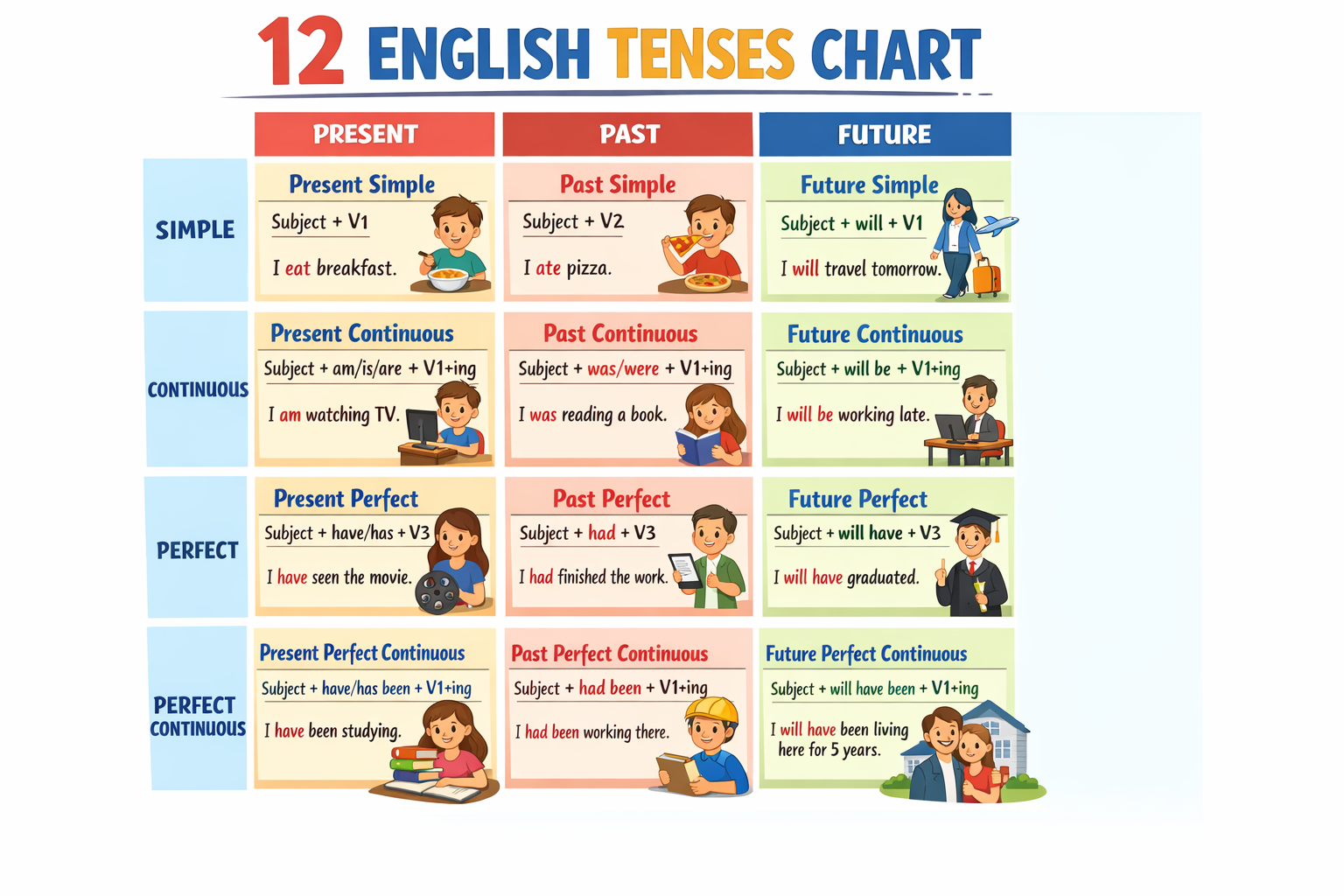
🌍 Trusted Grammar Resources
For additional explanations and interactive exercises on the Simple Present Tense, check out the Cambridge English Grammar Guide or practise with the BBC Learning English Reference Section.
📈 Why Learn the Simple Present Tense?
The simple present tense helps you:
- Describe daily activities clearly
- Speak more naturally
- Avoid common grammar mistakes
- Build a strong grammar foundation
At the end of the day, mastering English isn’t about being perfect; it’s about being understood. The simple present tense is the very foundation of how we share our daily lives with other people. Every time you practice a sentence or work through an exercise, you are building the muscle memory you need to speak without hesitating. You’ve got the rules down down now—all that’s left is to put them to use!
Practice Exercise: Test Your Simple Present Tense Understanding
Choose the correct verb form for each sentence:
- The earth __________ around the sun. (revolve / revolves)
- My brothers __________ not like loud music. (do / does)
- Where __________ your sister work? (do / does)
- Water __________ at 0°C. (freeze / freezes)
- He __________ his homework right after school. (finish / finishes)
- Solar panels __________ sunlight into electrical energy. (convert / converts)
- She __________ always check her work email before breakfast. (do / does)
- Either the manager or the consultants __________ the daily site inspections. (conduct / conducts)
- The train to London __________ at 9:00 AM every morning. (depart / departs)
- They __________ not agree with the proposed changes to the contract. (do / does)
Answer Key & Detailed Pedagogical Explanations
- revolves — Scientific general truth with a third-person singular subject (the earth = it).
- do — Plural subject (my brothers = they), so use do not rather than does not.
- does — Interrogative structure for a third-person singular subject (your sister = she).
- freezes — Universal scientific fact requiring the third-person singular suffix -s.
- finishes — Singular subject (he) requiring -es because the base verb finish ends in -sh.
- convert — Plural subject (solar panels) requires the base verb form without an -s.
- does — Singular subject (she) uses the auxiliary verb does when pairing with adverbs of frequency in routines.
- conducts — In either… or structures, the verb agrees with the closest subject (consultants = plural $\rightarrow$ conduct / consultant = singular $\rightarrow$ conducts).
- departs — Fixed timetable schedule using the third-person singular form (the train = it).
- do — Plural subject (they) requires the plural auxiliary do not (don’t) for standard present negation.
❓ FAQ
What are some “clue words” that tell me to use the simple present tense?
Look out for time expressions and adverbs of frequency. If you see words like always, usually, often, sometimes, never, every day, on Mondays, or once a week, you are almost certainly going to use the simple present tense because these words point directly to habits and routines.
Why does the verb “to be” look completely different?
he verb to be (am, is, are) is a rebel—it completely ignores the standard base verb rules. Instead of adding “-s”, it changes entirely depending on the subject:
I am a student.
He/She/It is happy.
You/We/They are here.
Do we add “-s” to the verb when making a negative sentence?
No, and this is a massive trap! Once you use does not (or doesn’t), the helper verb does already carries the third-person singular “-s”. The main verb that follows must stay in its clean, base form.
Incorrect: She doesn’t likes milk.
Correct: She doesn’t like milk.
What happens to verbs that end in “y”?
It depends entirely on the letter right before the “y”.
If it’s a consonant (like d in study), drop the “y” and add -ies (studies).
If it’s a vowel (like a in play), leave the “y” alone and just add -s (plays).
Can I use the simple present tense to talk about the future?
Surprisingly, yes! We use it for official, scheduled future events like public transport timetables, movie times, or school calendars. For example: “The train leaves at 8:00 tomorrow morning” or “The movie starts in ten minutes.”