
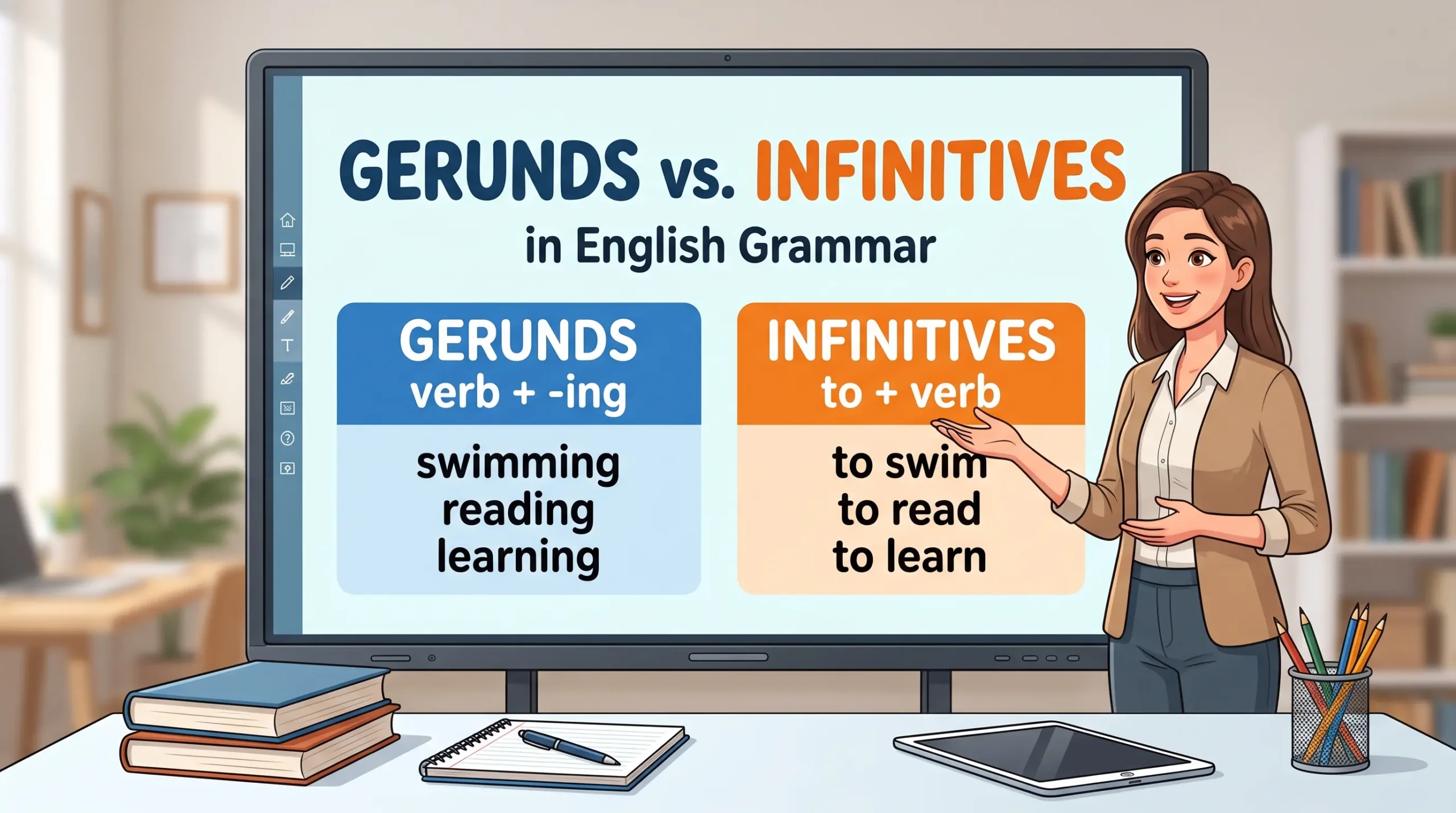
Gerunds vs. Infinitives in English grammar represent one of the most critical milestones in language learning. Understanding the difference between gerunds (verb + -ing) and infinitives (to + verb) is essential for clear communication. While both forms originate from verbs and function as nouns or complements within sentences, choosing between a gerund and an infinitive can completely alter the meaning of a sentence—or make it sound unnatural.
Whether you are preparing for academic writing, ESL exams (TOEFL, IELTS, Cambridge), or simply striving to speak English naturally, this comprehensive guide provides clear rules, categorization charts, common student mistakes, and interactive exercises to build your confidence.
1. What Are Verbal Nouns? Understanding the Basics
To understand how gerunds and infinitives work, we must first understand verbals. A verbal is a verb form that functions as a different part of speech in a sentence—most frequently as a noun.
What Is a Gerund?
A gerund is formed by adding -ing to the base form of a verb (e.g., swimming, reading, studying). Although it looks identical to a present participle used in continuous tenses, a gerund acts strictly as a noun.
- Example as Subject: Reading improves your English vocabulary.
- Example as Direct Object: She enjoys swimming in the ocean.
- Example as Object of Preposition: He is interested in learning code.
What Is an Infinitive?
An infinitive consists of the base form of a verb preceded by the word “to” (e.g., to swim, to read, to study). Infinitives are the dictionary form of verbs and can function as nouns, adjectives, or adverbs.
- Example as Subject: To err is human; to forgive is divine.
- Example as Direct Object: They decided to leave early.
- Example as Purpose (Adverb): She studied hard to pass the exam.
To understand how verbal nouns function, it helps to review the broader framework of Parts of Speech in English Grammar
2. Structural Functions: When Words Take the -ing or to Form
Understanding where gerunds and infinitives sit within sentence structures helps prevent fundamental grammatical errors.
+------------------+----------------------------------+------------------------------------+
| Structural Position| Gerund (-ing) Example            | Infinitive (to + verb) Example     |
+------------------+----------------------------------+------------------------------------+
| Subject          | Swimming is great exercise.      | To swim in cold water takes courage|
| Direct Object    | I enjoy reading historical novels.| I want to read that book.          |
| Subject Complement| Her passion is teaching.         | Her dream is to teach abroad.      |
| Object of Prepos.| She left without saying goodbye.  | [Never used after prepositions]    |
+------------------+----------------------------------+------------------------------------+
The Unbreakable Preposition Rule
Gold Standard Rule: A preposition in English (e.g., in, on, at, about, with, without, before, after, of, for) MUST always be followed by a gerund or a noun phrase—never by an infinitive.
- Incorrect: Thank you for to help me. ❌
- Correct: Thank you for helping me. ✅
Although the -ing form looks identical to the participle used in the Present Continuous Tense, a gerund acts strictly as a noun
Free Worksheet (Practice Now)
Want to improve your English grammar with real practice?
You can download a FREE sample worksheet to see how our system works:
👉 Get your free worksheet here:
https://learnenglishgrammar.org/free-sample/
- Easy-to-follow exercises
- Instant AutoTick answers
- Perfect for students, parents, and self-learning
3. Verbs Followed Only by Gerunds
Certain main verbs in English naturally demand a gerund as their direct object. Memorizing high-frequency gerund verbs is one of the fastest ways to eliminate common spoken errors.
Core Gerund Verbs List
- Admit: He admitted stealing the document.
- Avoid: You should avoid driving in heavy rain.
- Consider: We are considering moving to London.
- Deny: The suspect denied taking the money.
- Discuss: We discussed opening a new branch.
- Enjoy: Children enjoy playing outdoors.
- Finish: Please finish writing your report by noon.
- Keep (continue): She kept working despite the noise.
- Mind (object to): Would you mind closing the window?
- Postpone / Delay: They postponed hosting the event.
- Recommend / Suggest: The doctor recommended sleeping eight hours daily.
- Risk: Don’t risk losing your hard-earned savings.
For an extended index of verb patterns, refer to the Cambridge Dictionary guide on verbs followed by gerunds or infinitives
4. Verbs Followed Only by Infinitives
Conversely, many action verbs express future intention, desire, commitment, or necessity, making them pair strictly with infinitives (to + base verb).
Core Infinitive Verbs List
- Agree: They agreed to sign the contract.
- Aim: We aim to complete the project by Friday.
- Ask: She asked to speak with the manager.
- Decide: He decided to study engineering.
- Expect: Analysts expect prices to rise next quarter.
- Hope: I hope to visit Japan next spring.
- Learn: Children learn to walk around one year old.
- Manage: He managed to pass the difficult test.
- Offer: She offered to carry my bags.
- Plan: We plan to launch the website tomorrow.
- Promise: He promised to call as soon as he arrived.
- Refuse: The committee refused to accept late entries.
- Want / Need: I want to improve my English writing skills.
5. Verbs That Take Both Forms (No Change in Meaning)
Some verbs can accept either a gerund or an infinitive with virtually no difference in context or meaning.
Verbs of Preference and Emotion
- Begin / Start:
- It started raining. ✅
- It started to rain. ✅
- Continue:
- She continued working late. ✅
- She continued to work late. ✅
- Like / Love / Hate / Prefer:
- I love cooking Italian dishes. ✅
- I love to cook Italian dishes. ✅
6. Verbs That Change Meaning (Critical Grammar Rules)
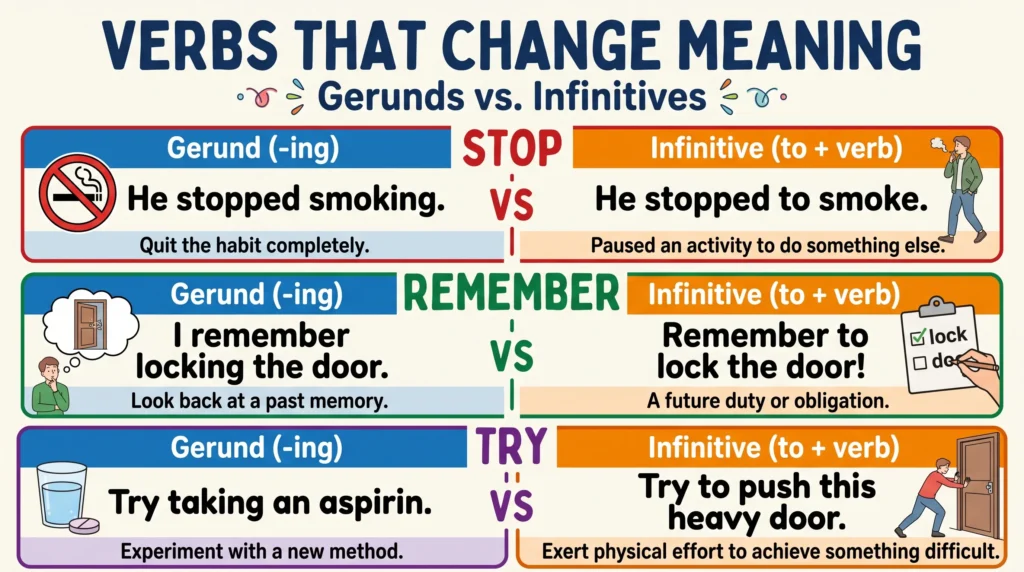
The most challenging aspect of this topic involves verbs whose meaning changes drastically depending on whether they are followed by a gerund or an infinitive.
+-----------+-----------------------------------+-----------------------------------+
| Verb      | Followed by Gerund (-ing)         | Followed by Infinitive (to + verb)|
+-----------+-----------------------------------+-----------------------------------+
| Stop      | Terminate an ongoing activity     | Pause an activity in order to do  |
|           | Example: He stopped smoking.      | something else.                   |
|           | (He quit the habit completely.)   | Example: He stopped to smoke.     |
|           |                                   | (He paused walking to light up.)  |
+-----------+-----------------------------------+-----------------------------------+
| Remember  | Look back at a past memory        | Remember a future obligation/task |
|           | Example: I remember locking the   | Example: Remember to lock the     |
|           | door. (I have a visual memory.)   | door! (Don't forget to do it.)    |
+-----------+-----------------------------------+-----------------------------------+
| Forget    | Forget a past event or experience | Forget to fulfill an obligation   |
|           | Example: I forgot meeting him.    | Example: I forgot to meet him.    |
|           | (I don't recall that past event.) | (I missed our planned appointment)|
+-----------+-----------------------------------+-----------------------------------+
| Try       | Experiment with a new method      | Make a physical effort to achieve |
|           | Example: Try taking an aspirin    | something difficult.              |
|           | for your headache. (Experiment)   | Example: Try to push this door.   |
|           |                                   | (Exert physical strength.)        |
+-----------+-----------------------------------+-----------------------------------+
| Regret    | Feel sorry about a past action    | Regret to deliver bad news (formal|
|           | Example: I regret telling him.    | announcement).                    |
|           | (I wish I hadn't said it.)        | Example: We regret to inform you. |
+-----------+-----------------------------------+-----------------------------------+
7. High-Frequency Student Errors & Pedagogical Fixes
When grading student essays or reviewing spoken practice, teachers frequently encounter recurring errors surrounding gerunds and infinitives. Below are four major trouble spots and how to correct them.
Error 1: Confusing “To” as a Preposition vs. “To” as Part of an Infinitive
Many ESL learners assume that the word “to” is always followed by a base verb. However, when “to” acts as a preposition in a fixed expression, it must be followed by a gerund.
- Incorrect: I am looking forward to meet you. ❌
- Correct: I am looking forward to meeting you. ✅
- Other Prepositional Expressions:
- Be used to working late.
- Object to paying extra fees.
- Confess to stealing the property.
Error 2: Using Infinitives After Prepositions
Because students translate directly from their native languages, they often place infinitives directly after prepositions.
- Incorrect: She is good at to teach mathematics. ❌
- Correct: She is good at teaching mathematics. ✅
Error 3: Double Infinitives and Omitted “To”
Sometimes students drop the particle “to” or duplicate it unnecessarily when connecting multiple verb phrases.
- Incorrect: We decided to go to shopping. ❌
- Correct: We decided to go shopping. ✅
Error 4: Confusing Bare Infinitives After Modal Auxiliary Verbs
Modal auxiliary verbs (can, could, may, might, must, should, will, would) are followed by a bare infinitive (base verb without “to”)—never a gerund or full infinitive.
- Incorrect: You must to finish your homework. ❌
- Incorrect: You must finishing your homework. ❌
- Correct: You must finish your homework. ✅
Misusing verbals is one of the most frequent issues covered in our overview of Common English Grammar Mistakes.
8. Interactive 10-Item Practice Quiz
Test your understanding of gerunds and infinitives! Complete each sentence by filling in the blank with the correct form of the verb in parentheses (gerund or infinitive).
- She promised __________ (call) me as soon as the plane landed.
- Have you considered __________ (apply) for the new position in marketing?
- Don’t forget __________ (turn off) the lights before leaving the office.
- He apologized for __________ (arrive) late to the meeting.
- I distinctly remember __________ (lock) the front door this morning.
- They managed __________ (fix) the broken engine after three hours of trying.
- Would you mind __________ (open) the window? It’s quite hot in here.
- We are looking forward to __________ (see) you at the annual conference.
- She stopped __________ (buy) a bottle of water on her way home from the gym.
- The teacher recommended __________ (review) the chapter before tomorrow’s exam.
9. Complete Answer Key & Pedagogical Explanations
- to call — The verb promise takes an infinitive to express future commitment.
- applying — The verb consider is always followed by a gerund when referring to possible actions.
- to turn off — Remember/Forget takes an infinitive when referring to a task or duty that needs to be performed.
- arriving — For is a preposition, so it must be followed by a gerund (arriving).
- locking — Remember takes a gerund when recalling a completed action from past memory.
- to fix — The verb manage takes an infinitive to indicate success in doing something difficult.
- opening — The phrase would you mind is always followed by a gerund in polite requests.
- seeing — In the phrasal verb look forward to, “to” functions as a preposition, requiring a gerund (seeing).
- to buy — Stopped is followed by an infinitive here because the subject paused an ongoing action (walking) in order to perform a new action (buy water).
- reviewing — The verb recommend takes a gerund object when no personal indirect object pronoun is present.
English Grammar Worksheets with AutoTick™
✔ AutoTick™ Secure Answer Checking System
✔ Step-by-step instructions
✔ Answer keys with clear explanations
✔ Password-protected marking (prevents cheating)
Summary Key Takeaways for Students
- Gerunds = Verb + -ing (acting as nouns, mandatory after prepositions).
- Infinitives = To + Base Verb (expressing future intention, desire, or purpose).
- Pay close attention to meaning-change verbs like stop, remember, forget, try, and regret.
- Watch out for fixed phrases where “to” is a preposition (e.g., look forward to + gerund).
What is the main difference between a gerund and an infinitive?
A gerund is the base form of a verb ending in -ing (e.g., swimming, studying) that functions exclusively as a noun. An infinitive consists of the base verb preceded by the word “to” (e.g., to swim, to study) and can function as a noun, adjective, or adverb depending on sentence context.
Can a preposition be followed by an infinitive?
No. In English grammar, prepositions (e.g., in, on, at, about, with, for, without, before, after) must always be followed by a gerund or a noun phrase, never an infinitive. For example, say “Thank you for helping me” instead of “Thank you for to help me.”
Why do some verbs change meaning when followed by a gerund vs. an infinitive?
Certain verbs—such as stop, remember, forget, try, and regret—change meaning based on time perspective or intent. Following these verbs with a gerund usually refers to an earlier past action or ongoing habit (e.g., “He stopped smoking” = quit the habit). Following them with an infinitive indicates purpose or a task to be performed (e.g., “He stopped to smoke” = paused an activity in order to light a cigarette).
What is a bare infinitive?
A bare infinitive is an infinitive form used without the particle “to” (e.g., go, run, stay). Bare infinitives are required after modal auxiliary verbs (e.g., can, could, must, should, will, would) and certain perception verbs like let, make, hear, and see (e.g., “She made him leave,” not “She made him to leave”).
How can I easily remember which verbs require gerunds and which require infinitives?
While practice is key, a helpful general rule of thumb is that infinitives often express future actions, desires, goals, or obligations (e.g., want to go, plan to study, agree to help), whereas gerunds often refer to real, completed, ongoing, or general activities (e.g., enjoy swimming, consider moving, avoid driving).