
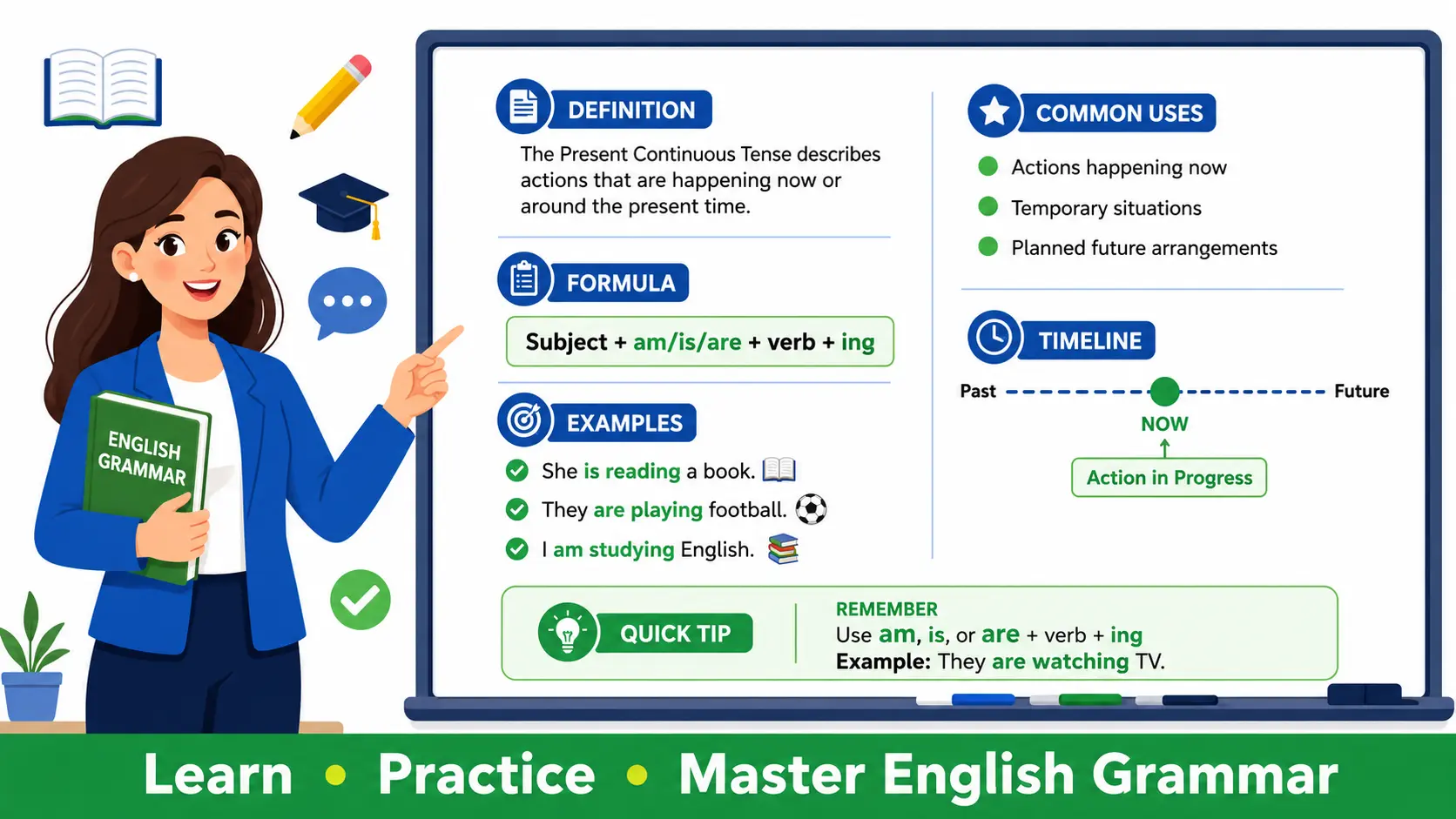
Present continuous tense rules are essential for describing actions that are happening now or taking place around the present time. Also known as the present progressive tense, this verb tense helps us express ongoing activities, temporary situations, and changes that are happening at the moment of speaking or during the current period.
The present continuous tense is formed using the appropriate form of the verb “to be” (am, is, or are) followed by the main verb ending in -ing. For example, “I am studying English,” “She is preparing dinner,” and “They are playing football” all describe actions in progress.
However, the present continuous tense is not limited to actions happening at this exact moment. We also use it to describe temporary situations, developing trends, and future arrangements that have already been planned. For instance, “He is staying with his uncle this week” describes a temporary situation, while “We are meeting our teacher tomorrow” refers to a planned future event.
In this guide, you will learn how to form positive sentences, negative sentences, and questions using the present continuous tense. You will also explore common spelling rules for adding -ing, important exceptions, practical examples, and frequent mistakes to avoid. With clear explanations and practice exercises, you can build your confidence and use the present continuous tense co
Table of Contents
🧠 What is the Present Continuous Tense?
The present continuous tense describes actions that:
- are happening right now
- are temporary
- are changing over time
📌 When to Use the Present Continuous Tense
✅ 1. Actions Happening Now
We use it for actions happening at the moment of speaking.
Examples:
- She is reading a book
- They are playing football
- I am writing an email
✅ 2. Temporary Actions
Used for actions happening for a short period.
Examples:
- She is working on a new project this week
- They are staying at a hotel for a few days
✅ 3. Changing Situations
Used for situations that are changing.
Examples:
- The weather is getting warmer
- Technology is improving rapidly
✅ 4. Future Plans or Arrangements
Used for planned future actions.
Examples:
- We are meeting the teacher tomorrow
- She is traveling to Singapore next week
✅5. Expressing Irritation or Repeated Habits (With “Always”)
When used with adverbs like always, constantly, or continually, the present continuous expresses mild annoyance or humorous emphasis about a repetitive habit.
- Examples: “He is always forgetting his keys.” / “You are constantly interrupting the teacher.”
✅6. Common Signal Words & Time Expressions (Trigger Words)
Certain key phrases instantly indicate that you should use the present continuous tense:
- Right now / At the moment: “She is writing an email at the moment.”
- Currently / These days: “He is currently living in Kuala Lumpur.”
- Look! / Listen! (Imperative signals): “Look! The solar panels are generating energy.” / “Listen! The teacher is speaking.”
✏️ Present Continuous Tense Rules and Structure
✔ Basic Structure
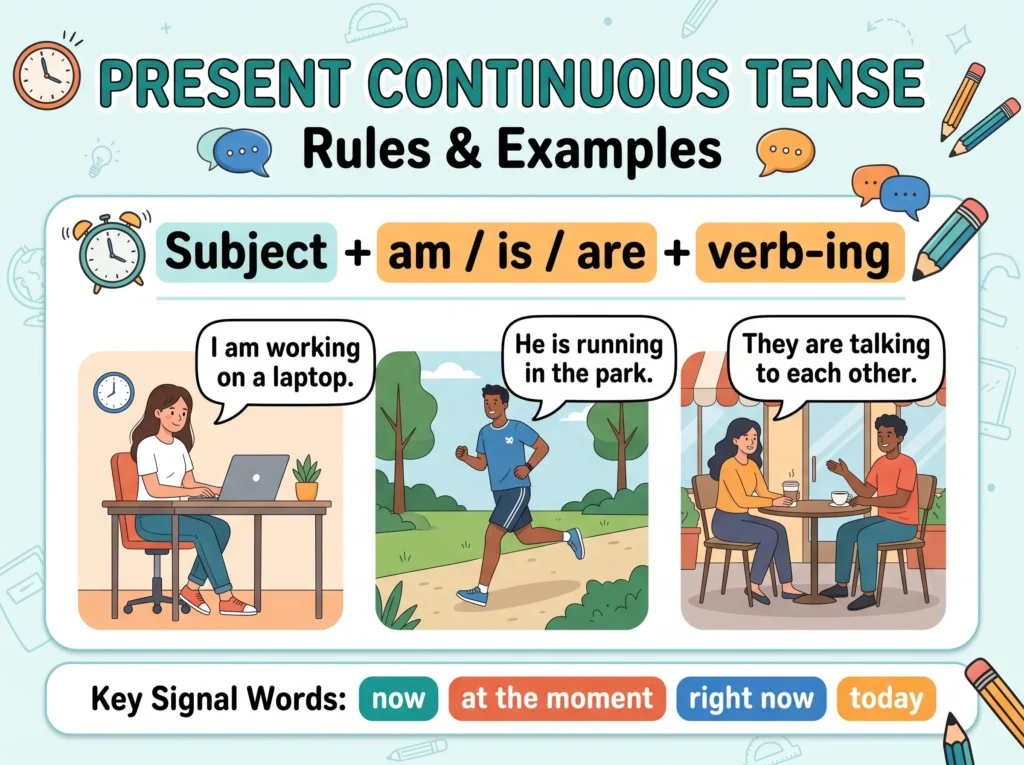
Structure:
- Subject + am / is / are + verb + ing
Examples:
- I am studying English
- She is reading a book
- They are watching television
✔ Negative Sentences
Structure:
- Subject + am/is/are + not + verb + ing
Examples:
- I am not working today
- She is not sleeping
- They are not playing outside
Common contractions:
- isn’t
- aren’t
- I’m not
✔ Questions
Structure:
- Am/Is/Are + subject + verb + ing
Examples:
- Are you studying?
- Is she reading a book?
- Are they playing football?
🔤 Spelling Rules for “-ing” Verbs
➕ Add -ing
- play → playing
- read → reading
✂️ Drop the final “e”
- make → making
- write → writing
🔁 Double the final consonant
(CVC pattern)
- run → running
- sit → sitting
1. Base Verbs Ending in “-ie” (Change -ie to -y):
When a verb ends in the letters -ie, change the -ie to -y before adding -ing.
- die -> dying, lie -> lying, tie -> tying.
2. Two-Syllable Verbs (Stress Pattern Rule):
Only double the final consonant if the stress falls on the second syllable. If the first syllable is stressed, do not double the consonant.
- Second syllable stressed (Double): be-GIN -> beginning, pre-FER -> preferring.
- First syllable stressed (No double): VIS-it -> visiting, hap-pen -> happening.
3. Verbs Ending in -w, -x, or -y:
Never double the letters w, x, or y at the end of a verb.
- play -> playing, fix -> fixing, snow -> snowing.
English Grammar Worksheets with AutoTick™
✔ AutoTick™ Secure Answer Checking System
✔ Step-by-step instructions
✔ Answer keys with clear explanations
✔ Password-protected marking (prevents cheating)
📝 More Examples of Present Continuous Tense
- She is studying for the exam
- They are building a new house
- I am learning English grammar
Stative Verbs (Verbs NEVER Used in Present Continuous)
A major area where students lose marks on exams is using continuous tenses with stative verbs. Stative verbs describe states, feelings, senses, or thoughts—not physical actions. They are almost always written in the Simple Present Tense.
| Category | Stative Verbs (Do NOT add -ing) | Incorrect Example | Correct Example |
| Emotions | like, love, hate, want, need, prefer | She is wanting coffee. | She wants coffee. |
| Mental States | know, believe, understand, remember | I am knowing the answer. | I know the answer. |
| Possession | have, belong, own, possess | He is owning a car. | He owns a car. |
| Senses | seem, sound, taste, smell, look | This soup is tasting good. | This soup tastes good. |
The Dynamic Exception: Some verbs can be both stative and dynamic, but their meaning changes completely:
- Stative: “I have a laptop.” (Possession — no -ing).
- Dynamic: “I am having lunch.” (Action of eating — uses -ing).
- Stative: “I think you are right.” (Opinion — no -ing).
- Dynamic: “I am thinking about the problem.” (Mental process — uses -ing).
To understand the subtle differences between ongoing actions and completed results across verb tenses, explore the British Council Present continuous Reference.
Simple Present vs. Present Continuous Comparison
| Feature | Simple Present Tense | Present Continuous Tense |
| Primary Focus | Habits, facts, daily routines | Actions happening right now / temporary |
| Timeframe | Permanent or repeated actions | Temporary or ongoing actions |
| Formula | Subject + Base Verb (+s/es) | Subject + am/is/are + Verb-ing |
| Signal Words | always, usually, every day, often | now, at the moment, currently, today |
| Example | “I live in Malaysia.” (Permanent) | “I am living in a hotel.” (Temporary) |
8 High-Frequency Present Continuous Mistakes & How to Fix Them
- Mistake 1: Forgetting the Present Participle Suffix (“-ing”)
- ❌ Incorrect: She is play football.
- ✔️ Correct: She is playing football.
- Pedagogical Reason: The auxiliary verb is must always be paired with the present participle (-ing) form of the main verb.
- Mistake 2: Subject-Verb Disagreement with Auxiliary “To Be”
- ❌ Incorrect: They is watching TV.
- ✔️ Correct: They are watching TV.
- Pedagogical Reason: Plural subjects (they, we, you) strictly require the plural auxiliary verb are.
- Mistake 3: Omitting the Auxiliary Verb (“To Be”)
- ❌ Incorrect: She reading a book right now.
- ✔️ Correct: She is reading a book right now.
- Pedagogical Reason: The -ing participle cannot function as a predicate without its auxiliary helper (am, is, or are).
- Mistake 4: Using Present Continuous for Permanent Universal Facts
- ❌ Incorrect: The sun is rising in the east every morning.
- ✔️ Correct: The sun rises in the east every morning.
- Pedagogical Reason: Permanent scientific truths and universal facts require the Simple Present Tense, not the Present Continuous.
- Mistake 5: Adding Auxiliary “Do/Does” into Negative Continuous Structures
- ❌ Incorrect: I am not do studying.
- ✔️ Correct: I am not studying.
- Pedagogical Reason: Do not insert auxiliary do/does into continuous forms; the be verb (am/is/are) handles negation directly.
- Mistake 6: Using Continuous Forms with Stative Verbs
- ❌ Incorrect: I am understanding the grammar lesson now.
- ✔️ Correct: I understand the grammar lesson now.
- Pedagogical Rule: Verbs representing mental processes (understand, know, believe) are stative and cannot take continuous -ing forms.
- Mistake 7: Misapplying Spelling Rules on Double Consonants
- ❌ Incorrect: They are visit-ting their relatives in Sri Damansara.
- ✔️ Correct: They are visiting their relatives in Sri Damansara.
- Pedagogical Reason: For two-syllable verbs stressed on the first syllable (VIS-it), do not double the final consonant.
- Mistake 8: Misplacing Frequency Adverbs Like “Always”
- ❌ Incorrect: He always is losing his keys.
- ✔️ Correct: He is always losing his keys.
- Pedagogical Rule: Frequency adverbs expressing repetitive habits sit directly between the auxiliary verb (is) and the present participle (losing).
Practice Exercise: Test Your Knowledge
Choose the correct verb form or complete the sentence for each item:
- Right now, the technician __________ (repair) the solar inverter.
- Listen! The principal __________ (speak) to the students.
- I cannot answer the phone because I __________ (have) a shower.
- She __________ (not like) spicy food. (like / is liking)
- They __________ (meet) their project advisor at 3:00 p.m. tomorrow.
- Look outside! It __________ (snow) heavily on the mountains.
- Why __________ you __________ (stand) near the open window?
- He __________ (always / leave) his dirty dishes on the table!
- The solar panels __________ (generate) high output during sunny afternoons. (generates / are generating)
- At present, our team __________ (develop) an automated grading application.
Answer Key & Detailed Pedagogical Explanations:
is developing — Temporary current project in progress (Signal phrase: At present).
is repairing — Action happening right now (Signal phrase: Right now).
is speaking — Action happening at the moment of speech (Imperative signal: Listen!).
am having — Dynamic action in progress (having a shower refers to the active process of bathing).
does not like — Like is a stative verb expressing emotion and cannot take -ing.
are meeting — Present continuous used for a confirmed, planned future arrangement.
is snowing — Action happening live at the moment of observation (Imperative signal: Look!).
are / standing — Interrogative form split by the subject (you).
is always leaving — Uses is always + V-ing to express mild annoyance about a repetitive habit.
are generating — Plural subject (solar panels) paired with continuous output in progress.
🚀 Practise Present Continuous Tense (Improve Faster)
Understanding is important — but practice is what makes you fluent.
👉 🚀 Get Full English Grammar Worksheets (Levels 1–6)
✔ Covers all tenses
✔ Step-by-step learning
✔ Instant AutoTick answers
🎁 Not Ready Yet? Try the Free Sample
👉 🎁 Download Free Sample Worksheet (Auto-Marked)
✔ Instant feedback
✔ Saves marking time
✔ Perfect for beginners
🔗 Related Grammar Lessons
- 👉
/english-tenses/ - 👉
/simple-present-tense/ - 👉
/simple-past-tense/ - 👉
/present-perfect-tense/ - 👉
/verbs/
🌍 Trusted Grammar Resources
For additional explanations, you can explore:
Trusted English Grammar Resources
For additional explanations and reference, you can also visit Cambridge English Grammar Guide and BBC Learning English .
📈 Why Learn Present Continuous Tense?
The present continuous tense helps you:
- Describe actions happening now
- Talk about temporary situations
- Express future plans clearly
- Improve your communication skills
❓ Frequently Asked Questions
What are present continuous tense rules?
Present continuous tense rules explain how to form sentences using am/is/are + verb + -ing to describe actions happening now or around the present time.
When do we use present continuous tense?
We use the present continuous tense for actions happening now, temporary situations, changing trends, and future arrangements.
What is the structure of present continuous tense?
The structure is:
Subject + am/is/are + verb (-ing)
Example: She is reading a book.
Can present continuous be used for future?
Yes, the present continuous tense can be used for planned future events.
Example: I am meeting my teacher tomorrow.
What is the Present Continuous Tense in simple words?
The Present Continuous Tense (also known as the Present Progressive Tense) describes actions happening right now at the exact moment of speaking, temporary situations, ongoing changes, or planned future events. It connects the action directly to an active time frame using the formula am/is/are + verb-ing.
What are the key spelling rules when adding “-ing” to verbs?
Key Spelling Rules for Adding “-ing”
Standard Verbs: Simply add -ing to the base form (read → reading, walk → walking).
Verbs Ending in Silent “-e”: Drop the final -e before adding -ing (make → making, write → writing).
CVC Pattern (Consonant-Vowel-Consonant): Double the final consonant for short, single-syllable verbs ending in a single consonant (run → running, sit → sitting).
Verbs Ending in “-ie”: Change the -ie to -y before adding -ing (die → dying, tie → tying).
Verbs Ending in “-w”, “-x”, or “-y”: Never double these final letters, regardless of the preceding vowel (play → playing, fix → fixing, snow → snowing).
What is the difference between “I live in Malaysia” and “I am living in Malaysia”?
“I live in Malaysia” (Simple Present) implies a permanent, long-term living arrangement or general life status.
“I am living in Malaysia” (Present Continuous) indicates a temporary situation, suggesting you are residing there for a limited period (e.g., for a short-term contract or study program).