
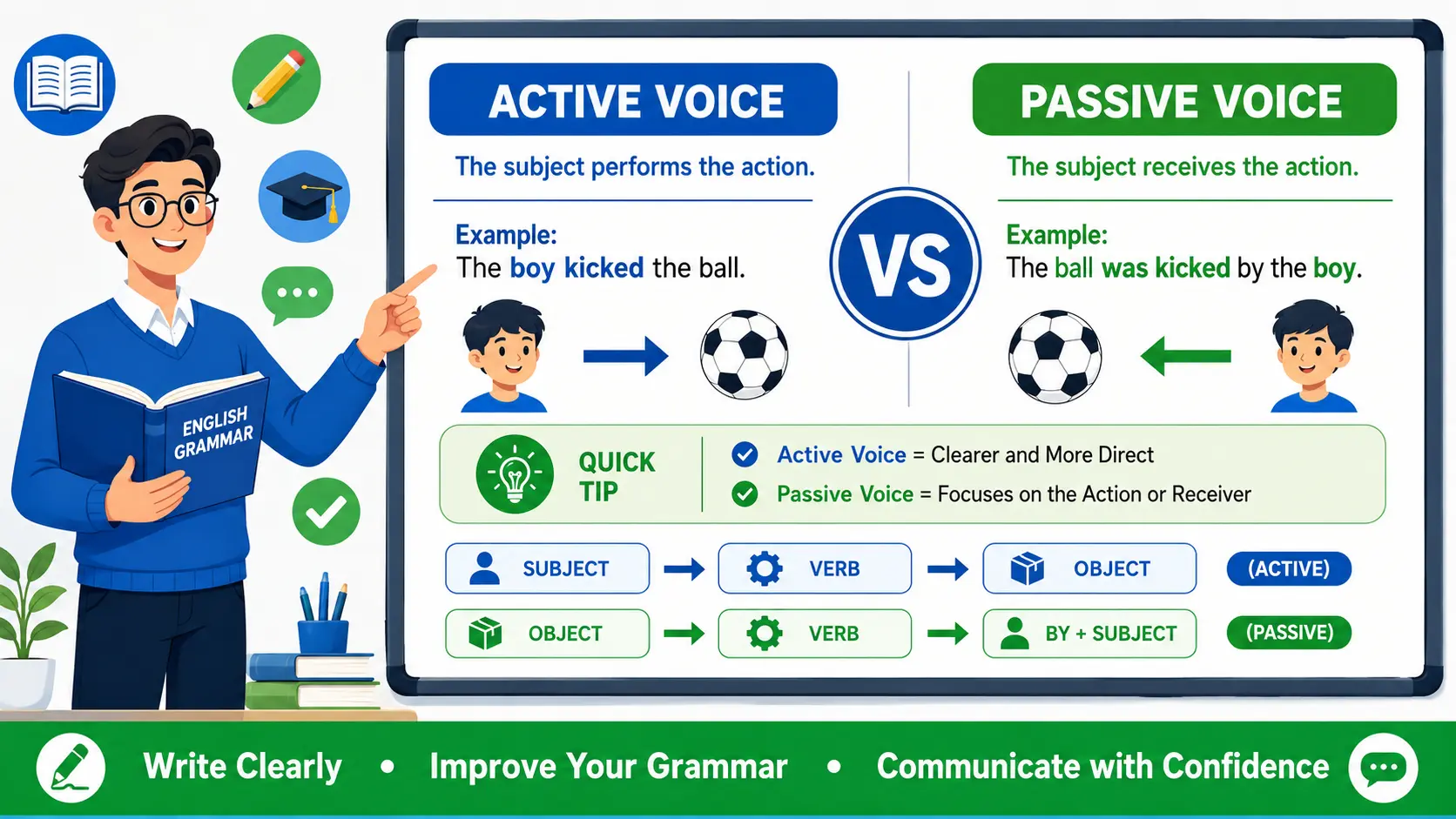
Active voice vs. passive voice is one of those grammar topics that sounds incredibly intimidating—like something straight out of a dusty textbook. But in reality, it’s just about energy and focus. Understanding the difference isn’t just about passing a grammar test; it is the ultimate secret weapon for making your writing clearer, more punchy, and way more interesting to read.
Think of it like a movie director choosing where to point the camera. In any sentence, you have someone doing something, and you have the thing getting affected. Active voice puts the camera right on the hero taking action. Passive voice panics, turns the camera around, and focuses on the object instead. If you’ve ever felt like your English sentences are a bit too long, sluggish, or robotic, there is a massive chance you are leaning on the passive voice without even realizing it.
In simple terms, it all comes down to direction:
Active voice: The subject performs the action.
Passive voice: The subject receives the action.
The Classic Example:
Active: The cat ate the food. (Energetic, direct, clear.)
Passive: The food was eaten by the cat. (A bit slow and upside-down.)
🎁 Start with a Free Grammar Sample
Want to practice active and passive voice?
👉 🎁 Download Free Grammar Worksheets Sample
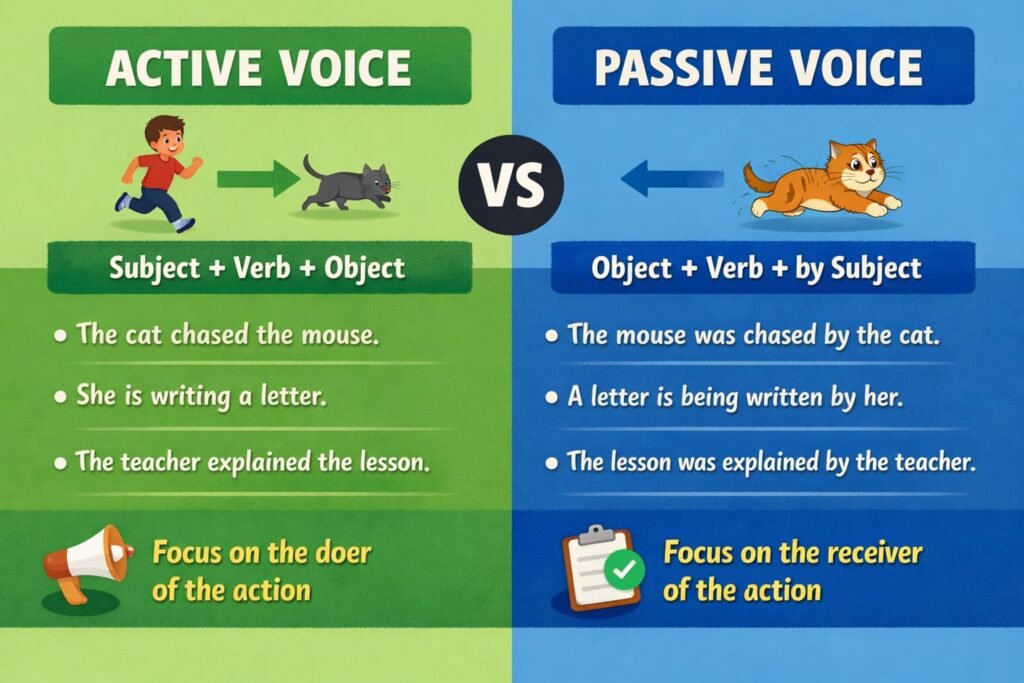
Table of Contents
Active vs Passive Voice Examples
What Is Active Voice?
In active voice, the subject does the action.
Structure:
Subject + Verb + Object
Examples:
- She writes a letter
- The teacher explains the lesson
- They built a house
👉 Active voice is clear, direct, and easier to understand.
What Is Passive Voice?
In passive voice, the subject receives the action.
Structure:
Object + “be” + past participle (+ by + subject)
Examples:
- A letter is written by her
- The lesson is explained by the teacher
- A house was built by them
Passive voice is used when:
- The doer is unknown
- The action is more important
The Mechanics of Passive Structure:
To form a passive sentence accurately, you must combine a form of the auxiliary verb to be (is, am, are, was, were, being, been) with the past participle (3rd form) of the main verb. If you wish to mention who performed the action, append the agent phrase using the preposition by (by John, by the committee).
Agentless Passive Sentences (Omitting the Agent):
In many passive sentences, the agent (the doer of the action) is completely omitted. This happens when the doer is unknown, irrelevant, obvious, or intentionally hidden to avoid assigning blame.
- Unknown Doer: “My wallet was stolen at the station.” (We don’t know who stole it).
- Obvious Doer: “The suspect was arrested last night.” (Obviously by the police).
- Avoiding Blame: “An error was made in the financial calculations.” (Hides who made the mistake).
Here is the honest truth: passive voice gets a bad reputation. Teachers often tell you to never use it, but that’s not entirely fair. Passive voice isn’t “wrong”—it’s just a tool for specific moments. We naturally use it when we genuinely don’t know who did the action (e.g., “My keys were stolen”), or when the action itself is way more important than the person doing it. The trick isn’t to banish the passive voice completely; it’s learning how to use it intentionally instead of accidentally.
Tense Conversion Master Guide: Active to Passive
Changing active sentences into passive sentences requires altering the auxiliary verb to be while keeping the original tense intact.
| Grammatical Tense | Active Voice Structure | Passive Voice Structure | Active Example → Passive Example |
| Simple Present | Subject + Base Verb + Object | Object + is/am/are + Past Participle | “She writes the report.” $\rightarrow$ “The report is written by her.” |
| Simple Past | Subject + Past Verb + Object | Object + was/were + Past Participle | “They built a house.” $\rightarrow$ “A house was built by them.” |
| Simple Future | Subject + will + Verb + Object | Object + will be + Past Participle | “He will launch the site.” $\rightarrow$ “The site will be launched by him.” |
| Present Continuous | Subject + is/am/are + Verb-ing | Object + is/am/are + being + Past Participle | “She is preparing dinner.” $\rightarrow$ “Dinner is being prepared by her.” |
| Past Continuous | Subject + was/were + Verb-ing | Object + was/were + being + Past Participle | “They were fixing the car.” $\rightarrow$ “The car was being fixed by them.” |
| Present Perfect | Subject + have/has + Past Participle | Object + have/has + been + Past Participle | “We have completed the test.” $\rightarrow$ “The test has been completed by us.” |
| Modal Verbs | Subject + Modal + Base Verb | Object + Modal + be + Past Participle | “You must finish this work.” $\rightarrow$ “This work must be finished by you.” |
🔥 Key Differences (Easy Comparison)
| Active Voice | Passive Voice |
|---|---|
| Subject does the action | Subject receives the action |
| Clear and direct | Longer and less direct |
| More common | Used in formal situations |
Transitive vs. Intransitive Verbs (When Passive is IMPOSSIBLE)
Not every sentence can be turned into a passive structure. A sentence can only be converted into passive voice if its verb is transitive—meaning it takes a direct object to complete its meaning.
- Transitive Verbs (Can be passive): Verbs like build, write, eat, buy, and clean require an object.
- Active: “The chef cooked a delicious meal.”
- Passive: “A delicious meal was cooked by the chef.”
- Intransitive Verbs (CANNOT be passive): Verbs like arrive, die, sleep, exist, fall, occur, and go do not take a direct object.
- ❌ Incorrect: “The accident was happened yesterday.”
- ✔️ Correct: “The accident happened yesterday.” (Always active).
A sentence can only be converted into passive voice if its verb is transitive. For comprehensive guidelines on distinguishing transitive from intransitive verbs, consult the Purdue OWL Passive Voice Guide
When to Use Active Voice
Use active voice when you want:
- Clear and strong sentences
- Easy understanding
- Direct communication
👉 Example:
✔ The company launched a new product
When to Use Passive Voice
Use passive voice when:
- You don’t know the doer
- The action is more important
- You want a formal tone
👉 Example:
✔ The product was launched last year
Scientific and Technical Reporting:
In scientific research, lab reports, and technical documentation, objectivity is paramount. Researchers use passive voice to keep the focus strictly on the procedures, data, and outcomes rather than individual scientists.
- Example: “The liquid was heated to 100°C and observed for five minutes.” (Focuses on the experiment, not the scientist holding the beaker).
Corporate, Legal, and Public Relations Contexts:
In professional correspondence, passive voice is frequently employed to deliver bad news, discuss regulatory guidelines, or highlight collective achievements without singling out individuals.
- Example: “Your application has been received, and selected candidates will be contacted next week.”
🚀 Practice with Worksheets
Reading is not enough — practice helps you improve faster.
Our worksheets include:
- Active & passive voice exercises
- Step-by-step difficulty (Level 1–6)
- Autotick Cheat-Proof Answers
👉 🚀 Get Instant Access to All Worksheets (Levels 1–6)
Common Mistakes in Active Voice vs Passive Voice
Many learners confuse active voice vs passive voice by placing the object in the wrong position. Always remember that in active voice, the subject performs the action, while in passive voice, the subject receives the action.
Common Mistakes to Avoid
- ❌ Using passive voice too often
- ❌ Forgetting “by” in passive sentences
- ❌ Wrong past participle
Mistake 1: Using Irregular Past Forms Instead of Past Participles
- ❌ Incorrect: “The email was wrote by the manager.”
- ✔️ Correct: “The email was written by the manager.”
- Pedagogical Reason: Passive voice strictly requires the 3rd verb form (Past Participle: write $\rightarrow$ wrote $\rightarrow$ written).
Mistake 2: Overusing Passive Voice in Narrative or Descriptive Writing
- ❌ Slow/Sluggish: “The door was opened by Mary, and then a noise was heard by her.”
- ✔️ Punchy/Active: “Mary opened the door and heard a noise.”
- Pedagogical Reason: Relying too heavily on passive voice dilutes story progression and inflates sentence wordiness without adding value.
Mistake 3: Subject-Verb Misagreement in Complex Passive Structures
- ❌ Incorrect: “The list of approved candidates were published today.”
- ✔️ Correct: “The list of approved candidates was published today.”
- Pedagogical Reason: In passive voice, the auxiliary verb was/were must agree with the new subject (list, singular), not the plural noun inside the prepositional phrase (candidates).
👉 Fix more mistakes here:
/common-mistakes/
Practice Exercise
Choose the correct sentence:
- The cake was eaten by John.
- John ate the cake.
👉 Which one is active voice?
💡 Related Lessons
🎁 Try a Free Sample
Not ready yet?
👉 🎁 Get Free Grammar Worksheets Sample
Interactive Practice Exercise
Convert the sentences or identify the grammatical voice for each of the following items:
- (Active to Passive) “The engineering team updated the site servers.” → Change to Passive.
- (Passive to Active) “A new record was set by the Olympic athlete.” → Change to Active.
- (Identify Voice) “The solar panels produce electricity every day.” → Identify Voice.
- (Identify Voice) “The missing keys were found under the desk.” → Identify Voice.
- (Active to Passive) “The quantity surveyor reviewed the Extension of Time application.” → Change to Passive.
- (Passive to Active) “The grammar worksheet was published by the teacher.” → Change to Active.
- (Identify Voice) “Heavy rain delayed the construction project for two weeks.” → Identify Voice.
- (Identify Voice) “A new website theme is being tested by the webmaster.” → Identify Voice.
- (Active to Passive) “The system automatically sends a confirmation email.” → Change to Passive.
- (Passive to Active) “The mistake was quickly corrected by the editor.” → Change to Active.
Answer Key & Detailed Explanations
- “The site servers were updated by the engineering team.” — Passive Voice. The direct object (site servers) becomes the new subject, followed by was/were + past participle (updated).
- “The Olympic athlete set a new record.” — Active Voice. The prepositional agent (by the Olympic athlete) becomes the active subject performing the main action.
- Active Voice — The subject (solar panels) actively performs the main action (produce) on the direct object (electricity).
- Passive Voice — Agentless passive. The subject (missing keys) receives the action of being found (were found), while the actor is omitted.
- “The Extension of Time application was reviewed by the quantity surveyor.” — Passive Voice. The complex noun phrase becomes the subject, paired with singular past tense auxiliary was reviewed.
- “The teacher published the grammar worksheet.” — Active Voice. The agent (teacher) moves to the subject position to drive the simple past verb (published).
- Active Voice — The subject (Heavy rain) directly performs the action (delayed) upon the object (construction project).
- Passive Voice — Present Continuous Passive. Formed using is/are being + past participle (is being tested) to show an ongoing action received by the subject.
- “A confirmation email is automatically sent by the system.” — Passive Voice. The present simple active verb (sends) converts to is sent, keeping the adverb (automatically) positioned before the main verb.
- “The editor quickly corrected the mistake.” — Active Voice. Restores direct, energetic flow by placing the actor (the editor) back at the start of the sentence.
Frequently Asked Questions
Is passive voice grammatically “wrong”? My teacher always crosses it out!
Absolutely not! Passive voice is $100\%$ grammatically correct. The reason teachers and Microsoft Word or Google Docs editors constantly flag it is because it can make your writing feel sleepy and slow.
If you write, “The ball was kicked by the boy, and then the window was broken by the ball,” it sounds exhausting. But if you write, “The boy kicked the ball and broke the window,” it has instant energy. Use passive voice when you need it, but use active voice when you want to keep your reader awake!
How can I easily tell if a sentence is passive just by looking at it?
Look for the “By Zombies” trick! It’s a hilarious but flawless shortcut. If you can add the words “by zombies” to the end of your sentence after the verb, and it still makes perfect grammatical sense, you are looking at a passive sentence.
“The homework was eaten…” (by zombies) $\rightarrow$ Passive!
“The house was built…” (by zombies) $\rightarrow$ Passive!
“John ate the pizza…” (by zombies? No, that sounds crazy because John is already doing the eating) $\rightarrow$ Active!
What is the trick to changing a passive sentence into an active one?
It’s a three-step flip.
Find the person or thing hiding at the end of the sentence (usually after the word “by”).
Drag them right to the very front to make them the star of the show.
Change the verb from the long form (was eaten) to the simple action form (ate).
For example, take: “The grammar lesson was explained by the teacher.” Find the doer (the teacher), put them first, and snap the verb into action: “The teacher explained the grammar lesson.” Boom—instant active voice.
Why does scientific and business writing love the passive voice so much?
In science and corporate updates, the creators want to sound completely unbiased, objective, and formal. They want to hide the “human factor” to show that the facts speak for themselves.
Instead of writing, “I mixed the chemicals and I accidentally caused an explosion,” a scientist will write, “The chemicals were mixed, and an explosion was caused.” It removes personal blame and keeps the focus entirely on the experiment itself.