Table of Contents
Introduction
Countable vs uncountable nouns are an important part of English grammar that help you use words correctly in sentences.
In English grammar, nouns are divided into countable nouns and uncountable nouns. Understanding the difference helps you use articles, quantities, and verbs correctly.
This guide explains countable vs uncountable nouns with clear rules, examples, and common mistakes.
What Are Countable Nouns?
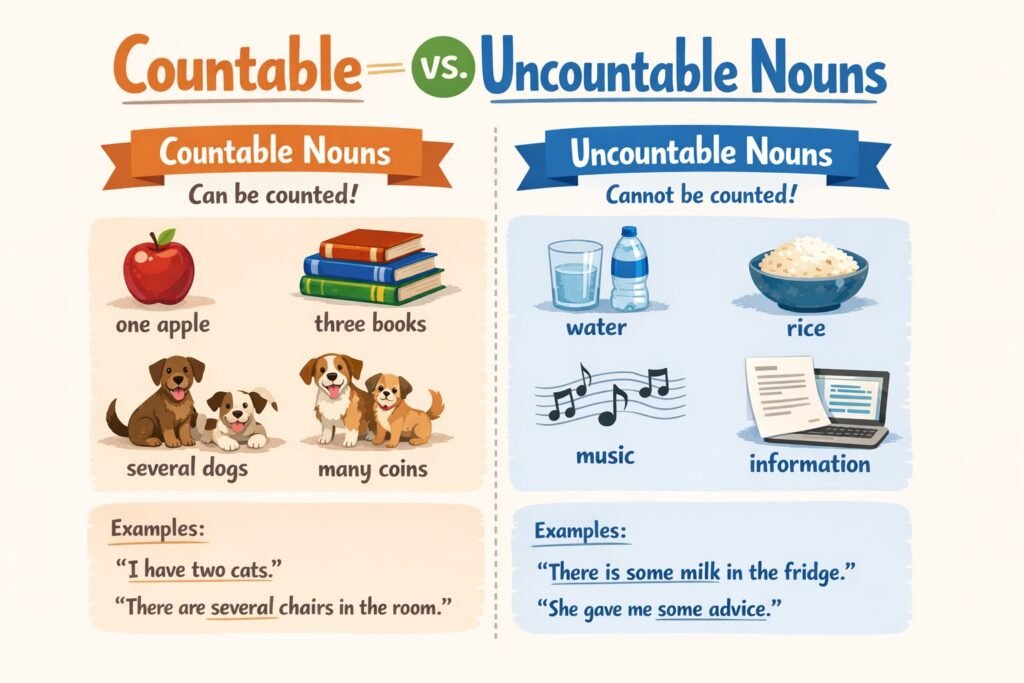
Countable nouns are nouns that you can count. They have singular and plural forms.
Examples:
- one book → two books
- one apple → three apples
- one car → many cars
Countable nouns can be used with:
- Numbers (one, two, three)
- Articles (a, an)
Example Sentences:
- I have a book.
- She bought three apples.
What Are Uncountable Nouns?
Uncountable nouns are nouns that cannot be counted individually. They usually do not have a plural form.
Examples:
- water
- sugar
- information
- furniture
❌ Incorrect:
- two waters
- three informations
✅ Correct:
- a glass of water
- a piece of information
Uncountable Noun Categories
To help identify uncountable nouns easily, group them into these common conceptual categories:
- Abstract Concepts: information, advice, knowledge, luck, truth, honesty, progress.
- Liquids and Gases: water, milk, juice, air, steam, oxygen, coffee.
- Mass Materials & Grains: rice, sand, sugar, salt, flour, gold, wood.
- Collective Groups: furniture, luggage, baggage, equipment, money, machinery.
- Natural Phenomena: weather, rain, lightning, thunder, snow.
Subject-Verb Agreement with Uncountable Nouns
Because uncountable nouns do not have a plural form, they always take a singular verb in present and past tenses.
- Correct: “The furniture is brand new.” (Not “are”).
- Correct: “Your advice was very helpful.” (Not “were”).
How to Count Uncountable Nouns (Partitives and Counters)
Although you cannot add numbers directly to uncountable nouns (one water ❌), you can make them countable by placing a counter phrase or unit of measurement in front of them.
Number + Measurement/Container + of + Uncountable Noun
| Uncountable Noun | Measurement / Container Phrase | Example Sentence |
| Water / Milk | a glass of / a bottle of / a carton of | “Please bring two bottles of water.” |
| Bread | a loaf of / a slice of | “She bought a loaf of fresh bread.” |
| Information / Advice | a piece of / an item of | “Let me give you a piece of advice.” |
| Paper | a sheet of / a piece of | “Hand me three sheets of paper.” |
| Furniture / Equipment | a piece of / a set of | “They ordered a new set of equipment.” |
| Rice / Sugar | a bowl of / a bag of / a kilogram of | “We need a bag of rice from the shop.” |
Key Differences Between Countable vs Uncountable Nouns
| Countable Nouns | Uncountable Nouns |
|---|---|
| Can be counted | Cannot be counted |
| Singular & plural forms | Usually no plural |
| Use a/an | Do not use a/an |
| Example: books, apples | Example: water, rice |
Using Quantifiers
With Countable Nouns
Use:
- many
- few
- a few
Examples:
- There are many books on the table.
- She has a few friends in school.
With Uncountable Nouns
Use:
- much
- little
- a little
Examples:
- There is much water in the bottle.
- He has a little money left.
With Both Types
Some quantifiers can be used with both:
- some
- a lot of
- plenty of
Examples:
- I have some books.
- I have some water.
The Subtle Difference: Positive vs. Negative Meaning
A common advanced exam trap is understanding the difference between adding or leaving out the article “a” before few or little.
- A few (Countable) / A little (Uncountable) = Positive Meaning (Some / Enough):
- “I have a few friends in the city.” (Meaning: I have some friends, which is good.)
- “We have a little time left.” (Meaning: We have enough time to finish.)
- Few (Countable) / Little (Uncountable) = Negative Meaning (Hardly Any / Not Enough):
- “He has few friends in the city.” (Meaning: He is lonely; hardly any friends.)
- “We have little time left.” (Meaning: We are almost out of time; hurry up!)
Common Examples
Countable Nouns
- books
- students
- chairs
- dogs
Uncountable Nouns
- milk
- rice
- advice
- information
Nouns That Can Be BOTH Countable and Uncountable
Some English nouns change their classification—and their meaning—depending on whether they refer to a general substance/concept (uncountable) or a specific item/type (countable).
- Hair:
- Uncountable (Whole head of hair): “She has long brown hair.”
- Countable (Individual strands): “I found two hairs in my soup!”
- Coffee / Tea:
- Uncountable (The liquid in general): “I love drinking coffee.”
- Countable (Informal for ‘cups of coffee’): “Can we get two coffees, please?”
- Paper:
- Uncountable (The raw material): “This box is made of paper.”
- Countable (A document, essay, or newspaper): “I read an interesting paper today.”
- Light:
- Uncountable (The energy): “Plants need light to grow.”
- Countable (A specific lamp/bulb): “Turn off the lights before leaving.”
- Time:
- Uncountable (The general concept or duration): “How much time do we have?”
- Countable (Specific occasions or instances): “I have visited London three times.”
Common Mistakes in Countable and Uncountable Nouns
- Mistake 1: Using “Many” with Mass / Uncountable Liquids
- ❌ Incorrect: I have many water.
- ✔️ Correct: I have much water. (or “a lot of water”)
- Pedagogical Reason: Quantifiers like many are strictly reserved for countable nouns (many bottles, many glasses). Uncountable liquid mass nouns take much, some, or a lot of.
- Mistake 2: Using the Indefinite Article “An” Before Uncountable Nouns
- ❌ Incorrect: She gave me an advice.
- ✔️ Correct: She gave me some advice. (or “a piece of advice”)
- Pedagogical Reason: Uncountable nouns cannot be paired directly with indefinite articles (a/an). Use partitive expressions like a piece of or general quantifiers like some.
- Mistake 3: Pluralizing Uncountable Nouns Ending in “-s”
- ❌ Incorrect: The news are very good today.
- ✔️ Correct: The news is very good today.
- Pedagogical Reason: Words like news, physics, mathematics, and measles end in the letter -s, but they are uncountable singular nouns requiring a singular verb.
- Mistake 4: Using “Many” and Pluralizing Academic/Workplace Nouns
- ❌ Incorrect: They have many homeworks and works to do.
- ✔️ Correct: They have a lot of homework and work to do.
- Pedagogical Reason: Both homework and work are strictly uncountable in English and never take an -s. Use a lot of, much, or switch to countable synonyms like assignments or tasks.
- Mistake 5: Pluralizing Abstract Nouns and General Knowledge
- ❌ Incorrect: He shared many useful informations with us.
- ✔️ Correct: He shared a lot of useful information with us.
- Pedagogical Reason: Information, knowledge, and research are abstract uncountable nouns. They cannot be pluralized with an -s. To count them, use phrases like pieces of information.
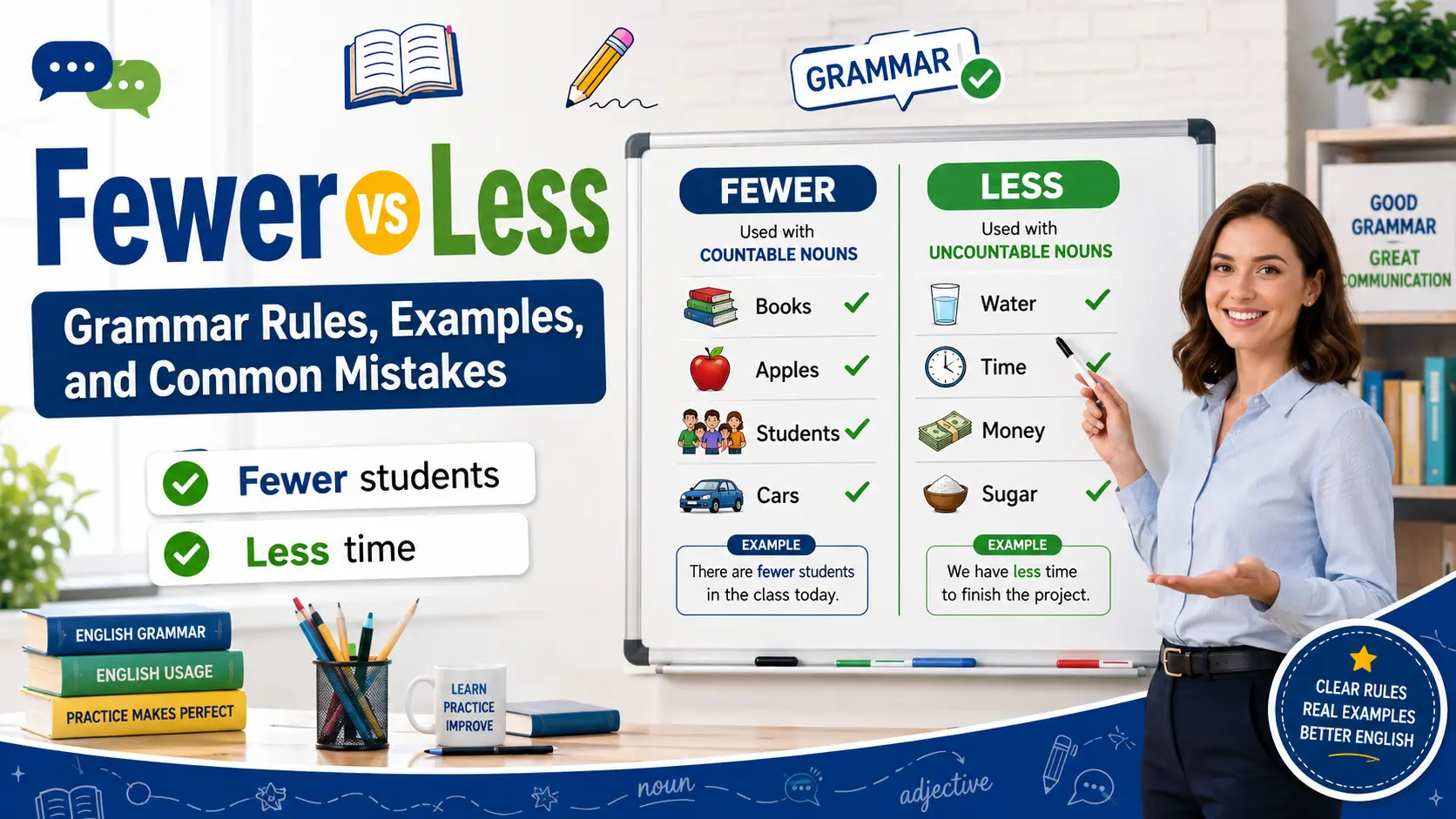
- Mistake 6: Using “Fewer” Instead of “Less” for Mass Nouns
- ❌ Incorrect: We need to consume fewer sugar and salt.
- ✔️ Correct: We need to consume less sugar and salt.
- Pedagogical Rule: Use fewer for items you can physically count (fewer calories, fewer spoons of sugar). Use less for uncountable mass amounts (less sugar, less water).
- Mistake 7: Adding “-s” to Uncountable Household and Grouping Terms
- ❌ Incorrect: They bought new furnitures and luggages for the trip.
- ✔️ Correct: They bought new furniture and luggage for the trip.
- Pedagogical Reason: Grouping categories like furniture, luggage, baggage, and equipment are collective mass concepts in English and cannot take plural endings.
- Mistake 8: Misusing “Number of” for Mass Quantities
- ❌ Incorrect: A large number of progress was made on the site.
- ✔️ Correct: A large amount of progress was made on the site.
- Pedagogical Rule: Use “a number of” before plural countable nouns (“a number of students”). Use “an amount of” or “a quantity of” before uncountable nouns (“an amount of progress”).
Tips to Identify Countable and Uncountable Nouns
Here are some simple tips to help you quickly identify countable and uncountable nouns:
- Countable nouns can be counted (one apple, two books) and have plural forms.
- Uncountable nouns cannot be counted individually and do not have plural forms (water, rice, information).
- Use “many” and “a few” with countable nouns.
- Use “much” and “a little” with uncountable nouns.
Tips to Remember
✔ Use a/an only with countable nouns
✔ Use many/few with countable nouns
✔ Use much/little with uncountable nouns
Interactive Practice Exercise
Choose the correct word or phrase to complete each sentence:
- Could you buy two __________ of milk from the supermarket? (bottles / milk)
- The team has made __________ progress on the project this week. (a lot of / many)
- She has __________ knowledge about renewable energy systems. (much / many)
- There were very __________ people at the morning seminar. (few / little)
- I need to find __________ place to store my extra furniture. (a / some)
- The professor gave us several valuable __________ during the lecture. (feedbacks / pieces of feedback)
- We bought __________ new equipment for the laboratory yesterday. (some / an)
- He consumes __________ sugar in his daily diet than he used to. (fewer / less)
- The hotel provided detailed __________ about local sightseeing tours. (information / informations)
- A large __________ of traffic was delayed due to the heavy rain. (amount / number)
Answer Key & Detailed Explanations
- bottles — Liquid milk is an uncountable mass noun, so it requires a countable container noun (bottles) to specify amount.
- a lot of — Progress is an abstract uncountable noun, making many incorrect (a lot of works for both countable and uncountable nouns).
- much — Knowledge is an uncountable abstract noun, so use much or a lot of rather than many.
- few — People is a plural countable noun, requiring few (or a few) rather than little.
- a — Place is a singular countable noun, so it takes the indefinite article a.
- pieces of feedback — Feedback is an uncountable mass noun that cannot take an -s; quantify it using a partitive phrase like pieces of.
- some — Equipment is an uncountable noun and cannot be paired with the indefinite article an; use some or a piece of.
- less — Sugar is an uncountable mass noun, requiring less rather than fewer (which is reserved for countable items like calories).
- information — Information is strictly uncountable in English and never takes a plural -s ending.
- amount — Traffic is an uncountable mass noun, so it pairs with “an amount of” rather than “a number of”.
🚀 Upgrade Your English Faster (Premium Worksheets)
If you want more structured practice:
👉 Get the full Grammar Worksheet Pack here
Perfect for:
- Students
- ESL learners
- Self-study
🔗 Related Grammar Lessons
Continue learning:
🌐 External Resources
For deeper understanding:
- 👉 https://dictionary.cambridge.org/grammar/british-grammar/nouns-countable-and-uncountable
- 👉 https://www.bbc.co.uk/learningenglish/course/intermediate/unit-3/session-1
Common Mistakes with Countable and Uncountable Nouns
Many learners confuse countable and uncountable nouns when using quantifiers. For example, saying “many information” is incorrect because information is an uncountable noun. Instead, you should say “much information” or “a piece of information.”
Another common mistake is using plural forms for uncountable nouns, such as “advices” or “furnitures.” These words do not have plural forms and should always be used as uncountable nouns.
Conclusion
Understanding countable vs uncountable nouns is essential for correct grammar.
- Countable nouns → can be counted and have plural forms
- Uncountable nouns → cannot be counted
With practice, you will use them naturally in everyday English
.❓ Frequently Asked Questions (FAQ)
What is the difference between countable and uncountable nouns?
Countable nouns can be counted and have plural forms (e.g., books, apples).
Uncountable nouns cannot be counted and usually do not have plural forms (e.g., water, information).
Can uncountable nouns be counted?
Not directly. You need measurement phrases such as:
a piece of advice
a glass of water
Can I use “a” with uncountable nouns?
No. You cannot say a water or an information.
Instead, use:
some water
a piece of information
What quantifiers are used with countable nouns?
Use:
many
few
a few
What quantifiers are used with uncountable nouns?
Use:
much
little
a little