
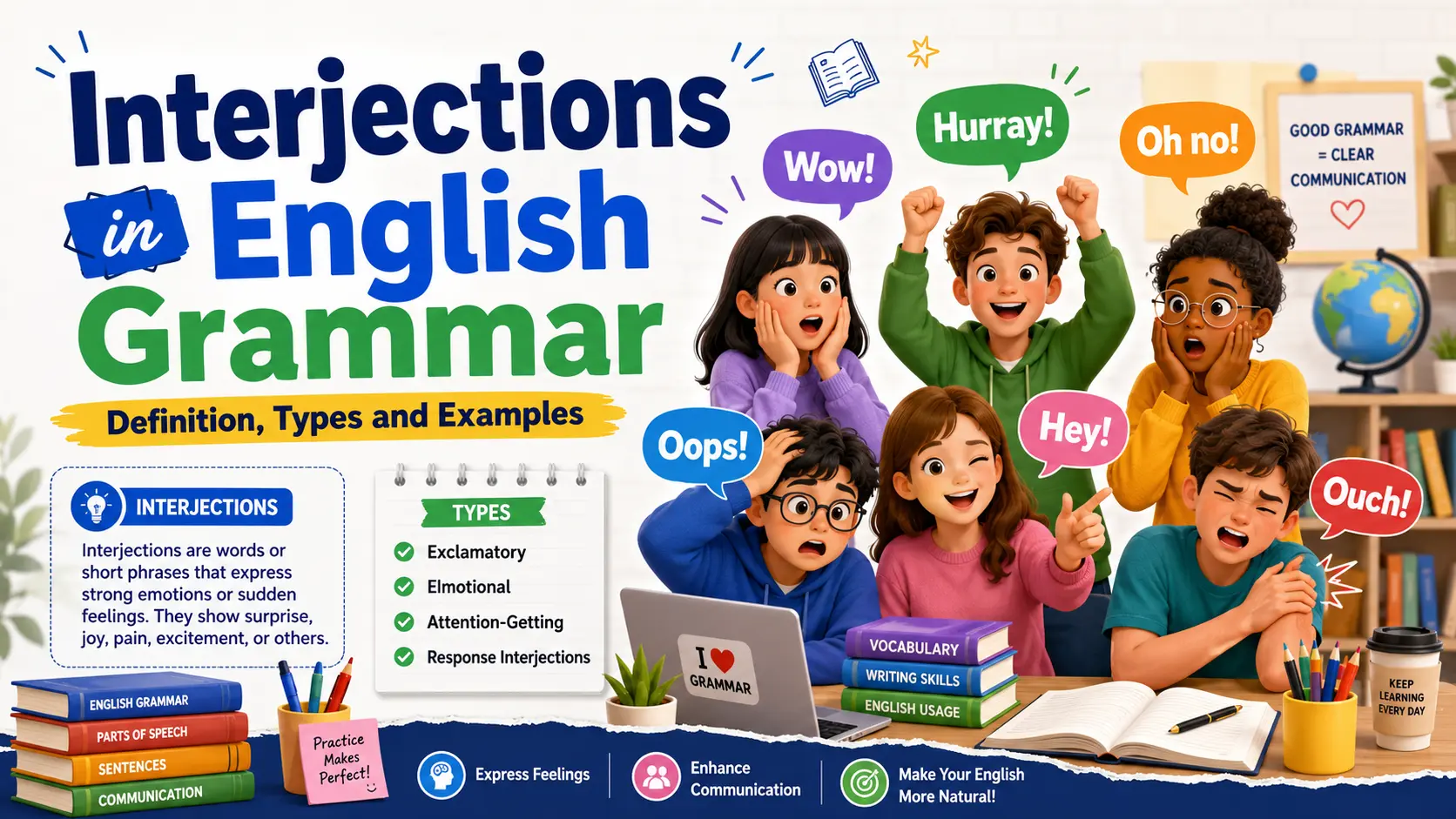
Interjections in English grammar are short, powerful words or phrases used to express sudden feelings, spontaneous emotions, reactions, or immediate physical responses. Whether you are exclaiming “Wow!” at a stunning sunset, crying “Ouch!” after bumping your toe, or calling out “Hey!” to catch a friend’s attention, interjections serve as the primary emotional drivers of daily communication. Although they are often brief—sometimes consisting of just a single syllable—they play an essential role in giving life, warmth, and genuine human personality to spoken and written language.
Without interjections in English grammar, everyday conversations and narrative writing would quickly become flat, mechanical, and overly formal. These unique describing expressions allow speakers and writers to inject immediate feeling directly into a sentence without needing complex grammatical structures. They act as immediate emotional shortcuts, conveying surprise, relief, frustration, joy, or hesitation in a single instant.
In formal sentence construction, interjections operate with remarkable freedom. Unlike nouns, verbs, or adjectives, they are grammatically independent, meaning they do not directly modify other words or rely on traditional subject-verb relationships to carry meaning. Instead, they sit at the beginning of sentences, stand alone as exclamation points, or cushion natural pauses in dialogue.
In this comprehensive guide, you will explore the full spectrum of interjections in English grammar. We will break down primary versus secondary interjections, categorize them by emotional tone, examine exact punctuation mechanics—such as knowing when to use exclamation points, commas, or question marks—and review key guidelines for when to use them in creative dialogue and when to avoid them in formal academic writing. Let’s dive in and master how these small words make a big impact!
Table of Contents
What Are Interjections?
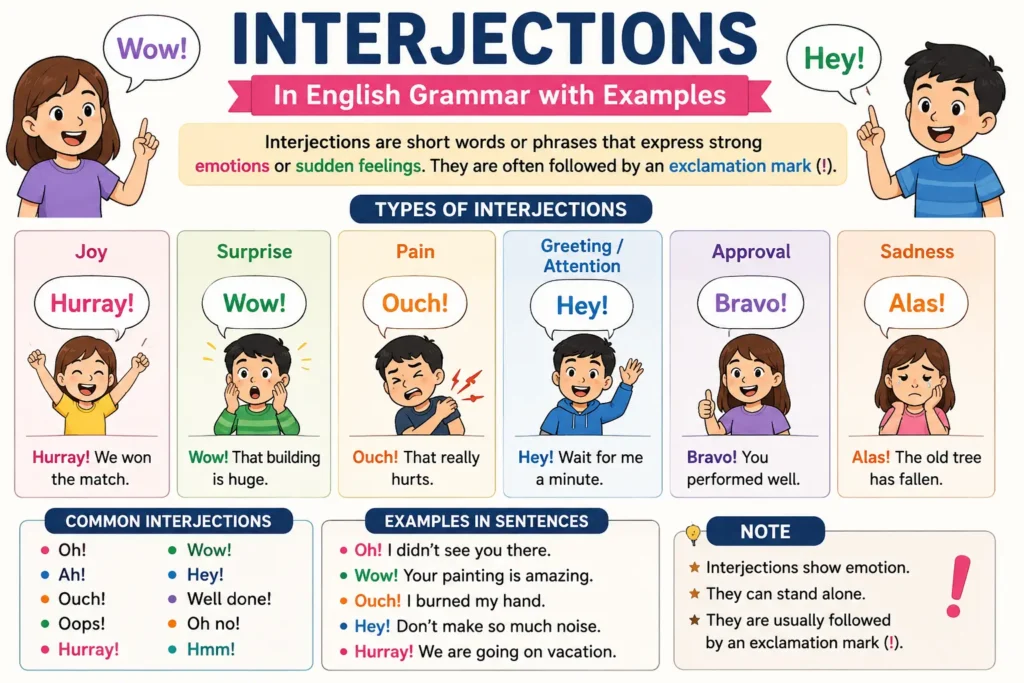
An interjection is a word or phrase that expresses emotion or sudden feeling. It is not grammatically connected to the rest of the sentence. Interjections can express happiness, surprise, pain, excitement, anger, disappointment, greeting, or agreement.
Examples:
- Wow! That is an amazing painting.
- Ouch! My finger hurts.
- Hey! Wait for me.
- Oh no! I forgot my homework.
In these examples, the interjections express immediate feelings or reactions.
Primary vs. Secondary Interjections
Grammarians classify interjections into two distinct structural types depending on their origin and form:
- 1. Primary Interjections: Words that are exclusively used as interjections and do not belong to any other part of speech. They carry no literal meaning on their own outside of expressing pure emotion.
- Examples: Wow, Ouch, Gosh, Ahem, Phew, Ugh, Alas.
- 2. Secondary Interjections: Words, nouns, adjectives, or short clauses that already have an established meaning in English but function as interjections when spoken with strong emotion.
- Examples: Nouns (“Goodness!”), Adjectives (“Great!”), Verbs (“Look!”), Phrases (“Oh my goodness!”).
Grammarians classify interjections into primary and secondary structural types based on their grammatical origin. You can review a complete breakdown of interjection classifications on the Cambridge Dictionary Interjections Guide.
Features of Interjections
Interjections have several important characteristics:
1. They Express Emotion
Interjections show feelings directly and quickly.
Examples:
- Hurray! We won the match.
- Alas! The old tree has fallen.
2. They Are Often Followed by an Exclamation Mark
Most interjections are followed by an exclamation mark because they express strong emotion.
Examples:
- Wow!
- Oh!
- Oops!
However, if the emotion is mild, a comma may also be used.
Example:
- Oh, I didn’t see you there.
3. They Can Stand Alone
Many interjections form complete expressions by themselves.
Examples:
- Bravo!
- Amazing!
- Ouch!
4. They Are Common in Informal English
Interjections are frequently used in conversations, stories, dialogues, and social media posts.
Example:
- Hey, how are you today?
Interjection Punctuation and Tone Reference Chart
| Interjection | Category | Intensity Level | Recommended Punctuation | Context / Example Sentence |
| Phew | Relief | Mild to Strong | Exclamation / Comma | “Phew! That test was much easier than expected.” |
| Well | Hesitation / Intro | Mild | Comma Only | “Well, I suppose we can try one more time.” |
| Yikes | Alarm / Shock | Strong | Exclamation Point | “Yikes! That solar panel surface gets extremely hot.” |
| Aha | Discovery | Moderate | Exclamation Point | “Aha! I finally found the error in my code.” |
| Eek | Fear / Disgust | Strong | Exclamation Point | “Eek! There is a huge spider on the desk.” |
English Grammar Worksheets with AutoTick™
✔ AutoTick™ Secure Answer Checking System
✔ Step-by-step instructions
✔ Answer keys with clear explanations
✔ Password-protected marking (prevents cheating)
Types of Interjections
Interjections can be divided into different categories according to the feelings they express.
1. Interjections of Joy
These interjections express happiness, excitement, or pleasure.
Examples:
- Hurray! We are going on vacation.
- Yay! I passed the exam.
- Wonderful! This cake tastes delicious.
2. Interjections of Surprise
These show shock or surprise.
Examples:
- Wow! That building is huge.
- Oh! I didn’t expect that.
- What! You finished already?
3. Interjections of Pain
These express physical pain or discomfort.
Examples:
- Ouch! That really hurts.
- Ow! I stepped on a nail.
- Ah! My back is sore.
4. Interjections of Greeting
These are used when meeting someone.
Examples:
- Hello! Nice to meet you.
- Hi! How have you been?
- Hey! Come here for a moment.
5. Interjections of Approval
These express agreement or praise.
Examples:
- Bravo! You performed well.
- Excellent! Your answer is correct.
- Well done! Keep it up.
6. Interjections of Sadness
These express sorrow or disappointment.
Examples:
- Alas! The hero died.
- Oh no! We missed the bus.
- Sadly! The shop closed early.
7. Interjections of Attention
These are used to get someone’s attention.
Examples:
- Listen! I have something important to say.
- Look! The rainbow is beautiful.
- Hey! Watch out for the car.
Common Interjections in English
Here are some commonly used interjections and their meanings:
| Interjection | Meaning |
|---|---|
| Wow! | Surprise or admiration |
| Ouch! | Pain |
| Hurray! | Joy |
| Alas! | Sadness |
| Hey! | Calling attention |
| Oops! | Mistake |
| Bravo! | Praise |
| Oh no! | Disappointment |
| Ah! | Realization or relief |
| Hmm | Thinking |
Interjections in Sentences
Let us look at more examples of interjections used in complete sentences.
- Wow! Your new car looks fantastic.
- Oops! I dropped the glass.
- Hurray! Our team won the competition.
- Hey! Don’t run in the hallway.
- Alas! The old castle was destroyed.
These examples show how interjections make sentences more lively and emotional.
Difference Between Interjections and Other Parts of Speech
Interjections are different from nouns, verbs, adjectives, and other parts of speech because they are not grammatically linked to the sentence.
Example:
- Wow! The movie was excellent.
The word “wow” does not describe or modify any word in the sentence. It only expresses emotion.
Importance of Interjections
Interjections are important because they make speech and writing more expressive and natural. Without interjections, communication may sound dull or robotic.
Compare these sentences:
- The fireworks are beautiful.
- Wow! The fireworks are beautiful.
The second sentence sounds more emotional and engaging.
Punctuation Mechanics: Exclamation Points, Commas, and Question Marks
Selecting the correct punctuation mark following an interjection drastically alters the emotional weight and tone of your sentence.
- 1. Strong Interjections (Exclamation Points):When an interjection represents a sudden, intense surge of emotion, use an exclamation mark and capitalize the next word.
- Example: “Ouch! The hot baking tray burned my hand.”
- 2. Mild Interjections (Commas):When an interjection serves as a mild pause, transition, or subtle reflection, follow it with a comma and keep the following word in lowercase unless it is a proper noun.
- Example: “Oh, I didn’t realize you were already finished.”
- 3. Interrogative Interjections (Question Marks):When an interjection seeks confirmation, expresses doubt, or asks for clarification, use a question mark.
- Example: “Huh? Could you repeat those instructions?” / “Right? That makes complete sense.”
Rules for Using Interjections
1. Use Exclamation Marks for Strong Emotion
Examples:
- Hurray! We won.
- Ouch! That hurts.
2. Use Commas for Mild Emotion
Example:
- Oh, I understand now.
3. Avoid Overusing Interjections
Too many interjections can make writing confusing or childish.
Incorrect:
- Wow! Hey! Oh! This is amazing!
Better:
- Wow! This is amazing!
4. Avoid Interjections in Formal Academic and Technical Writing
While interjections add natural dialogue to fiction, blogs, and personal narrative essays, they are generally avoided in academic research papers, legal reports, business correspondence, and technical manuals.
- ❌ Avoid: “Wow! The experimental results showed a 15% increase in efficiency.”
- ✔️ Preferred: “The experimental results demonstrated a significant 15% increase in efficiency.”
5. Watch for Volatile Sound Words (Onomatopoeic Interjections)
Be careful not to confuse pure sound imitations (onomatopoeia) with functional interjections. Words like buzz, hiss, and bang are verbs or nouns imitating sounds, whereas shh, psst, and tsk-tsk function directly as secondary conversational interjections.
Interjections in Daily Conversation
People use interjections naturally in everyday life.
Examples:
- Oh! I forgot my keys.
- Hmm, let me think about it.
- Yay! It’s the weekend.
They are especially common in spoken English because they help speakers show feelings instantly.
Interjections in Writing
Writers use interjections in stories, novels, dialogues, and advertisements to make language more realistic.
Example from dialogue:
- “Ouch!” cried Tom as he touched the hot pan.
Interactive Practice Exercise: Test Your Knowledge
Identify the interjection in each sentence, specify the emotion it conveys, and choose the correct punctuation (!, ,, or ?):
- ( Wow / Well ) __________ That was the best solar cooking demonstration I have ever seen!
- ( Oh / Ouch ) __________ I accidentally bumped my knee against the table leg.
- ( Shh / Yay ) __________ The baby is finally sleeping in the next room.
- ( Hmm / Bravo ) __________ I am not quite sure if this formula applies to countable nouns.
- ( Alas / Hey ) __________ The ancient building could not be saved from demolition.
- ( Oops / Aha ) __________ I forgot to save my WordPress draft before refreshing.
Answer Key & Explanations:
- Wow! — Expresses high admiration or surprise; takes an exclamation mark.
- Ouch! — Expresses sudden physical pain; takes an exclamation mark.
- Shh, — Expresses a desire for silence or quiet attention; takes a comma or mild exclamation mark.
- Hmm, — Expresses hesitation or deep thought; takes a comma.
- Alas! — Expresses sorrow or grief over a past loss; takes an exclamation mark.
- Oops! — Expresses a minor accidental mistake; takes an exclamation mark.
Related Grammar Topics
In creative writing, interjections help readers understand characters’ emotions more clearly.
Interjections are one of the important topics in English grammar and belong to the broader category of parts of speech. To understand grammar better, learners should also study other parts of speech such as nouns, verbs, adjectives, pronouns, and conjunctions.
You can improve your grammar skills further by learning about different types of tenses in English. Understanding tenses helps learners use interjections more naturally in conversations and writing.
Nouns and pronouns are often used together with interjections in sentences. For example, in the sentence “Wow! She sings beautifully,” the pronoun “she” works together with the interjection “wow” to express admiration.
Verbs are also important in sentences that contain interjections because they describe actions or states. In the sentence “Ouch! I hurt my hand,” the verb “hurt” explains the action connected to the emotion.
Adjectives help describe people, objects, and feelings more clearly. Interjections combined with adjectives can make sentences more expressive, such as “Wow! The beautiful painting looks amazing.”
Conjunctions are useful for connecting words and ideas in English grammar. Learning conjunctions together with interjections can help students write smoother and more natural sentences.
Practice Worksheets and Free Samples
Want to practice exercises and printable worksheets? Download our free English grammar worksheets and explore premium worksheet packs designed for students, parents, and teachers.
Conclusion
Interjections are small but powerful words that express emotions, reactions, and feelings. They add excitement, emotion, and natural expression to communication. Whether expressing joy with “hurray,” surprise with “wow,” or pain with “ouch,” interjections help make English more lively and engaging. Learning how to use interjections correctly can improve both speaking and writing skills. By practicing common interjections in daily conversations and sentences, learners can sound more natural and confident in English.
Frequently Asked Questions (FAQ)
What is the primary function of an interjection in a sentence?
An interjection’s main job is to express sudden emotion, tone, or physical reaction (such as joy, pain, surprise, or hesitation). Unlike other parts of speech like nouns, verbs, or adjectives, interjections do not modify other words and are grammatically independent from the rest of the sentence.
Are interjections always followed by an exclamation mark?
No. While exclamation marks are used for strong, intense feelings (e.g., “Ouch! That hot tray burned my hand”), commas are used when the emotion is mild or conversational (e.g., “Oh, I see what you mean now”). Question marks can also follow interjections when seeking confirmation or showing confusion (e.g., “Huh? Could you repeat that?”).
What is the difference between a primary interjection and a secondary interjection?
A primary interjection is a standalone word that exists solely to show emotion and has no other definition or grammatical function (e.g., wow, ouch, phew, ugh). A secondary interjection is a word or phrase that normally belongs to another part of speech—such as a noun, verb, or adjective—but functions as an interjection when spoken with sudden emotion (e.g., “Goodness!”, “Look!”, “Brilliant!”).
Can an interjection stand alone as a complete sentence?
Yes! Interjections can form complete, standalone utterances in speech and writing because their emotional meaning is clear without needing a subject or a verb. For example, shouting “Bravo!”, “Stop!”, or “Oops!” communicates a full thought on its own.
Why should you avoid using interjections in formal writing?
Interjections carry an informal, conversational tone that mimics spoken dialogue. In formal contexts—such as academic essays, technical reports, business emails, and legal documents—interjections make the writing sound overly emotional, subjective, or ungrammatical. Instead of using “Wow! The results were great”, formal writing prefers direct analysis: “The experimental results demonstrated significant improvement.”