
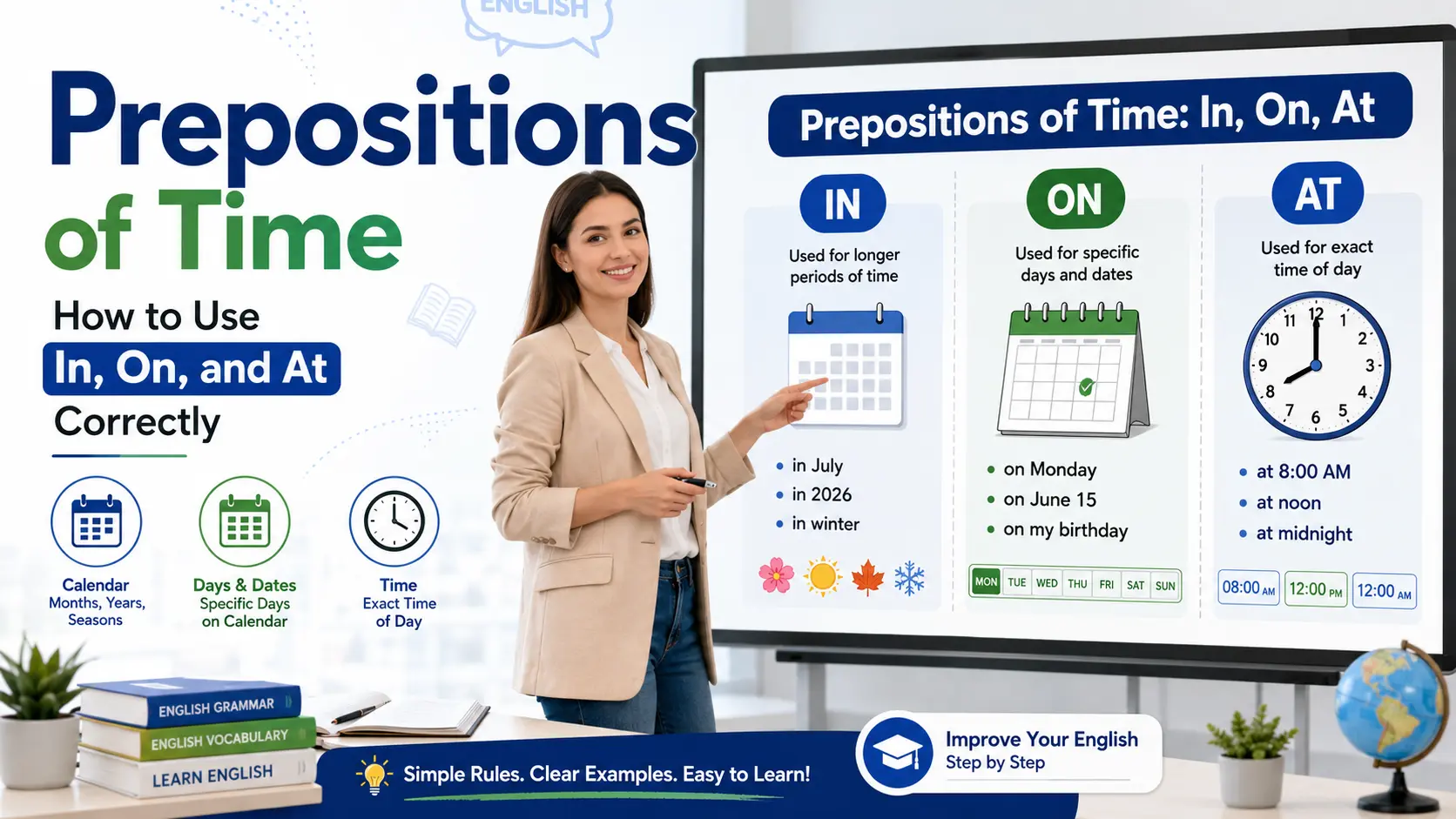
Prepositions of time serve as time markers in English grammar. They establish temporal relationships between the action (verb) and a specific point in time, allowing your reader or listener to anchor events accurately on a timeline. Without prepositions of time, telling stories, setting appointments, or detailing historical sequences would become disjointed and confusing.
Understanding these three small words (in, on, at) relies on grasping spatial-to-temporal abstraction. Just as in represents container space (in a box) and at represents a pin-point coordinate (at the door), their temporal uses reflect the exact same dimension: in holds broad periods of time, on covers flat surfaces of calendar days, and at targets a exact point on a clock.
Table of Contents
🎁 Free Printable Worksheet
Practise as you learn! Download the FREE Prepositions Worksheet (PDF) and complete the exercises while reading this lesson.
Using “In”
The preposition in is used for longer periods of time such as months, years, seasons, and parts of the day.
Examples:
- She was born in 2005.
- The flowers bloom in spring.
- I usually study in the evening.
- We moved here in July.
Rule:
Use in for months, years, seasons, and longer periods.
In + Future Duration (Meaning “Within” or “After”):
We also use in to express how long it takes before something happens in the future or how much time a task requires.
- Example: “The bus will arrive in ten minutes.” (Ten minutes from now).
- Example: “I finished the exam in two hours.” (It required two hours to complete).
Using “On”
The preposition on is used for specific days and dates.
Examples:
- I have a meeting on Monday.
- Her birthday is on 15 June.
- We will travel on Saturday morning.
Rule:
Use on for days of the week and specific dates.
On + Specific Part of a Named Day:
While we say “in the morning”, as soon as you specify the day of the week before “morning”, the preposition changes to on.
- Standard: “I study in the morning.”
- Specific Day: “I have an exam on Monday morning.” (Not “in Monday morning”).
Using “At”
The preposition at is used for exact times or specific moments.
Examples:
- The class starts at 9 a.m.
- We will meet at noon.
- The movie begins at 7:30 p.m.
Rule:
Use at for precise times.
At + Standard Time Periods & Expressions:
- Parts of the Day (Exceptions): at night, at dawn, at dusk.
- Fixed Phrases: at the moment, at present, at the same time, at the end of the day.
- Example: “She is currently busy at the moment.”
Using “At” The preposition at is used for exact times or specific moments. Examples: The class starts at 9 a.m. We will meet at noon. The movie begins at 7:30 p.m. Rule: Use at for precise times.
A helpful way to picture this is to think of a funnel moving from big to small: In is for big, broad chunks of time (like whole seasons or years), On narrows down to specific days, and At zooms right into the exact moment on a clock.
The In / On / At Pyramid Framework
To master preposition selection instantly, visualize an inverted triangle divided into three horizontal tiers:
| Preposition | Scope / Specificity | Time Expressions Covered | Example Phrases |
| IN | Broadest (General & Long) | Centuries, Decades, Years, Seasons, Months, Centuries, Parts of the Day | in the 21st century, in the 1990s, in 2026, in summer, in August, in the morning |
| ON | Medium (Specific Days/Dates) | Days of the week, Calendar dates, Holidays ending in “Day”, Specific day parts | on Monday, on 15 June, on Christmas Day, on my birthday, on Friday night |
| AT | Narrowest (Exact Points) | Clock times, Precise moments, Meals, Holidays without “Day” | at 7:30 p.m., at noon, at midnight, at lunchtime, at sunrise, at Christmas |
Prepositions of time establish temporal relationships based on scope and specificity. You can review a complete breakdown of preposition rules on the Cambridge Dictionary Prepositions of Time Guide
Quick Comparison
Here is a simple comparison of the three prepositions:
| Preposition | Usage | Example |
|---|---|---|
| In | Months, years, seasons, long periods | in 2024, in July |
| On | Days and dates | on Monday, on 15 June |
| At | Exact times | at 8 a.m., at noon |
🎁 Try a Free Grammar Worksheet Sample
Want to practise what you’ve learned?
Our free sample worksheet lets you experience how the exercises work before you decide.
✔ Instant answers with auto-marking
✔ Clear explanations for every question
✔ Beginner-friendly and easy to follow
✔ Suitable for students, teachers, and ESL learners
👉 🎁 Download Free Grammar Worksheets Sample
Crucial Exceptions & Special Rules
To avoid frequent loss of marks in grammar assessments, take special note of these structural exceptions:
1. Holidays: “At” vs. “On”
- Use at when referring to the general holiday season as a whole period.
- “We visit family at Christmas.” (The entire holiday period).
- Use on when referring to the specific day itself.
- “We open gifts on Christmas Day.” (Specific 24-hour day).
2. The Zero Preposition Rule (No Preposition Needed!)
Do not use in, on, or at before time expressions when they are preceded by modifying determiners such as this, last, next, every, each, some, or any.
Plaintext
Incorrect: I will see you on next Monday.
Correct:   I will see you next Monday.

Incorrect: We traveled in last year.
Correct:   We traveled last year.

Incorrect: She works at every day.
Correct:   She works every day.
Common Preposition Mistakes
- Mistake 1: Misusing “In” with Specific Days of the Week
- ❌ Incorrect: I will see you in Monday.
- ✔️ Correct: I will see you on Monday.
- Pedagogical Reason: Specific days of the week (Monday, Friday, weekends) strictly require the preposition on.
- Mistake 2: Confusing “On” with Specific Clock Times
- ❌ Incorrect: The meeting is on 7 p.m.
- ✔️ Correct: The meeting is at 7 p.m.
- Pedagogical Reason: Precise moments and clock times (7 p.m., noon, midnight) always pair with at.
- Mistake 3: Using “On” for Years and Long Time Eras
- ❌ Incorrect: She was born on 1990.
- ✔️ Correct: She was born in 1990.
- Pedagogical Reason: Years, centuries, decades, and seasons represent extended periods of time and require in.
- Mistake 4: Misusing “In” with Specific Calendar Dates
- ❌ Incorrect: The project deadline is in 12 October.
- ✔️ Correct: The project deadline is on 12 October.
- Pedagogical Reason: Months take in when written alone (in October), but adding a specific calendar date shifts the focus to a specific day, requiring on.
- Mistake 5: Saying “In night” Instead of “At night”
- ❌ Incorrect: I love watching the stars in night.
- ✔️ Correct: I love watching the stars at night.
- Pedagogical Reason: Parts of the day using an article take in the (in the morning, in the evening), but night takes the direct preposition at without an article.
- Mistake 6: Confusing “In Time” vs. “On Time”
- ❌ Incorrect: The 9:00 a.m. train left in time. (when meaning punctual)
- ✔️ Correct: The 9:00 a.m. train left on time.
- Pedagogical Reason: Use on time to mean punctual according to a schedule. Use in time to mean having enough time to spare before something happens (“in time to catch the train”).
- Mistake 7: Adding “To” After Transitive Verbs of Movement
- ❌ Incorrect: We arrived to the airport early.
- ✔️ Correct: We arrived at the airport early.
- Pedagogical Rule: Use arrive at for specific buildings or locations, and arrive in for cities or countries. Avoid pairing arrive with to.
- Mistake 8: Misusing “For” and “Since” for Duration
- ❌ Incorrect: She has been working here since three years.
- ✔️ Correct: She has been working here for three years.
- Pedagogical Reason: Use for to measure total duration (three years). Use since to pinpoint a specific starting moment (since 2021).
- Mistake 9: Using “In” Instead of “At” for Specific Locations vs. Cities
- ❌ Incorrect: He is waiting in the bus stop.
- ✔️ Correct: He is waiting at the bus stop.
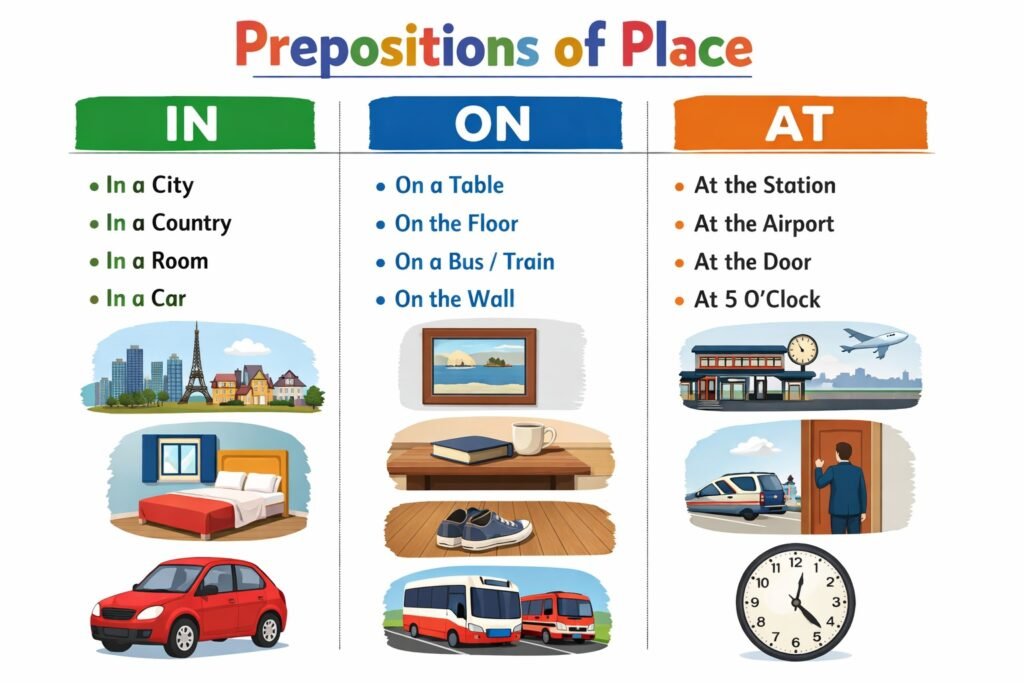
- Pedagogical Rule: Use at for specific points or landmarks (at the bus stop, at the desk). Reserve in for enclosed spaces or geographic areas (in the office, in Kuala Lumpur).
- Mistake 10: Inserting Unnecessary Prepositions Before Time Words
- ❌ Incorrect: I will call you on next Monday.
- ✔️ Correct: I will call you next Monday.
- Pedagogical Reason: Prepositions (on, in, at) are dropped entirely when time expressions are preceded by next, last, this, or every.
Tips for Learning Prepositions of Time
To remember these prepositions easily:
- Use in for longer time periods.
- Use on for days and dates.
- Use at for exact times.
Practicing with examples will help you understand how these prepositions work in everyday English.
- Learn more about English grammar rules to improve your understanding.
- You can also study parts of speech to build strong basics.
🎁 Free Printable Worksheet
Enjoyed this lesson on Prepositions? Reinforce what you’ve learned with our FREE printable worksheet.
✅ Printable PDF
✅ Detailed answer key with explanations
✅ Perfect for self-study or classroom use
Practice Exercise: Prepositions of Time Mastery
Fill in the blanks with in, on, at, or Ø (no preposition required):
- The international conference begins __________ 9:00 a.m. __________ Monday morning.
- She graduated from university __________ 2021.
- Are you doing anything special __________ Christmas Day?
- We are moving to our new house __________ next month.
- He likes to go for a run __________ sunrise.
- The flowers in the garden look beautiful __________ spring.
- They scheduled the site inspection __________ Friday afternoon.
- I usually complete my daily work tasks __________ the morning.
- Will you be attending the seminar __________ this weekend?
- The contract agreement was signed __________ midnight.
Answer Key & Detailed Pedagogical Explanations
Answer 10: at — Use at for exact points on the clock and specific fixed times of night (at midnight).
Answer 1: at / on — Use at for specific clock times (9:00 a.m.) and on for specific days or day parts (Monday morning).
Answer 2: in — Use in for years, months, decades, and long historical eras (in 2021).
Answer 3: on — Use on when the word “Day” is explicitly present (Christmas Day). Note: Use at for the general holiday period (at Christmas).
Answer 4: Ø (No preposition) — Time expressions modified by next, last, this, or every drop prepositions entirely.
Answer 5: at — Use at for precise points in time and natural daily transitions (at sunrise, at noon, at night).
Answer 6: in — Use in for seasons of the year (in spring, in summer).
Answer 7: on — Use on for specific days of the week paired with a time of day (on Friday afternoon).
Answer 8: in — Use in for general periods of the day (in the morning, in the afternoon, in the evening).
Answer 9: Ø (No preposition) — The presence of the demonstrative modifier this means no preposition is needed (this weekend).
🚀 Improve Faster with Structured Grammar Worksheets
If you want to build strong grammar skills, consistent practice is key.
Our full worksheet set is designed to guide learners from basic to advanced levels in a simple and structured way.
✅ What’s Included:
✔ Worksheets for Levels 1–6 (beginner to intermediate)
✔ Covers all key grammar topics (tenses, parts of speech, sentence structure, and more)
✔ Auto-marking answer sheets (instant score and feedback)
✔ Clear explanations to help you learn from mistakes
✔ Easy-to-use format for home learning or classroom use
🎯 Who Is It For?
- Students who want to improve step by step
- Teachers looking for ready-to-use materials
- ESL learners who need clear and simple explanations
Conclusion
Prepositions of time such as in, on, and at help describe when something happens. By understanding the rules and practicing with examples, you can use these prepositions correctly in your sentences.
Remember, mastering a language takes time and patience. Be kind to yourself as you learn, and celebrate the small wins along the way!
👉 🚀 Get Full Access to All Worksheets (Levels 1–6)
When do we use “at”?
Use “at” for exact times.
What should I do if I keep mixing them up?
Don’t sweat it! Language learning is all about pattern recognition. The more you read and listen to English, the more these prepositions will naturally start to “sound” right to your ears. Mistakes are just proof that you are trying and growing.
Are there any exceptions to these rules?
Yes, English can be quirky! For example, we say “in the morning” or “in the evening,” but we shift to “at night.” Don’t worry about memorizing every exception right away—you will naturally pick them up as you practice.
Do we use prepositions with words like “next,” “last,” or “every”?
Actually, no! This is a very common trap. You don’t need a preposition here. For example, say “I have a lesson next Monday” instead of “on next Monday,” or “I traveled last year” instead of “in last year.”
Why do we say “in the morning” but “at night”?
This is an established historical convention in English. Morning, afternoon, and evening are viewed as broad durations (in the…), whereas night was historically viewed as a single, indivisible block or point of darkness, thus taking at.
Is it “at the weekend” or “on the weekend”?
Both are correct! “At the weekend” is standard in British English (UK, Australia, Malaysia), while “on the weekend” is standard in American English (US, Canada). Stick to one dialect consistently throughout your writing.