
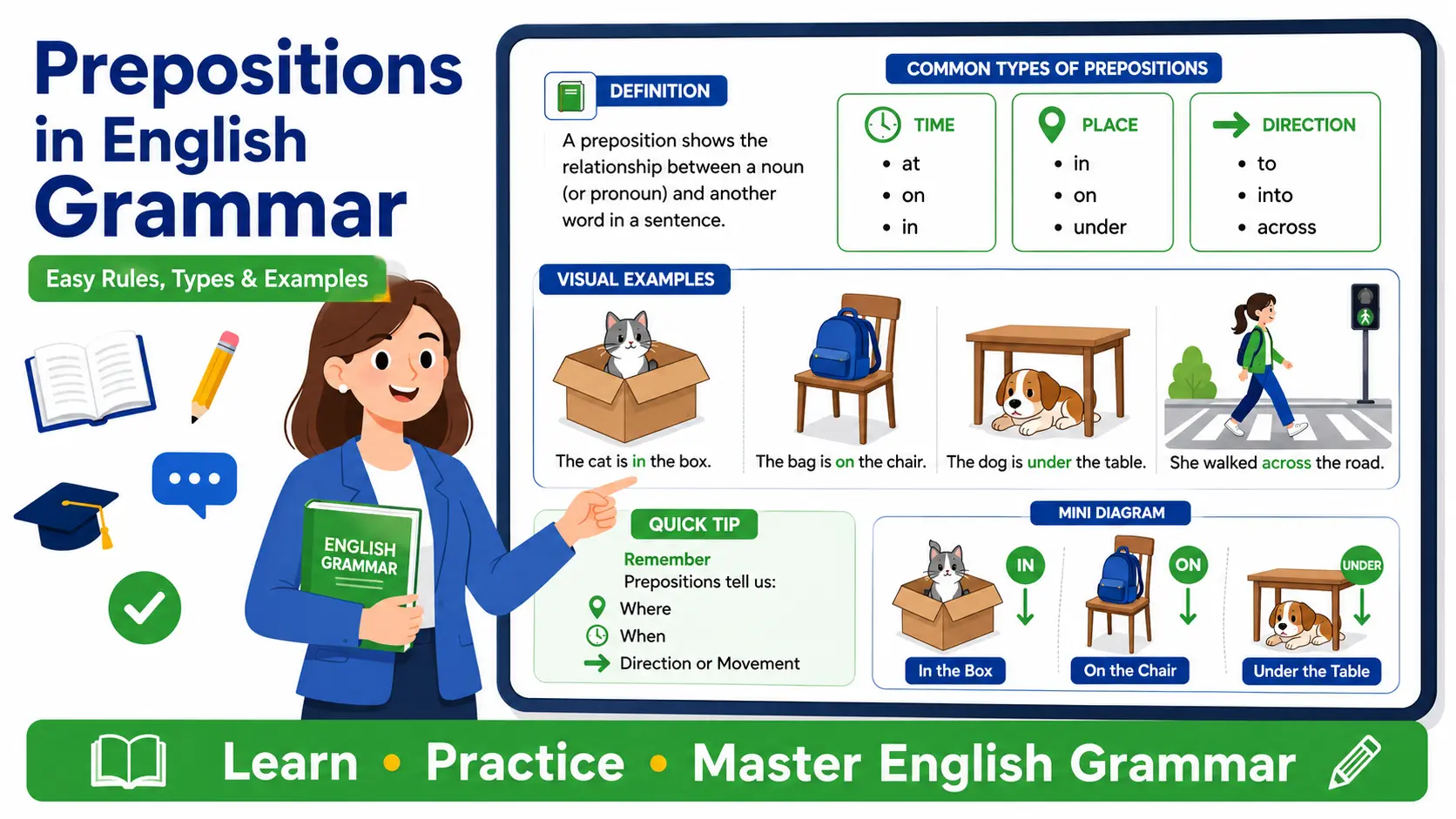
Prepositions in English are important grammar tools that show relationships between words in a sentence. In this guide, you will learn the definition, types, and examples of prepositions in English in a simple and clear way.
Prepositions are commonly used in everyday communication. Learning how to use them correctly helps make your sentences clearer and more natural.
Let’s be completely honest for a second: prepositions can be absolute troublemakers. They are usually the shortest words in a sentence, yet they cause some of the biggest headaches for English learners. If you’ve ever stared at a sentence wondering whether you should say “I’m in the bus” or “I’m on the bus” (it’s on, by the way, which makes zero logical sense!), you are not alone. We’ve all been there, and it is a completely normal part of the learning journey.
🎁 Free Sample:
Practice prepositions with real exercises
👉 Download Free Grammar Worksheets Sample
👉 Want to improve faster?
👉 Get Instant Access to Grammar Worksheets (Level 1–6)
The tricky thing about prepositions is that you can’t always translate them directly from your native language. What requires one word in your language might take three different words in English depending on the context. But here is the good news: you don’t need to memorize a massive dictionary of rules. Once you start seeing them in action and practicing with real-world examples, your brain naturally starts to pick up on the patterns.
Common Prepositions in English
Some of the most common prepositions include:
- in
- on
- at
- under
- between
- behind
- over
- before
- after
Prepositions are usually followed by a noun or pronoun, forming a prepositional phrase.
Examples:
- The book is on the table.
- She arrived after dinner.
- The cat is under the chair.
💡 Many learners struggle with prepositions because they don’t fully understand parts of speech and how words function in a sentence.
👉 Read: Parts of Speech Guide
Prepositions of Time
Prepositions of time describe when something happens.
Common examples:
- in – months, years, long periods
- on – specific days and dates
- at – specific times
Examples:
- She was born in 2005.
- The meeting is on Monday.
- The class starts at 9 a.m.
👉 To better understand time usage, learn how verbs change in different English tenses.
👉 Read: 12 English Tenses Explained
Prepositions are usually followed by a noun or pronoun, forming a prepositional phrase. You can review a complete catalog of preposition functions on the Cambridge Dictionary Grammar Reference.
Prepositions of Place
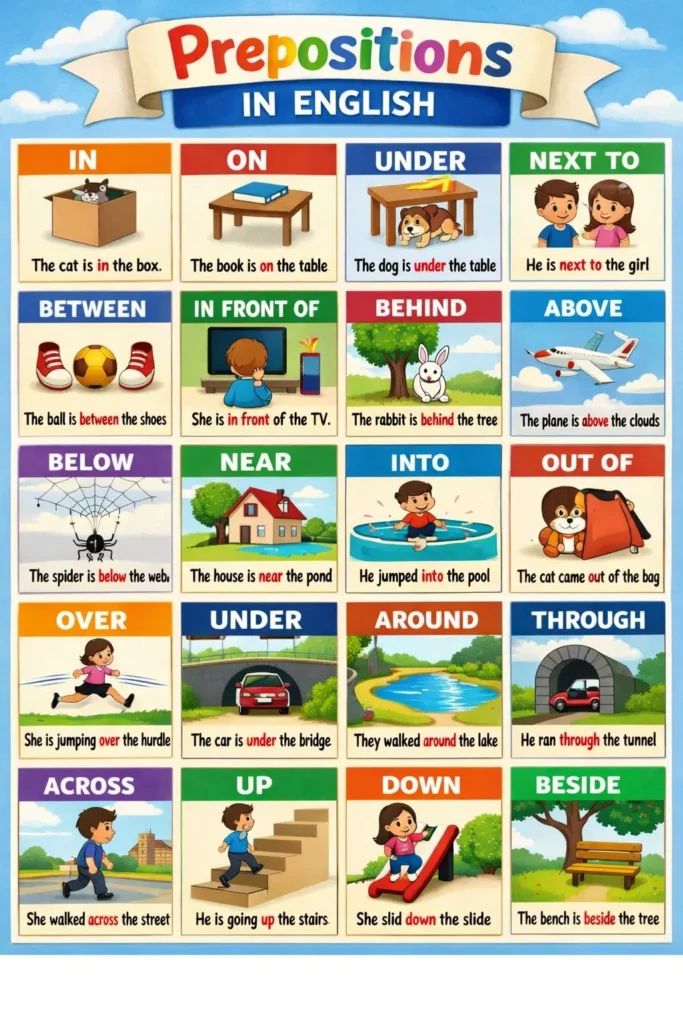
Prepositions of place describe where something is located.
Common examples:
- in
- on
- under
- behind
- between
- next to
Examples:
- The keys are on the table.
- The dog is under the chair.
- The shop is between the bank and the café.
Prepositions of Direction
Prepositions of direction show movement from one place to another.
Common examples:
- to
- into
- onto
- from
- through
Examples:
- She walked to the store.
- The cat jumped onto the table.
- They went into the building.
✏️ Practice what you’ve learned:
👉 Get Instant Access to Grammar Worksheets
🎁 Or try a Free Sample first
Complex Prepositions and Compound Structures
Not all prepositions consist of a single word like in, on, or at. English frequently uses complex prepositions—phrases of two or three words that function together as a single prepositional unit.
- Two-Word Complex Prepositions:
- According to: “According to the instruction manual, the vacuum tube cooker heats up in 20 minutes.”
- Because of: “The outdoor event was canceled because of heavy rain.”
- Due to: “Flight delays occurred due to unexpected severe weather.”
- Three-Word Complex Prepositions:
- In front of: “A large panel solar reflector was placed in front of the workshop.”
- In addition to: “In addition to grammar rules, students should practice daily reading.”
- On behalf of: “He accepted the environmental award on behalf of the entire research team.”
Prepositional Phrases
A prepositional phrase consists of a preposition followed by a noun or pronoun.
Examples:
- in the morning
- on the table
- after the meeting
These phrases give more information about time, place, or direction in a sentence.
💡 Tip: Many grammar mistakes happen when learners misuse prepositions.
👉 Learn more: Common Grammar Mistakes
Dependent Prepositions Master List (Verbs, Adjectives, & Nouns)
Dependent prepositions are fixed combinations where a specific verb, adjective, or noun strictly requires a particular preposition to be grammatically correct.
1. Verb + Preposition Combinations:
- Apologize for: “She apologized for arriving late to the lecture.”
- Depend on: “Solar cooking efficiency depends on direct overhead sunshine.”
- Insist on: “The teacher insisted on complete silence during the exam.”
2. Adjective + Preposition Combinations:
- Interested in: “Many primary students are interested in interactive grammar quizzes.”
- Famous for: “Malaysia is famous for its rich culture and delicious food.”
- Capable of: “A high-quality evacuated tube is capable of reaching 200°C.”
3. Noun + Preposition Combinations:
- Reason for: “What was the primary reason for the unexpected project delay?”
- Solution to: “Calculated practice exercises provide a clear solution to grammar confusion.”
- Increase in: “The regional school district noticed a steady increase in test scores.”
Why Learning Prepositions Is Important
Prepositions are essential for building clear and natural English sentences. They help describe relationships between people, places, and events.
Because many prepositions have multiple meanings, learning them with examples and practice is the best way to improve.
Look, nobody master prepositions overnight, and making a few mistakes along the way is actually a sign that you’re trying. The goal isn’t to be a flawless grammar textbook—it’s to be understood and to feel confident when you speak or write. Take it one phrase at a time, celebrate the small wins, and give yourself some grace. You’ve got this!
Common Preposition Mistakes & Misuses
- Mistake 1: Unnecessary Prepositions After Transitive Verbs
- ❌ Incorrect: “We need to discuss about the project rules.”
- ✔️ Correct: “We need to discuss the project rules.”
- Pedagogical Reason: Verbs like discuss, answer, reach, and enter take a direct object and do not require a trailing preposition.
- Mistake 2: Confusing “In Time” vs. “On Time”
- On Time: Means punctual or according to a set schedule (“The train arrived right on time at 9:00 AM”).
- In Time: Means early enough or with time to spare before a deadline (“We arrived in time to catch the opening remarks”).
- Mistake 3: Misusing “To” Instead of “At” for Static Locations
- ❌ Incorrect: “I stayed to home all weekend.”
- ✔️ Correct: “I stayed at home all weekend.”
- Pedagogical Reason: Use to for directional movement toward a destination; use at to indicate a static position or location.
🚀 Improve Your Grammar Faster
Reading helps—but practice is what really improves your grammar.
Our Grammar Worksheets (Level 1–6) include:
✔ Step-by-step exercises
✔ Autotick cheat-proof answer sheets
✔ Structured learning by level
🎁 Not sure yet?
👉 Download Free Sample Worksheets
📚 Continue Learning
To build a strong grammar foundation, explore:
12 English Tenses Explained
Parts of Speech Guide
Common Grammar Mistakes
Interactive Practice Exercise: Prepositions Challenge
Choose the correct preposition (in, on, at, for, of, to) for each gap:
- The international conference will take place __________ October 15th.
- She has been working as a quantity surveyor __________ over fifteen years.
- My office is located __________ the third floor of the commercial building.
- He is fully capable __________ solving complex engineering calculations.
- They arrived __________ the airport just in time for their flight.
- The students divided the worksheet answers __________ three equal categories.
Answer Key & Explanations:
- on — Specific calendar dates require on (on October 15th).
- for — Quantifying total duration of time requires for (for over fifteen years).
- on — Levels, floors, and flat surfaces take on (on the third floor).
- of — The adjective capable takes the dependent preposition of.
- at — Specific location points require at (at the airport).
- into — Actions involving division or transformation take into (divided into).
FAQ
Why are prepositions so difficult to master in English?
Prepositions are tricky because they are highly idiomatic—meaning their usage doesn’t always follow strict logic, and they rarely translate directly from one language to another. For example, you sit in a chair (with arms) but on a chair (without arms). Instead of trying to memorize rules, the best way to master them is by learning them in “chunks” or phrases, rather than as isolated words.
What is the difference between “in,” “on,” and “at” for location?
Think of these three as a funnel moving from general to specific:
In (The widest part): Used for enclosed spaces, neighborhoods, cities, and countries. (e.g., in a room, in London)
On (The middle part): Used for surfaces and streets. (e.g., on the table, on Fifth Avenue)
At (The specific point): Used for exact addresses or precise locations. (e.g., at 123 Main Street, at the entrance)
Is it grammatically correct to end a sentence with a preposition?
Yes, absolutely! There is an old, rigid myth that you should never end a sentence with a preposition (like saying, “Who are you talking to?”). However, modern English perfectly accepts this. Forcing a preposition into the middle of a sentence often makes you sound stiff and unnatural (e.g., “To whom are you talking?”). Write the way people actually speak.
What is a “dependent preposition” and why do they matter?
Dependent prepositions are words that must follow certain verbs, nouns, or adjectives to make sense. They don’t have a spatial meaning; they just belong together.
Good examples: You depend on someone, you are interested in a topic, or you are afraid of spiders. If you change the preposition, the sentence becomes incorrect, which is why practicing these specific combinations is so important.
How can I stop making mistakes with prepositions when I write?
Because prepositions are all about context, passive reading isn’t enough to make them stick. The most effective strategy is a mix of active tracking (keeping a notebook of phrases you see in books or articles) and targeted practice (using structured worksheets to test your skills). When you learn a new verb, always learn the preposition that tags along with it.