
Table of Contents
Introduction
Let’s be honest: we have all been there. You are typing out a quick message or writing an important email, your fingers are flying across the keyboard, and suddenly you pause. Wait, is it t-h-e-i-r or t-h-e-r-e? You are definitely not alone. This trio is famous for causing sudden typing paralysis, and honestly, it is one of those things that can make you second-guess your own native language or feel incredibly frustrated if you are just learning English.
Many learners struggle with their vs there vs they’re because these words sound the same.
Understanding the difference between these three words will help you avoid one of the most common grammar mistakes in English writing.
👉 Download Free Grammar Worksheets & Examples (PDF):
🟢 What Is “Their”?
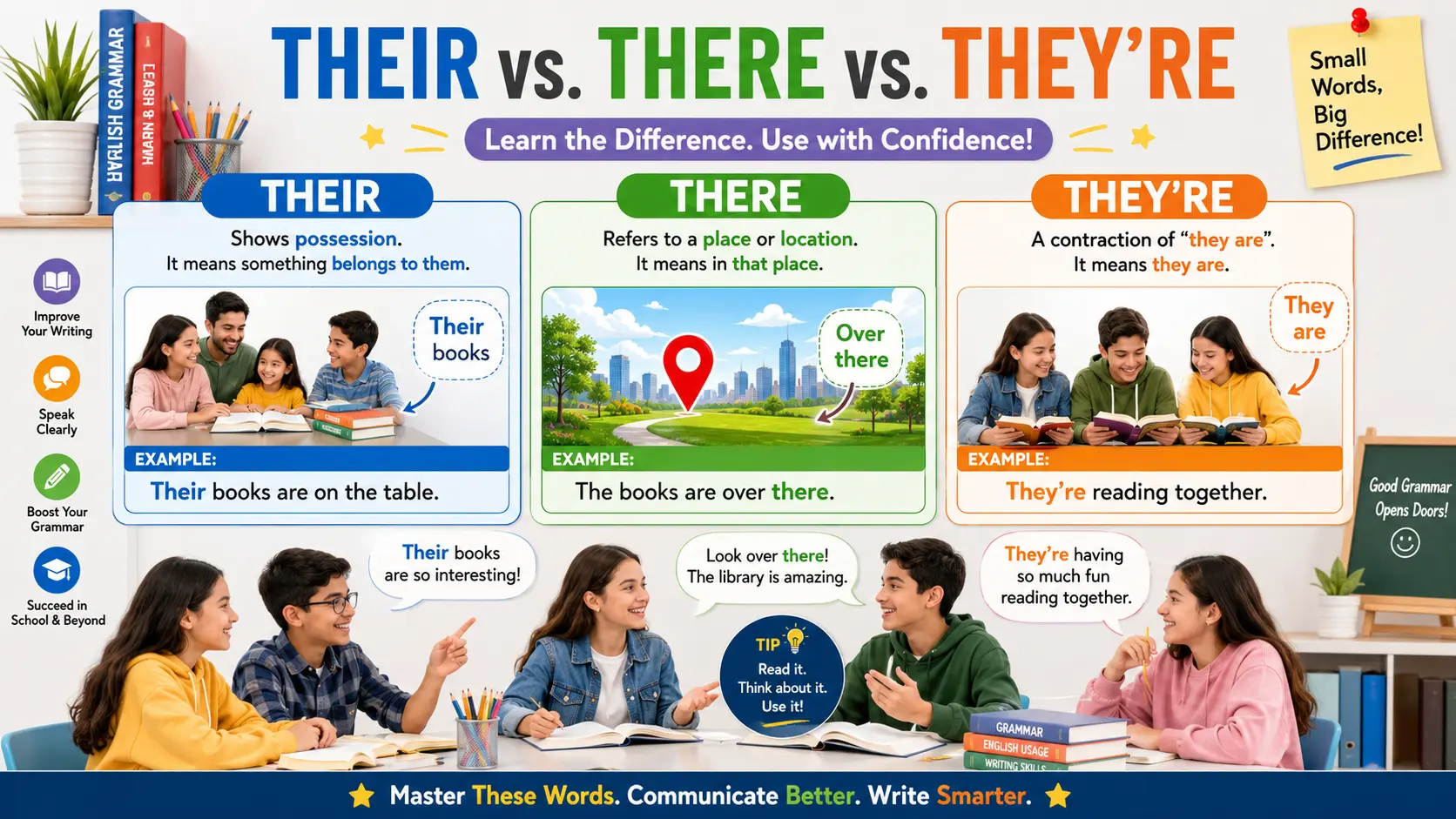
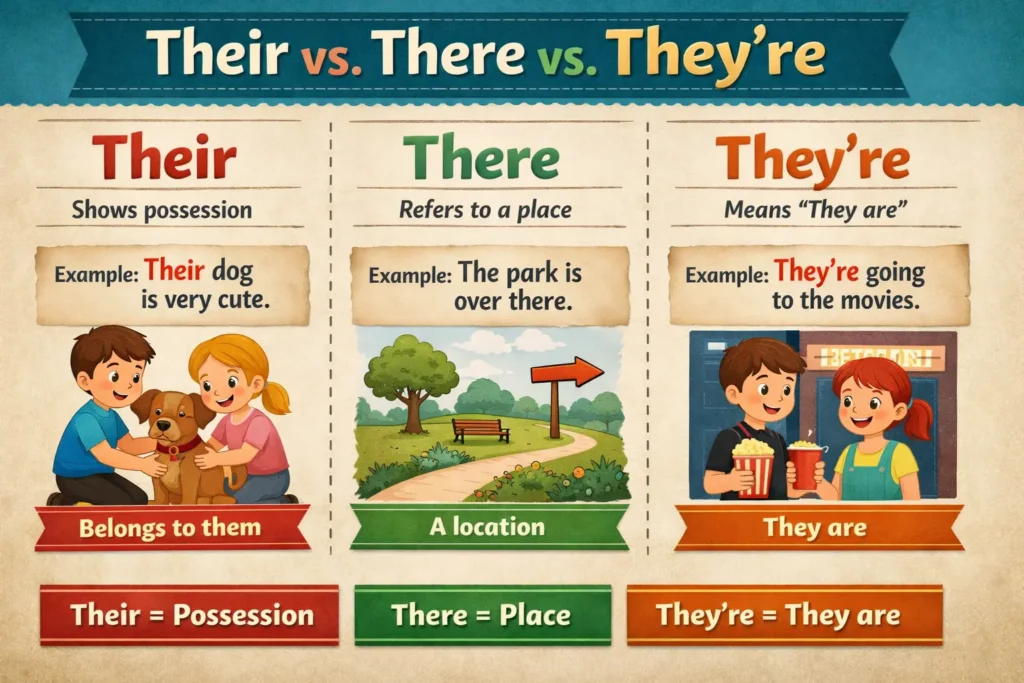
Their is a possessive adjective. It shows that something belongs to them.
Examples:
- The students forgot their books.
- The children are playing with their toys.
- The team celebrated their victory.
✅ In these sentences, their shows possession.
🔵 What Is “There”?
There refers to a place or location. It can also be used to introduce a sentence.
Examples:
- The keys are over there.
- We went there yesterday.
- There is a book on the table.
✅ In the last example, there introduces the sentence.
🟣 What Is “They’re”?
They’re is a contraction of they are.
Examples:
- They’re going to the park.
- They’re studying for the test.
- They’re very excited about the trip.
💡 Tip: Replace they’re with they are. If it still makes sense, it is correct.
Example:
- They’re happy → They are happy ✔️
Their vs. There vs. They’re Visual Shortcut Matrix
| Word | Hidden Word / Visual Anchor | Primary Grammatical Function | Easy Test / Substitute | Example Sentence |
| Their | Contains HEIR (a person who inherits) or I | Possessive Adjective (Ownership) | Replace with “our” or “his” | “The teachers brought their laptops.” |
| There | Contains HERE (a physical location) | Adverb of Place / Introductory Expletive | Opposite of “here” | “Put the solar cooker over there.” |
| They’re | Contains Apostrophe (‘) replacing the letter “a” | Contraction (They + are) | Replace with “they are” | “They’re going to publish the article.” |
💡 Simple Trick to Remember
How I finally stopped guessing
It is completely natural to mix these up because when we speak, our brains only hear one sound. But when we write, the page demands precision. I used to find myself rewriting entire sentences just to avoid choosing the wrong one! That was until I started using a few incredibly simple visual shortcuts that instantly clear up the confusion. Let’s look at the foolproof trick that will save you from ever having to double-check yourself again.
- Their → belongs to them
- There → place or location
- They’re → they are
6 High-Frequency Mistakes & How to Fix Them
- Mistake 1: Misusing “There” for Ownership
- ❌ Incorrect: “The students forgot to turn in there worksheets.”
- ✔️ Correct: “The students forgot to turn in their worksheets.”
- Pedagogical Reason: Worksheets are items owned by the students; ownership always requires their.
- Mistake 2: Writing “Their” When Describing Location
- ❌ Incorrect: “We stayed their for three days during the conference.”
- ✔️ Correct: “We stayed there for three days during the conference.”
- Pedagogical Reason: The sentence describes a place where someone stayed. Use there because it contains the location word here.
- Mistake 3: Confusing “They’re” with Possessive Pronouns
- ❌ Incorrect: “They’re house is located near the public park.”
- ✔️ Correct: “Their house is located near the public park.”
- Pedagogical Test: Try the substitution rule: “They are house is located…” makes no sense, so they’re is incorrect.
- Mistake 4: Adding Apostrophes to “Theirs”
- ❌ Incorrect: “The victory was officialy their’s.”
- ✔️ Correct: “The victory was officially theirs.”
- Pedagogical Reason: Theirs is a possessive pronoun and never takes an apostrophe. Apostrophes in personal pronouns indicate contractions, not possession.
- Mistake 5: Misidentifying “There’s” (There Is) with Plural Nouns
- ❌ Incorrect: “There’s three different rules you need to follow.”
- ✔️ Correct: “There are three different rules you need to follow.”
- Pedagogical Reason: There’s is a contraction for there is (singular). Plural subjects (three rules) require there are.
- Mistake 6: Overusing “Their” as a Singular Pronoun Without Subject Alignment
- ❌ Incorrect: “Every student must bring their own pencil.” (Traditional formal grammar)
- ✔️ Correct: “All students must bring their own pencils.” / “Every student must bring his or her pencil.”
- Pedagogical Reason: While the “singular their” is widely accepted in modern informal English, aligning plural subjects (all students) with plural possessives (their) avoids ambiguity in formal writing.
🔗 Learn More Grammar Rules
👉 Improve your grammar with these guides:
🤔 Why This Mistake Happens
The confusion happens because their, there, and they’re are homophones — words that sound the same but have different meanings and spellings.
Homophones present unique spelling challenges because human brains process auditory input faster than orthographic rules. Because they sound identical when spoken, people often choose the wrong word when writing.
Interactive Practice Exercise: Test Your Knowledge
Choose the correct word (their, there, or they’re) for each gap:
- __________ going to announce the test results tomorrow afternoon.
- Please leave your backpacks over __________ by the classroom door.
- The researchers published __________ findings in an international journal.
- Do you know if __________ participating in the solar cooking workshop?
- __________ is a significant difference between these two grammar rules.
- The children spent all afternoon cleaning __________ study desks.
- I have lived __________ for over ten years.
- __________ planning to update __________ website themes this weekend.
- Look at those birds! __________ building a nest in that tall tree.
- Is that red automobile parked outside __________ car?
Answer Key & Detailed Explanations:
- They’re — Contraction for They are going to announce.
- there — Refers to a physical position/location (contains here).
- their — Possessive adjective modifying findings.
- they’re — Contraction for they are participating.
- There — Introductory expletive showing existence (There is a difference).
- their — Possessive adjective indicating the desks belong to the children.
- there — Adverb of place referring to a location lived in.
- They’re / their — First gap: They are planning (contraction); Second gap: possessive adjective modifying website themes.
- They’re — Contraction for They are building.
- their — Possessive adjective modifying car.
✅ Conclusion
The difference between their, there, and they’re is easy to remember:
- Their shows possession
- There refers to a place or introduces a sentence
- They’re means they are
Mastering these differences will help you avoid common grammar mistakes and improve your English writing.
A Quick Final Thought
At the end of the day, mastering English grammar isn’t about being perfect right out of the gate—it’s about building confidence. Once you train your eyes to see the “place” in there and the “people” in their, it becomes second nature. Don’t be discouraged if you still make a typo now and then; even professional writers do! Keep practicing, use the guide below, and you’ll notice yourself typing these out with total confidence in no time.
👉 Get Free Worksheets & Practice Exercises
Master English Grammar with Instant Feedback:
Upgrade your practice routine with our English Grammar Lessons with Autotick Marking Facilities. Access interactive practice sets, instant automated grading, and detailed answer keys for all core grammar topics!”
❓ FAQs: Their vs There vs They’re
Why do people confuse their, there, and they’re so often?
The biggest reason is that they are homophones—words that sound exactly the same when spoken but have completely different spellings and meanings. Because our brains process language primarily through sound when we think of a sentence, our fingers often type the version we use most frequently, rather than the one that actually fits the rules. Even native English speakers make this mistake constantly when typing quickly!
What is the easiest way to remember the difference?
The easiest trick is to look for the hidden visual clues inside the words themselves:
Their has an “I” in it. Think of I as a person. If it has a person in it, it belongs to people (possession).
There has the word “here” hidden inside it. Both here and there talk about a location or place.
They’re has an apostrophe (’). The apostrophe always acts like a tiny placeholder for a missing letter—in this case, the “A” in they are.
How can I quickly test if I used “they’re” correctly?
Use the “Separate Rule.” Whenever you write they’re, read the sentence out loud but say “they are” instead. If the sentence still makes perfect sense, your grammar is correct.
Example: “They’re coming to dinner” $\rightarrow$ “They are coming to dinner.” (This works!)
Example: “Is that they’re car?” $\rightarrow$ “Is that they are car?” (This sounds wrong, so they’re is incorrect here; it should be their).
Is “their” a noun, a pronoun, or an adjective?
Grammatically, their is a possessive adjective (sometimes called a possessive determiner). It modifies a noun by showing who owns it. Because it describes a noun (like their house or their ideas), it functions just like an adjective.
Can “there” be used to start a sentence if it isn’t a location?
Yes, absolutely! This is called an “introductory there” or an expletive construction. We use it simply to state that something exists.
Example: “There is a massive thunderstorm coming.”
Example: “There are three reasons why this happens.” In these cases, there doesn’t mean a specific physical place; it just introduces the topic.
What about “theirs” and “there’s”? How do they fit in?
These are close relatives that often cause extra confusion:
Theirs is a possessive pronoun used on its own without a noun following it (e.g., “The victory is theirs“). Notice there is no apostrophe here!
There’s is a contraction meaning “there is” or “there has” (e.g., “There’s a book on the table” $\rightarrow$ “There is a book on the table”).