
Table of Contents
Introduction to Modal Verbs
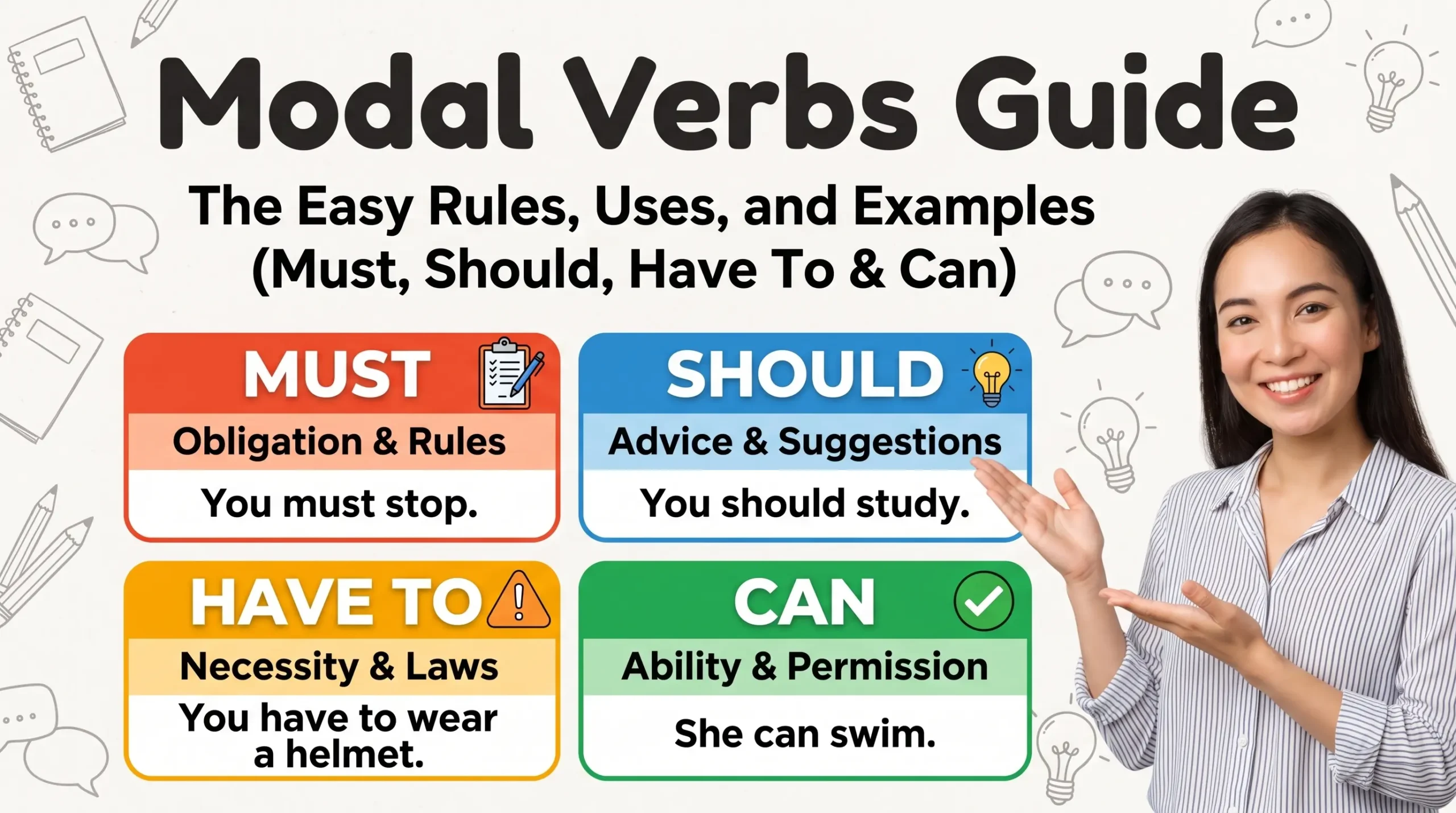
Welcome to our complete Modal Verbs Guide, where we break down how auxiliary verbs express obligation, advice, necessity, and capability in English. Unlike standard main verbs or basic helping verbs, modal auxiliary’s verbs in English grammar do not describe direct physical or mental actions by themselves. Instead, they modify the main verb to signal how an action is perceived—whether it is a strict legal requirement, a friendly recommendation, a physical capability, or a formal prohibition.
Mastering modal verbs—specifically Must, Should, Have To, and Can—is essential for achieving natural, polite, and precise communication in both written and spoken English. This comprehensive guide breaks down the structural rules, specific situational uses, pedagogical error analyses, and interactive practice exercises to help you master these essential grammar tools.
1. Fundamental Rules Governing All Modal Verbs
Before examining each verb individually, you must understand the five universal structural rules that govern modal auxiliaries in standard English grammar.
Rule 1: Modal Verbs Never Change Form
Standard English main verbs change their endings based on the subject (e.g., I run, he runs, they ran). Modal verbs (must, should, can) are defective verbs—they have no third-person singular -s ending, no past participle (-ed), and no present participle (-ing) form.
- ❌ Incorrect: He cans speak fluent English.
- ✔️ Correct: He can speak fluent English.
- ❌ Incorrect: She is shoulding study harder.
- ✔️ Correct: She should study harder.
Rule 2: Followed Directly by the Bare Infinitive
A modal verb is always followed directly by the base form of the main verb (the bare infinitive, without the word to).
- ❌ Incorrect: You must to finish your report by 5 PM.
- ✔️ Correct: You must finish your report by 5 PM.
- ❌ Incorrect: We should buying a new computer.
- ✔️ Correct: We should buy a new computer.
(Note: “Have to” is classified as a semi-modal verb because it incorporates the infinitive particle “to” as part of its fixed formula).
Rule 3: No Auxiliary Verbs in Negatives or Questions
Unlike standard verbs that require helper verbs like do, does, or did for questions and negatives, core modal verbs form negatives simply by adding not (or n’t) and form questions by inverting with the subject.
- ❌ Incorrect: Do you can solve this equation?
- ✔️ Correct: Can you solve this equation?
- ❌ Incorrect: You don’t must enter this secure area.
- ✔️ Correct: You must not enter this secure area.
Rule 4: Modal Verbs Cannot Be Combined
In standard English, two modal verbs cannot be placed directly side-by-side in a single clause.
- ❌ Incorrect: She will can join us for dinner tomorrow.
- ✔️ Correct: She will be able to join us for dinner tomorrow.
2. Detailed Breakdown of Key Modal Verbs (Must, Should, Have To & Can)
A. MUST: Strong Obligation, Authority & Logical Certainty
The modal verb must expresses strong personal obligation, authoritative requirements, or high logical certainty based on available evidence.
Key Functions and Usage Rules:
- Internal Strong Obligation: Use must when the obligation comes from the speaker’s personal feeling, determination, or internal sense of duty.
- Example: I must call my mother tonight; I haven’t spoken to her in weeks.
- Written Rules and Official Commands: Use must in official notices, laws, or instructional documents.
- Example: All visitors must register at the front desk before entering the facility.
- Strong Logical Deduction (Near Certainty): Use must when you are almost 100% sure something is true based on clear evidence.
- Example: The ground is completely wet. It must have rained heavily overnight.
Negative Form: MUST NOT (MUSTN’T)
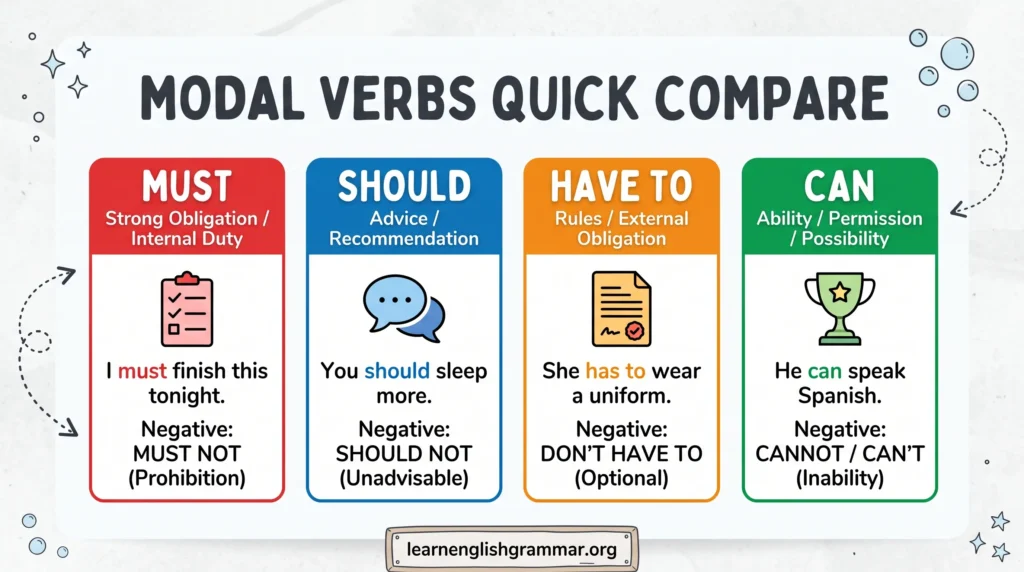
Crucial Distinction: While must indicates strong necessity, must not (or mustn’t) indicates absolute prohibition—meaning it is forbidden or illegal to perform the action.
- Example: You must not smoke in the hospital laboratory. (It is strictly prohibited).
B. HAVE TO: External Obligation, Rules & Physical Necessity
While have to functions identically to modal verbs in meaning, it is structurally a semi-modal. Unlike core modals, have to changes its form according to tense and subject (has to, had to, will have to) and uses do/does/did for questions and negative forms.
Key Functions and Usage Rules:
- External Obligation and Laws: Use have to when the rule, requirement, or constraint comes from an external authority, law, boss, or outside circumstance rather than personal preference.
- Example: Drivers have to carry a valid driver’s license at all times. (External legal requirement).
- Example: Mark has to wear a uniform at his new job.
- Past and Future Obligations: Because must lacks past and future tense forms, have to is used for obligations across all time frames.
- Past: We had to submit our tax forms yesterday.
- Future: You will have to present your passport at border control tomorrow.
Negative Form: DO NOT HAVE TO
Critical Meaning Shift: Negating have to does not mean prohibition. Instead, don’t have to / doesn’t have to signals a lack of obligation or necessity—meaning the action is optional.
- Example: You don’t have to come to the office on Saturday; it is completely optional.
C. SHOULD: Advice, Recommendations & Expectations
The modal verb should is significantly weaker than must or have to. It conveys recommendations, advisable behavior, social expectations, or mild obligation.
Key Functions and Usage Rules:
- Giving Friendly Advice or Suggestions: Use should when offering guidance on what is good, wise, or beneficial.
- Example: You should sleep at least eight hours before taking your final examination.
- Social Duties and General Expectations: Use should for actions that are desirable or morally right, though not legally enforced.
- Example: People should recycle plastic containers to protect the environment.
- Probability and Logical Expectation: Use should when expecting something to happen based on normal scheduling or assumptions.
- Example: The delivery package should arrive by 3 PM today.
Negative Form: SHOULD NOT (SHOULDN’T)
Use should not (or shouldn’t) to advise someone against doing something because it is unwise, unhelpful, or harmful.
- Example: You shouldn’t eat heavy meals right before going to sleep.
D. CAN: Ability, Permission & Possibility
The modal verb can is one of the most versatile auxiliary verbs in English, covering physical capability, informal permission, and theoretical possibilities.
Key Functions and Usage Rules:
- General Ability and Skill: Use can to express present physical, mental, or acquired abilities.
- Example: She can fluently translate complex French legal documents.
- Informal Permission: Use can in casual settings to ask for or give permission.
- Example: Can I borrow your pen for a second?
- Example: You can leave the meeting early if you have finished your tasks.
- General or Theoretical Possibility: Use can to describe circumstances that are generally possible under standard conditions.
- Example: Winters in northern regions can get extremely harsh and cold.
Negative Form: CANNOT (CAN’T)
Note that the full written negative form of can is spelled as a single word (cannot), while the spoken contraction is can’t. It indicates inability or denial of permission.
- Example: You cannot enter the venue without a valid entry ticket.
3. Comparison Matrix for Modal Verbs
| Modal Verb | Primary Category | Degree of Force | Example Sentence |
| Must | Internal Obligation / Rule | Extremely Strong | I must save money for my emergency fund. |
| Must Not | Prohibition / Forbidden | Absolute Restriction | You must not park in front of the emergency exit. |
| Have To | External Requirement / Law | Extremely Strong | Employees have to badge in at the security gate. |
| Don’t Have To | Lack of Obligation / Optional | Zero Constraint | You don’t have to attend the optional workshop. |
| Should | Advice / Expectation | Moderate / Advisory | You should review your vocabulary notes daily. |
| Can | Ability / Permission | Neutral / Capability | She can solve advanced calculus problems effortlessly. |
4. 10 Common Mistakes with Modal Verbs & How to Fix Them & How to Fix Them
Below are ten high-frequency errors made by English language learners, paired with corrections and clear pedagogical reasons.
- Mistake 1: Adding “to” After Core Modal Verbs
- ❌ Incorrect: You must to present your identification at the counter.
- ✔️ Correct: You must present your identification at the counter.
- Pedagogical Reason: Core modal verbs (must, should, can) are followed directly by the bare infinitive. Inserting the particle to breaks modal verb rules.
- Mistake 2: Adding Third-Person Singular “-s” to Modals
- ❌ Incorrect: She cans operate heavy machinery safely.
- ✔️ Correct: She can operate heavy machinery safely.
- Pedagogical Reason: Modal verbs are invariant. They never take third-person endings like -s or -es, regardless of the subject pronoun.
- Mistake 3: Confusing “Must Not” (Prohibition) with “Don’t Have To” (Option)
- ❌ Incorrect: You must not pay for the museum entrance today because it is free on Sundays.
- ✔️ Correct: You don’t have to pay for the museum entrance today because it is free on Sundays.
- Pedagogical Reason: Must not indicates that an action is strictly illegal or forbidden. When an action is merely unnecessary or free of charge, use don’t have to.
- Mistake 4: Using “Do/Does” to Form Questions with Core Modals
- ❌ Incorrect: Do you can speak Spanish fluently?
- ✔️ Correct: Can you speak Spanish fluently?
- Pedagogical Reason: Core modal verbs do not use auxiliary verbs like do or does to construct questions. Questions are formed by simple subject-modal inversion.
- Mistake 5: Stacking Two Modal Verbs Together
- ❌ Incorrect: He should can pass the driver’s test easily.
- ✔️ Correct: He should be able to pass the driver’s test easily.
- Pedagogical Reason: English grammar forbids placing two modal verbs side-by-side. Convert the second verb into an equivalent phrasal form (can becomes be able to).
- Mistake 6: Using Modals with Past Tense Main Verbs
- ❌ Incorrect: They should completed their homework yesterday.
- ✔️ Correct: They should have completed their homework yesterday.
- Pedagogical Reason: Modal verbs must always be followed by the base form of the main verb. To express past unfulfilled advice, use should have + past participle.
- Mistake 7: Misspelling “Cannot” as Two Separate Words in Formal Writing
- ❌ Incorrect: I can not attend the board meeting tomorrow morning.
- ✔️ Correct: I cannot attend the board meeting tomorrow morning.
- Pedagogical Reason: In standard formal English, the negative form of can is written as a single compound word (cannot), unlike should not or must not.
- Mistake 8: Using “Must” for Past Obligations
- ❌ Incorrect: Yesterday, I must go to the dentist for an emergency root canal.
- ✔️ Correct: Yesterday, I had to go to the dentist for an emergency root canal.
- Pedagogical Reason: The modal verb must has no past tense form. All past obligations must be expressed using had to.
- Mistake 9: Using “Should” for Absolute Legal Mandates
- ❌ Incorrect: Drivers should stop when the traffic light turns red.
- ✔️ Correct: Drivers must stop when the traffic light turns red. (or “have to stop”)
- Pedagogical Reason: Should conveys advice or recommendations that can be legally ignored. Enforced laws and mandatory requirements require must or have to.
- Mistake 10: Using “Must” for Negative Deductions
- ❌ Incorrect: He worked out all day, so he must not be energetic.
- ✔️ Correct: He worked out all day, so he can’t be energetic.
- Pedagogical Reason: When making a negative logical deduction based on clear evidence, standard English uses can’t (or cannot), not must not.
5. Interactive Practice Exercise: Modal Verbs Mastery
Choose the correct option (must, must not, have to, don’t have to, should, or can) to complete each sentence.
Want instant feedback on your answers? Try our Free Interactive Practice Exercise with Autotick Marking to test your knowledge in real-time.
- You __________ wear a safety helmet while working on the construction site; it is a strict government regulation.
- The museum entrance is completely free today, so you __________ buy a ticket.
- She __________ speak three languages fluently, including German, Italian, and Spanish.
- You __________ touch those high-voltage electrical wires under any circumstances! It is extremely dangerous.
- If you feel dizzy and tired, you __________ take a short break and drink some water.
- I __________ work late last night to finish the quarterly budget report before the deadline.
- Members of the library __________ return borrowed books within two weeks to avoid paying late fees.
- __________ you lend me a hand with lifting these heavy cardboard boxes?
- You __________ worry about preparing dinner tonight; I have already ordered food from the restaurant.
- Candidates __________ submit their completed job applications prior to 5:00 PM on Friday.
Answer Key & Detailed Pedagogical Explanations
- Answer 1: must (or have to) — Use must or have to to express mandatory legal regulations and safety requirements imposed by authority.
- Answer 2: don’t have to — Use don’t have to to indicate that an action is unnecessary or optional because admission is free.
- Answer 3: can — Use can to describe personal abilities, learned skills, and language proficiencies.
- Answer 4: must not — Use must not to express strong prohibition where an action is dangerous or forbidden.
- Answer 5: should — Use should to offer sensible health advice and helpful personal recommendations.
- Answer 6: had to — Use had to because the sentence describes a past obligation completed “last night” (since must cannot be used in the past tense).
- Answer 7: have to (or must) — Use have to or must for institutional rules and policy mandates enforced by an organization.
- Answer 8: Can — Use Can at the start of a clause to form a polite, informal request for assistance.
- Answer 9: don’t have to — Use don’t have to to reassure someone that an action is completely unnecessary.
- Answer 10: must (or have to) — Use must or have to to convey formal administrative deadlines and mandatory application requirements.
Review our full breakdown on subject-verb agreement to avoid confusing helper verbs.
Upgrade your learning experience with our full range of English Grammar Lessons featuring Autotick Marking Facilities. Get instant automated grading, detailed explanation keys, and guided exercises for every grammar topic!
Frequently Asked Questions About Modal Verbs
What is the main difference between “must” and “have to”?
The primary difference lies in the source of the obligation. Use must when the obligation comes from the speaker’s internal feelings, personal choice, or sense of duty (e.g., “I must call my sister”). Use have to when the obligation is imposed by external rules, laws, or authority (e.g., “I have to wear a uniform at work”). Additionally, have to can be conjugated into past and future tenses, whereas must is used strictly in the present.
Why can’t I say “I must to go” or “He can to swim”?
Core modal verbs (can, could, may, might, must, shall, should, will, would) are auxiliary verbs that must be followed directly by a bare infinitive (the base form of the verb without the particle to). Adding to violates standard English modal syntax. The only common exception is the semi-modal ought to.
How do I use modal verbs in the past tense?
Core modals like must and should do not have past tense forms. To express past advice or missed opportunities, pair the modal with have + past participle (e.g., “You should have studied harder”). For past obligations, replace must with had to (e.g., “Yesterday, I had to stay late at work”).
Does “must not” mean the same thing as “don’t have to”?
No, they express opposite concepts. Must not (or mustn’t) indicates a strict prohibition—meaning an action is forbidden, dangerous, or illegal (e.g., “You must not park here”). Don’t have to indicates a lack of obligation—meaning the action is optional and entirely up to you (e.g., “You don’t have to pay; it’s free”).
Which modal verb should I use to make polite requests?
For casual settings with friends or peers, can is standard (e.g., “Can I use your pen?”). For more polite or formal situations (such as in business emails or when speaking to strangers), use could or may (e.g., “Could you please send me the report?” or “May I leave early today?”).