
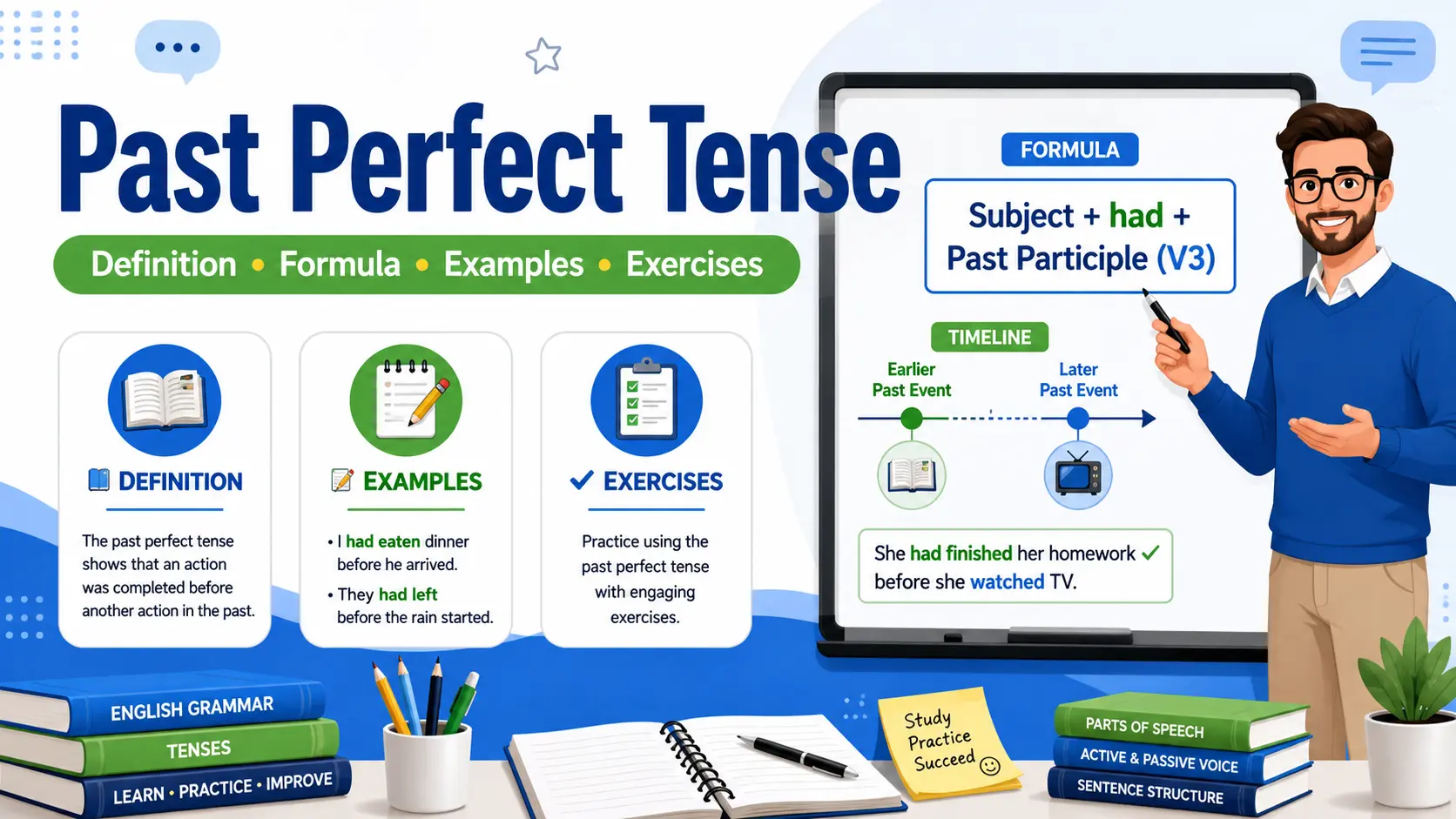
We’ve all been there trying to tell a great story about something that happened last weekend, only to realize we need to jump even further back in time to explain why it happened. It’s like saying, “By the time I finally sat down to watch the match, my friend had already accidentally ruined the score for me.” That little trick of stepping backward into a “past before the past” is exactly what we are mastering today. Don’t worry if it sounds a bit like time travel; once you see how it works, it becomes an incredibly natural way to make your stories clearer and more engaging.
Table of Contents
🔍 What is the Past Perfect Tense?
The past perfect tense is used to describe an action that was completed before another action in the past.
👉 In simple terms:
It shows the earlier past action.
Example:
- She had finished her homework before dinner.
- They had left when I arrived.
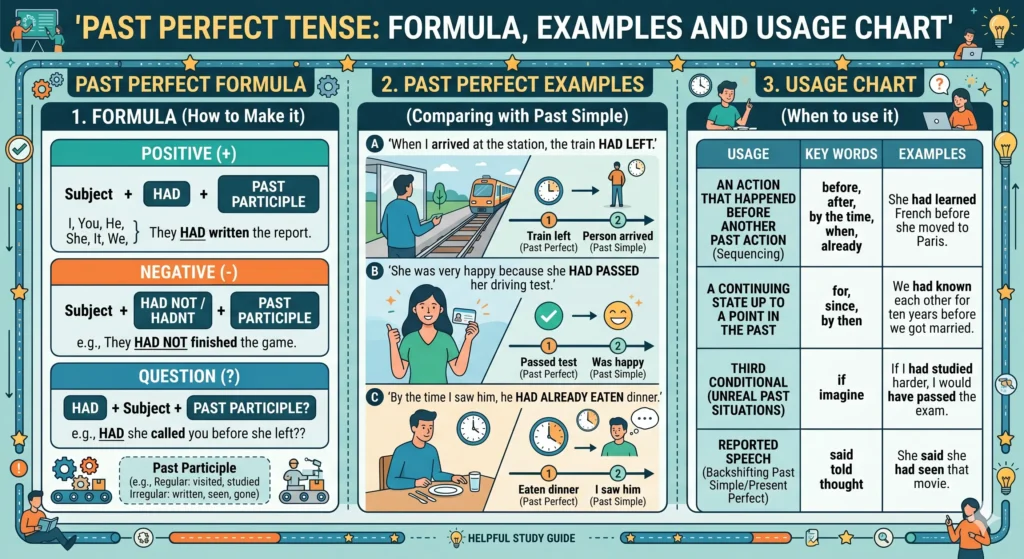
🧱 Past Perfect Tense Structure (Formula)
Past perfect constructions follow standard academic rules for verbal aspect
Subject+had+past participle (V3)
✔ Affirmative Sentences
- I had eaten breakfast.
- She had gone to school.
❌ Negative Sentences
- I had not eaten breakfast.
- She had not gone to school.
👉 Short form:
- had not → hadn’t
❓ Interrogative Sentences
- Had you finished your work?
- Had they arrived early?
Past Tenses Sequence Matrix
| Tense | Sentence Position / Structural Function | Timeline Description | Example Sentence |
| Past Perfect Simple | Subject + had + V3 | First / Earlier Action (Completed before another past moment) | “The train had left before we reached the platform.” |
| Past Simple | Subject + V2 | Second / Later Action (Completed after the earlier past action) | “The train had left before we reached the platform.” |
| Past Continuous | Subject + was/were + V-ing | Background Action (In progress when another action occurred) | “It was raining when the train arrived.” |
📌 When to Use the Past Perfect Tense
1️⃣ To show one action happened before another
- She had left before I arrived.
- We had eaten before the movie started.
2️⃣ To describe a completed action in the past
- He had completed the project on time.
3️⃣ With time expressions
Common words:
- before
- after
- already
- just
- by the time
Examples:
- By the time I got there, they had gone.
- She had already finished her homework.
🧠 Signal Words
Look for these words:
- before
- after
- already
- just
- by the time
- when
📖 More Examples of Past Perfect Tense
- They had cleaned the room before guests arrived.
- I had never seen such a beautiful place.
- She had studied English before moving abroad.
- We had finished dinner when he called.
🎯 Past Perfect Tense Timeline (Visual Explanation)
The past perfect tense is best understood using a timeline because it shows the order of events in the past.
When I first started looking closely at how we stitch our memories together, I realized that our brains naturally think in layers. We don’t just experience life in a straight line; we constantly connect the dots between what we did and what happened before that. That’s why I love using timelines for this specific tense. It takes away the guesswork of grammar formulas and turns the language into a visual map. Let’s look at how drawing it out can instantly make those confusing sentences click into place.
🕒 How the Timeline Works
- Earlier action → Past Perfect Tense
- Later action → Past Simple Tense
👉 Example:
- She had finished her homework before dinner started.
📌 Timeline Explanation
Past -----------|-----------|-------- Present
                ↑           ↑
         had finished     dinner started
👉 This shows:
- The homework was completed first
- Dinner happened after
📖 More Timeline Examples
Example 1
- They had left before we arrived.
Timeline:
Past -----------|-----------|-------- Present
                ↑           ↑
           had left       arrived
Example 2
- I had never seen such a beautiful place before I visited Paris.
Timeline:
Past -----------|-----------|-------- Present
                ↑           ↑
        had never seen     visited Paris
⚠️ Why This Is Important
Many learners confuse tenses because they don’t see the sequence clearly.
👉 The past perfect tense helps you:
- Avoid confusion
- Show clear order of events
- Write more accurately
💡 Pro Tip
Whenever you see two actions in the past, ask:
👉 Which happened first?
- First → use past perfect tense
- Second → use past simple
🧠 Quick Memory Trick
👉 Think of past perfect as:
“The past before the past”
Stative Verbs and Stative Exceptions
Unlike continuous tenses, the Past Perfect Simple easily handles stative verbs (verbs describing states of mind, emotion, perception, or possession rather than active physical processes).
- Mental States & Knowledge:
- Correct: “I had known the owner for five years before we signed the contract.”
- ❌ Avoid: “I had been knowing the owner…” (Stative verbs do not take continuous forms).
- Possession & Ownership:
- Correct: “By the time they sold the company, they had owned the custom solar cookers for a decade.”
- Emotions & Perception:
- Correct: “She had always loved English literature before she enrolled in the university course.”
⚠️ Common Mistakes
- Mistake 1: Using Past Simple Verb Forms (V2) Instead of Past Participles (V3)
- ❌ Incorrect: She had went to the main office before calling.
- ✔️ Correct: She had gone to the main office before calling.
- Pedagogical Reason: The auxiliary verb had must always pair with the past participle (V3), never the simple past (V2).
- Mistake 2: Misplacing Time Adverbs (“Already”, “Just”, “Never”)
- ❌ Incorrect: I had finished already my revisions before dinner.
- ✔️ Correct: I had already finished my revisions before dinner.
- Pedagogical Rule: Mid-position adverbs sit directly between the helper verb had and the main past participle (V3).
- Mistake 3: Overusing Past Perfect When Simple Sequential Order Is Clear
- ❌ Incorrect: Yesterday I had woken up, I had eaten breakfast, and I had gone to work.
- ✔️ Correct: Yesterday I woke up, ate breakfast, and went to work.
- Pedagogical Reason: When listing chronological events using then, and, or clear sequence, use the Simple Past. Reserve Past Perfect strictly when stepping out of order to explain an earlier event.
- Mistake 4: Using “Did” Instead of “Had” in Past Perfect Questions
- ❌ Incorrect: Did they finished their exercises before the teacher arrived?
- ✔️ Correct: Had they finished their exercises before the teacher arrived?
- Pedagogical Reason: Form Past Perfect questions by placing had before the subject, followed by V3.
- Mistake 5: Misusing “By the Time” with the Past Perfect in Both Clauses
- ❌ Incorrect: By the time he had arrived, she had left.
- ✔️ Correct: By the time he arrived, she had left.
- Pedagogical Rule: The clause following by the time takes the Simple Past, while the main clause takes the Past Perfect.
- Mistake 6: Confusing “Before” and “After” Clause Placement
- Rule 1 (With After): After + Past Perfect, Past Simple (“After she had studied, she slept”).
- Rule 2 (With Before): Past Perfect + before + Past Simple (“She had studied before she slept”).
🔄 Past Perfect vs Past Simple
| Past Perfect | Past Simple |
|---|---|
| Earlier action | Later action |
| She had left before I arrived | I arrived |
| Shows sequence | Shows completed action |
👉 Example:
- She had left before I arrived
Learning a language is a journey of small victories, and getting comfortable with a tense like this is a massive milestone. It’s the difference between just listing facts and actually painting a picture with your words. As you head into the practice section below, take your time and don’t sweat it if you make a mistake—that’s exactly how the rules stick. Give these exercises a shot and see how quickly you start recognizing the patterns!
Want to practice offline or get instant feedback? Download the FREE sample featuring our AutoTick instant-marking system!
📝 Exercises (Practice Section)
Complete each sentence by putting the verb in brackets into the correct tense (Past Perfect or Past Simple):
- By the time the fire truck arrived, the neighbors __________ (already / put) out the small fire.
- She realized she __________ (forget) her keys as soon as she closed the front door.
- The students __________ (not / complete) the worksheet before the bell rang.
- ( Had ) __________ you __________ (see) that specific grammar guide prior to yesterday’s lecture?
- After we __________ (review) the contract terms, we signed the agreement.
- The ground was dry because it __________ (not / rain) for several weeks.
- He __________ (never / visit) Malaysia until he attended the international conference.
- Before she moved to Sri Damansara, she __________ (work) as a quantity surveyor in town.
- When I turned on the television, the news broadcast __________ (already / start).
- They missed the flight because they __________ (misread) the departure time on their tickets.
Answer Key & Detailed Explanations:
- had already put — Put out occurred before the fire truck arrived.
- had forgotten — Forgetting keys happened prior to closing the door (Simple Past).
- had not completed (hadn’t completed) — Negative action prior to the bell ringing.
- Had / seen — Interrogative Past Perfect querying an event prior to yesterday.
- had reviewed — Action following after takes Past Perfect prior to signing (Simple Past).
- had not rained — Earlier absence of rain causing dry ground.
- had never visited — State existing prior to the past visit.
- had worked — Employment existing before the past move.
- had already started — Broadcast began prior to turning on the TV.
- had misread — Misreading ticket occurred prior to missing the flight.
Master All English Tenses with Automated Grading:
Looking for complete tense mastery? Explore our English Grammar Lessons with Autotick Marking Facilities to get hundreds of interactive exercises, automated grading, and detailed answer explanations for every English tense!”
❓ FAQ
What is the past perfect tense in simple words?
Think of the past perfect tense as “the past before the past.” It is the tool we use when we are already talking about the past, but we need to step even further back in time to show an action that was completed before another event happened.
What is the formula of past perfect tense?
The structure is incredibly consistent because it never changes, no matter who or what the subject is:
Subject + had + past participle (V3 form of the verb)
Example: She (Subject) + had + gone (V3) to school.
For negatives: Just add “not” after had (had not / hadn’t).
When do we use past perfect tense?
We use it whenever the timing of two past events matters. If you just list things in order, you can use the past simple (e.g., “I ate breakfast and then I went to work”). But if you want to emphasize that one action was completely finished before the next one started, you use the past perfect for the earlier action (e.g., “I had eaten breakfast before I went to work”).
What are some common examples of the past perfect tense?
Here are a few quick examples to help you see it in action:
She had finished her homework before dinner started.
They had left the station before our train arrived.
I had never seen such a beautiful beach until I visited Sabah.