
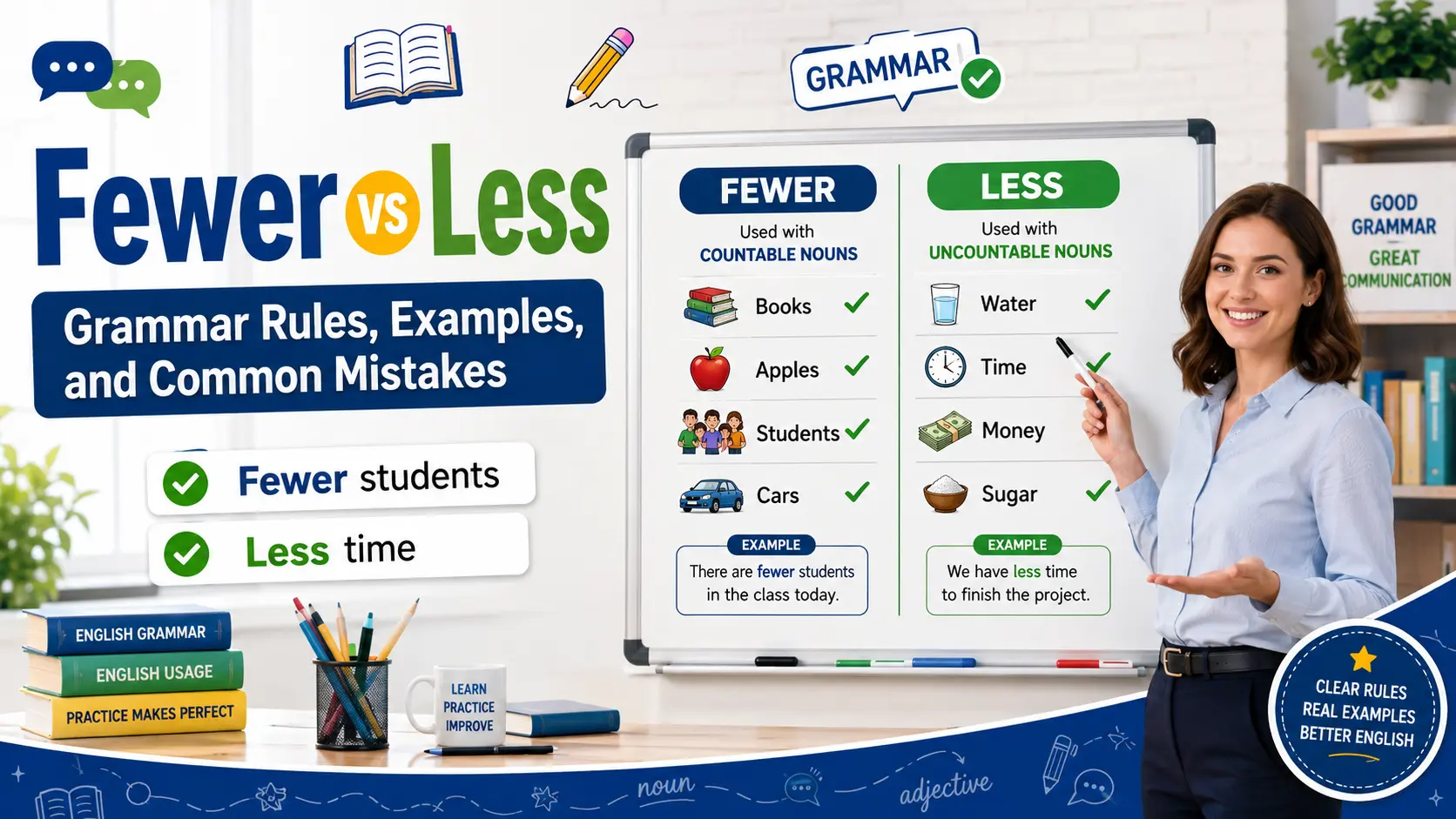
Fewer vs less is one of the most common grammar mistakes in English. Have you ever wondered whether you should say “fewer people” or “less people”? Many English learners—and even native speakers—confuse these two words.
If you’ve ever stood in a grocery store checkout line, stared at the “10 items or less” sign, and felt a sudden pang of grammatical doubt, you are definitely not alone. Language is fluid, and because we hear these words interchanged so constantly in movies, casual conversations, and advertisements, our brains naturally start to blur the lines. It’s completely normal to second-guess yourself here, but cracking the code is much easier than it looks.
Table of Contents
The Historical Origins of the “Fewer vs. Less” Rule
The distinction between fewer and less is not a modern creation; it dates back over a thousand years to Old English, where feawa (few) and laes (less) served distinct grammatical functions.
However, the rigid prescriptive rule we follow today was popularized in 1770 by the British grammarian Robert Baker in his book Remarks on the English Language. Baker noted a personal preference for using fewer with plural nouns (such as fewer dry boots) and less with continuous quantities (less water). Over the following centuries, style guides adopted Baker’s preference as an absolute rule. Understanding that this distinction exists to enhance sentence precision—rather than arbitrarily restrict language—makes applying it much more straightforward.
Understanding the Difference Between Fewer and Less
Understanding the difference can make your English sound more natural, professional, and grammatically correct. In this guide, you’ll learn the simple rule, see plenty of examples, and discover how to avoid one of the most common grammar mistakes in English.
The Basic Rule
| Use Fewer | Use Less |
|---|---|
| Countable nouns | Uncountable nouns |
| fewer books | less water |
| fewer students | less time |
| fewer cars | less money |
The easiest way to remember the difference is:
- Fewer is used with things you can count.
- Less is used with things you cannot count individually.
Use “Fewer” for Countable Nouns
Countable nouns are things that can be counted one by one.
Examples:
- fewer apples
- fewer students
- fewer books
- fewer cars
- fewer mistakes
Correct:
- There are fewer students in the classroom today.
- I made fewer mistakes on this test.
- We need fewer chairs for the meeting.
Use “Less” for Uncountable Nouns
Uncountable nouns are things that are measured rather than counted.
Examples:
- less water
- less time
- less money
- less sugar
- less traffic
Correct:
- I have less time than I did yesterday.
- This recipe uses less sugar.
- We spent less money this month.
Master Comparison: “Fewer” vs. “Less” at a Glance
| Feature / Category | “Fewer” | “Less” |
| Primary Noun Type | Plural Countable Nouns | Singular Uncountable / Mass Nouns |
| Core Question | “How many?” | “How much?” |
| Modification Type | Individual, discrete items | Continuous amounts, volumes, or mass |
| Standard Examples | fewer errors, fewer ingredients, fewer pages | less effort, less flour, less paper |
| Measurement Exception | Rare (Used for individual unit counts) | Standard for time, money, distance, & weight |
English Grammar Worksheets with AutoTick™
✔ AutoTick™ Secure Answer Checking System
✔ Step-by-step instructions
✔ Answer keys with clear explanations
✔ Password-protected marking (prevents cheating)
Why Do People Confuse Them?
In everyday conversation, many people use less for both countable and uncountable nouns.
For example:
- ❌ Less people attended the event.
- ✅ Fewer people attended the event.
Although you may hear native speakers say “less people,” formal English grammar considers this incorrect because people can be counted.
The confusion happens because “less” often sounds more natural in casual speech, but using “fewer” correctly will improve your grammar and writing.
Common Examples
Let’s compare some sentences.
Countable Nouns → Use Fewer
❌ Less books were sold this year.
✅ Fewer books were sold this year.
❌ There are less cars on the road today.
✅ There are fewer cars on the road today.
❌ She has less friends than her brother.
✅ She has fewer friends than her brother.
Uncountable Nouns → Use Less
❌ I need fewer water.
✅ I need less water.
❌ We have fewer patience today.
✅ We have less patience today.
❌ He spends fewer money on food.
✅ He spends less money on food.
A Simple Trick to Remember
Ask yourself:
Can I count it one by one?
If the answer is yes, use fewer.
If the answer is no, use less.
Examples:
- Students → countable → fewer students
- Cookies → countable → fewer cookies
- Water → uncountable → less water
- Time → uncountable → less time
This simple question will help you choose the correct word in most situations.
Mastering fewer vs less is a great step toward improving your English. However, it is only one of many commonly confused grammar rules. Explore our Common English Grammar Mistakes category to discover more lessons, examples, and tips for avoiding frequent errors.
Special Cases
English grammar has a few exceptions where less is commonly used even with things that can technically be counted.
Time
We usually say:
- less than an hour
- less time
- less than five minutes
Example:
- The journey took less than two hours.
Money
Even though money can be counted, we often treat it as a single amount.
Example:
- The laptop costs less than $500.
Distance
Example:
- The school is less than five kilometers away.
Weight and Measurement
Example:
- The package weighs less than 10 kilograms.
In these situations, we are thinking about the total amount rather than individual units, so less is preferred.
1. Singular Nouns that Take “Fewer” (Exceptions to the Rule)
While fewer is almost exclusively used with plural nouns, it can modify singular nouns when referring to distinct, countable components of a whole.
- Example: “This modified solar recipe requires fewer than one full cup of oil.”
2. The Difference Between “Fewer” and “Lesser”
Do not confuse less with lesser. While less refers to quantity or amount, lesser is an adjective meaning “inferior in size, quality, or importance.”
- Correct: “He chose the lesser of two evils.” (Meaning the secondary or less severe option).
- Incorrect: “He made lesser mistakes on the exam.” $\rightarrow$ Correct: “He made fewer mistakes on the exam.”
Common Mistakes to Avoid
Here are some mistakes English learners frequently make:
❌ Less emails
✅ Fewer emails
❌ Less customers
✅ Fewer customers
❌ Fewer information
✅ Less information
❌ Fewer advice
✅ Less advice
Confusing Abstract Countable Nouns with Uncountable Nouns
- ❌ Incorrect: “There are less reasons to worry about the system update.”
- ✔️ Correct: “There are fewer reasons to worry about the system update.”
- Pedagogical Reason: Even though “reasons” feels like an abstract concept, the word itself is grammatically plural and countable (one reason, two reasons).
Misusing “Less” with Percentage Changes on Countable Nouns
- ❌ Incorrect: “Our company received 20% less applications this quarter.”
- ✔️ Correct: “Our company received 20% fewer applications this quarter.”
- Pedagogical Reason: Because “applications” can be individual items, percentage modifiers must take fewer.
Double Modifiers (“Less Fewer”)
- ❌ Incorrect: “We have less fewer tasks remaining today.”
- ✔️ Correct: “We have fewer tasks remaining today.”
- Pedagogical Reason: Combining comparative quantifiers creates an ungrammatical double comparative.
Remember that information and advice are uncountable nouns in English, so they always take less, not fewer.
The difference between fewer and less becomes much easier to understand when you know the difference between countable and uncountable nouns. If you’re still unsure whether a noun can be counted or measured, check out our guide on Countable and Uncountable Nouns for detailed explanations and examples.
Quick Summary
Use fewer with countable nouns:
- fewer books
- fewer people
- fewer cars
- fewer students
Use less with uncountable nouns:
- less water
- less money
- less time
- less information
A simple rule to remember is:
If you can count it, use fewer. If you measure it, use less.
At the end of the day, remember that grammar is a tool for communication, not a test to trip you up. If you accidentally slip up and say “less” when you meant “fewer” during a casual conversation, don’t sweat it—the person you are talking to will still understand you perfectly. Perfection isn’t the goal; making progress and feeling a little more confident in your writing each day is what truly matters.
Expanded Practice Exercise: Test Your Knowledge
Choose the correct word (fewer or less) for each sentence:
- We encountered __________ technical issues after upgrading the website caching plugin.
- The project took __________ than three weeks to complete.
- Cooking with an evacuated vacuum tube requires __________ energy than using an electric stove.
- There are __________ students enrolled in the morning session this semester.
- He carried __________ than twenty dollars in his wallet.
- The revised grammar guide contains __________ pages, but offers __________ confusion.
- She made __________ mistakes on her second attempt.
- The factory produced __________ pollution after installing modern solar panels.
Answer Key & Explanations:
- fewer — “Issues” is a plural countable noun (one issue, two issues).
- less — Units of time (three weeks) represent a single bulk duration.
- less — “Energy” is a mass uncountable noun.
- fewer — “Students” is a plural countable noun.
- less — Sums of money (twenty dollars) function as a singular total amount.
- fewer / less — “Pages” is countable (fewer); “confusion” is uncountable (less).
- fewer — “Mistakes” is a plural countable noun.
- less — “Pollution” is an uncountable mass noun.
Final Thoughts
The difference between fewer and less is one of the most common grammar mistakes in English. Fortunately, the rule is simple once you understand it. Use fewer for things you can count and less for things you cannot count individually.
The next time you’re writing an email, preparing a report, or speaking English, take a moment to ask yourself: “Can I count this?” The answer will usually tell you whether to choose fewer or less.
With a little practice, you’ll make fewer grammar mistakes and write with greater confidence.
Frequently Asked Questions
Why do grocery stores use “10 items or less” if it’s grammatically incorrect?
It is a classic case of custom winning over strict grammar rules! While “10 items or fewer” is technically correct because items can be counted, “10 items or less” has been used for generations. It is shorter, punchier, and easier to fit on a supermarket sign. Even though it breaks the rule, the meaning is perfectly clear to shoppers.
While ’10 items or fewer’ is technically correct because items can be counted, ’10 items or less’ has been used for generations. Learn more about modern English usage evolution on the Merriam-Webster Usage Guide.
Should I say “less words” or “fewer words”?
You should say “fewer words.” Because individual words can be counted one by one (e.g., a 500-word essay), “words” is a countable noun. However, if you are referring to text as a whole concept, you would say “less writing” or “less text,” because “writing” and “text” are uncountable.
Is “people” countable or uncountable?
“People” is a countable noun. Even though it is an irregular plural word (it doesn’t end in an “s”), you can still count individuals—one person, two people, three people. Therefore, the grammatically correct phrase is always “fewer people,” not “less people.”
Why do we say “less than 20 dollars” if we can count money?
We use “less” here because we are viewing the $20 as a single, total quantity or bulk amount, rather than as 20 individual one-dollar bills. The same exception applies to other total measurements like time (less than 5 minutes), distance (less than 3 miles), and weight (less than 10 pounds).
Is it “less than 10” or “fewer than 10”?
It depends on what “10” refers to! If you are referring to countable items (e.g., “There were fewer than 10 participants at the meeting”), use fewer. If “10” refers to a measurement of time, distance, age, or money (e.g., “He is less than 10 years old” or “It costs less than 10 dollars”), use less.
What is the opposite of “fewer” and “less”?
The primary opposite of fewer is more (or many when asking questions). The opposite of less is also more (or much when asking questions). Because “more” works for both countable and uncountable nouns, it rarely causes grammatical confusion!