
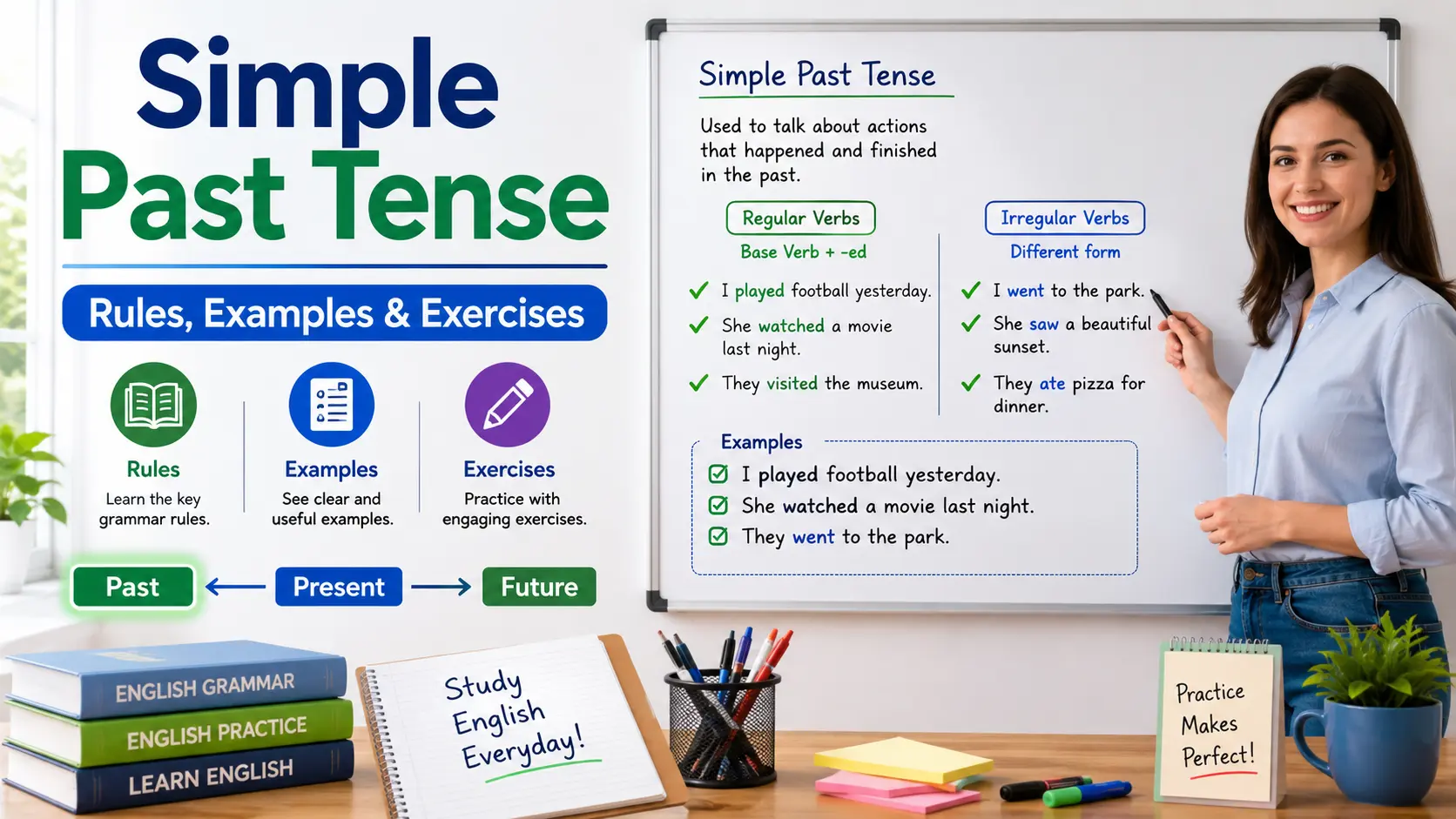
The simple past tense is used to describe actions that happened and finished in the past. It is one of the main topics in English grammar, especially when learning different English tenses.
👉 These actions are already completed — they are not happening now.
Examples:
- I walked to school yesterday.
- She finished her homework last night.
- They played football in the evening.
Think of the simple past tense as your personal storytelling tool. Whenever you want to share a funny memory, talk about what you did over the weekend, or explain an experience to a friend, this is the tense you’ll rely on. It takes your actions out of the present moment and safely tucks them into history. The great news is that once an action is finished, the tense stays fixed—meaning you don’t have to worry about the action changing anymore!
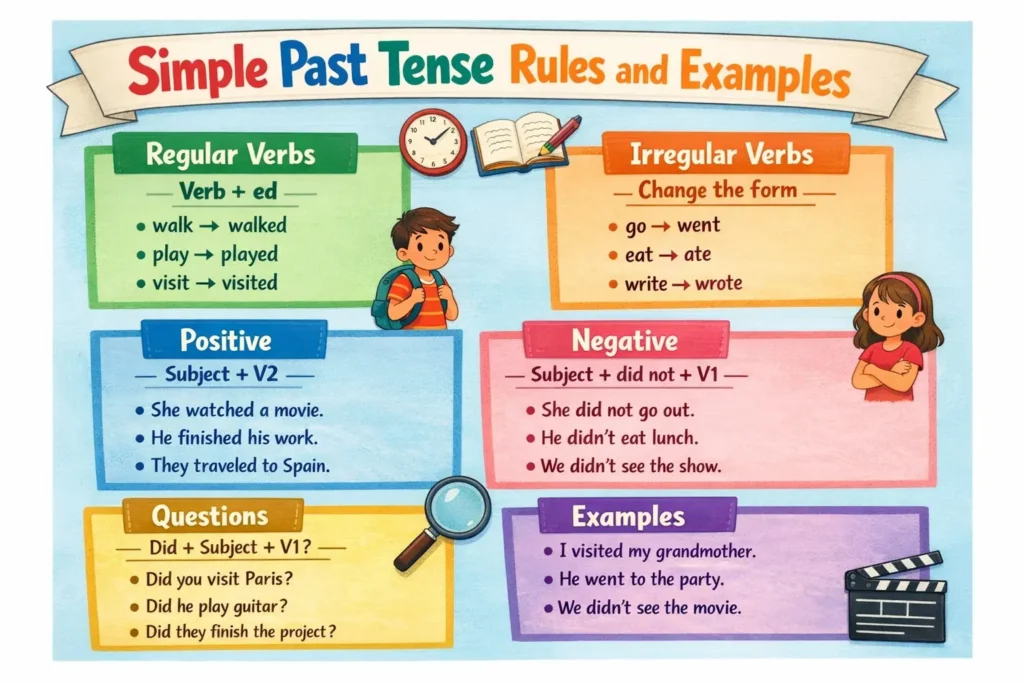
Table of Contents
📌 When Do We Use the Simple Past Tense?
We use the simple past tense for:
1. Completed actions in the past
- I visited my grandmother yesterday.
2. Actions that happened at a specific time
- He left at 8 a.m.
3. A series of past actions
- She woke up, brushed her teeth, and went to school.
🧠 Simple Past Tense Structure
✅ Positive Sentences
Subject + past form of verb
- I worked late.
- She watched TV.
- They ate dinner.
❌ Negative Sentences
Subject + did not (didn’t) + base verb
- I did not go to school.
- He didn’t like the movie.
👉 Note: Use base verb, NOT past verb after “did”
Here is a golden rule that will save you from a ton of future text editing: the word “did” is a total bully. In negatives and questions, did steps in and hogs all the past-tense power for itself. Because did already took the past form, it forces the main verb to stay in its plain, standard base form. Think of it as a double-negative rule—you never want to use two past tense words right next to each other. Keep did past, and keep your main verb clean!
Did + subject + base verb?
- Did you finish your homework?
- Did she call you?
Wh- Question Formation (Information Questions)When asking for specific information in the past (where, when, why, what, who, how), place the question word at the very beginning of the sentence:Question Word + did + Subject + Base Verb
- Examples: “Where did you go last night?” / “Why did they leave the meeting early?” / “What time did the show start?”
- The Special Case: Verb “To Be” (Was / Were)The auxiliary verb did is never used with the past tense of to be. Instead, swap sentence positions directly:
| Subject | Affirmative | Negative | Question |
| I / He / She / It | I was tired. | She was not at home. | Was he present? |
| You / We / They | They were happy. | We were not late. | Were you ready? |
🔤 Regular Verbs (Add -ed)
Most verbs form the past tense by adding -ed.
Examples:
- walk → walked
- play → played
- clean → cleaned
📝 Spelling Rules
- love → loved
- stop → stopped
- study → studied
Base Verbs Ending in “e”: Simply add -d. (like -> liked, arrive -> arrived).
Base Verbs Ending in Consonant + “y”: Change the -y to -i and add -ed. (carry -> carried, try -> tried).
Base Verbs Ending in Vowel + “y”: Keep the y and add -ed. (enjoy -> enjoyed, stay -> stayed).
One-Syllable Verbs Ending in CVC (Consonant-Vowel-Consonant): Double the final consonant before adding -ed. (stop -> stopped, plan -> planned, hug -> hugged). (Exception: Do not double consonants if the word ends in w, x, or y, such as play -> played).
If looking at this list of irregular verbs makes you want to close the page—take a deep breath! You are completely normal. Irregular verbs are notoriously mischievous because they throw the standard rules completely out the window. Nobody expects you to memorize hundreds of them overnight. The secret is that we actually use the same few dozen irregular verbs (like go, see, and eat) for 90% of our daily conversations. Master just a handful of the common ones first, and your brain will naturally start remembering the rest through context.
🔄 Irregular Verbs (Special Forms)
Some verbs do NOT follow the “-ed” rule.
Examples:
| Base Verb | Past Tense |
|---|---|
| go | went |
| eat | ate |
| see | saw |
| take | took |
| come | came |
Pattern 1: Verbs That Never Change (No-Change Group)
cut -> cut, put -> put, hit -> hit, cost -> cost, let -> let.
Pattern 2: Vowel Change Group (i -> a)
sing -> sang, drink -> drank, swim -> swam, begin -> began.
Pattern 3: Verbs Ending in “-ought” or “-aught”
buy -> bought, bring -> brought, think -> thought, teach -> taught, catch -> catch.
Pattern 4: Verbs Changing “-d” to “-t”
build -> built, send -> sent, spend -> spent.
✏️ More Example Sentences
- I bought a new book yesterday.
- She wrote a letter to her friend.
- We had a great time at the party.
- They did not understand the question.
- Did you see that movie?
Simple Past Tense vs. Present Perfect Tense
A major source of confusion for English learners is deciding whether to use the Simple Past or the Present Perfect.
- Simple Past (Finished Time / Specific Time): Use when the action is completely finished and happened at a specific, stated past time.
- Example: “I lost my keys yesterday.” (Finished action at a specific past time).
- Present Perfect (Unfinished Time / Connection to Present): Use when the exact time is unstated, or the action continues to affect the present moment.
- Example: “I have lost my keys.” (Implication: I still don’t have them right now).
⚠️ Common Mistakes
❌ Wrong:
- I did not went to school.
✅ Correct:
- I did not go to school.
❌ Wrong:
- She goed home early.
✅ Correct:
- She went home early.
❌ Wrong:
- Did you ate dinner?
✅ Correct:
- Did you eat dinner?
Using Past Tense Forms After “To” (Infinitive Errors)
- ❌ Incorrect: “I wanted to went home.”
- ✔️ Correct: “I wanted to go home.”
- Pedagogical Reason: Infinitive verbs following “to” must always remain in their clean base form (to go, to see, to study).
Double Past-Tense Marking in Negative Sentences
- ❌ Incorrect: “She didn’t liked the presentation.”
- ✔️ Correct: “She didn’t like the presentation.”
- Pedagogical Reason: The auxiliary verb did already carries the past tense signal. Placing -ed on the main verb creates an ungrammatical double past form.
You can also explore more common errors in our guide on common grammar mistakes.
📚 Tips to Learn Faster
- Practice every day
- Learn common irregular verbs
- Write your own sentences
- Read simple English stories
🚀 Practice with Worksheets
Reading is helpful — but practice is the key to improvement.
👉 Try structured exercises to master the simple past tense:
👉 🎁 Download Free Grammar Worksheets Sample
👉 🚀 Get Full Grammar Worksheets (Levels 1–6)
Practice Exercises
Complete the sentences using the correct past tense form:
- They __________ (build) a new solar oven last weekend.
- We __________ (not see) the announcement on the website yesterday.
- Where __________ you __________ (buy) that grammar workbook?
- The students __________ (be) very excited about the field trip.
- She __________ (stop) the car when the light turned red.
Answer Key & Detailed Explanations:
- built — Irregular verb changing from -d to -t.
- did not see / didn’t see — Negative past form using did not + base verb see.
- did / buy — Question structure: Where + did + subject + base verb buy.
- were — Past form of to be for plural subject students (they).
- stopped — Double the consonant p (CVC rule) before adding -ed.
🎯 Final Thoughts
The simple past tense is one of the most important parts of English grammar. Once you understand how it works, you can talk about past events clearly and confidently.
Start with simple rules, practice regularly, and you will improve step by step.
At the end of the day, moving from the present tense into the past tense is one of the biggest leaps you’ll take in your English learning journey. It unlocks the ability to share your history, your background, and your stories with the world. Don’t worry about being completely flawless right from the start. Grab a piece of paper, try out the practice exercises below, and celebrate the small wins. You’re building an incredible foundation, one step at a time!
For additional explanations and interactive exercises, you can check out the British Council’s Past Simple Guide.
FAQ on Simple Past Tense
What are the most common “clue words” for the simple past tense?
To spot or use the simple past tense easily, look for specific past time markers. The most common ones are yesterday, last (last night, last week, last year), ago (two days ago, five minutes ago), and specific past years or times (in 2015, at 9:00 AM).
Why do some “-ed” verbs sound like a “T” or a “D”?
Even though regular past tense verbs all end in -ed, they are pronounced in three different ways depending on the last sound of the base verb:
Sounds like /t/: If the verb ends in a voiceless sound like p, k, s, ch, sh (e.g., walked sounds like “walk-t”, watched sounds like “watch-t”).
Sounds like /d/: If the verb ends in a voiced sound like l, n, r, v, z (e.g., cleaned sounds like “clean-d”, played sounds like “play-d”).
Sounds like /id/: Only when the verb ends in a T or D sound do we add an extra syllable (e.g., started, wanted, decided).
What is the past tense of the verb “to be”?
Just like in the present tense, the verb to be doesn’t follow normal rules and doesn’t use “did” for negatives or questions. It has two past forms: was and were.
Use was for: I, he, she, it (e.g., “I was tired,” “She wasn’t there”).
Use were for: you, we, they (e.g., “They were happy,” “Were you late?”).
How can I tell the difference between a regular and an irregular verb?
Unfortunately, there is no visual trick or spelling rule to look at a base verb and know if it is irregular. The best way to learn them is through exposure and grouping them by patterns. For example, some irregulars don’t change at all (put -> put, cut -> cut), while others change their middle vowel (sing -> sang, drink -> drank).