Adjectives in English are the colorful paintbrushes of our language. Imagine trying to describe your favorite meal, a memorable vacation, or even a rainy afternoon without using words like delicious, unforgettable, or gloomy—it is almost impossible! Without adjectives, our language becomes flat, plain, and entirely black-and-white.
Whether you are describing a small puppy, pointing out a specific house down the street, or expressing your opinion about a movie, you are relying entirely on adjectives. They don’t just add flair to your writing; they provide essential details that make your communication clear, precise, and interesting. Mastering them is one of the fastest ways to elevate your everyday English from simple to truly expressive.
In this comprehensive guide, we will explore the wonderful world of adjectives together. You will discover the different types of adjectives, learn the secret rules behind stacking them in the correct order, and catch the common mistakes that trip up many learners. Let’s dive in and start bringing your English sentences to life!
Table of Contents
📌 What Is an Adjective?
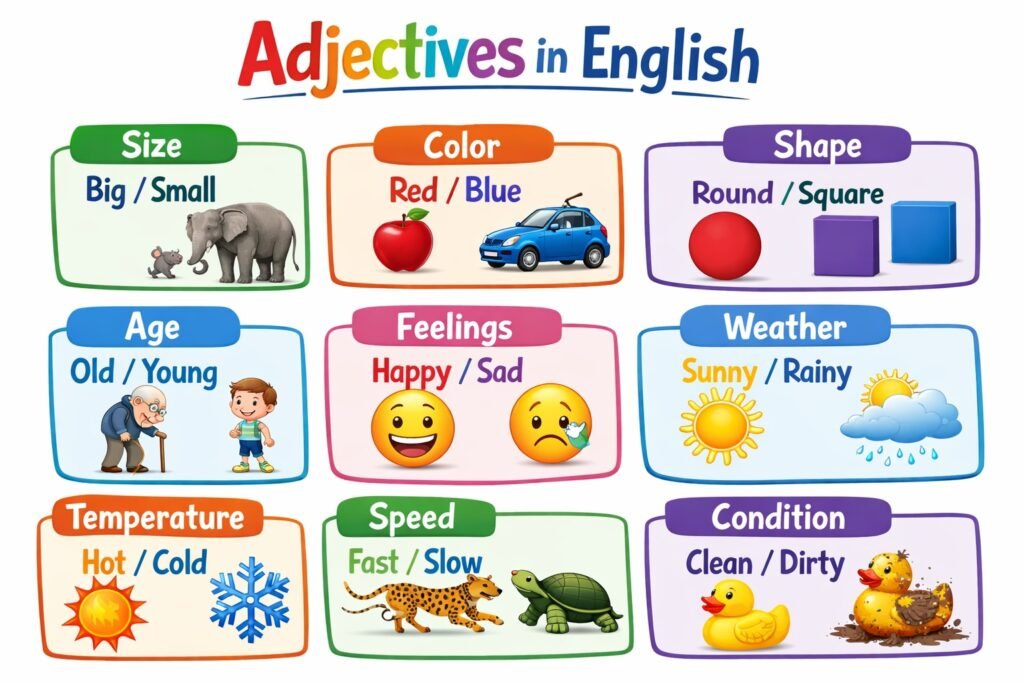
An adjective is a word that describes or gives more information about a noun or pronoun.
👉 It tells us:
- What kind
- Which one
- How many
✅ Examples:
- She has a beautiful dress.
- I bought a red car.
- There are three apples.
🔗 Related Grammar Lessons
To build a strong grammar foundation, you should also learn:
- 👉 Nouns in English (Types & Examples)
- 👉 Verbs in English (Complete Guide)
- 👉 Subject-Verb Agreement Rules
- 👉 English Tenses Explained
💡 These lessons are linked together to help you learn faster and improve your grammar step by step.
English Grammar Worksheets with AutoTick™
✔ AutoTick™ Secure Answer Checking System
✔ Step-by-step instructions
✔ Answer keys with clear explanations
✔ Password-protected marking (prevents cheating)
📊 Types of Adjectives in English
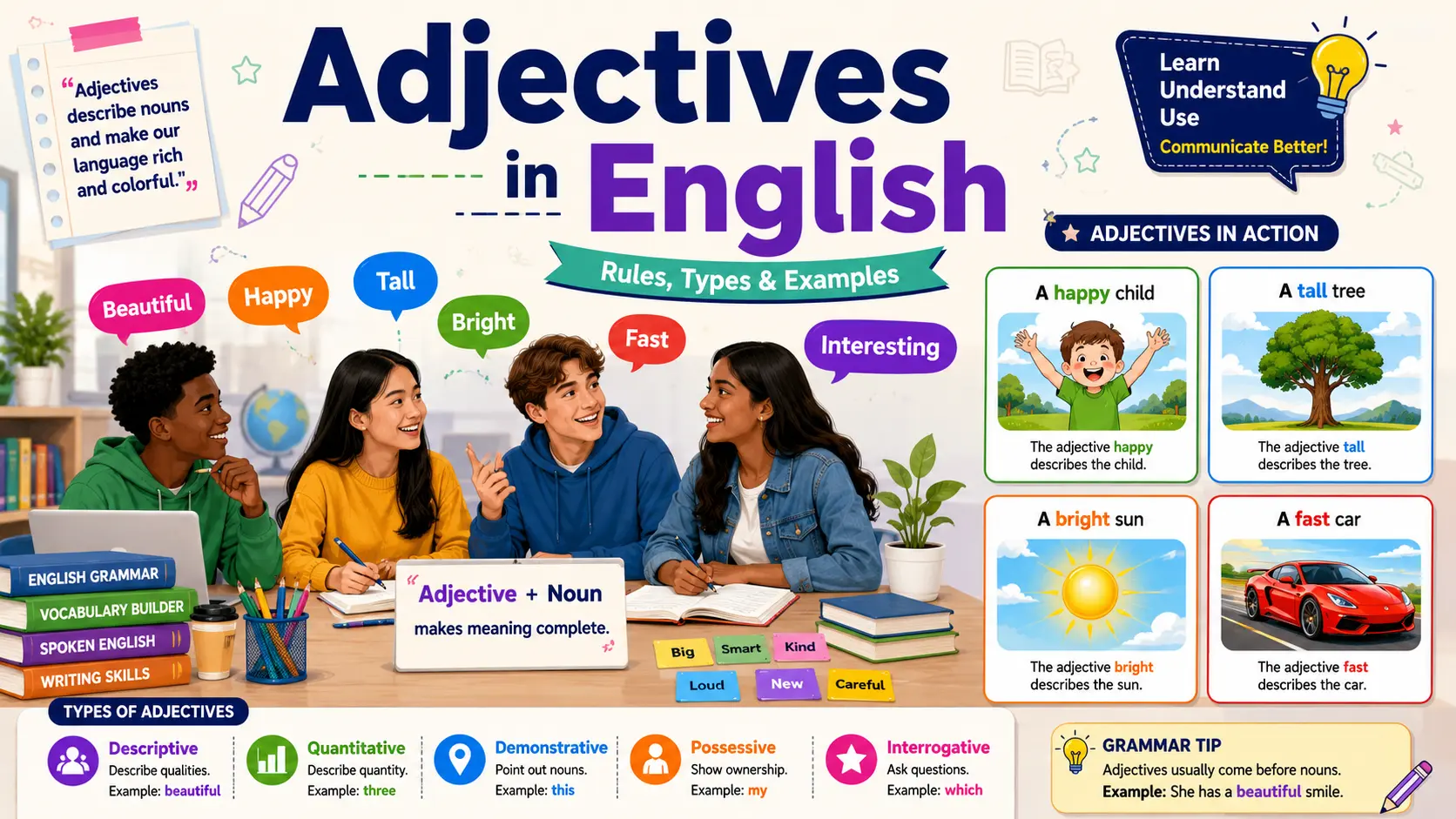
1. Descriptive Adjectives
These describe the quality of a noun.
Examples:
- a happy child
- a tall building
- a small dog
2. Quantitative Adjectives
- some water
- many books
- few students
3. Demonstrative Adjectives
- this book
- that house
- these apples
4. Possessive Adjectives
- my bag
- your phone
- their house
5. Interrogative Adjectives
- which color do you like?
- what book are you reading?
The Royal Order of Adjectives Master Chart
| Order | Category | Description | Example Words | Example in Context |
| 1 | Determiner | Articles, possessives, demonstratives | a, the, this, my, three | “A beautiful large desk” |
| 2 | Opinion | Personal value or quality judgment | lovely, delicious, terrible | “A lovely large desk” |
| 3 | Size | Physical dimensions or scale | huge, small, tall, tiny | “A lovely huge desk” |
| 4 | Age | Period or duration of existence | ancient, young, modern, new | “A lovely huge antique desk” |
| 5 | Shape | Form, geometry, or outline | round, square, oval, flat | “A lovely huge antique rectangular desk” |
| 6 | Color | Hue, shade, or color shade | crimson, blue, pale, dark | “A lovely huge antique rectangular mahogany desk” |
| 7 | Origin | Place or culture of creation | Malaysian, British, solar | “A lovely huge antique rectangular mahogany Malaysian desk” |
| 8 | Material | Physical substance made of | wooden, metallic, glass, silk | “A lovely huge antique rectangular mahogany Malaysian wooden desk” |
| 9 | Purpose | What the noun is designed for | writing, cooking, solar, running | “A lovely huge antique rectangular mahogany Malaysian wooden writing desk” |
📏 Order of Adjectives in English(Important Rule)
When using more than one descriptor in a row, English strictly regulates the order based on adjective type. Learn more about proper modifier sequence in the Cambridge Dictionary Adjectives Reference
📌 Correct Order:
Opinion → Size → Age → Shape → Color → Origin → Material → Purpose
✅ Examples:
- a beautiful small old wooden table
- a big red ball
⚠️ Common Adjective Rules
1. Adjectives do not change form
- a big house
- two big houses
2. Adjectives usually come before nouns
- a blue car
- a fast runner
3. Adjectives after linking verbs
- She is happy
- The food tastes delicious
Advanced Types: Proper, Compound, and Participle Adjectives
Beyond basic descriptive adjectives, advanced English writing uses three specialized categories:
- 1. Proper Adjectives (Always Capitalized):Derived from proper nouns, especially countries, regions, or famous historical figures.
- Examples: “We studied Malaysian architecture,” “They enjoy French cuisine.”
- 2. Compound Adjectives (Hyphenation Rules):Formed when two or more words work together as a single unit to modify a noun. When placed before the noun, connect them with a hyphen.
- Example: “She gave a well-thought-out presentation.” / “He operates a time-saving auto-marking system.”
- Note: If the compound adjective comes after the noun, omit the hyphen: “Her presentation was well thought out.”
- 3. Participle Adjectives (-ing vs. -ed):Verbs ending in -ing or -ed that function as adjectives.
- -ed Adjectives: Describe how a person feels (“The bored student fell asleep”).
- -ing Adjectives: Describe the thing that causes the feeling (“The boring lecture lasted three hours”).
When placed before a noun, compound adjectives are connected with a hyphen. For complete guidelines on hyphenating compound modifiers, visit the Purdue OWL Hyphenation Guide
🔄 Comparative and Superlative Adjectives
- big → bigger → biggest
- happy → happier → happiest
- beautiful → more beautiful → most beautiful
High-Frequency Adjective Mistakes & How to Fix Them
- Mistake 1: Pluralizing Adjectives Before Plural Nouns
- ❌ Incorrect: She bought two bigs bags at the market.
- ✔️ Correct: She bought two big bags at the market.
- Pedagogical Reason: English adjectives are invariant—they never take an -s plural ending, regardless of the noun count.
- Mistake 2: Using Double Comparatives or Superlatives
- ❌ Incorrect: This solar cooker is more faster than the box model.
- ✔️ Correct: This solar cooker is faster than the box model.
- Pedagogical Reason: Never combine -er / -est suffixes with the words more or most.
- Mistake 3: Confusing Comparative Adjectives with Absolute Modifiers
- ❌ Incorrect: That was the most perfect answer on the exam.
- ✔️ Correct: That was a perfect answer on the exam.
- Pedagogical Reason: Absolute adjectives (e.g., perfect, unique, impossible, dead) cannot be graded or compared because they represent absolute conditions.
- Mistake 4: Misplacing Adjectives Relative to Indefinite Pronouns
- ❌ Incorrect: I want to buy something new item. / I saw a special something.
- ✔️ Correct: I want to buy something new.
- Pedagogical Rule: When modifying indefinite pronouns (something, anyone, nothing, everywhere), the adjective sits directly after the pronoun.
- Mistake 5: Swapping “-ed” and “-ing” Participle Adjectives
- ❌ Incorrect: I am very interesting in learning solar energy technology.
- ✔️ Correct: I am very interested in learning solar energy technology.
- Pedagogical Reason: Use -ed when describing internal human emotions; use -ing when describing the external cause.
- Mistake 6: Placing Adjectives After the Noun (French/Romance Language Traps)
- ❌ Incorrect: He drives a car blue.
- ✔️ Correct: He drives a blue car.
- Pedagogical Reason: In English, attributive adjectives must precede the noun they modify, unlike Romance languages where adjectives frequently follow the noun.
Interactive Practice Exercise: Test Your Adjective Mastery
Choose the correct adjective form or arrangement for each gap:
- They purchased a __________ (wooden / old / round) table for the kitchen.
- This project is __________ (more complex / complexer) than the previous assignment.
- The students felt completely __________ (exhausted / exhausting) after the final exam.
- He bought a __________ (leather / black / stylish) jacket at the shop.
- She lives in a __________ (three-story / three-stories) residential building.
- My grandfather owns an __________ (ancient / Italian / beautiful) painting.
- Out of all the participants, she provided the __________ (most thoughtful / more thoughtful) response.
- Is there __________ (anything interesting / interesting anything) listed on the menu?
- We observed two __________ (small green / green small) birds outside the window.
- The teacher explained a __________ (well-structured / well structured) grammar lesson.
Answer Key & Detailed Explanations:
- round old wooden — Follows order: Shape (round) $\rightarrow$ Age (old) $\rightarrow$ Material (wooden).
- more complex — Two-syllable adjectives ending without -y form comparatives using more.
- exhausted — Describes the internal feeling experienced by the students (-ed).
- stylish black leather — Follows order: Opinion (stylish) $\rightarrow$ Color (black) $\rightarrow$ Material (leather).
- three-story — Compound adjectives modifying nouns take singular hyphenated units (three-story).
- beautiful ancient Italian — Follows order: Opinion (beautiful) $\rightarrow$ Age (ancient) $\rightarrow$ Origin (Italian).
- most thoughtful — Superlative form comparing three or more participants.
- anything interesting — Adjectives follow indefinite pronouns (anything).
- small green — Follows order: Size (small) $\rightarrow$ Color (green).
- well-structured — Hyphenated compound adjective sitting directly before the noun lesson.
📥 Free Adjective Worksheet (Download)
👉 Get your free printable worksheet here:
🔗 Download Free Adjective Worksheet
✔ Beginner-friendly
✔ Perfect for students and teachers
✔ Includes answers
💎 Premium Grammar Worksheets (Recommended)
Want more practice with auto-marking worksheets and structured lessons?
👉 Check out the full collection here:
🔗 English Grammar Worksheets (All Topics)
⭐ Includes:
- Subject-Verb Agreement worksheets
- Tenses practice sheets
- Adjective & Adverb exercises
- Ready-to-use classroom materials
💡 Ideal for:
- Teachers
- Parents
- Students preparing for exams
💡 Tips for Using Adjectives in English
- Use adjectives to make your writing more interesting
- Avoid using too many adjectives in one sentence
- Learn common adjective combinations (collocations)
- Practise using adjectives in daily conversations
👉 The more you practise adjectives in English, the more natural your sentences will become.
✅ Conclusion
Adjectives in English are essential for clear and effective communication. By understanding their types, rules, and correct order, you can improve your grammar quickly.
Start practising adjectives in English today using the free worksheet and explore more lessons to master English faster.
Frequently Asked Questions (FAQs)
What is the main purpose of an adjective in English?
The primary purpose of an adjective is to modify, describe, or give more details about a noun or a pronoun. Adjectives answer specific questions about a noun, such as What kind? (a luxury hotel), Which one? (this laptop), or How many? (five students).
Do English adjectives change form for plural nouns?
No. One of the best rules in English grammar is that adjectives never change form. They remain exactly the same whether the noun is singular or plural. For example, you say “one smart student” and “three smart students.” You never add an “s” to an adjective.
What is the correct order of adjectives?
The correct order is:
Opinion → Size → Age → Shape → Color → Origin → Material → Purpose
Example: a beautiful small old wooden table
What is the difference between a comparative and a superlative adjective?
Use a comparative adjective to compare exactly two things (e.g., “This room is bigger than that one” or “He is more helpful“).
Use a superlative adjective to compare three or more things to show which one is at the absolute limit (e.g., “This is the biggest room in the house” or “She is the most helpful student”).
Can an adjective come at the end of a sentence?
Yes. While adjectives usually sit directly before a noun, they can also appear at the end of a sentence after a linking verb (such as be, seem, look, taste, feel). In the sentence “The sunset looks amazing,” the word amazing is a predicate adjective describing the sunset.