Table of Contents
Introduction
The Past Continuous Tense is an important part of English grammar that helps you describe actions happening at a specific time in the past.
If you want to improve your English grammar, understanding the Past Continuous Tense is essential. This tense helps you describe actions that were happening at a specific moment in the past. In this guide, you’ll learn the structure, rules, examples, and common mistakes — plus get access to free worksheets and an auto-marking system
What is the Past Continuous Tense?
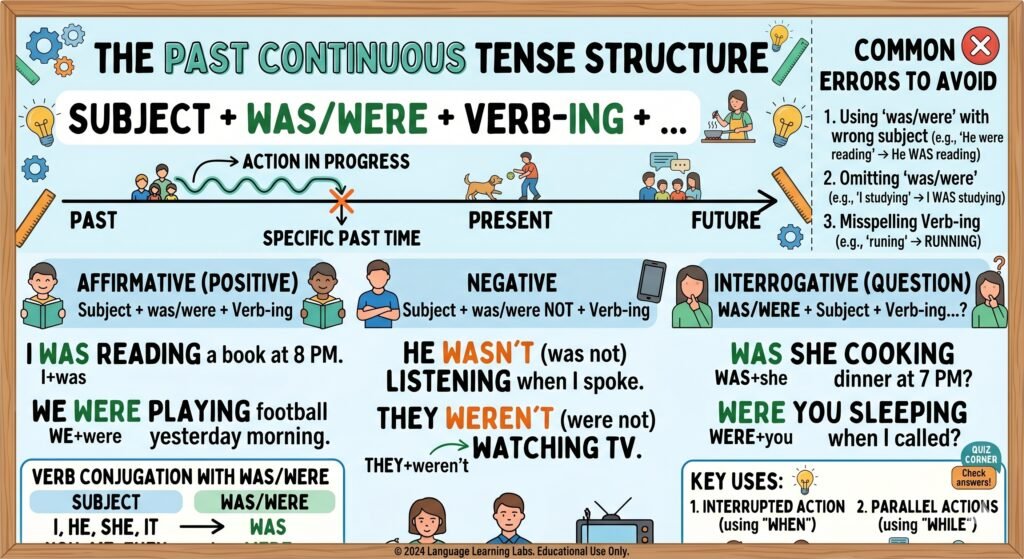
The Past Continuous Tense (also called the Past Progressive Tense) is used to describe actions that were ongoing at a particular time in the past.
👉 Example:
- I was reading at 8 PM.
- They were playing football when it started to rain.
Structure of Past Continuous Tense
The structure is simple:
Subject + was/were + verb (-ing)
| Subject | Helping Verb | Example |
|---|---|---|
| I / He / She / It | was | She was studying |
| You / We / They | were | They were running |
Past Continuous Master Structure Reference Chart
| Sentence Type | Structural Formula | Singular Subject Example (I, He, She, It) | Plural Subject Example (You, We, They) |
| Affirmative | Subject + was/were + V-ing | “She was writing a report.” | “They were discussing the plan.” |
| Negative | Subject + was/were + not + V-ing | “He was not (wasn’t) sleeping.” | “We were not (weren’t) listening.” |
| Yes/No Question | Was/Were + Subject + V-ing? | “Was it raining yesterday?” | “Were you working late?” |
| Wh- Question | Wh- Word + was/were + Subj + V-ing? | “Why was she crying?” | “Where were they going?” |
When to Use Past Continuous Tense
1. Action happening at a specific time in the past
- I was watching TV at 9 PM.
2. Interrupted actions (very important!)
- I was sleeping when the phone rang.
3. Two actions happening at the same time
- She was cooking while he was cleaning.
4. Background description in stories
- The sun was shining, and birds were singing.
5. Expressing Repeated Past Habits with “Always” or “Constantly” (Expressing Irritation)
When paired with adverbs like always, constantly, or forever, the Past Continuous emphasizes a annoying or frequent past habit that occurred repeatedly over time.
- Example: “He was constantly losing his keys when he lived in the apartment.”
- Example: “They were always complaining about the hot weather during the trip.”
6. Polite or Tentative Requests (Softening Language)
In spoken English, speakers often use the Past Continuous with verbs like wonder, hope, or think to make requests sound more polite and less direct.
- Example: “I was wondering if you could help me review this grammar worksheet.”
- Example: “We were hoping to ask you a few questions about the assignment.”
Examples of Past Continuous Tense
Here are more examples to help you understand:
- He was working late last night.
- We were talking during the meeting.
- The children were laughing loudly.
- It was raining heavily yesterday.
Negative Sentences
To make negative sentences, add not after was/were:
Subject + was/were + not + verb (-ing)
👉 Examples:
- I was not (wasn’t) sleeping.
- They were not (weren’t) studying.
Questions in Past Continuous
To form questions:
Was/Were + subject + verb (-ing)?
👉 Examples:
- Was she reading?
- Were they playing football?
Stative Verbs Exception (Non-Continuous Verbs)
A major area where English learners lose marks in exams is applying continuous tenses to stative verbs. Stative verbs describe states, feelings, senses, or mental conditions rather than physical actions. These verbs do not normally take the -ing form and must use the Simple Past Tense instead.
- Mental States & Emotions:know, understand, remember, believe, want, need, love, hate.
- ❌ Incorrect: “I was knowing the answer when the teacher asked.”
- ✔️ Correct: “I knew the answer when the teacher asked.”
- Possession & Relationship:belong, own, possess, consist.
- ❌ Incorrect: “He was owning three cars at that time.”
- ✔️ Correct: “He owned three cars at that time.”
Common Mistakes to Avoid
❌ Wrong: I was eat dinner.
✅ Correct: I was eating dinner.
❌ Wrong: They was playing.
✅ Correct: They were playing.
❌ Wrong: She was not study.
✅ Correct: She was not studying.
Confusing “When” and “While” in Interrupted Action Clauses
- ❌ Incorrect: “While the phone rang, I was watching TV.”
- ✔️ Correct: “I was watching TV when the phone rang.” / “While I was watching TV, the phone rang.”
- Pedagogical Reason: Use while before the longer, background continuous action (was watching), and use when before the short, single interrupting action (rang).
Using Simple Past Verbs After “Was/Were”
- ❌ Incorrect: “They were went to the park when I saw them.”
- ✔️ Correct: “They were going to the park when I saw them.”
- Pedagogical Reason: Helper verbs was and were must always be followed by the present participle (-ing), never by the V2 simple past verb form.
Spelling Errors When Adding “-ing” to Base Verbs
- ❌ Incorrect: “He was runing fast.” / “She was writeing an essay.”
- ✔️ Correct: “He was running fast.” / “She was writing an essay.”
- Pedagogical Reason: Double the final consonant for short CVC (consonant-vowel-consonant) verbs (run -> running), and drop the silent -e before adding -ing (write -> writing).
Past Continuous vs Simple Past
Understanding the difference is key:
| Past Continuous | Simple Past |
|---|---|
| Ongoing action | Completed action |
| I was reading | I read |
| She was cooking | She cooked |
👉 Example:
- I was reading when he called.
Practice with Free Worksheets
To master the Past Continuous Tense, practice is es🎯 Download your FREE Past English Grammar Worksheets
✔ Printable exercises
✔ Beginner to advanced levels
✔ Perfect for students, teachers, and self-learners
Bonus: Free Auto-Marking System
No more manual marking!
When you download worksheets from LearnEnglishGrammar.org, you also get access to:
✅ Instant results
✅ Automatic scoring
✅ Time-saving for teachers
✅ Easy self-check for students
Internal Links for Better Learning
Continue improving your grammar with these helpful lessons:
Why Learn Past Continuous Tense?
Learning this tense helps you:
✔ Describe past situations clearly
✔ Improve storytelling skills
✔ Speak more naturally in English
✔ Perform better in exams
Final Tips
- Always remember: was/were + verb-ing
- Use it for actions in progress in the past
- Practice daily with worksheets
Start Learning Today (Free!)
If you’re serious about improving your English:
👉 Download your FREE worksheets
👉 Try the Auto-Marking system
⭐ Extra Practice Tips for Past Continuous Tense
- Practice daily using worksheets
- Try writing short stories using past continuous
- Combine with simple past for better understanding
- Use real-life situations for practice
Interactive Practice Exercise: Past Continuous vs. Simple Past
Complete each sentence by putting the verb in brackets into the correct form (Past Continuous or Simple Past):
- While the teacher __________ (explain) the rule, the lights went out.
- I __________ (see) an old friend while I was waiting for the bus.
- What __________ you __________ (do) at 10:00 PM last night?
- She dropped her phone while she __________ (run) to catch the train.
- They __________ (not / listen) when the speaker announced the results.
- The sun __________ (shine) brightly when we left the house.
Answer Key & Detailed Explanations:
- was explaining — Long ongoing background action requiring Past Continuous (while clause).
- saw — Short completed event (saw) interrupting the continuous action (was waiting).
- were / doing — Past Continuous question formation for a specific past time marker (10:00 PM).
- was running — Continuous action in progress during which a sudden event (dropped) occurred.
- were not listening — Negative Past Continuous for an action in progress at a specific past moment.
- was shining — Setting the background scene in a narrative context.
Master English Tenses with Automated Grading
“Take your tense mastery further with our full collection of English Grammar Lessons with Autotick Marking Facilities. Get instant automated grading, detailed explanation keys, and comprehensive practice sets for all English tenses!
FAQ
What is the Past Continuous Tense?
The Past Continuous Tense is used to describe actions that were happening at a specific time in the past. It is formed using “was” or “were” with a verb ending in -ing.
What is the formula of Past Continuous Tense?
The formula of the Past Continuous Tense is:
Subject + was/were + verb (-ing)
Example: She was studying. They were playing.
When do we use Past Continuous Tense?
We use the Past Continuous Tense to describe:
Actions happening at a specific time in the past
Interrupted actions
Two actions happening at the same time
Background descriptions in stories
What is an example of Past Continuous Tense?
An example of the Past Continuous Tense is:
“I was watching TV when he called.”
This shows an ongoing action interrupted by another action.
What is the difference between Past Continuous and Simple Past?
The Past Continuous Tense describes ongoing actions, while the Simple Past Tense describes completed actions.
Example:
I was reading (ongoing)
I read (completed)
How do you make negative sentences in Past Continuous Tense?
To make negative sentences in the Past Continuous Tense, use:
Subject + was/were + not + verb (-ing)
Example: She was not sleeping. They were not studying.