
Parts of Speech in English Overview
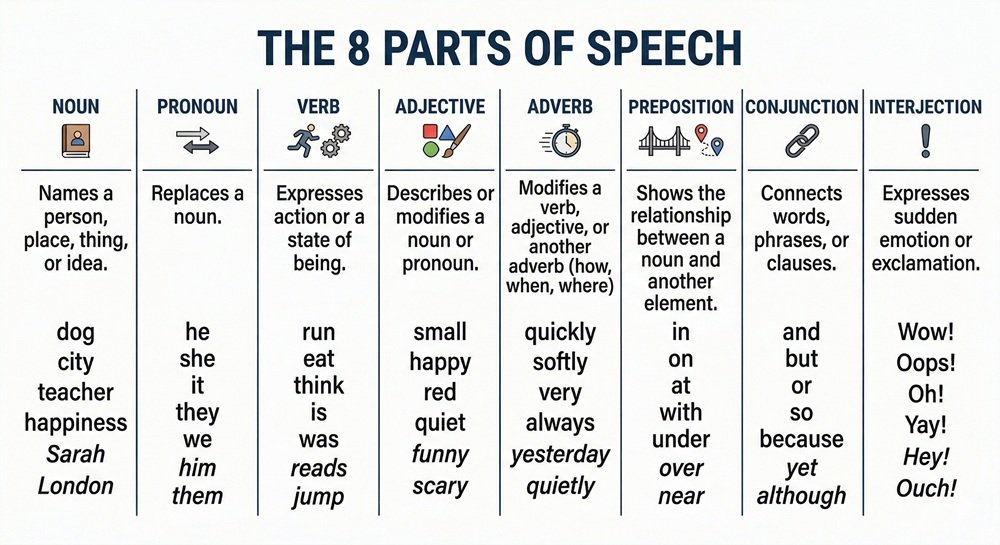
The parts of speech in English are the basic categories of words used to form sentences. Every word belongs to a specific group depending on how it is used.
If you’ve ever looked at a page of English text and felt completely overwhelmed, I want you to take a deep breath. You are not alone. When I first started diving deep into language learning, it felt like trying to solve a puzzle without the picture on the box. But here is the secret: every single sentence you read, speak, or write is built from just eight basic building blocks. Think of them like LEGO bricks. Once you learn how these eight pieces fit together, the mystery vanishes, and you suddenly have the power to build whatever you want. Let’s break them down together, step by step.
Understanding parts of speech is one of the most important first steps in learning English. It helps you:
- Build correct sentences
- Improve your writing
- Speak more clearly
- Understand how English works
Examples of Parts of Speech in Sentences
Understanding parts of speech becomes easier when you see them used in sentences:
- Noun: The dog is barking.
- Verb: She runs every morning.
- Adjective: It is a beautiful day.
- Adverb: He runs quickly.
- Pronoun: She is my friend.
- Preposition: The book is on the table.
- Conjunction: I like tea and coffee.
- Interjection: Wow! That’s amazing.
👉 These examples help learners understand how each part of speech works in real sentences.
🎁 Start with a Free Grammar Sample
Want to practice what you learn?
Try our worksheets for free:
👉 🎁 Download Free Grammar Worksheets Sample with Answers and Explanation
What Are the Parts of Speech in English?
The 8 parts of speech in English include nouns, verbs, adjectives, and more.
Here are eight main parts of speech in traditional English grammar:
1. Nouns
A noun names a person, place, thing, or idea.
Examples:
- teacher
- city
- book
- happiness
👉 Learn more: Nouns and their types
2. Pronouns
A pronoun replaces a noun to avoid repetition.
Examples:
- he
- she
- they
- it
Pronouns make sentences smoother and easier to read.
👉 Learn more: Pronouns
3. Verbs
A verb shows an action, occurrence, or state of being.
Examples:
- run
- eat
- write
- is
Verbs are essential because every sentence needs one.
👉 Learn more: Verbs
4. Adjectives
An adjective describes a noun or pronoun.
Examples:
- beautiful
- tall
- red
- happy
Adjectives add detail and make sentences more interesting.
👉 Learn more: Adjectives
5. Adverbs
An adverb modifies a verb, adjective, or another adverb.
It often tells:
- how
- when
- where
- how often
Examples:
- quickly
- slowly
- very
- yesterday
6. Prepositions
A preposition shows the relationship between words in a sentence.
Examples:
- in
- on
- at
- under
Prepositions often describe time, place, or direction.
👉 Learn more: Prepositions in English Grammar
7. Conjunctions
A conjunction connects words, phrases, or clauses.
Examples:
- and
- but
- or
- because
Conjunctions help combine ideas smoothly.
👉 Learn more: Conjunctions
8. Interjections
An interjection expresses strong emotion.
Examples:
- wow!
- oh!
- hey!
- ouch!
They are often followed by an exclamation mark.
🚀 Practice What You Learn
Reading is helpful — but practice makes real improvement.
Our grammar worksheets help you apply all 8 parts of speech step by step.
What You Get:
- Worksheets for Levels 1–6
- Covers nouns, verbs, tenses, and more
- Autotick Cheat-Proof Answer Sheets
- Perfect for students and teachers
👉 Get Instant Access to All Worksheets (Levels 1–6) with Answers & Explanations
Why Parts of Speech Are Important
Learning parts of speech helps you understand how sentences are built.
Once you master them, it becomes much easier to learn:
- Sentence structure
- English tenses
- Common mistakes
💡 Recommended Next Step
If you’re just starting, recommended Next Step
My Best Advice: Take it One Block at a Time
I always tell my students that you don’t need to memorize all of this overnight. Grammar isn’t about perfection; it’s about communication. When I was mastering these concepts, I found it incredibly helpful to just focus on one part of speech a day. Spotting nouns during my morning coffee, or tracking verbs while reading an article. Real fluency happens when you move from passive reading to active practice. So, don’t just read this list—grab a pen, dive into some exercises, and give yourself permission to make mistakes. That is exactly how the pieces finally click into place.
🎁 Try a Free Sample First
Not ready yet? Start with a free sample:
👉 🎁 Get Free Grammar Worksheets Sample with Answers and Explanation
FAQs
What actually are parts of speech, and why should I care?
Think of parts of speech as the job descriptions for words. Just like a hospital needs doctors, nurses, and receptionists to function, a sentence needs different types of words to make sense. A single word can even change its job depending on where you put it. For example, in “I work every day,” work is an action (a verb). But in “I love my work,” work is a thing (a noun). Understanding these roles is the ultimate shortcut to fixing confusing sentences and writing with confidence.
Are there really only 8 parts of speech in English?
In traditional English grammar, yes, we stick to the classic eight: nouns, pronouns, verbs, adjectives, adverbs, prepositions, conjunctions, and interjections. However, if you dive into modern linguistics, you might hear people talk about a 9th category called determiners (words like the, a, this, each). Don’t let that overwhelm you, though! If you master the core eight listed in this guide, you will have a flawless foundation for 99% of the English language.
What is the easiest way to memorize all of them?
They help us understand how words function in sentences and improve grammar accuracy.