
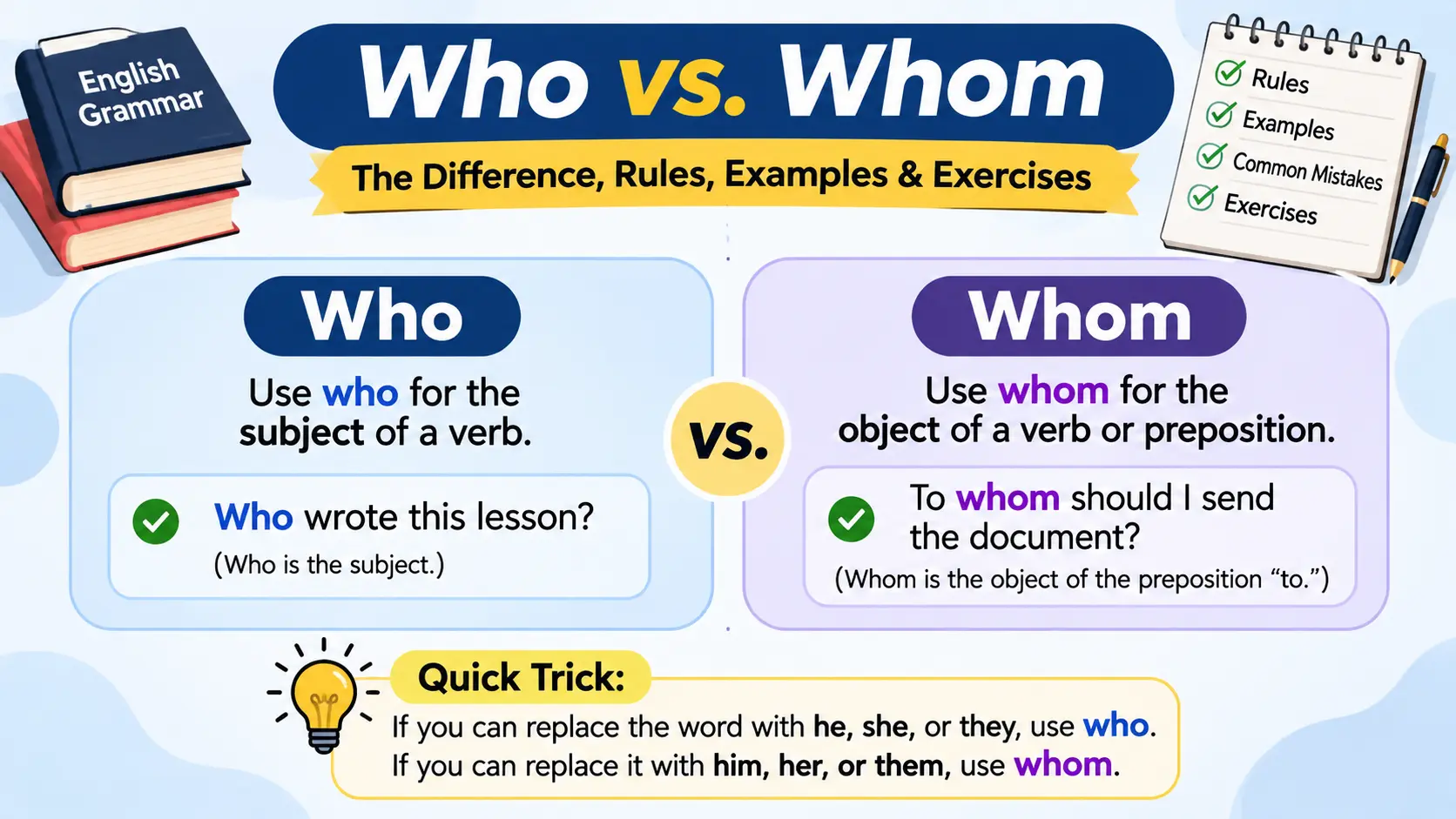
Knowing when to use who and whom can be confusing, even for advanced English learners and native speakers. Both words refer to people, but they serve different purposes in a sentence.
The difference is straightforward: who is used as a subject pronoun (the person doing the action), while whom is used as an object pronoun (the person receiving the action). Understanding this simple rule will help you choose the correct word when writing and speaking English.
In everyday conversations, people often use who instead of whom, and this is widely accepted in informal English. However, whom is still useful in formal writing, business correspondence, academic assignments, and English grammar examinations.
In this guide, you’ll learn how to tell the difference between who and whom using the easy he/him substitution trick. We’ll also look at how to use whom after prepositions, how both words appear in relative clauses, and the common mistakes to avoid.
You’ll find plenty of practical examples, exercises, and answer keys to help you understand the rules and put them into practice.
Table of Contents
1. The Main Difference Between Who and Whom
To understand who and whom, you first need to know the difference between a subject and an object.
- Who is a subject pronoun. It refers to the person performing the action.
- Whom is an object pronoun. It refers to the person receiving the action or following a preposition.
Here is a simple comparison:
| Pronoun | Grammatical role | Similar pronouns |
|---|---|---|
| Who | Subject | He, she, they |
| Whom | Object | Him, her, them |
What Is Who?
Use who when referring to the person performing the action of a verb.
Examples:
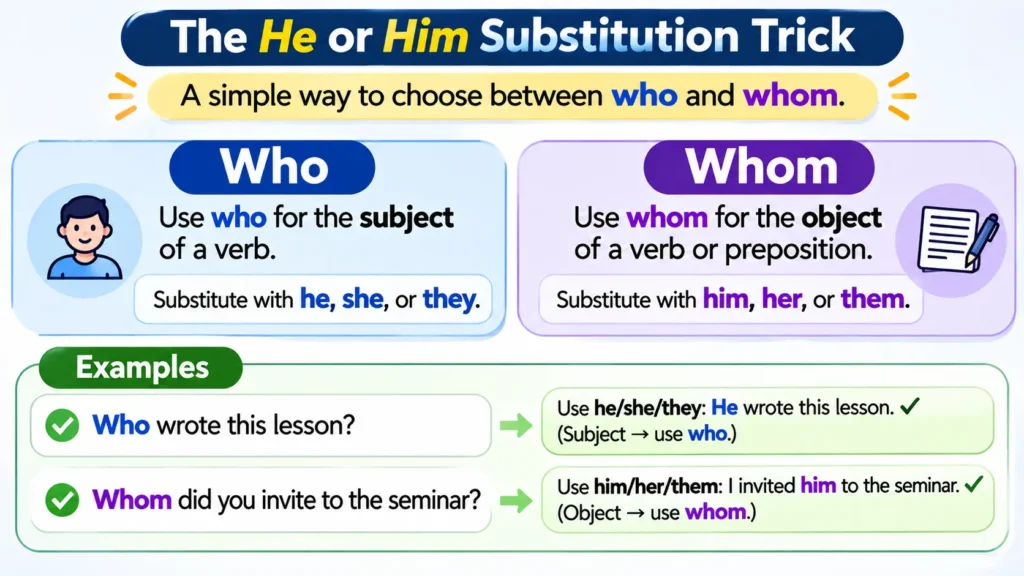
- Who wrote this lesson?
- The teacher who explained the rule was very helpful.
- Who is coming to the meeting?
In these sentences, who is the subject performing the action.
What Is Whom?
Use whom when referring to the person receiving the action or following a preposition.
Examples:
- Whom did you invite to the seminar?
- The student whom I helped was grateful.
- To whom should I send the document?
In these examples, the person is receiving the action or is the object of a preposition.
To understand subject and object pronouns more fully, read our guide to pronouns in English grammar
2. The Easy He or Him Substitution Trick
One of the easiest ways to decide between who and whom is to use the he/him substitution trick.
The rule is simple:
- If you can replace the word with he, she, or they, use who.
- If you can replace it with him, her, or them, use whom.
Remember:
| Substitution | Correct pronoun |
|---|---|
| He / She / They | Who |
| Him / Her / Them | Whom |
Example 1: Who or Whom Called Me Yesterday?
Consider this question:
“Who or whom called me yesterday?”
Try changing the question into a statement:
- He called me yesterday. (Correct)
- Him called me yesterday. (Incorrect)
Since he is correct, the answer is who.
Correct sentence: Who called me yesterday?
Example 2: Who or Whom Should I Contact?
Consider this question:
“Who or whom should I contact for support?”
Try changing it into a statement:
- I should contact he. (Incorrect)
- I should contact him. (Correct)
Since him is correct, the answer is whom in formal grammar.
Correct formal sentence: Whom should I contact for support?
In everyday conversation, however, “Who should I contact for support?” is also widely used.
3. Using Whom After Prepositions
In formal English, use whom when the pronoun immediately follows a preposition.
Common prepositions include:
- To
- For
- With
- About
- From
- By
- Of
- In
- On
- At
The basic pattern is:
Preposition + Whom
Examples:
- Correct: To whom it may concern.
- Correct: The colleague with whom I share an office is very helpful.
- Correct: About whom were you talking?
- Correct: From whom did you receive the letter?
In formal writing, these constructions are preferred to using who immediately after the preposition.
Formal vs. Informal English
In everyday English, speakers often place the preposition at the end of a question. This is called preposition stranding.
Compare:
| Informal English | Formal English |
|---|---|
| Who are you going with? | With whom are you going? |
| Who did you speak to? | To whom did you speak? |
| Who are you talking about? | About whom are you talking? |
Both forms are commonly understood, but the formal constructions are more suitable for academic writing and formal correspondence.
To learn more about how prepositions work in English, see our guide to prepositions in English
4. Who and Whom in Relative Clauses
Relative clauses provide additional information about a person or thing. When referring to people, both who and whom can be used, depending on their grammatical role within the relative clause.
A. Who as a Subject Relative Pronoun
Use who when the pronoun performs the action of the verb inside the relative clause.
Structure:
Noun + Who + Verb + Object
Examples:
- The tutor who teaches the grammar class lives in Petaling Jaya.
- The student who answered the question received a prize.
- The woman who works in the office is my sister.
In each sentence, who performs the action of the verb.
B. Whom as an Object Relative Pronoun
Use whom when the pronoun receives the action of the verb inside the relative clause.
Structure:
Noun + Whom + Subject + Verb
Examples:
- The applicant whom the manager interviewed was well qualified.
- The student whom I helped passed the examination.
- The teacher whom we invited attended the meeting.
In these sentences, another person performs the action, while whom refers to the person receiving it.
In everyday English, who is also frequently used instead of whom in these object positions.
5. Tricky Cases and Advanced Grammar Rules
Some sentences are more difficult because they contain additional phrases or compound pronouns. Understanding these situations will help you avoid common mistakes.
Case 1: Intervening Phrases Such as “I Think” and “She Believes”
Sometimes, phrases such as I think, she believes, and we suppose appear between a relative pronoun and its verb.
These extra phrases can make it difficult to identify whether to use who or whom.
Example:
“She is the instructor who or whom I believe won the award.”
How do you decide?
First, temporarily remove the phrase “I believe”.
The remaining sentence is:
“She is the instructor who or whom won the award.”
Now apply the substitution trick:
- She won the award. (Correct)
- Her won the award. (Incorrect)
Since she is the correct subject pronoun, use who.
Correct sentence:
“She is the instructor who I believe won the award.”
Case 2: Whoever vs. Whomever
The same subject and object rules apply to whoever and whomever.
- Whoever is used as a subject.
- Whomever is used as an object.
Remember:
| Word | Similar pronoun |
|---|---|
| Whoever | He / She / They |
| Whomever | Him / Her / Them |
Examples:
Whoever finishes the worksheet first will receive a bonus point.
Explanation: Whoever is the subject of the verb finishes.
Please hand this document to whomever you meet at the front desk.
Explanation: You meet him or her. Therefore, whomever is the object of the verb meet.
Case 3: When Whoever Follows a Preposition
This is a particularly important rule.
Although whoever and whomever follow the same subject and object principle, you must examine their function inside the clause.
Example:
“Give the prize to whoever scores highest on the test.”
Why do we use whoever rather than whomever?
Look at the clause:
“Whoever scores highest on the test.”
Who performs the action of scoring?
- He scores highest. (Correct)
- Him scores highest. (Incorrect)
Therefore, whoever is correct.
Although the entire clause follows the preposition to, the word whoever is the subject of the verb scores within its own clause.
For further explanation and examples, refer to the Cambridge Dictionary guide to who and whom.
6. Who vs. Whom: Summary Comparison Table
Use this table as a quick reference when deciding which word to use.
| Context | Rule | Correct example |
|---|---|---|
| Subject | Who + verb | Who called the office? |
| Object | Whom + subject + verb | Whom did she choose? |
| After a preposition | Preposition + whom (formal) | To whom should I send the document? |
| Relative clause (subject) | Who + verb | The teacher who made the quiz is here. |
| Relative clause (object) | Whom + subject + verb (formal) | The teacher whom I met was helpful. |
| Compound subject | Whoever + verb | Whoever wants to join is welcome. |
| Compound object | Whomever + subject + verb | You may invite whomever you like. |
Remember: In everyday conversation, who is commonly used in place of whom in object positions. However, learning the formal distinction will help you understand traditional grammar rules.
7. Common Mistakes with Who and Whom
Even experienced English learners sometimes confuse these two pronouns. Here are three common mistakes and how to correct them.
Mistake 1: Using Whom When Who Is Required
Incorrect: The student whom scored 100% on the quiz was praised.
Correct: The student who scored 100% on the quiz was praised.
Explanation:
The student performs the action of scoring.
- He scored 100%.
- Him scored 100%. (Incorrect)
Therefore, who is correct.
Mistake 2: Using Who Immediately After a Preposition in Formal Writing
Incorrect in formal English: The author from who I borrowed this quotation is well known.
Correct: The author from whom I borrowed this quotation is well known.
Explanation:
The word whom follows the preposition from and acts as its object.
Mistake 3: Confusing the Subject and Object in Questions
Incorrect: Whom is coming to class today?
Correct: Who is coming to class today?
Explanation:
The person coming to class performs the action.
- He is coming to class.
- Him is coming to class. (Incorrect)
Therefore, who is correct.
8. Practice Exercise: Who vs. Whom
Test your understanding by completing the following sentences with who, whom, whoever, or whomever.
Questions
- The student __________ turned in the assignment late lost two marks.
- To __________ did you address the parcel?
- Mrs. Lee, __________ we met at the education fair, recommended this website.
- __________ wrote this answer key made a small mistake in Question 4.
- The candidate __________ the committee recommended has accepted the offer.
- You can share these grammar worksheets with __________ needs extra practice.
- Dr. Aris is a researcher __________ I believe will win the award.
- With __________ will you be completing the project?
Answer Key and Explanations
1. Who
The pronoun is the subject of the verb turned in.
- He turned in the assignment late.
- Therefore, use who.
2. Whom
The pronoun follows the preposition to.
- To him.
- Therefore, use whom in formal English.
3. Whom
The pronoun is the object of the verb met.
- We met her.
- Therefore, use whom in formal English.
4. Who
The pronoun performs the action of writing.
- He wrote this answer key.
- Therefore, use who.
5. Whom
The committee performs the action of recommending the candidate.
- The committee recommended him.
- Therefore, use whom in formal English.
6. Whoever
The pronoun is the subject of the verb needs.
- He needs extra practice.
- Therefore, use whoever.
7. Who
Ignore the intervening phrase I believe.
The remaining clause is:
“Who will win the award?”
- He will win the award.
- Therefore, use who.
8. Whom
The pronoun immediately follows the preposition with.
- With him.
- Therefore, use whom in formal English.
9. Improve Your English Grammar with More Practice
Understanding grammar rules is only the first step. Regular practice will help you remember what you have learned and use English more accurately.
Explore our collection of [English Grammar Lessons] to improve your understanding of different grammar topics.
You can also practise using our English grammar worksheets, which include the AutoTick marking facility to help students check their answers and receive results automatically.
Whether you are a student, teacher, or independent English learner, regular exercises can help strengthen your grammar skills.
Try Our Free English Grammar Worksheets
Would you like more practice with English grammar? Explore our free sample English Grammar Worksheets to test your understanding and improve your grammar skills.
Download a free sample and try the exercises at your own pace. No subscription is required.
Get Your Free Grammar Worksheets
Take Your English Grammar Practice Further
Looking for more structured English grammar practice? Explore our collection of English Grammar Worksheets, designed for students, teachers, tutors, and independent learners.
Our worksheets cover different grammar topics and levels, with the AutoTick marking facility to help students check their answers and receive results automatically.
Explore Our English Grammar Worksheets
10. Frequently Asked Questions (FAQ)
1. What is the main difference between who and whom?
Who is a subject pronoun used when a person performs an action. Whom is an object pronoun used when a person receives an action or follows a preposition.
For example:
Who called you?
Whom did you call?
2. Is whom still used in modern English?
Yes. Whom is still used, particularly in formal writing, academic contexts, and constructions where it immediately follows a preposition.
However, in everyday spoken English, people frequently use who instead of whom in object positions.
3. Should I use to who or to whom?
In formal English, use to whom because whom is the object form required after the preposition to.
Example: To whom should I address the letter?
In informal conversation, people commonly say, “Who should I address the letter to?”
4. Can I use who instead of whom in everyday conversation?
Yes. In everyday spoken English, using who instead of whom in object positions is widely accepted.
For example:
Formal: Whom did you speak to?
Informal: Who did you speak to?
Both are commonly understood. However, it is useful to understand the formal distinction, especially when writing academic assignments or formal correspo
5. How can I remember when to use who and whom?
Use the simple he/him substitution trick:
If he, she, or they fits, use who.
If him, her, or them fits, use whom.
For example:
Who called? He called. (Who)
Whom did you invite? I invited him. (Whom)
This simple method can help you choose the correct pronoun