
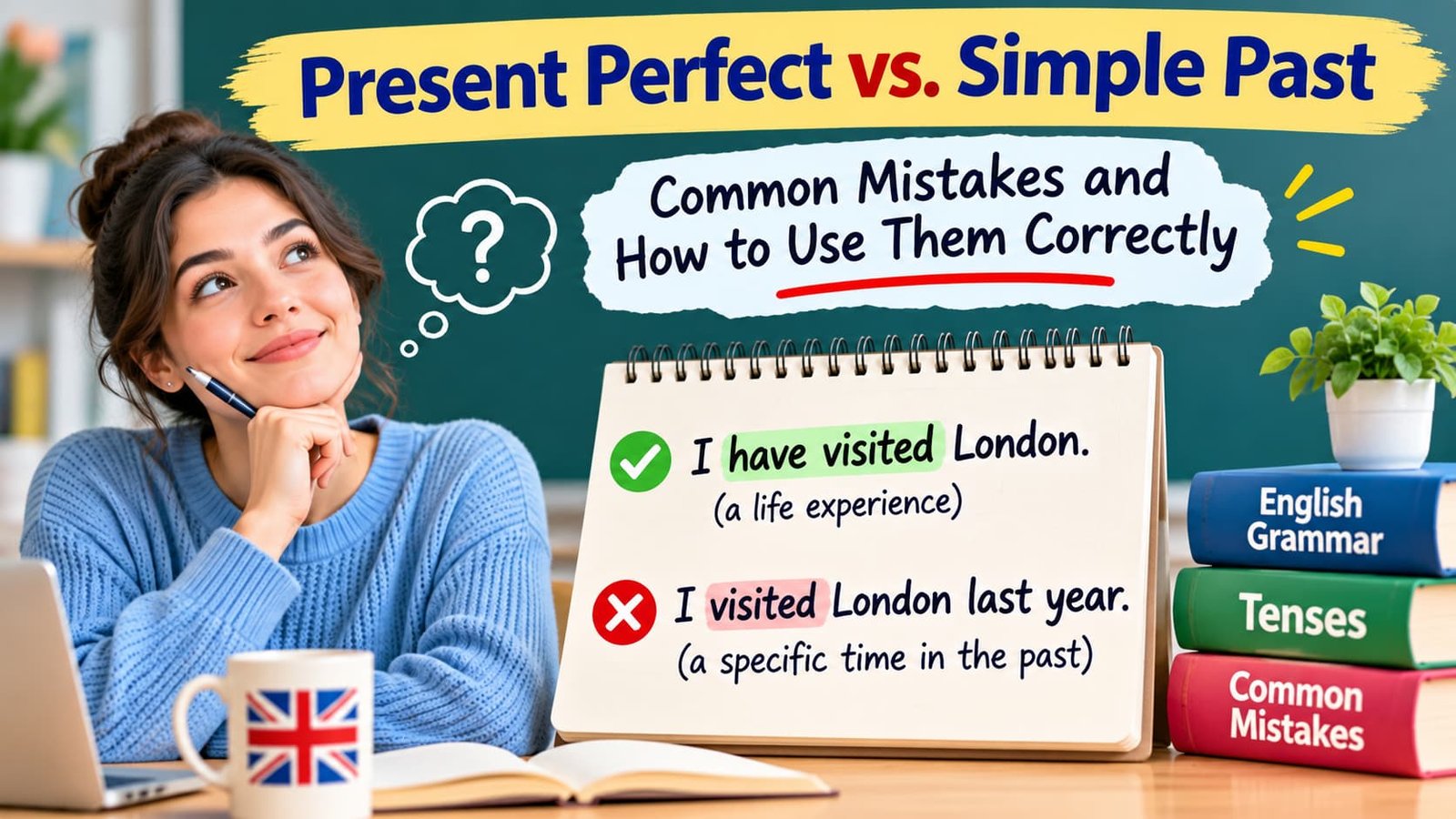
Present Perfect vs Simple Past is a common grammar challenge for English learners. Both tenses describe actions that happened in the past, but they are used in different situations.
Look at these two sentences:
- I have visited London.
- I visited London last year.
Both sentences tell us that someone went to London. The difference is that the first describes a life experience without saying when the visit took place. The second tells us exactly when it happened.
Knowing when to use the Present Perfect and Simple Past can make a real difference to your English. These tenses are useful when talking about personal experiences, things you have done, recent events and activities that took place at a particular time.
In this guide, we will look at how each tense works, compare their uses with everyday examples, and explore common mistakes that English learners should avoid. You will also have the opportunity to practise what you have learned with exercises and answers.
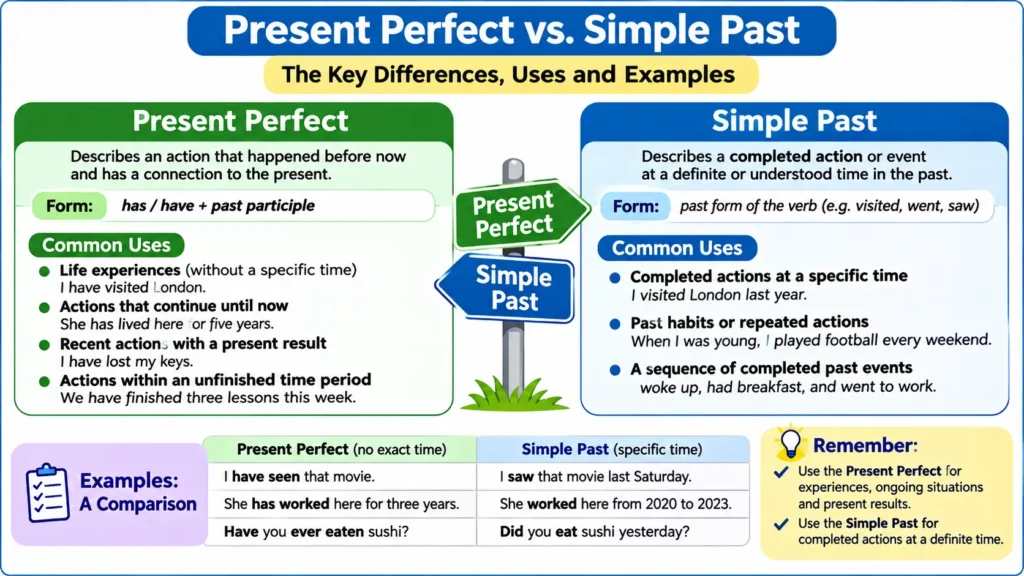
Table of Contents
1. What Is the Present Perfect Tense?
The Present Perfect Tense describes an action or event that happened before now but has a connection to the present.
It is commonly used for:
- Past experiences without mentioning an exact time.
- Actions that started in the past and continue until now.
- Recent actions with a present result.
- Actions occurring within an unfinished period of time.
Present Perfect structure
The Present Perfect is formed using:
Subject + has/have + past participle
| Subject | Helping verb | Past participle | Example |
|---|---|---|---|
| I / You / We / They | have | finished | They have finished their work. |
| He / She / It | has | finished | She has finished her work. |
Examples:
- I have visited Japan twice.
- She has completed her assignment.
- They have lived here for ten years.
- He has lost his wallet.
Notice that the sentences do not necessarily tell us exactly when the actions happened. The focus is on the experience, continuing situation, or present result.
When to use the Present Perfect
A. To describe life experiences
Use the Present Perfect when talking about experiences without specifying exactly when they happened.
Examples:
- I have travelled to Australia.
- She has never eaten sushi.
- Have you ever ridden a horse?
- They have visited several European countries.
The exact time is not important. What matters is whether the experience has happened at some point in the person’s life.
To understand this tense in greater detail, read our complete guide to Present Perfect Tense, including its rules, structure, uses, and examples.
B. To describe actions that started in the past and continue now
Use the Present Perfect with for and since when an action or situation began in the past and is still continuing.
Examples:
- I have worked here for five years.
- She has lived in Kuala Lumpur since 2020.
- They have known each other for a long time.
Remember:
- For refers to a period of time: for three months, for two years, for a long time.
- Since refers to the starting point: since Monday, since 2022, since last January.
C. To describe recent actions with present results
Use the Present Perfect when a completed action has a result or consequence that is relevant now.
Examples:
- I have lost my keys. (I cannot find them now.)
- She has broken her glasses. (Her glasses are broken now.)
- The teacher has cancelled the lesson. (The lesson will not take place.)
D. To describe actions within an unfinished time period
Use the Present Perfect when the time period is still continuing.
Examples:
- I have answered five emails today.
- She has attended three meetings this week.
- We have had two tests this month.
The words today, this week, and this month can be used with the Present Perfect when the relevant time period is not finished.
2. What Is the Simple Past Tense?
The Simple Past Tense describes actions or events that started and finished at a definite or understood time in the past.
It is commonly used for:
- Completed actions in the past.
- Events that happened at a specific time.
- Past habits and repeated activities.
- A sequence of completed past events.
Simple Past structure
For regular verbs, add -ed to the base form.
Examples:
- work → worked
- visit → visited
- clean → cleaned
- finish → finished
Irregular verbs have different past forms.
Examples:
- go → went
- eat → ate
- see → saw
- write → wrote
- buy → bought
The basic structure is:
Subject + past tense verb
Examples:
- I visited my grandmother yesterday.
- She finished her homework last night.
- They went to Singapore last month.
- He bought a new laptop two days ago.
When to use the Simple Past
A. To describe completed actions at a specific time
Examples:
- I watched a movie yesterday.
- She graduated in 2022.
- We moved to this house last year.
- He called me an hour ago.
The actions are finished, and the time is identified.
B. To describe past habits
Use the Simple Past to describe habits or repeated actions that took place in the past.
Examples:
- When I was young, I played football every weekend.
- She walked to school every morning.
- My father worked in a bank for twenty years.
These sentences describe past routines or situations that are no longer continuing.
C. To describe a sequence of completed events
The Simple Past is commonly used when telling stories or describing events that happened one after another.
Example:
Yesterday, I woke up early, prepared breakfast, drove to work, and attended a meeting.
Each action happened and finished in the past.
3. Present Perfect vs. Simple Past: Main Differences
The main difference is whether the speaker is focusing on an experience or connection to the present, or on a completed event in the past.
Compare these examples:
| Present Perfect | Simple Past |
|---|---|
| I have visited Thailand. | I visited Thailand last year. |
| She has finished her work. | She finished her work yesterday. |
| They have lived here for five years. | They lived there for five years. |
| Have you eaten lunch? | Did you eat lunch yesterday? |
| He has lost his phone. | He lost his phone this morning. |
Let’s examine the differences more closely.
Difference 1: Exact time is not mentioned
Present Perfect:
- I have seen that movie.
- She has visited London.
Simple Past:
- I saw that movie last Saturday.
- She visited London in 2024.
The Present Perfect does not normally identify a completed past time. The Simple Past is appropriate when the speaker identifies when the event happened.
Difference 2: The action continues or has ended
Present Perfect:
- I have worked here for ten years.
This normally means I started working here ten years ago and still work here.
Simple Past:
- I worked there for ten years.
This means the employment period has ended.
Difference 3: The result is important now
Present Perfect:
- Tom has broken his leg.
The sentence suggests that his leg is still broken or that the injury is relevant now.
Simple Past:
- Tom broke his leg last year.
The sentence simply tells us when the injury happened. It does not necessarily tell us whether he has recovered.
4. Common Mistakes: Present Perfect vs. Simple Past
Many English learners use these two tenses interchangeably. However, certain time expressions and sentence meanings require careful attention.
Here are some common mistakes and their corrections.
Mistake 1: Using the Present Perfect with a finished past time
Incorrect: I have visited Japan last year.
Correct: I visited Japan last year.
Why?
Last year refers to a completed period in the past. Therefore, use the Simple Past.
More examples:
- Incorrect: She has called me yesterday.
- Correct: She called me yesterday.
- Incorrect: We have moved here in 2020.
- Correct: We moved here in 2020.
Mistake 2: Using the Simple Past for an experience without a specific time
Incorrect: I went to Australia several times.
Correct: I have been to Australia several times.
Why?
When describing life experiences without mentioning when they happened, the Present Perfect is generally appropriate.
However, the Simple Past can also be correct when the speaker is referring to a completed period of life or providing a past-time context.
Mistake 3: Confusing for and since
Incorrect: I have lived here since five years.
Correct: I have lived here for five years.
Why?
Use for with a duration and since with a starting point.
More examples:
- Incorrect: She has worked here for 2021.
- Correct: She has worked here since 2021.
- Incorrect: They have known each other since ten years.
- Correct: They have known each other for ten years.
Mistake 4: Using the Simple Past instead of the Present Perfect for an unfinished situation
Incorrect: I lived here for ten years. (when you still live here and intend to express that the situation continues)
Correct: I have lived here for ten years.
Why?
Use the Present Perfect to show that the situation began in the past and continues now.
However, I lived here for ten years is correct if you no longer live there.
Mistake 5: Using the wrong tense with just, already, and yet
In many standard English learning contexts, these words are commonly taught with the Present Perfect.
Examples:
- Incorrect: She just finished her homework. (in a context where Present Perfect is expected)
- Correct: She has just finished her homework.
- Incorrect: I already ate lunch. (in a context where Present Perfect is expected)
- Correct: I have already eaten lunch.
- Incorrect: Have you finished your work yet? (this sentence is actually correct)
An important note: American English often uses the Simple Past with just and already in everyday conversation. For example, “I just finished my homework” is perfectly natural in American English. The choice can depend on the variety of English and the context.
5. Time Expressions: Which Tense Should You Use?
Time expressions can help you decide whether to use the Present Perfect or Simple Past.
Common Present Perfect time expressions
| Time expression | Example |
|---|---|
| Ever | Have you ever visited Japan? |
| Never | I have never eaten octopus. |
| Just | She has just arrived. |
| Already | They have already finished. |
| Yet | Have you completed the task yet? |
| Since | He has lived here since 2020. |
| For | We have worked together for five years. |
| So far | I have read three chapters so far. |
| Recently | She has recently changed jobs. |
Common Simple Past time expressions
| Time expression | Example |
|---|---|
| Yesterday | I met him yesterday. |
| Last night | She called me last night. |
| Last week | We travelled last week. |
| Two days ago | He arrived two days ago. |
| In 2020 | They moved here in 2020. |
| When I was young | I played football when I was young. |
| This morning | I saw her this morning. (if the morning is over) |
Important: Some time expressions can be used with either tense depending on their meaning and whether the time period is finished.
For example:
- I have spoken to her this morning. (the morning is still in progress)
- I spoke to her this morning. (the morning is over)
6. How to Choose the Correct Tense
When deciding between the Present Perfect and Simple Past, ask yourself these three questions:
Question 1: Am I mentioning a definite, completed time in the past?
If yes, use the Simple Past.
Example:
- I bought this phone yesterday.
Question 2: Am I talking about an experience without saying exactly when it happened?
If yes, the Present Perfect is usually appropriate.
Example:
- I have bought a new phone before.
Question 3: Did the action start in the past and continue until now, or does it have a relevant connection to the present?
If yes, the Present Perfect may be appropriate.
Example:
- I have owned this phone for three years.
This simple method can help you avoid many common tense mistakes.
7. Practice Exercises: Present Perfect or Simple Past?
Test your understanding by choosing the correct verb form in each sentence.
Fill in the blanks using either the Present Perfect or Simple Past.
- I __________ (visit) Singapore last December.
- She __________ (finish) her homework already.
- They __________ (live) in this town since 2018.
- We __________ (watch) that movie yesterday.
- __________ you ever __________ (eat) Korean food?
- He __________ (lose) his wallet this morning, and he cannot find it.
- My parents __________ (travel) to Japan three times.
- I __________ (meet) your brother at the supermarket last week.
- She __________ (work) here for six years and still works here.
- They __________ (buy) a new car two days ago.
- We __________ (not complete) the project yet.
- He __________ (go) to London in 2023.
Answers and Explanations
- visited – “Last December” identifies a completed time in the past, so use the Simple Past.
- has finished – “Already” indicates a completed action with present relevance.
- have lived – The situation started in 2018 and continues now.
- watched – “Yesterday” refers to a completed past time.
- Have / eaten – The question asks about life experience without specifying when.
- has lost – The missing wallet has a present consequence. The Simple Past, “lost”, is also possible in some contexts, particularly when the past time is emphasised.
- have travelled – The sentence describes life experiences without specifying when.
- met – “Last week” is a completed past time.
- has worked – The employment started in the past and continues now.
- bought – “Two days ago” identifies a completed past time.
- have not completed – “Yet” is commonly used with the Present Perfect to describe an action that remains unfinished.
- went – “In 2023” identifies a specific completed time in the past.
8. Summary: Present Perfect vs. Simple Past
Here is a quick comparison to help you remember the main rules.
| Present Perfect | Simple Past |
|---|---|
| Past action connected to the present | Completed past action |
| Life experiences without a specific time | Events at a specific past time |
| Actions continuing until now | Past situations that have ended |
| Recent actions with present relevance | Past events or sequences |
| Has / Have + past participle | Past form of the verb |
Remember these examples:
- I have visited Paris. (life experience)
- I visited Paris last year. (specific past time)
- She has worked here for five years. (still works here)
- She worked there for five years. (employment has ended)
The most important rule is to consider the meaning and time reference of the sentence, rather than simply memorising a list of time expressions.
Further Reading: Present Perfect and Simple Past
Would you like to learn more about the Present Perfect and Simple Past? These trusted English grammar resources provide additional explanations, examples, and practice activities.
- Cambridge Dictionary – Past Simple or Present Perfect?
Learn how to distinguish between the two tenses, especially when talking about completed actions, definite past times, and experiences connected to the present. - British Council – Present Perfect
Explore the uses of the Present Perfect with clear explanations, practical examples, and interactive grammar exercises.
9. Frequently Asked Questions
1. What is the main difference between Present Perfect and Simple Past?
The Present Perfect describes a past action connected to the present, an experience without a specified time, or a situation that continues until now. The Simple Past describes a completed action or event in the past.
2. Can I use the Present Perfect with yesterday?
Normally, no. Yesterday refers to a completed past time, so use the Simple Past.
Correct: I saw him yesterday.
Incorrect: I have seen him yesterday.
3. Can I use the Present Perfect with today?
Yes. You can use the Present Perfect when referring to an action within a time period that is still continuing.
Example: I have completed three lessons today.
4. What is the difference between have been and went?
“Have been to” commonly describes a completed visit or life experience without specifying when.
Example: I have been to Japan twice.
“Went” describes an action at a particular time or within a past-time context.
Example: I went to Japan last year.
5. Is the Present Perfect used more in British or American English?
Both British and American English use the Present Perfect. However, American English often uses the Simple Past in situations where British English commonly uses the Present Perfect, particularly with words such as just and already.
6. Is “I have lived here for ten years” correct?
Yes. It means you started living here ten years ago and still live here.
If you no longer live there, you can say: “I lived there for ten years.”
10. Improve Your English Grammar with More Practice
Understanding the difference between the Present Perfect and Simple Past takes practice. Try using both tenses when talking about your experiences, daily activities, completed events, and personal history.
For more learning activities, explore our English grammar resources and worksheets.
Try our free English Grammar Worksheets
Practise different grammar topics with our free sample worksheets. They are suitable for students, teachers, tutors, and independent learners.
Download Free English Grammar Worksheets
Explore Our English Grammar Worksheets
Looking for more structured grammar practice? Explore our English Grammar Worksheets, covering different topics and learning levels, with the AutoTick marking facility to help check answers automatically.
Explore English Grammar Worksheets
With regular practice, you will become more confident in choosing between the Present Perfect and Simple Past and using both tenses correctly in everyday English.