
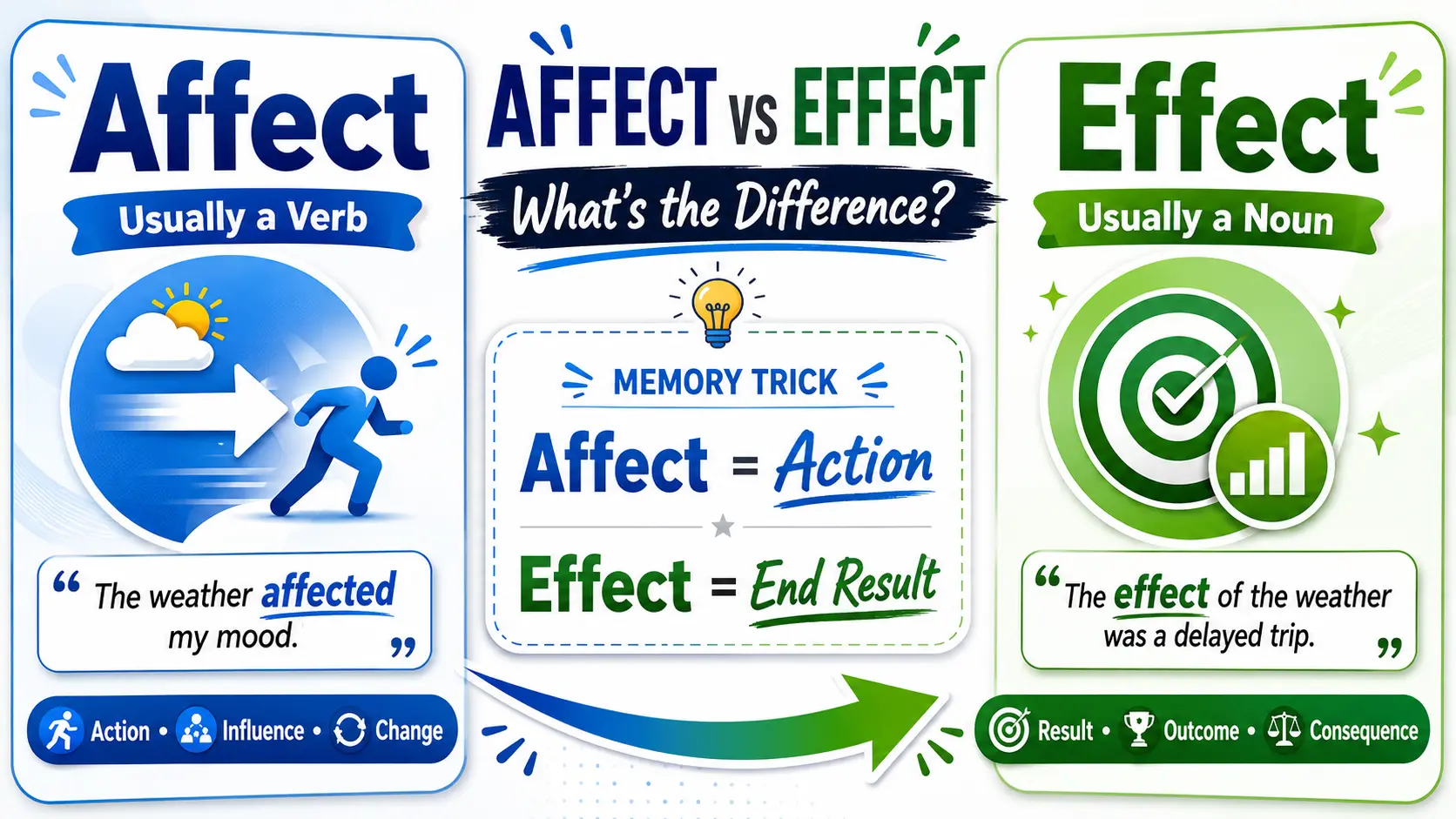
Many English learners struggle with affect vs effect because these words sound similar and are often used in related situations. Let’s be honest: even native English speakers look at a blank screen sometimes, cursor blinking, wondering whether to type affect or effect. It’s one of those grammar hurdles that feels designed to trip us up. You know exactly what you want to say, but the moment you have to choose between that ‘A’ and that ‘E’, your brain suddenly hits a wall.
If you’ve ever found yourself second-guessing a sentence like, “The weather affected my mood,” or “The weather effected my mood,” you are definitely not alone. I used to get stuck on this all the time until I learned a couple of ridiculously simple mental shortcuts. Let’s break it down together so you never have to guess again.
If you find yourself constantly second-guessing word choices like this, don’t worry—English is full of these little traps. In fact, affect and effect are just the tip of the iceberg. If you want to clean up your writing even further, check out Commonly Confused Words, where we break down other tricky pairs like accept vs. except and their, there, and they’re.
Free Printable Worksheet on Affect vs Effect
Practise as you learn! Download the FREE Affect vs Effect Worksheet (PDF) and complete the exercises while reading this lesson.
Table of Contents
Quick Answer
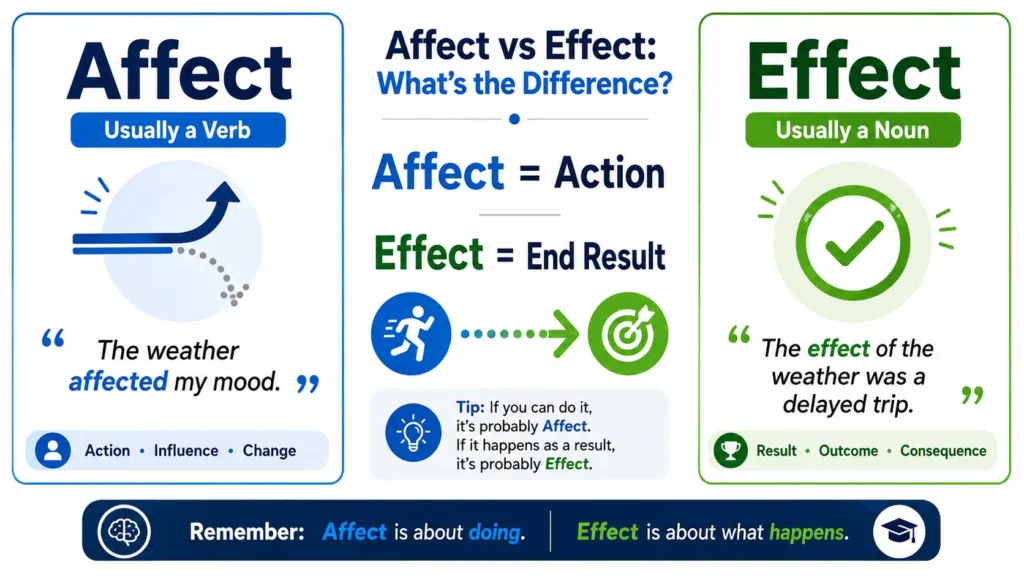
- Affect is usually a verb (an action word).
- Effect is usually a noun (a result).
The Golden Rule
Affect = Action
Effect = End Result
- Example: The heavy rain affected (action) traffic.
- Example: The effect (end result) of the heavy rain was severe traffic congestion.
The Origins of “Affect” and “Effect”
Understanding why these two words exist side by side comes down to their Latin roots. Both words crossed into Middle English through Old French, but they trace back to different Latin verbs:
- Affect comes from the Latin verb afficere, which literally means “to do something to,” “to act upon,” or “to influence.” The prefix ad- (to/towards) combined with facere (to do/make) creates a word inherently built around action.
- Effect comes from the Latin verb efficere, which means “to work out,” “to accomplish,” or “to complete.” The prefix ex- (out of) combined with facere (to do/make) creates a word built around completion or the final result.
Recognizing that affect is about the ongoing process (acting upon) while effect is about the outcome (accomplished result) makes choosing the right word far more intuitive.
Understanding why these two words exist side by side comes down to their Latin roots. You can explore deeper etymological breakdowns of English vocabulary on the Merriam-Webster Etymology Dictionary.
What Does “Affect” Mean?
Affect means to influence, change, or have an impact on something.
Something -> affects -> Something else
- Lack of sleep can affect your concentration.
- Exercise positively affect your health.
- The new policy affected many employees.
Takeaway: If you can replace the word with “alter” or “influence,” you want affect.
Grammatical Characteristics of “Affect” as a Verb:
Because affect functions almost exclusively as a transitive verb, it always requires a direct object—the person, place, or thing undergoing the change. It can be modified by adverbs and conjugated across all standard English tenses:
- Present Tense: “Environmental changes directly affect local wildlife.”
- Past Tense: “The sudden power outage affected our entire server network.”
- Present Continuous: “Rising material costs are actively affecting project budgets.”
- Modals: “A bad night’s sleep can severely affect your reaction time.”
What Does “Effect” Mean?
Effect means the result, outcome, or consequence of an action.
The effect of Something = The Result
- The effect of the medicine was immediate.
- One effect of climate change is rising sea levels.
- The new training program had a positive effect on productivity.
Takeaway: If you can put “the,” “a,” or “an” in front of it, you almost always want effect.
Common Adjective & Preposition Combinations with “Effect”:
In professional and academic writing, effect frequently pairs with specific prepositions and adjectives. Mastering these set phrases will make your sentences sound polished and natural:
- Have an effect ON: “The new tax law will have a major effect on small businesses.”
- In effect: “The temporary building restrictions remain in effect until December.”
- Take effect: “The revised schedule will take effect starting next Monday.”
- Side effect: “Drowsiness is a common side effect of this medication.”
- Ripple effect: “The factory closure had a devastating ripple effect across the local economy.”
Sentence Formula Master Reference
| Sentence Formula | Correct Word | Example Sentence |
| Subject + [Verb] + Direct Object | Affects / Affected | “The delay affected our delivery schedule.” |
| The + [Noun] + of + [Thing] | Effect | “The effect of the delay was costly.” |
| Have / Has + a/an + [Adjective] + [Noun] | Effect | “It had a noticeable effect on sales.” |
| Cause and [Noun] | Effect | “We studied the law of cause and effect.” |
| To + [Verb] + change (Bring about) | Effect (Advanced) | “The director hopes to effect real policy change.” |
Side-by-Side Comparison
| Affect (Verb) | Effect (Noun) |
| To influence or change | The result or outcome |
| To impact | The consequence |
| “The teacher’s encouragement affected the student’s confidence.” | “The effect of the teacher’s encouragement was increased confidence.” |
Easy Memory Tricks
1. The RAVEN Method
This is the ultimate grammar lifesaver:
- R = Remember
- A = Affect is a
- V = Verb
- E = Effect is a
- N = Noun
2. First-Letter Matching
- A = Action = Affect
- E = End Result = Effect
Common Mistakes to Avoid
- Incorrect: The new software had a positive affect on productivity.
- Correct: The new software had a positive effect on productivity.(Why? Because “a positive effect” is a noun phrase talking about a result.)
- Incorrect: The new software effected productivity.
- Correct: The new software affected productivity.(Why? Because the software is actively influencing the productivity.)
Advanced Alert: The Special Exception
Every grammar rule has a rebel phase. Out in the wild, you might occasionally see effect used as a verb.
“The manager effected several important changes.”
In this rare, formal context, “effected” means to bring about or to produce a result. Unless you are writing formal legal or corporate policy, you can safely stick to the standard rules!
Exception 1: “Effect” as a Verb (To Bring About / To Execute)
When used as a verb, to effect means “to bring about,” “to accomplish,” or “to produce a specific result.” It is most frequently paired with nouns like change, reforms, solutions, or agreements in legal, government, or business policy contexts.
- Standard Verb (Affect = influence): “The new director affected company culture.” (She influenced or altered the culture).
- Special Verb (Effect = create/execute): “The new director effected sweeping organizational changes.” (She created and brought those changes into existence).
Exception 2: “Affect” as a Noun (Psychological Demeanor)
In clinical psychology, psychiatry, and neurology, affect (pronounced with emphasis on the first syllable: AFF-ect) is a noun referring to the external, observable expression of an individual’s emotions or mood.
- Clinical Example: “The patient exhibited a flat affect during the evaluation.” (The patient showed no visible emotional expression).
- Everyday Equivalent: Unless you are analyzing psychiatric symptoms or writing clinical case notes, you will never need to use affect as a noun in general English.
Real-World Contexts
In Business Writing
Using these correctly keeps your emails and reports looking sharp and professional.
- Rising costs may affect company profits.
- The effect of inflation can be seen across many industries.
In Academic Writing
Precision is key when writing essays or research papers.
- Researchers studied how diet affects health.
- The study examined the effects of sleep deprivation.
Before you test your skills on the quiz below, you might want to brush up on basic sentence structures. Knowing how Subject Verb Agreement and nouns interact makes picking the right word effortless. Take a quick look at our Easy Guide to Parts of Speech to help you spot nouns and verbs in a flash, or dive into our Master Test Worksheets to give your sentences an instant professional polish.
Test Your Skills!
Choose the correct word (affect or effect) for each sentence:
- The economic downturn had a profound __________ on consumer spending.
- How will the new construction noise __________ your morning classes?
- The medicine took __________ within twenty minutes of administration.
- She tried not to let the harsh criticism __________ her confidence.
- Scientists are still studying the long-term __________ of global warming.
- The manager implemented new protocols to __________ positive changes in workflow.
- High humidity can negatively __________ the solar panel output.
- The law went into __________ at midnight.
- Caffeine has a noticeable __________ on my heart rate.
- Did the sudden weather change __________ your flight schedule?
Answer Key & Detailed Explanations:
- effect — Noun following the article phrase “a profound…”
- affect — Verb meaning “to influence” or “to alter.”
- effect — Noun inside the fixed phrase “took effect” (became active).
- affect — Verb following the infinitive marker “to affect.”
- effects — Plural noun following the modifier “long-term.”
- effect — Advanced verb usage meaning “to bring about” (effect changes).
- affect — Action verb indicating influence on solar output.
- effect — Noun in the prepositional phrase “into effect.”
- effect — Noun following the article phrase “a noticeable…”
- affect — Action verb modifying the flight schedule.
Free Printable Worksheet on Affect vs Effect
Practise as you learn! Download the FREE Affect vs Effect Worksheet (PDF) and complete the exercises while reading this lesson.
✅ Printable PDF
✅ Detailed answer key with explanations
✅ Perfect for self-study or classroom use
More Grammar Resources
If you found this guide helpful, explore our other English grammar lessons. Mastering commonly confused words is the fastest way to build your writing confidence!
Feel free to check out our free sample worksheets for quick practice or head over to our English Grammar Test Worksheet to unlock premium printable grammar packs and advanced learning resources.
English Grammar Worksheets with AutoTick™
✔ AutoTick™ Secure Answer Checking System
✔ Step-by-step instructions
✔ Answer keys with clear explanations
✔ Password-protected marking (prevents cheating)
Frequently Asked Questions (FAQ)
Can “affect” ever be a noun?
Yes, but it is very rare! In psychology, affect (pronounced with the stress on the first syllable: AFF-ect) is used as a noun to describe a person’s visible emotional expression or demeanor. For example: “The patient displayed a flat affect.” Unless you are writing a clinical psychology paper, you will almost always use it as a verb.
Are “affective” and “effective” different too?
Absolutely. They follow the exact same roots as their cousins:
Affective relates to moods, feelings, and attitudes (e.g., “Seasonal Affective Disorder”).
Effective means producing the desired end result (e.g., “That was an effective marketing strategy”).
Is it “into effect” or “into affect”?
It is always “into effect.” Because you are talking about bringing a new rule or law to its starting point or final state (a result), you use the noun form.
Example: “The new office policy goes into effect on Monday.”
How do I know which one to use after the words “no” or “any”?
If you say “no ______” or “any ______,” you need the noun effect. Words like no, any, much, and some modify nouns.
Example: “The coffee had no effect on my tiredness.”
Example: “Did the rain have any effect on the field?”