
Your vs you’re is one of the most common grammar mistakes in English. Many learners confuse these words because they sound the same when spoken.
However, your and you’re have completely different meanings and uses. Understanding the difference between your vs you’re will help you write more clearly and avoid common errors.
To be completely honest, even native English speakers mess this up constantly. I can’t tell you how many times I’ve been texting a friend in a hurry, sent a quick “Your welcome!”, and immediately felt that tiny prick of grammatical shame. It happens to the best of us because our brains think in sounds before they think in spelling. If you’ve been mixing these two up, please don’t beat yourself up about it—you are definitely not alone, and it’s an incredibly easy fix once you know what to look for.
👉 Download your free grammar worksheets here:
https://learnenglishgrammar.org/free-sample/
Table of Contents
🟢 What Is “Your”?
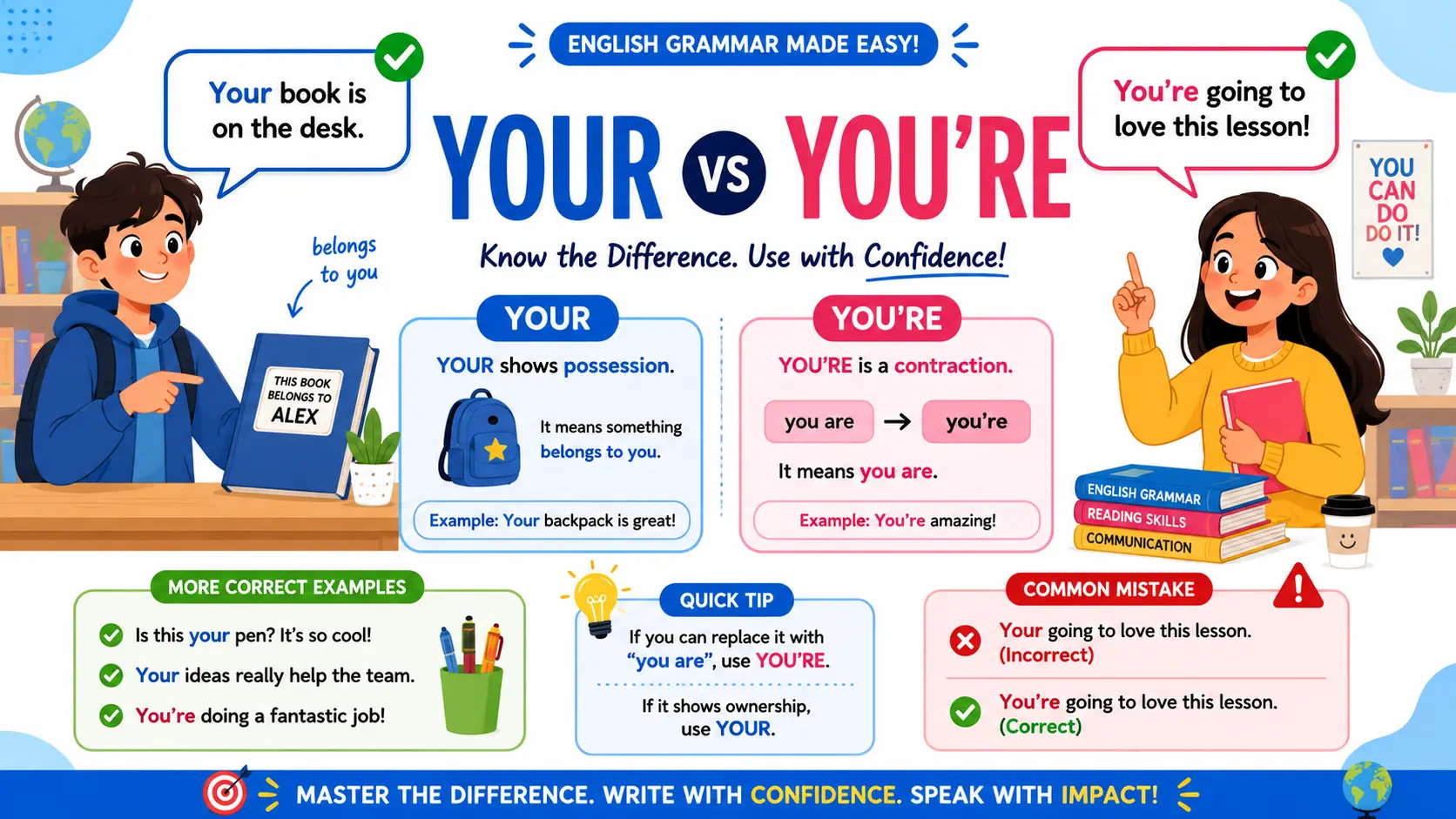
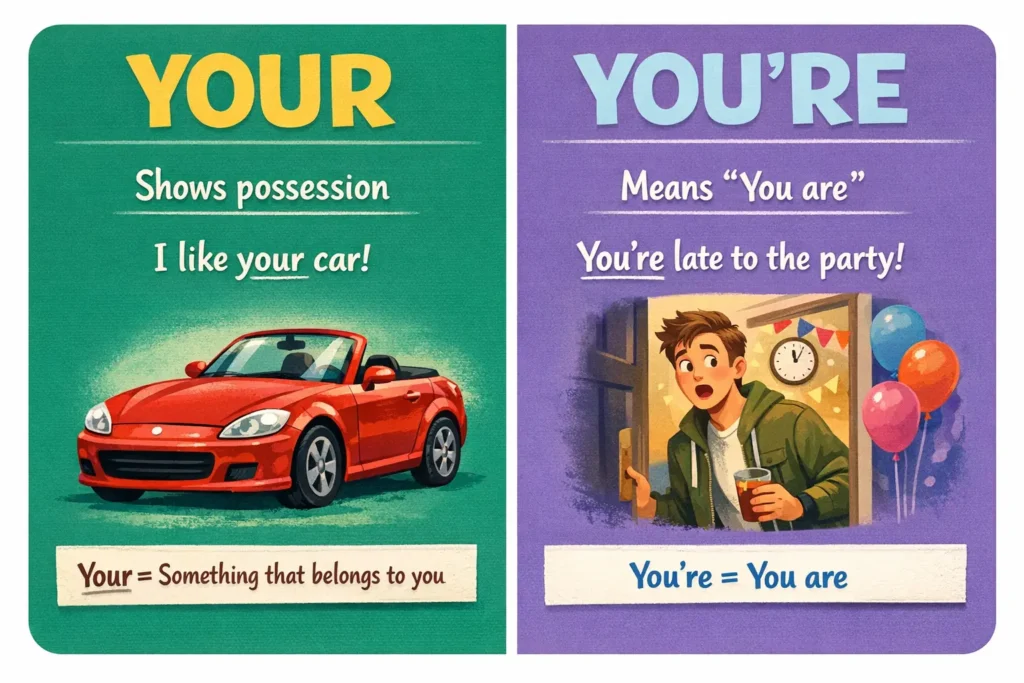
Your is a possessive adjective. It shows that something belongs to the person you are speaking to.
Examples:
- Is this your book?
- I like your idea.
- Please bring your homework tomorrow.
In these sentences, your shows possession.
🟢 What Is “You’re”?
You’re is a contraction of you are.
It combines the words you and are into a shorter form.
Examples:
- You’re my best friend.
- I think you’re right.
- You’re going to enjoy this movie.
In each example, you’re means you are.
🟢 Your vs You’re Examples
Your:
- Please finish your work.
- I like your new jacket.
You’re:
- You’re doing a great job.
- You’re going to succeed.
Your vs. You’re Visual Shortcut Matrix
| Word Category | Structural Role | Meaning | Test Method | Correct Example |
| Your | Possessive Adjective | Belongs to you | Substitute with “my” or “his” | “I read your article yesterday.” |
| You’re | Contraction (You + Are) | You are | Substitute with “you are” | “You’re going to pass the exam.” |
| Yours | Possessive Pronoun | Belongs to you (Standalone) | Never takes an apostrophe | “The decision is yours.” |
| Yore | Archaic Noun | Time long past | Means “ancient times” | “Legends from days of yore.” |
🟢 Simple Trick to Remember
A quick way to choose between your vs you’re is to replace the word with “you are.” This is the exact mental shortcut I use every single time I hesitate over a keyboard. Think of it like a quick sanity check. Whenever I’m typing out an email and my finger hovers over the keys, I mentally read the sentence out loud using “you are.” If it sounds totally ridiculous and clunky, my brain instantly goes, Nope, grab the other one! It takes literally one second, but it has saved me from looking unprofessional in important emails more times than I care to admit.
Example:
You’re very kind.
→ You are very kind ✔
I like your car.
→ I like you are car ❌
If the sentence still makes sense, use you’re.
If not, use your.
Common Mistakes in Your vs You’re
Mistake 1: Writing “Your Welcome”
❌ Incorrect: Thank you for the assistance! — Your welcome!
✔️ Correct: Thank you for the assistance! — You’re welcome!
Pedagogical Reason: You are stating “You are welcome,” which requires the contraction you’re.
Mistake 2: Confusing Possession with Physical Actions
❌ Incorrect: I hope your coming to the grammar workshop today.
✔️ Correct: I hope you’re coming to the grammar workshop today.
Pedagogical Test: Substitute “you are”: “I hope you are coming…” makes complete sense, so you’re is required.
Mistake 3: Misusing “You’re” Before Nouns
❌ Incorrect: Please place you’re coat on the rack near the entrance.
✔️ Correct: Please place your coat on the rack near the entrance.
Pedagogical Test: Substitute “you are”: “Please place you are coat…” is grammatically incorrect; the coat belongs to the listener, requiring your.
Mistake 4: Adding Apostrophes to Possessive Pronouns (“Your’s”)
❌ Incorrect: Is this custom solar cooker your’s?
✔️ Correct: Is this custom solar cooker yours?
Pedagogical Reason: Personal possessive pronouns (yours, hers, ours, theirs, its) never use an apostrophe.
Mistake 5: Misidentifying “Your” in Gerund Clauses
❌ Incorrect: I appreciate you coming to help with the website layout.
✔️ Correct: I appreciate your coming to help with the website layout.
Formal Grammar Rule: In formal academic writing, a gerund (coming) is treated as a noun, so it is preceded by a possessive adjective (your).
Mistake 6: Writing “You’re” When Modifying Adjectives and Nouns Together
❌ Incorrect: You’re excellent feedback helped improve our worksheet designs.
✔️ Correct: Your excellent feedback helped improve our worksheet designs.
🟢 Why This Mistake Happens
The confusion between your vs you’re happens because they are homophones.
Homophones are words that sound the same but have different meanings and spellings.
Because they sound identical, many learners choose the wrong word when writing.
For additional examples and rules on possessive pronouns versus contractions, consult the Merriam-Webster Your vs. You’re Guide
🟢 Practice Exercise
Choose the correct word (your or you’re) for each gap:
- __________ going to be impressed by the new website updates.
- Please verify that __________ email address is entered correctly.
- If __________ finished with the test, you may submit your answer sheet.
- The teacher praised __________ dedication to mastering English grammar.
- I noticed that __________ solar reflector is positioned toward the sun.
- Do you know if __________ scheduled to present at the meeting tomorrow?
- Make sure __________ wearing safety goggles during the practical demonstration.
- We received __________ application for the educational worksheet bundle.
- __________ likely to see significant improvements with daily practice.
- Is that red notebook on the table __________ personal journal?
Answer Key & Detailed Explanations:
- You’re — Contraction for You are going to be impressed.
- your — Possessive adjective modifying the noun email address.
- you’re — Contraction for If you are finished.
- your — Possessive adjective modifying the abstract noun dedication.
- your — Possessive adjective modifying the noun solar reflector.
- you’re — Contraction for if you are scheduled.
- you’re — Contraction for make sure you are wearing.
- your — Possessive adjective modifying the noun application.
- You’re — Contraction for You are likely to see.
- your — Possessive adjective modifying the noun personal journal.
🟢 Improve Faster (Worksheets)
👉 Get full practice materials here:
https://learnenglishgrammar.org/english-grammar-worksheets/
These worksheets include:
- Grammar exercises
- Answer keys
- Easy-to-follow explanations
🟢 Learn More Grammar Topics
You may also like:
👉 Subject-Verb Agreement Rules
https://learnenglishgrammar.org/subject-verb-agreement-rules/
👉 Active Voice vs Passive Voice
https://learnenglishgrammar.org/active-vs-passive-voice/
🟢 External Reference
For more explanation, see:
https://www.grammarly.com/blog/your-vs-youre/
Free Printable Worksheet on Affect vs Effect
Practise as you learn! Download the FREE Your Vs You’re Worksheet (PDF) and complete the exercises while reading this lesson.
🟢 Conclusion
The difference between your vs you’re is simple once you understand their meanings:
- Your shows possession
- You’re means you are
By using the “you are” test, you can easily avoid this common grammar mistake.
At the end of the day, mastering these little language quirks isn’t about being a perfect grammar robot—it’s just about making sure your ideas come across exactly the way you want them to. We live in a fast-paced digital world where first impressions often happen over text or email, and getting this right is a small, easy way to show you care about the details. So, grab a coffee, download the practice sheets below, and give yourself a little grace while you learn!
👉 Download your free sample worksheets now:
https://learnenglishgrammar.org/free-sample/
Why do I see native English speakers mix these up so often?
Honestly, it usually comes down to pure laziness or typing too fast! Because “your” and “you’re” sound exactly the same in our heads, our fingers often just type the shortest version out of muscle memory. It’s rarely because people don’t know the rule; it’s just that their brains are moving faster than their keyboards.
Is “yours” a word, and does it need an apostrophe?
Yes, “yours” is absolutely a word (it’s a possessive pronoun, like in the sentence, “That jacket is yours”). However, it never takes an apostrophe. Adding one (your’s) is a very common mistake, but it isn’t grammatically correct in English.
Can I use “you’re” in formal business emails, or is it too casual?
You can definitely use it! Contractions like “you’re,” “it’s,” and “can’t” are perfectly acceptable in modern business writing—they make you sound like a human being rather than a rigid robot. However, if you are writing a highly formal document like a legal contract, an academic thesis, or a serious cover letter, it’s safer to spell it out completely as “you are.”
What about “yore”? Is that related to these two?
It sounds identical, but it has a completely different meaning! “Yore” is an old-fashioned, literary word that means “time long past.” You’ll usually only hear it in the phrase “days of yore” (which basically means “the olden days”). Unless you’re writing a fantasy novel or a history book, you won’t need to use it.
Are there any other words that trick people the same way?
Oh, absolutely—English loves to make things confusing! The exact same trap happens with there/their/they’re and its/it’s. The best defense is always the same trick we used today: expand the contraction. If you’re stuck on “it’s,” say “it is” out loud. If it fits, you need the apostrophe!