
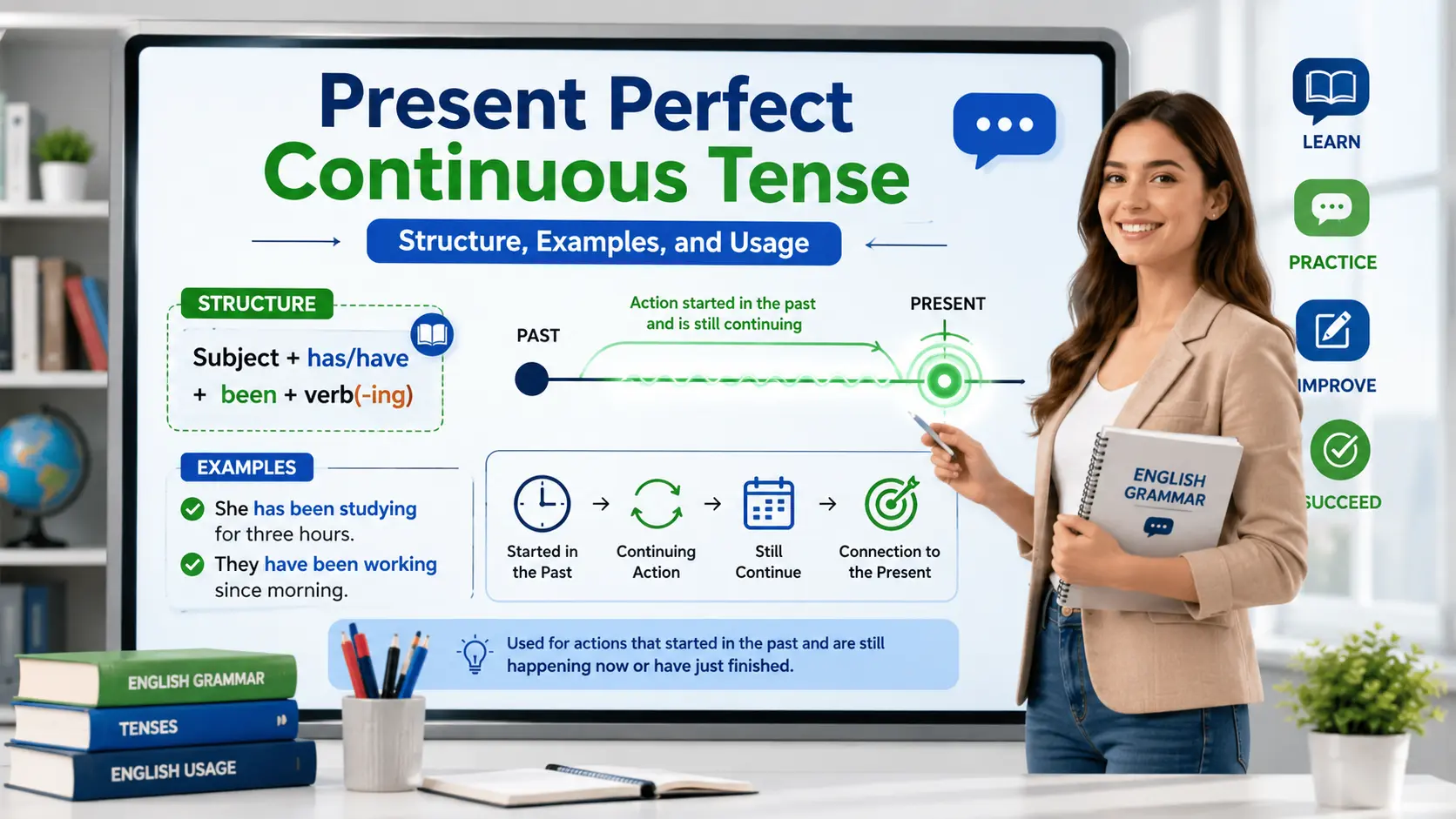
The Present Perfect Continuous Tense is used to describe actions that started in the past and are still continuing or have recently stopped but still have a visible result. This tense focuses on the duration of an action rather than just the result.
Understanding this tense is important for improving fluency and expressing ongoing situations clearly in English.
If you are learning English grammar step by step, you may also want to review:
These tenses will help you understand how the Present Perfect Continuous fits into the bigger picture.
Table of Contents
What is the Present Perfect Continuous Tense?
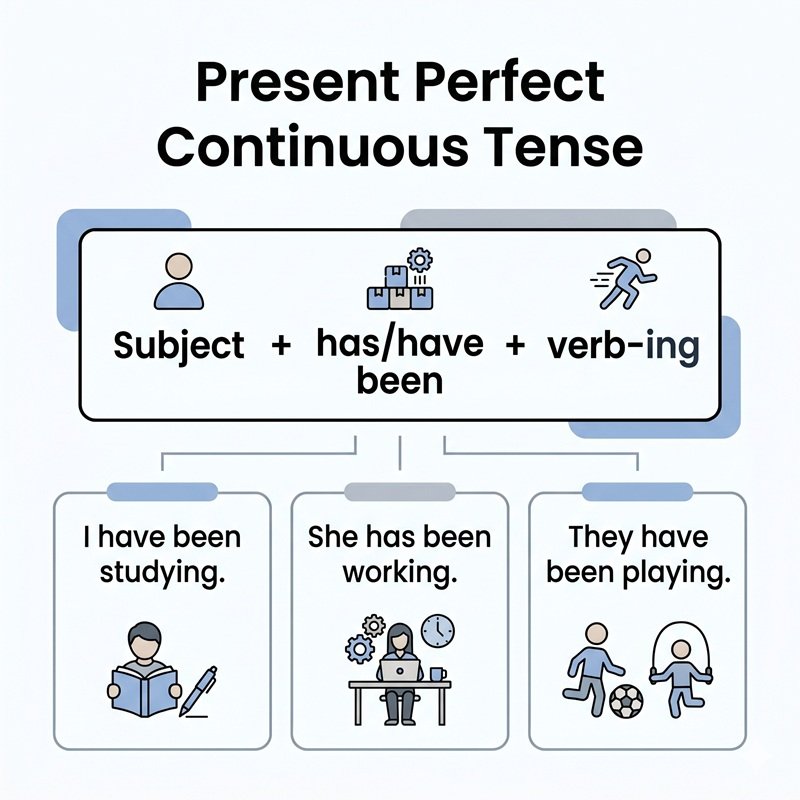
The Present Perfect Continuous Tense describes:
- Actions that started in the past and continue now
- Actions that recently stopped but have present results
- Actions that emphasize duration (how long)
Examples:
- I have been studying for two hours.
- She has been working all day.
- They have been playing football since morning.
👉 Compare this with:
- Present Perfect Tense (focus on result)
- Present Continuous Tense (focus on current action)
Present Perfect Continuous Master Formula Chart
| Sentence Type | Formula | Singular Subject (He, She, It) | Plural Subject (I, You, We, They) |
| Affirmative | Subject + has/have been + V-ing | “She has been reading for two hours.” | “They have been working since morning.” |
| Negative | Subject + has/have not been + V-ing | “He has not been feeling well lately.” | “We have not been studying enough.” |
| Yes/No Question | Has/Have + Subject + been + V-ing? | “Has she been practicing the piano?” | “Have you been waiting long?” |
| Wh- Question | Wh- Word + has/have + Subject + been + V-ing? | “How long has he been running?” | “Why have they been arguing?” |
Structure of Present Perfect Continuous
Present Perfect Continuous constructions follow established academic rules governing verbal aspect and present relevance.
Subject+has/have been+verb-ing
Examples:
- I have been reading a book.
- He has been watching TV.
- We have been learning English.
👉 If you are unsure about verb forms, review:
- Simple Present Tense (basic verb forms)
- Present Continuous Tense(verb + ing)
Positive, Negative, and Question Forms
✅ Positive Sentences
- She has been studying since morning.
- They have been working for hours.
❌ Negative Sentences
- She has not been studying since morning.
- They have not been working for hours.
❓ Questions
- Has she been studying since morning?
- Have they been working for hours?
👉 You can compare sentence patterns with:
Three-Tense Present Aspect Comparison Matrix
| Tense Name | Structural Pattern | Primary Focus | Timeline / Anchor Point | Example Sentence |
| Present Continuous | Subject + am/is/are + V-ing | Action happening RIGHT NOW | Purely current moment | “I am reading a book.” (Happening this second) |
| Present Perfect Simple | Subject + has/have + V3 | COMPLETED RESULT | Past action with present relevance | “I have read the book.” (I am finished with it) |
| Present Perfect Continuous | Subject + has/have been + V-ing | DURATION & ONGOING EFFORT | Past leading up to/including NOW | “I have been reading for two hours.” (Process is ongoing) |
When to Use the Present Perfect Continuous
1. Actions that started in the past and continue now
- I have been living here for five years.
👉 Compare with:
- Present Perfect Tense (focus on completion)
2. Actions that recently stopped with visible results
- He is tired because he has been running.
👉 Compare with:
- Past Continuous Tense (action in progress in the past)
3. To emphasize duration (for / since)
- She has been reading for two hours.
- We have been waiting since 9 a.m.
👉 Also review:
- Present Perfect Tense (uses for/since but focuses on result)
Signal Words
Common words used with this tense:
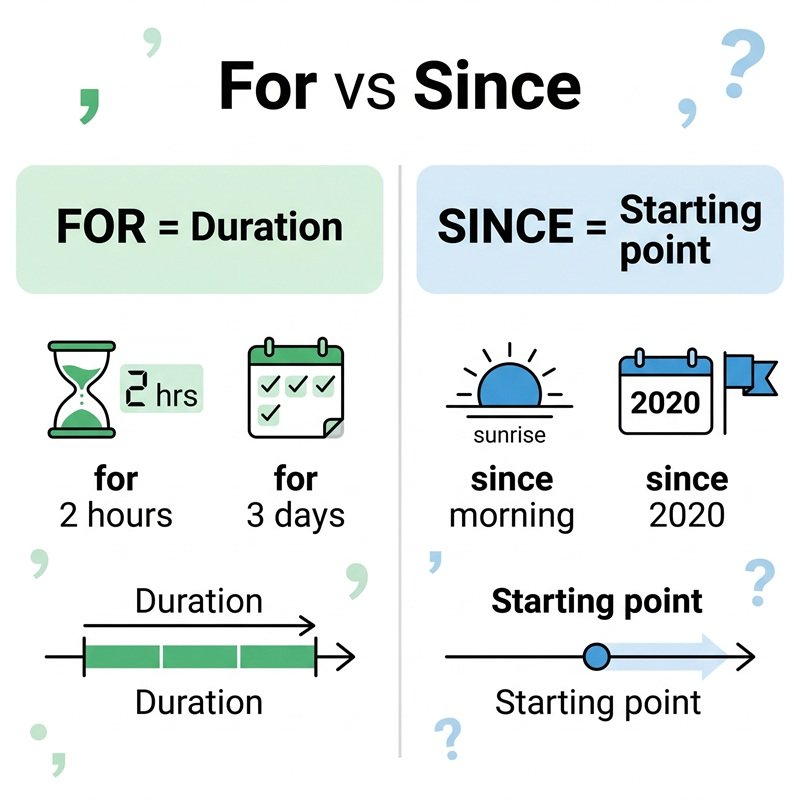
- for (a period of time)
- since (a point in time)
- all day
- recently
- lately
Present Perfect Continuous vs Present Perfect
| Present Perfect Continuous | Present Perfect |
|---|---|
| Focus on duration | Focus on result |
| “I have been reading” | “I have read” |
Example:
- I have been reading for two hours. (duration)
- I have read the book. (completed result)
Stative Verbs: An Exception to the Present Perfect Continuous
Dynamic verbs, which describe physical or active processes such as running, studying, and working, can generally be used in continuous tenses.
However, stative verbs—which describe mental states, emotions, perception, possession, or other conditions—are generally not used in the Present Perfect Continuous.
When a stative verb describes a state that began in the past and continues to the present, use the Present Perfect Simple instead.
| Category | Incorrect (Present Perfect Continuous) | Correct (Present Perfect Simple) | Pedagogical Reason |
| Mental States | “I have been knowing him for five years.” | “I have known him for five years.” | Knowing is a continuous state of mind, not an active physical process. |
| Possession | “He has been having that car since 2020.” | “He has had that car since 2020.” | Ownership is a legal condition rather than an ongoing physical action. |
| Emotions | “She has been liking English literature.” | “She has liked English literature.” | Emotional preferences do not take continuous -ing forms. |
| Perception | “We have been understanding the lesson.” | “We have understood the lesson.” | Mental comprehension takes simple perfect forms. |
Common Present Perfect Continuous Mistakes and How to Fix Them
Mistake 1: Confusing “For” and “Since” in Time Measurements
- ❌ Incorrect: She has been studying here since three hours.
- ✔️ Correct: She has been studying here for three hours.
- Pedagogical Reason: Always use for when specifying a span or length of time (3 hours, 5 days); use since when pointing to a specific starting moment (since 9:00 AM, since 2018).
Mistake 2: Dropping “Been” from the Verb Phrase
- ❌ Incorrect: They have working on the project all morning.
- ✔️ Correct: They have been working on the project all morning.
- Pedagogical Reason: The passive/continuous helper been connects the perfect auxiliary (have/has) to the active participle (-ing).
Mistake 3: Misplacing Mid-Position Adverbs (“Just”, “Recently”, “Already”)
- ❌ Incorrect: He has been recently practicing his presentation.
- ✔️ Correct: He has recently been practicing his presentation. / He has been practicing his presentation recently.
- Pedagogical Rule: Place time adverbs directly between has/have and been, or position them at the very end of the sentence.
Mistake 4: Using Present Simple for Actions Still Continuing Now
- ❌ Incorrect: I live in Kuala Lumpur for ten years.
- ✔️ Correct: I have been living in Kuala Lumpur for ten years.
- Pedagogical Reason: Simple Present describes permanent habits or facts, whereas duration leading up to the present requires Present Perfect Continuous.
Mistake 5: Using Past Simple Instead of Present Perfect Continuous for Visible Results
- ❌ Incorrect: He is out of breath because he ran.
- ✔️ Correct: He is out of breath because he has been running.
- Pedagogical Reason: Use Present Perfect Continuous when a recent past activity produces direct, observable physical evidence in the present moment (sweating, tiredness, dirty hands).
Want to practise English Tenses offline or test your knowledge in real time? Try our free sample and experience the AutoTick instant-marking system!
Tips for Learning This Tense
- Focus on duration words like for and since
- Always use verb + ing
- Remember to include has/have been
- Practice speaking with real-life examples
👉 Build a strong foundation:
Interactive Practice Exercise: Test Your Understanding
Complete each sentence by putting the verb in brackets into the correct tense (Present Perfect Continuous or Present Perfect Simple):
- The technicians __________ (repair) the server for over four hours, and it is almost fixed.
- How long __________ you __________ (learn) English grammar online?
- She __________ (know) her best friend since primary school.
- The ground is soaking wet because it __________ (rain) all afternoon.
- I __________ (read) three chapters of this book so far today.
- He __________ (not / feel) well recently, so he stayed home from work.
- They __________ (own) that property in Sri Damansara since 2015.
- Why are your hands covered in grease? — I __________ (fix) the solar cooker frame.
- She __________ (practiced) the piano since 8:00 AM this morning.
- We __________ (wait) for the bus for forty minutes.
Answer Key & Detailed Explanations:
- have been repairing — Emphasizes ongoing process and duration (for over four hours).
- have / been learning — Interrogative form calculating cumulative duration up to now.
- has known — Know is a stative verb of mental state, requiring Present Perfect Simple.
- has been raining — Explains observable present physical evidence (soaking wet ground).
- have read — Focuses on a completed quantitative result (three chapters).
- has not been feeling (hasn’t been feeling) — Describes a continuous recent condition.
- have owned — Own is a stative verb of possession, requiring Present Perfect Simple.
- have been fixing — Explains a recent ongoing action with visible present evidence (greasy hands).
- has been practicing — Continuous effort starting at a specific point in time (since 8:00 AM).
- have been waiting — Emphasizes continuous duration leading directly up to the present moment.
Master English Tenses with Automated Grading
Take your grammar skills to the next level with our complete collection of English Grammar Lessons with AutoTick Marking Facilities.
Practise hundreds of exercises covering all English tenses, receive instant automated grading, and access detailed explanations for every answer.
Conclusion
The Present Perfect Continuous Tense is essential for expressing ongoing actions and emphasizing duration. By understanding its structure and usage, you can communicate more clearly and naturally in English.
Practice regularly and try to use this tense in daily conversations to master it effectively.
FAQ
What is the Present Perfect Continuous Tense in simple words?
It is the tense used to talk about an action that started in the past and is either still happening right now, or has just stopped with visible evidence in the present. Think of it as connecting a past process directly to the present moment (e.g., “I have been studying for two hours” means you started two hours ago and are still studying now).
What is the structure of Present Perfect Continuous?
Subject + has/have been + verb-ing.
What is the main difference between “for” and “since”?
Both words measure time with this tense, but they point to different structural anchors:
Use for to measure a total duration or length of time (e.g., for 20 minutes, for 3 days, for 5 years).
Use since to identify a specific starting point in time (e.g., since 8:00 AM, since Tuesday, since 2018).
Can we use this tense with all verbs?
No, it is not used with stative verbs like “know”, “like”, and “believe”.
How do I choose between Present Perfect Simple and Present Perfect Continuous?
Focus on what you want to emphasize:
Choose Present Perfect Simple if you care about the completed result or quantity (e.g., “I have written three essays today”).
Choose Present Perfect Continuous if you care about the ongoing process, duration, or effort (e.g., “I have been writing all afternoon”).
What is the exact formula for the Present Perfect Continuous Tense?
The formula consists of three main parts:
Affirmative: Subject + has/have been + verb-ing (e.g., “She has been reading“)
Negative: Subject + has/have not been + verb-ing (e.g., “They have not been listening“)
Question: Has/Have + Subject + been + verb-ing? (e.g., “Have you been waiting long?”)
Can I use the Present Perfect Continuous Tense with stative verbs?
No. Stative verbs (verbs describing states of mind, emotions, perception, or possession like know, love, believe, possess, understand) cannot be used in continuous -ing forms. For ongoing states, use the Present Perfect Simple instead (e.g., Say “I have known her for years”, NOT “I have been knowing her for years”).