
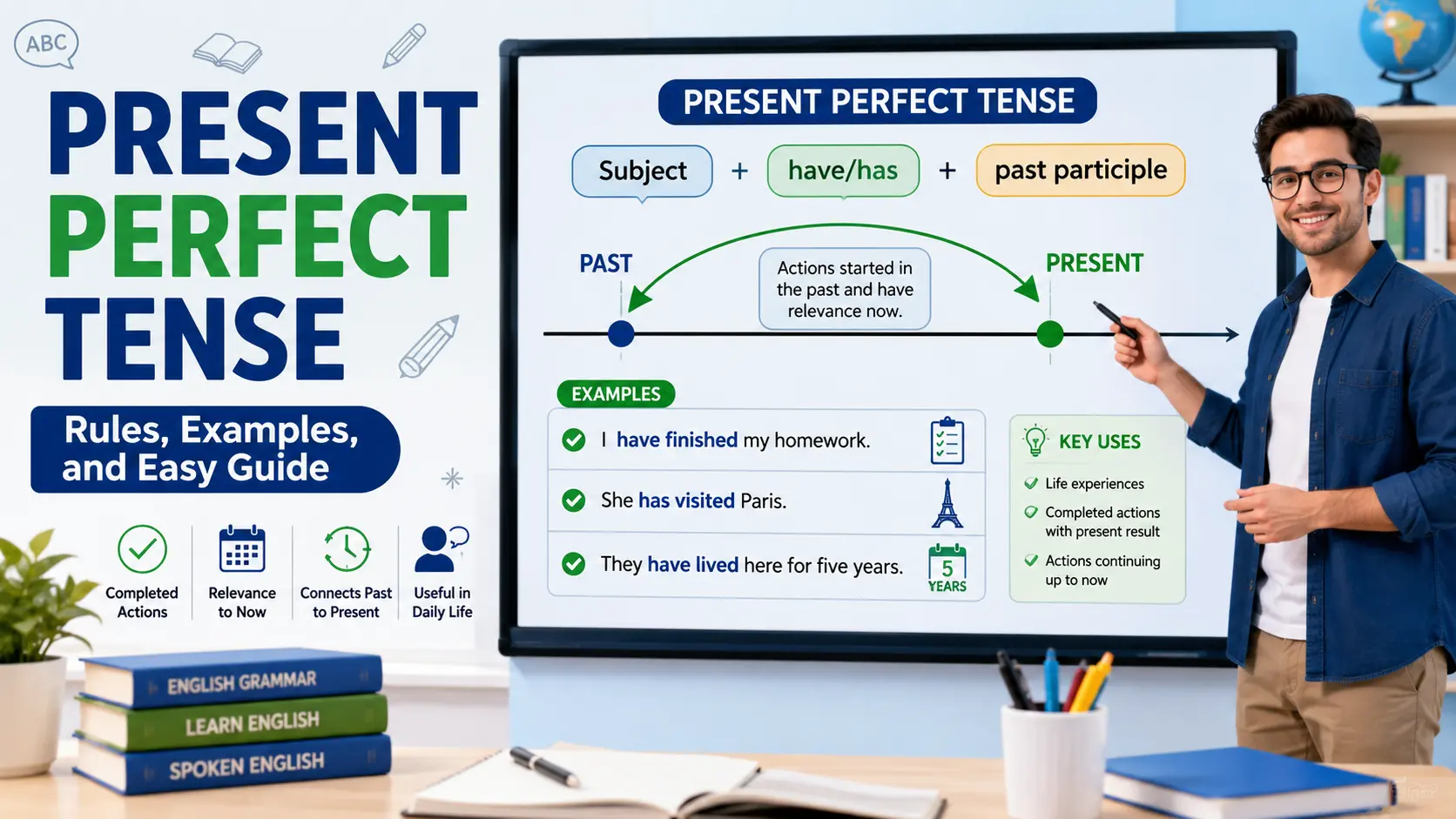
The present perfect tense is one of the most important topics in English grammar. It is used to describe actions that happened at an unspecified time before now or actions that started in the past and continue in the present.
If you are learning English, understanding the present perfect tense will help you improve both your speaking and writing skills.
👉 If you are new to tenses, start with this guide:
➡️ https://learnenglishgrammar.org/grammar-rules-in-english/
Let’s Be Honest about the Present Perfect
If you’ve ever felt a bit intimidated by this tense, you are definitely not alone. Many English learners find it a little tricky at first because it lives in two worlds at once—the past and the present. It’s like a bridge connecting what happened to how things stand right now. But once you get the hang of it, you’ll realize it’s actually a conversational superpower that makes your English sound incredibly natural.
Table of Contents
What is Present Perfect Tense?
The present perfect tense connects the past and the present. It focuses on the result of an action rather than the exact time it happened.
Examples:
- I have finished my homework.
- She has visited Japan.
In these sentences, the exact time is not mentioned.
👉 Learn basic tense structures here:
➡️ https://learnenglishgrammar.org/simple-present-tense/
Structure of Present Perfect Tense
The formula of the present perfect tense is:
Subject + have/has + past participle (V3)
- I / You / We / They → use have
- He / She / It → use has
Examples:
- I have eaten lunch.
- He has completed the project.
- They have gone to school.
👉 Confused about verb forms? Read this:
➡️ https://learnenglishgrammar.org/verb-forms-v1-v2-v3/
Present Perfect Tense Examples
Positive Sentences
- I have read this book.
- She has written a letter.
- We have watched that movie.
Negative Sentences
- I have not (haven’t) finished my work.
- He has not (hasn’t) called me.
- They have not seen the teacher.
Questions
- Have you done your homework?
- Has she arrived?
- Have they completed the task?
Sharing Your Story
Think of the present perfect as your go-to tense for storytelling and sharing your life’s highlights. When you’re chatting with friends about the cool places you’ve traveled to, the amazing foods you’ve tried, or the movies that blew your mind, you don’t need to stress about exact dates and times. You just want to share the experience itself. That’s exactly where this tense shines.
When to Use Present Perfect Tense
1. Actions with No Specific Time
Examples:
- I have lost my keys.
- She has bought a new phone.
2. Life Experiences
Examples:
- I have visited China.
- He has tried sushi.
3. Actions That Started in the Past and Continue Now
Examples:
- I have lived here for five years.
- She has studied English since 2020.
4. Recently Completed Actions
Examples:
- I have just eaten.
- She has already finished her homework.
- Have you finished yet?
5. Unfinished Time Periods (Today, This Week, This Month)
We use the Present Perfect when referring to a time period that is not yet completed at the moment of speaking.
- Examples: “I have drunk three cups of tea today.” (The day is not over yet; I might drink a fourth).
- Example: “She has attended two workshops this week.”
👉 Compare with present continuous here:
➡️ https://learnenglishgrammar.org/present-continuous-tense/
👉 Learn past actions here:
➡️ https://learnenglishgrammar.org/simple-past-tense/
Deep-Dive: The Mechanics of “For” vs. “Since”
Understanding how to quantify duration is essential for using the Present Perfect correctly. For additional examples of time expressions, visit the Purdue OWL Verb Tenses Guide
| Signal Word | Function / Purpose | Specific Time Markers | Example Sentence |
| FOR | Measures total duration (a period of time) | for 5 minutes, for three years, for a long time | “I have lived in Malaysia for ten years.” |
| SINCE | Pinpoints exact starting moment (a point in time) | since 2018, since 8:00 AM, since last Tuesday | “She has worked at the firm since 2020.” |
Common Signal Words
These words are often used with the present perfect tense:
- just
- already
- yet
- ever
- never
- since
- for
Examples:
- I have never seen that movie.
- Have you ever tried pizza?
- She has lived here for ten years.
👉 Learn more about adverbs here:
➡️ https://learnenglishgrammar.org/adverbs-in-english/
Present Perfect vs. Simple Past Comparison Chart
| Feature | Present Perfect Tense | Simple Past Tense |
| Time Frame | Unspecified, unfinished, or recent past | Specific, finished past time |
| Formula | Subject + have/has + V3 (Past Participle) | Subject + V2 (Simple Past Verb) |
| Connection to Present | Strong connection (impacts the present moment) | Disconnected (entirely locked in the past) |
| Typical Time Words | ever, never, just, already, yet, since, for | yesterday, last week, ago, in 2015, at 4 PM |
| Example | “I have broken my glasses.” (I can’t see right now) | “I broke my glasses yesterday.” (Focus on when) |
Common Mistakes to Avoid
❌ I have seen him yesterday.
✅ I saw him yesterday.
❌ She has went home.
✅ She has gone home.
❌ He have finished his work.
✅ He has finished his work.
Using Past Simple Verb Forms (V2) Instead of Past Participles (V3)
- ❌ Incorrect: “We have saw that movie three times.”
- ✔️ Correct: “We have seen that movie three times.”
- Pedagogical Reason: The Present Perfect strictly requires the V3 past participle form (see -> saw -> seen).
Misplacing “Yet” and “Already” in Sentence Structures
- ❌ Incorrect: “I haven’t finished yet my homework.”
- ✔️ Correct: “I haven’t finished my homework yet.”
- Pedagogical Reason: “Yet” functions as an adverb that typically belongs at the very end of negative sentences and questions.
Overusing Present Perfect for Ancient or Historical Facts
- ❌ Incorrect: “Shakespeare has written many famous plays.”
- ✔️ Correct: “Shakespeare wrote many famous plays.”
- Pedagogical Reason: When referring to historical figures who are deceased, the time window is closed, requiring the Simple Past.
👉 Avoid more grammar mistakes here:
➡️ https://learnenglishgrammar.org/common-grammar-mistakes/
Present Perfect vs Simple Past
- Present Perfect: I have eaten. (No specific time)
- Simple Past: I ate yesterday. (Specific time)
👉 Full explanation here:
➡️ https://learnenglishgrammar.org/simple-past-tense/
👉 Learn tense comparison here:
➡️ https://learnenglishgrammar.org/tenses-in-english/
Interactive Practice Exercise: Test Your Knowledge
Choose the correct verb form or signal word for each sentence:
- They __________ (not / complete) the site audit yet.
- I have known my business partner __________ 2015. (for / since)
- The technician __________ (already / replace) the faulty inverter.
- Shakespeare __________ (write) over thirty plays in his lifetime. (wrote / has written)
- Where is Ali? He has __________ (been / gone) to the bank and won’t be back until noon.
- She __________ (lose) her keys yesterday morning. (lost / has lost)
Answer Key & Detailed Explanations:
- have not completed — Negative Present Perfect using V3 (completed).
- since — Pinpoints a specific starting year (2015).
- has already replaced — Helper verb has paired with adverb already and V3 verb replaced.
- wrote — Historical completed action requires Simple Past (wrote).
- gone — Indicates he went to the bank and is currently still there.
- lost — Specific past time marker (yesterday morning) strictly requires Simple Past.
👉 Try more exercises here:
➡️ https://learnenglishgrammar.org/english-grammar-exercises/
Free Present Perfect Worksheet (Auto-Marking)
🎯 Want to practise the present perfect tense?
Try this free worksheet with auto-marking, instant scores, answers, and explanations.
👉 Get your free sample here:
➡️ https://learnenglishgrammar.org/free-grammar-worksheet-sample/
👉 Get the full worksheet pack here:
➡️ https://learnenglishgrammar.org/grammar-worksheets/
A Quick Tip for Your Journey
Don’t worry if you accidentally pair this tense with a specific time word like “yesterday” once in a while—even advanced speakers make slip-ups when they’re rushing! The key is to keep practicing and listening to how native speakers use it. Over time, choosing between “I did” and “I have done” will start to feel less like a grammar puzzle and more like second nature.
Conclusion
The present perfect tense is essential for everyday English. It allows you to talk about experiences, completed actions, and situations that continue into the present.
👉 Continue learning here:
➡️ https://learnenglishgrammar.org/grammar-rules-in-english/
FAQ About Present Perfect Tense
What is the formula of present perfect tense?
The formula is:
Subject + have/has + past participle (V3)
When do we use “have” and “has”?
Use have with I, You, We, and They.
Use has with He, She, and It.
Can we use present perfect with “yesterday”?
No, we cannot use the present perfect tense with “yesterday”.
We should use the simple past tense instead.
What is the difference between “been” and “gone”?
Both are past participles of movement, but they tell different stories:
Been means someone visited a place and has already returned.
Example: “Sarah has been to London.” (She went to London in the past, but she is back home now talking to you).
Gone means someone went to a place and is still there, or is still on the way.
Example: “Where is Sarah?” “She has gone to London.” (She is either on the plane right now or currently walking the streets of London).
How can I easily remember when to use Present Perfect instead of Simple Past?
Think of it this way: if the exact time matters (like yesterday, last year, at 3 PM), use the Simple Past. If the result or the experience is what matters right now, use the Present Perfect.
Simple Past: “I lost my keys this morning.” (Focus is on when it happened)
Present Perfect: “I have lost my keys!” (Focus is on the current problem—I can’t get into my house right now)