
In English grammar, tenses are used to show the time of an action. They help us understand whether something happens in the present, happened in the past, or will happen in the future.
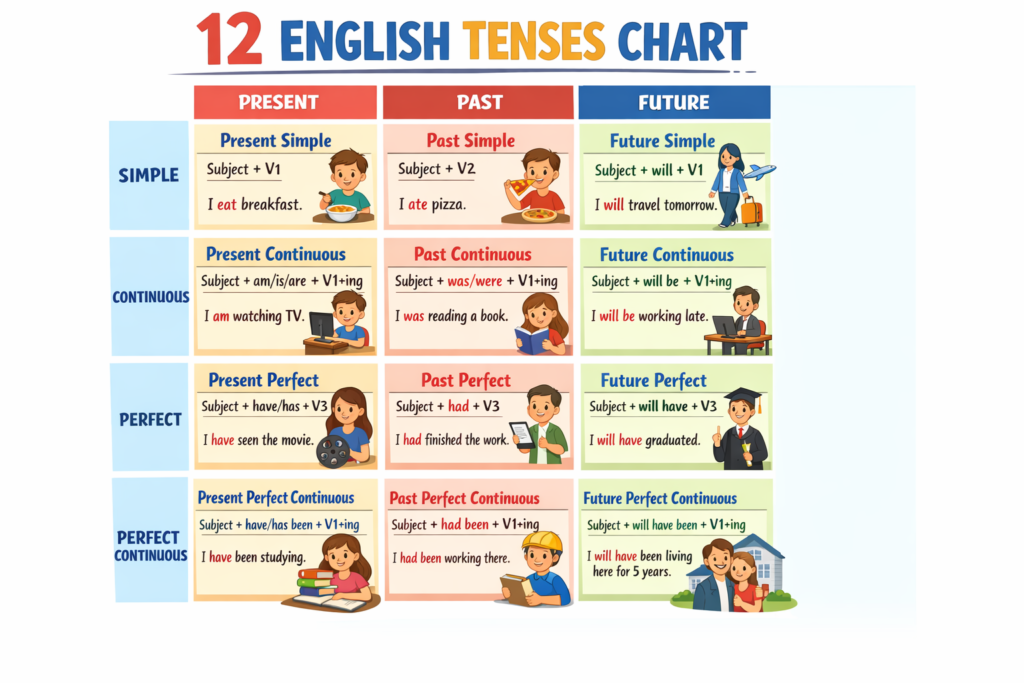
English grammar commonly recognizes twelve main tenses. These tenses are grouped into three main time categories:
- Present Tenses
- Past Tenses
- Future Tenses
Each category contains four different forms.
To fully understand this tense, regular practice is important.
👉 Get instant access to grammar worksheets with smart answer sheets for easy self-checking and faster improvement.
The 12 English Tenses Overview
The twelve tenses can be summarized in the following groups:
Present Tenses
- Simple Present
- Present Continuous
- Present Perfect
- Present Perfect Continuous
Past Tenses
- Simple Past
- Past Continuous
- Past Perfect
- Past Perfect Continuous
Future Tenses
- Simple Future
- Future Continuous
- Future Perfect
- Future Perfect Continuous
Present Tenses
1. Simple Present Tense
The simple present tense describes habits, repeated actions, and general truths.
Examples:
- She reads every day.
- The sun rises in the east.
- They live in Kuala Lumpur.
2. Present Continuous Tense
The present continuous tense describes actions happening right now or temporary actions.
Examples:
- She is reading a book.
- They are playing football.
- I am studying English.
3. Present Perfect Tense
The present perfect tense connects past actions to the present.
Examples:
- She has finished her homework.
- I have visited Japan.
- They have completed the project.
4. Present Perfect Continuous Tense
This tense describes actions that started in the past and continue to the present.
Examples:
- She has been studying for two hours.
- They have been working all day.
Past Tenses
5. Simple Past Tense
The simple past tense describes actions that happened and finished in the past.
Examples:
- She finished her homework yesterday.
- They watched a movie last night.
6. Past Continuous Tense
The past continuous tense describes actions that were happening at a specific moment in the past.
Examples:
- She was reading when I called.
- They were playing outside.
7. Past Perfect Tense
The past perfect tense describes an action that happened before another action in the past.
Examples:
- She had finished her homework before dinner.
- They had left before we arrived.
8. Past Perfect Continuous Tense
This tense describes actions that continued for a period of time before another event in the past.
Examples:
- She had been studying for three hours before the test.
Future Tenses
9. Simple Future Tense
The simple future tense describes actions that will happen later.
Examples:
- She will study tonight.
- They will travel next month.
10. Future Continuous Tense
This tense describes actions that will be happening at a specific time in the future.
Examples:
- She will be studying at 8 p.m.
- They will be traveling tomorrow.
11. Future Perfect Tense
The future perfect tense describes actions that will be completed before a certain time in the future.
Examples:
- She will have finished her homework by tonight.
- They will have completed the project by next week.
12. Future Perfect Continuous Tense
This tense describes actions that will continue for a period of time until a specific moment in the future.
Examples:
- She will have been studying for three hours by 9 p.m.
To fully understand this tense, regular practice is important.
👉 Get instant access to grammar worksheets with smart answer sheets for easy self-checking and faster improvement.
Why Learning the 12 English Tenses Is Important
Understanding the twelve English tenses helps you describe actions clearly in both speaking and writing. When you use the correct tense, your sentences become more accurate and easier to understand.
Learning tenses step by step will improve your grammar, communication skills, and confidence in using English.
Conclusion
The 12 English tenses are an essential part of English grammar. They help describe when actions happen and how they relate to time.
By learning how each tense works and practicing with examples, you will be able to express ideas more clearly and effectively in English.