
🟢 Introduction
Active voice vs passive voice is an important grammar topic for English learners. Understanding the difference helps you write clearer and more effective sentences.
In this guide, you will learn active voice vs passive voice with simple explanations, examples, and easy rules.
In simple terms:
- Active voice → the subject performs the action
- Passive voice → the subject receives the action
👉 Example:
- Active: The cat ate the food
- Passive: The food was eaten by the cat
Active voice is usually clearer and more direct
🎁 Start with a Free Grammar Sample
Want to practice active and passive voice?
👉 🎁 Download Free Grammar Worksheets Sample
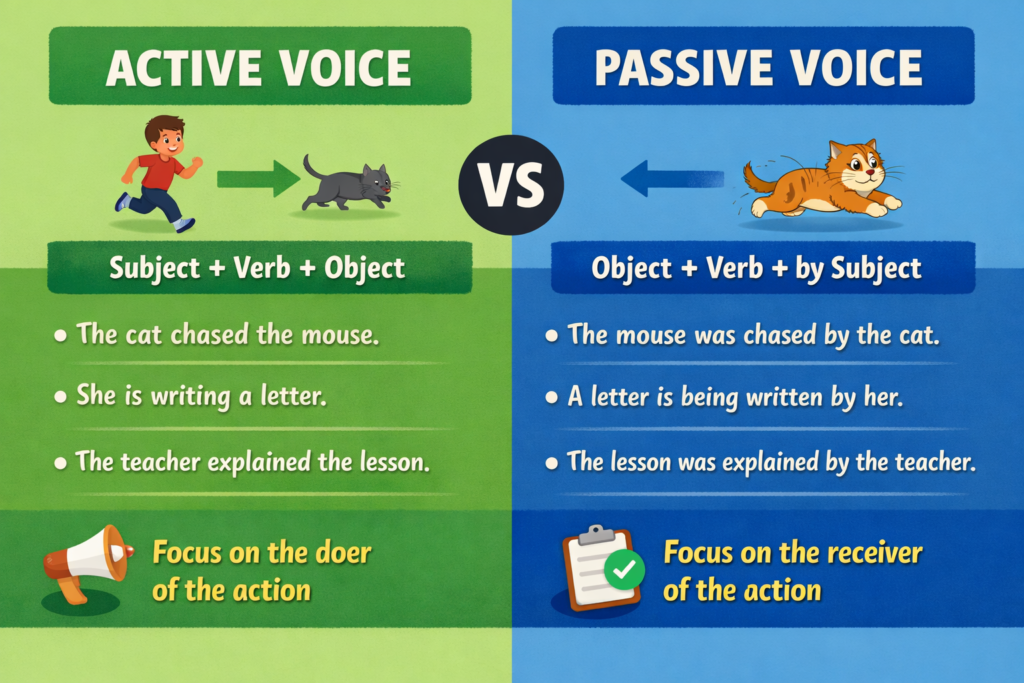
Active vs Passive Voice Examples
What Is Active Voice?
In active voice, the subject does the action.
Structure:
Subject + Verb + Object
Examples:
- She writes a letter
- The teacher explains the lesson
- They built a house
👉 Active voice is clear, direct, and easier to understand.
What Is Passive Voice?
In passive voice, the subject receives the action.
Structure:
Object + “be” + past participle (+ by + subject)
Examples:
- A letter is written by her
- The lesson is explained by the teacher
- A house was built by them
Passive voice is used when:
- The doer is unknown
- The action is more important
🔥 Key Differences (Easy Comparison)
| Active Voice | Passive Voice |
|---|---|
| Subject does the action | Subject receives the action |
| Clear and direct | Longer and less direct |
| More common | Used in formal situations |
When to Use Active Voice
Use active voice when you want:
- Clear and strong sentences
- Easy understanding
- Direct communication
👉 Example:
✔ The company launched a new product
When to Use Passive Voice
Use passive voice when:
- You don’t know the doer
- The action is more important
- You want a formal tone
👉 Example:
✔ The product was launched last year
🚀 Practice with Worksheets
Reading is not enough — practice helps you improve faster.
Our worksheets include:
- Active & passive voice exercises
- Step-by-step difficulty (Level 1–6)
- Autotick Cheat-Proof Answers
👉 🚀 Get Instant Access to All Worksheets (Levels 1–6)
Common Mistakes in Active Voice vs Passive Voice
Many learners confuse active voice vs passive voice by placing the object in the wrong position. Always remember that in active voice, the subject performs the action, while in passive voice, the subject receives the action.
Common Mistakes to Avoid
- ❌ Using passive voice too often
- ❌ Forgetting “by” in passive sentences
- ❌ Wrong past participle
👉 Fix more mistakes here:
/common-mistakes/
Practice Exercise
Choose the correct sentence:
- The cake was eaten by John.
- John ate the cake.
👉 Which one is active voice?
🟢 Frequently Asked Questions
What is active voice vs passive voice?
Active voice means the subject performs the action, while passive voice means the subject receives the action.
Why is active voice better?
Active voice is clearer and easier to understand.
💡 Related Lessons
🎁 Try a Free Sample
Not ready yet?