
In English grammar, pronouns are words that replace nouns in a sentence. They help avoid repetition and make sentences clearer and easier to understand.
This lesson explains pronouns in English grammar, focusing on personal pronouns and reflexive pronouns (sometimes called reflective pronouns).
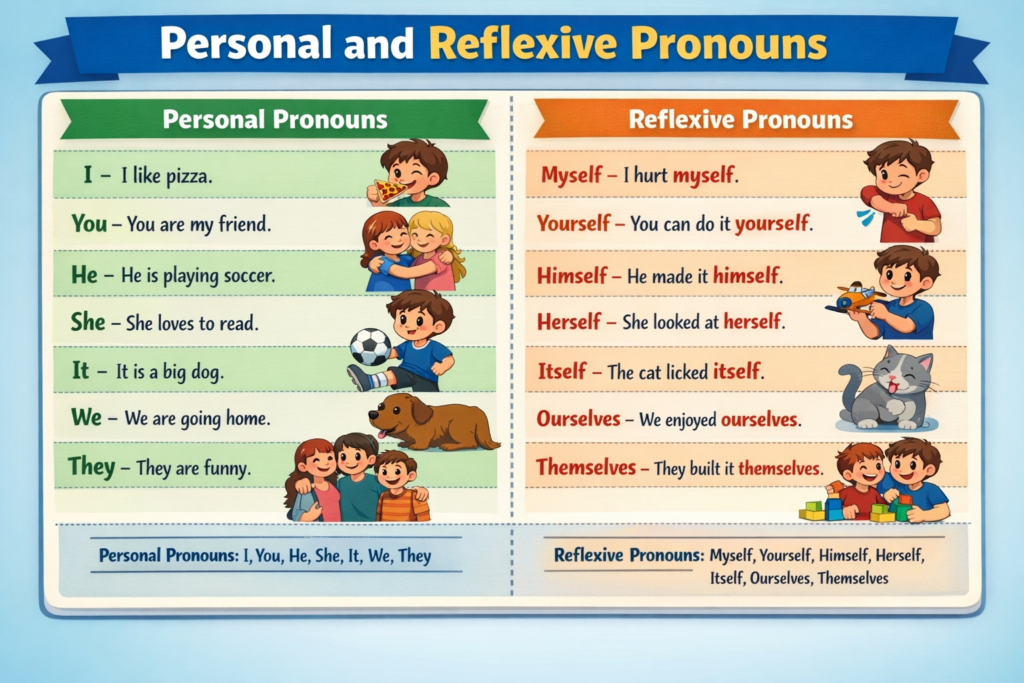
What Are Pronouns?
A pronoun is a word used instead of a noun.
Example:
- John is my friend. He is very kind.
Instead of repeating “John,” we use the pronoun he.
Personal Pronouns
Personal pronouns refer to specific people or things. They change depending on the subject or object in a sentence.
Subject Pronouns
Used as the subject of a sentence.
- I
- You
- He
- She
- It
- We
- They
Examples:
- I am learning English.
- She is my teacher.
- They are playing outside.
Object Pronouns
Used as the object of a verb or preposition.
- me
- you
- him
- her
- it
- us
- them
Examples:
- The teacher helped me.
- I saw him yesterday.
- She gave them the books.
Reflexive Pronouns (Reflective Pronouns)
Reflexive pronouns are used when the subject and the object of the sentence are the same person or thing.
They end in -self or -selves.
List of Reflexive Pronouns
- myself
- yourself
- himself
- herself
- itself
- ourselves
- yourselves
- themselves
Uses of Reflexive Pronouns
1. When the Subject and Object Are the Same
Examples:
- I taught myself English.
- She hurt herself.
- They prepared themselves for the test.
2. For Emphasis
Reflexive pronouns can be used to emphasize the subject.
Examples:
- I did it myself.
- The teacher herself explained the lesson.
Key Differences
| Personal Pronouns | Reflexive Pronouns |
|---|---|
| Replace nouns | Refer back to the subject |
| Used as subject or object | Used when subject = object |
| Example: he, she, they | Example: himself, herself |
Common Mistakes
Incorrect:
- Me went to school.
Correct:
- I went to school.
Incorrect:
- She did it herselfs.
Correct:
- She did it herself.
Incorrect:
- He gave the book to myself.
Correct:
- He gave the book to me.
Tips to Remember
- Use subject pronouns as the subject (I, he, she, they)
- Use object pronouns after verbs or prepositions (me, him, them)
- Use reflexive pronouns when the subject and object are the same
Conclusion
Pronouns are an important part of English grammar. Personal pronouns help replace nouns, while reflexive pronouns refer back to the subject or add emphasis.
By understanding how to use these pronouns correctly, you can form clearer and more natural English sentences.
Related Grammar Lessons
To continue learning English grammar, explore these related lessons:
• Parts of Speech in English
• Subject Verb Agreement Rules
• Countable vs Uncountable Nouns
• Common Grammar Mistakes
These lessons will help you improve your grammar skills step by step.