
Simple Present Tense Rules
The simple present tense rules are one of the most important parts of English grammar.
They help you describe habits, general truths, and daily actions clearly and correctly.
By learning the simple present tense rules, you can speak and write English more clearly and confidently.
🎁 Try a Free Grammar Worksheet (See How It Works)
Want to practise the simple present tense with instant feedback?
👉 🎁 Download Free Grammar Worksheet Sample
✔ Includes AutoTick answer system
✔ Instant marking
✔ Perfect for beginners
🧠 What is the Simple Present Tense?
The simple present tense describes actions that:
- happen regularly
- are always true
- are part of daily routines
📌 When to Use the Simple Present Tense
✅ 1. Habits and Daily Routines
We use it for actions that happen regularly.
Examples:
- She wakes up at 7 a.m.
- I drink coffee every morning
- They play football after school
✅ 2. General Facts and Truths
Used for things that are always true.
Examples:
- The sun rises in the east
- Water boils at 100°C
- Birds fly in the sky
✅ 3. Permanent Situations
Used for long-term or permanent situations.
Examples:
- She works at a bank
- They live in Malaysia
- He speaks English very well
✏️ Simple Present Tense Structure
✔ Affirmative Sentences
Structure:
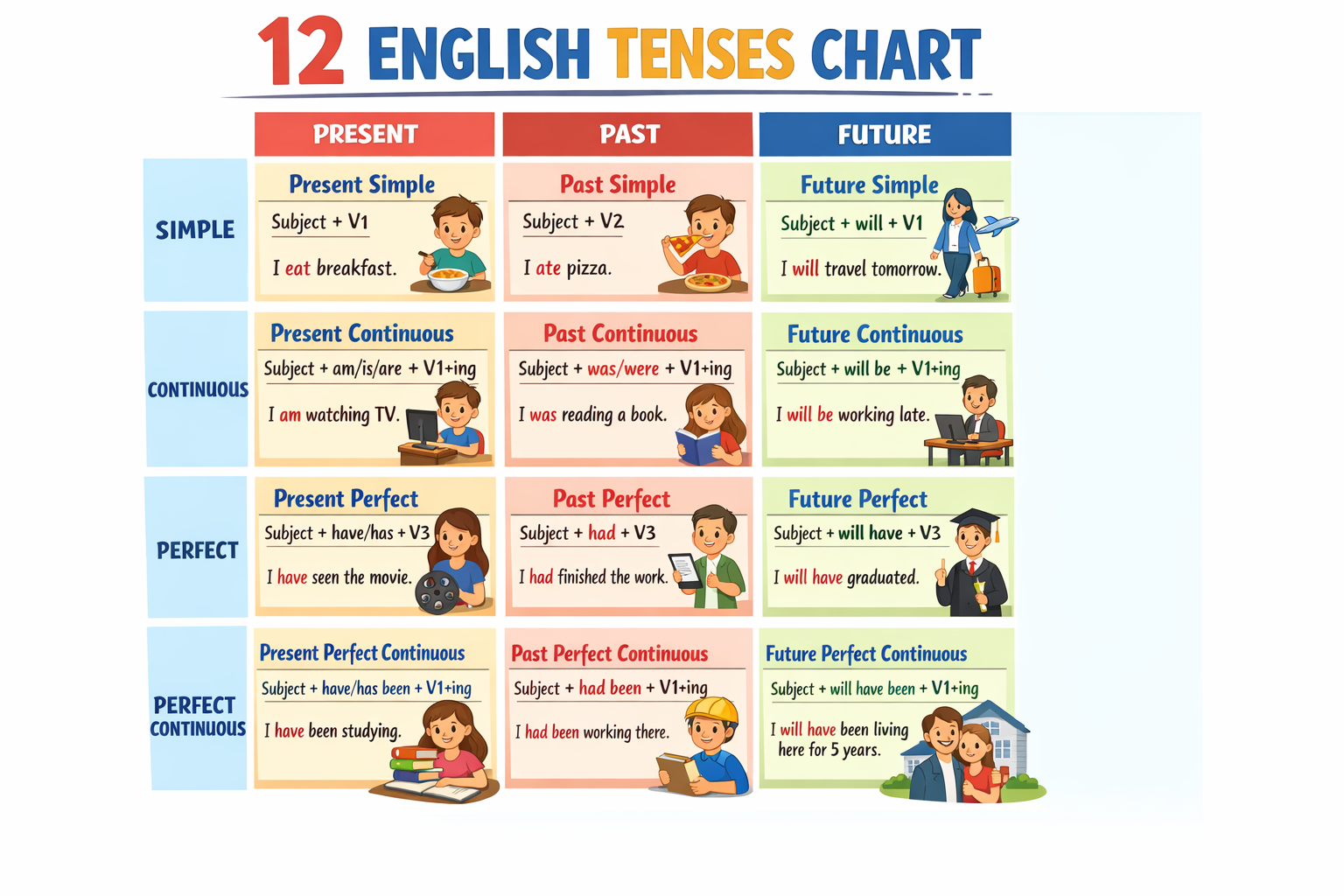
- Subject + base verb
Examples:
- I read books
- They study English
✔ Third Person Singular (Important Rule)
For he, she, it, add -s or -es to the verb.
Examples:
- He reads every day
- She writes emails
- The dog runs fast
✔ Negative Sentences
Structure:
- Subject + do/does not + base verb
Examples:
- I do not like coffee
- She does not eat meat
- They do not watch television
✔ Questions
Structure:
- Do/Does + subject + base verb
Examples:
- Do you like music?
- Does she play the piano?
- Do they live here?
🔤 Spelling Rules (He / She / It)
➕ Add -s
- play → plays
- read → reads
➕ Add -es
(verbs ending in s, sh, ch, x, o)
- watch → watches
- go → goes
- fix → fixes
🔁 Change y → ies
(consonant + y)
- study → studies
- carry → carries
📝 More Examples of Simple Present Tense
- She teaches English
- They work together
- He drives to work every day
- We study grammar in class
⚠️ Common Mistakes
❌ Incorrect:
She go to school every day
✅ Correct:
She goes to school every day
❌ Incorrect:
He don’t like coffee
✅ Correct:
He doesn’t like coffee
🚀 Practise Simple Present Tense (Improve Faster)
Reading is helpful — but practice is what makes you improve fast.
👉 🚀 Get Full English Grammar Worksheets (Levels 1–6)
✔ Covers all grammar topics
✔ Step-by-step learning
✔ Instant AutoTick answers sheets
🎁 Not Ready Yet? Try the Free Sample
👉 🎁 Download Free Sample Worksheet
🔗 Related Grammar Lessons
- 👉
/english-tenses/ - 👉
/present-continuous-tense/ - 👉
/verbs/
🌍 Trusted Grammar Resources
For additional explanations, you can explore:
Trusted English Grammar Resources
For additional explanations and reference, you can also visit Cambridge English Grammar Guide and BBC Learning English .
📈 Why Learn the Simple Present Tense?
The simple present tense helps you:
- Describe daily activities clearly
- Speak more naturally
- Avoid common grammar mistakes
- Build a strong grammar foundation
❓ FAQ
What is the simple present tense used for?
It is used for habits, general truths, and repeated actions.
When do we add “-s” to verbs?
When the subject is he, she, or it.