
Subject-Verb Agreement Rules
Subject-verb agreement is one of the most important rules in English grammar. It means the verb must match the subject in number (singular or plural) and person.
A singular subject takes a singular verb, while a plural subject takes a plural verb.
👉 Want full practice? Explore our complete Level 1–6 Grammar Worksheets:
English Grammar Worksheets (Level 1–6)
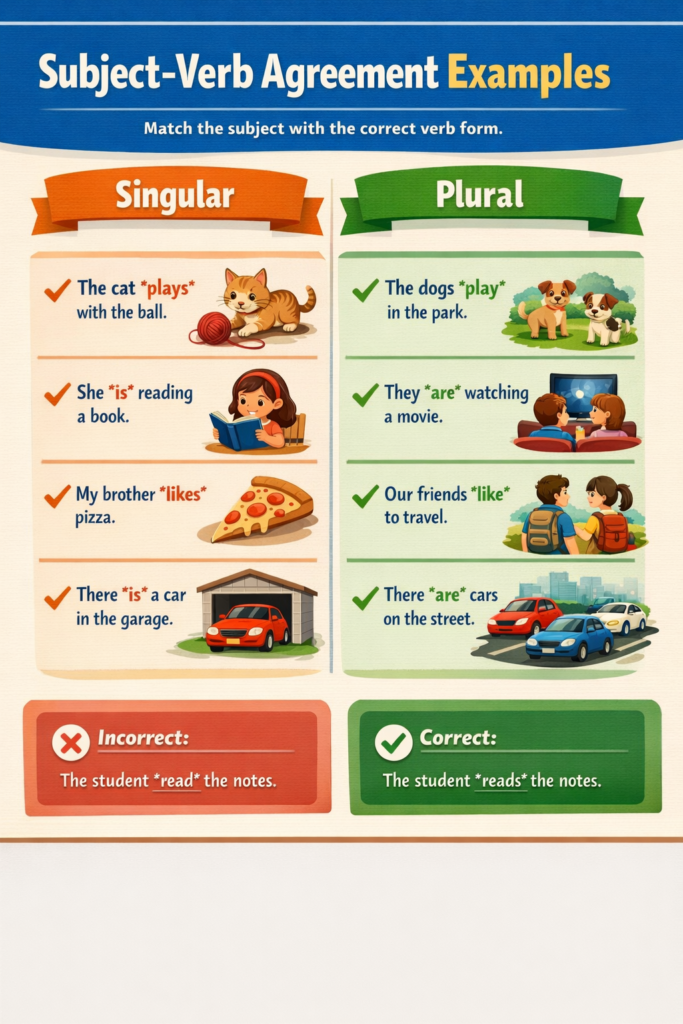
What Is Subject-Verb Agreement?
Subject-verb agreement ensures that the subject and verb in a sentence match correctly.
Examples:
- She writes every day.
- They write every day.
In the first sentence, she is singular, so the verb is writes.
In the second sentence, they is plural, so the verb is write.
Basic Rule of Subject-Verb Agreement
The most important rule is simple:
- Singular subject → singular verb
- Plural subject → plural verb
More examples:
- The dog runs fast.
- The dogs run fast.
Rule 1: Subjects Joined by “And”
When two subjects are joined by and, they usually take a plural verb.
Examples:
- Tom and Jerry are friends.
- The teacher and the student are talking.
Rule 2: Subjects Joined by “Or” or “Nor”
When subjects are joined by or or nor, the verb agrees with the subject closest to it.
Examples:
- Either the teacher or the students are coming.
- Either the students or the teacher is coming.
Rule 3: Indefinite Pronouns
Some pronouns are always singular and take singular verbs.
Examples of singular indefinite pronouns:
- everyone
- someone
- anyone
- nobody
- each
Examples in sentences:
- Everyone likes music.
- Someone is knocking at the door.
Rule 4: Collective Nouns
Collective nouns such as team, family, or group are usually treated as singular.
Examples:
- The team is playing well.
- The family lives in Kuala Lumpur.
Rule 5: Words Between Subject and Verb
Sometimes other words appear between the subject and the verb. These do not affect agreement.
Example:
- The box of books is on the table.
👉 The subject is box, not books.
Rule 6: Titles and Names
Titles of books, movies, or organizations are usually treated as singular.
Example:
- The Chronicles of Narnia is a famous book series.
Common Subject-Verb Agreement Mistakes
❌ Incorrect:
She go to school every day.
✅ Correct:
She goes to school every day.
❌ Incorrect:
The list of items are on the desk.
✅ Correct:
The list of items is on the desk.
How to Avoid Mistakes
- Identify the real subject
- Ignore words between subject and verb
- Check if the subject is singular or plural
- Practice regularly
👉 Learn more in our guide:
https://learnenglishgrammar.org/nouns-in-english-grammar/
👉 Improve your writing with:
https://learnenglishgrammar.org/adverbs-in-english-grammar/
Free Subject-Verb Agreement Worksheet
Want to improve your grammar with real practice?
Download a FREE worksheet sample:
👉 Get your free worksheet here:
https://learnenglishgrammar.org/free-sample/
- Easy-to-follow exercises
- Instant AutoTick answers
- Perfect for students, parents, and self-learning
Upgrade to Full Grammar Worksheets (Level 1–6)
Ready to master English grammar step by step?
Our complete worksheet package includes Level 1 to Level 6, suitable for all learners.
- Structured learning system
- Hundreds of practice questions
- Instant answers
- Great for exam preparation
👉 View full worksheet package:
English Grammar Worksheets (Level 1–6)
Why Subject-Verb Agreement Is Important
Correct subject-verb agreement helps you:
- Write clear and correct sentences
- Speak confidently
- Avoid common grammar mistakes
It is a key foundation in learning English grammar.
By mastering these subject verb-agreement rules, you can write clearer and more accurate English sentences.
External Reference
For more detailed explanations, visit:
https://www.grammarly.com/blog/subject-verb-agreement/
FAQ About Subject-Verb Agreement
What is subject-verb agreement?
It means the subject and verb must match in number and person.
What is an example of subject-verb agreement?
She runs every day. / They run every day.
Why is subject-verb agreement important?
It makes sentences clear and grammatically correct.
What is the basic rule?
Singular subject → singular verb, plural subject → plural verb.