
Verbs are one of the most important parts of speech in English grammar. A verb is a word that describes an action, a state, or an occurrence. Verbs help explain what the subject of a sentence is doing or what is happening.
For example, in the sentence “The student reads a book,” the word reads is the verb because it shows the action performed by the subject.
Learning how verbs work is essential for building correct sentences and communicating clearly in English.
What Is a Verb?
A verb is a word that expresses an action, condition, or state of being.
Examples of verbs include:
- run
- eat
- write
- speak
- think
- be
- have
Example sentences:
- She writes a letter.
- They play football after school.
- The teacher explains the lesson.
- We have a meeting today.
In each sentence, the verb shows what the subject is doing.
Types of Verbs
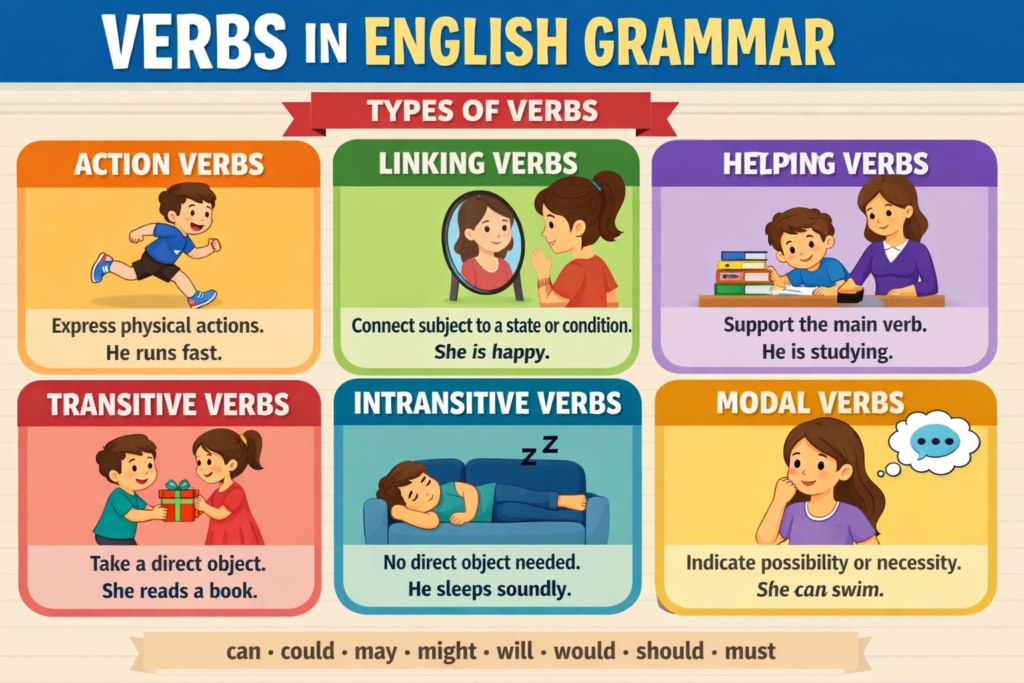
There are several types of verbs in English grammar.
1. Action Verbs
Action verbs describe actions that someone or something performs.
Examples:
- run
- jump
- read
- write
- cook
Example sentences:
- The children play in the park.
- She reads a book every evening.
- He writes an email to his friend.
2. Linking Verbs
Linking verbs connect the subject of a sentence with additional information about the subject. They do not show action.
Common linking verbs include:
- be (am, is, are, was, were)
- seem
- become
- appear
Example sentences:
- She is a teacher.
- The weather seems pleasant today.
- The soup tastes delicious.
3. Helping Verbs
Helping verbs, also called auxiliary verbs, help the main verb form different tenses or express possibility, ability, or necessity.
Common helping verbs include:
- be
- have
- do
- can
- will
- should
- must
Example sentences:
- She is reading a book.
- They have finished their homework.
- We will visit the museum tomorrow.
Verb Tenses
Verbs change form to show time. This is known as verb tense.
The three main tenses are:
Present Tense
The present tense describes actions that happen now or regularly.
Examples:
- She writes every day.
- They study English.
Past Tense
The past tense describes actions that happened in the past.
Examples:
- She wrote a letter yesterday.
- They studied English last year.
Future Tense
The future tense describes actions that will happen later.
Examples:
- She will write a report tomorrow.
- They will travel next week.
Examples of Verbs in Sentences
Here are some simple sentences showing verbs in everyday English:
- The teacher teaches the students.
- The baby cries loudly.
- My friend plays the piano.
- The birds fly in the sky.
- We learn new words every day.
In each sentence, the verb describes the action or condition of the subject.
Why Verbs Are Important
Verbs are essential because every complete sentence needs a verb. Without a verb, a sentence cannot express an action or idea clearly.
By understanding verbs and how they change with different tenses, learners can form more accurate sentences and communicate effectively.
Conclusion
Verbs are words that describe actions, states, or events. They play a central role in English grammar and appear in nearly every sentence. By learning the different types of verbs and how verb tenses work, English learners can improve their speaking, writing, and overall language skills.