
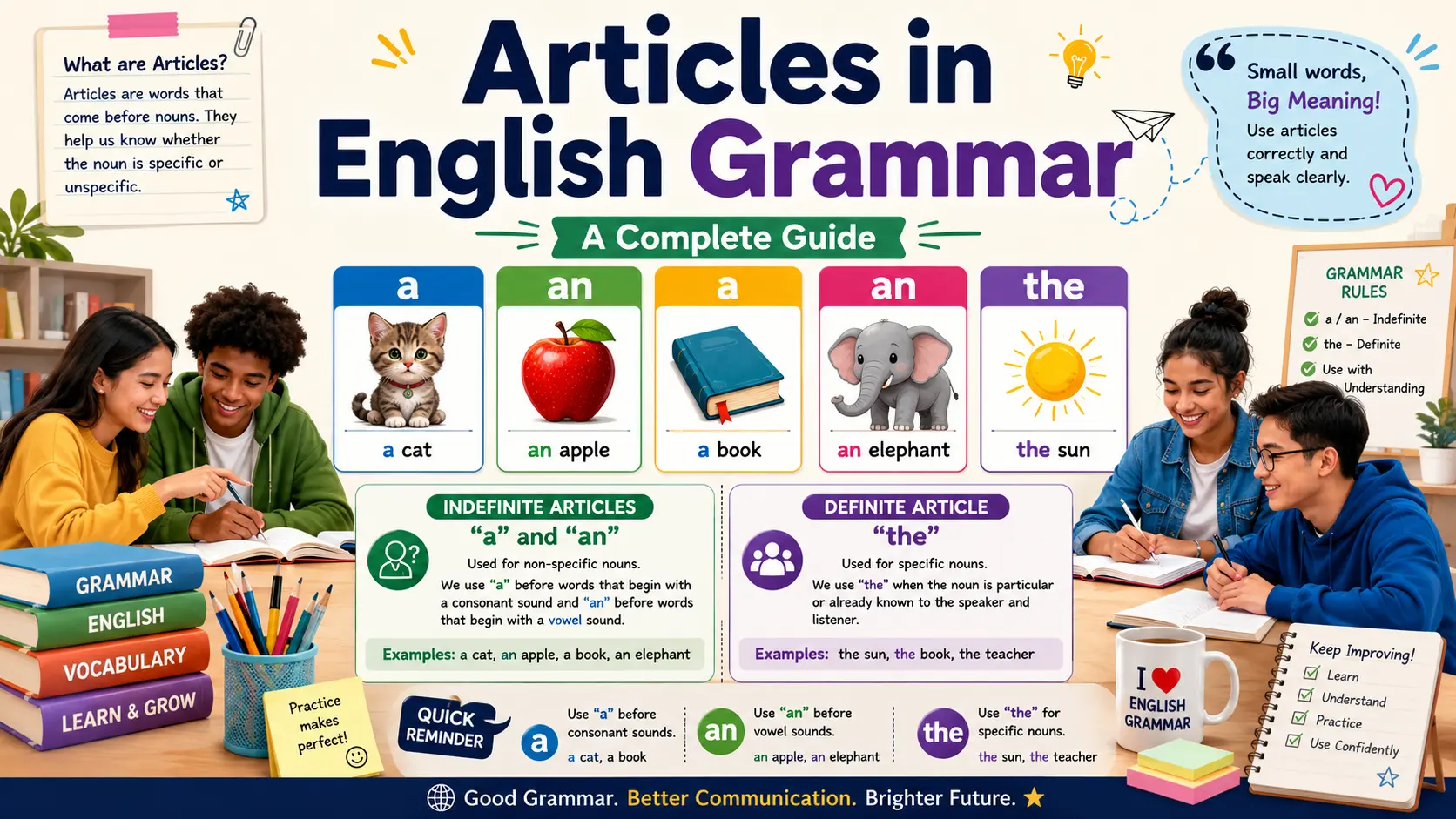
Many English learners overlook articles because they seem like tiny, insignificant filler words. However, think of articles as the directional signs of a sentence. They tell your listener exactly where to look: are we talking about any old “apple” in the bowl, or are we talking about “the apple” you’ve been saving for lunch? Getting this right doesn’t just make you sound more fluent; it prevents those small “wait, which one?” moments that can stall a good conversation.
The biggest hurdle most of us face isn’t the rule itself, but the exceptions. We’re taught “A, E, I, O, U,” but English loves to play by the ear, not the alphabet. That’s why we say “an hour” but “a university.” If you’re ever in doubt, say the phrase out loud. If the transition between the article and the noun feels like a “clunk” or a “glitch” in your throat, you probably need the other one. Your ears are often better grammarians than your eyes!
Articles in English grammar are small but important words that help define nouns. The three main articles are a, an, and the. In this guide, you will learn how to use articles in English grammar correctly with simple rules and clear examples.
In this guide, you’ll learn what articles are, how to use them, and see plenty of examples to help you understand easily.
🎁 Free Printable Worksheet
Practise as you learn! Download the FREE Articles Worksheet (PDF) and complete the exercises while reading this lesson.
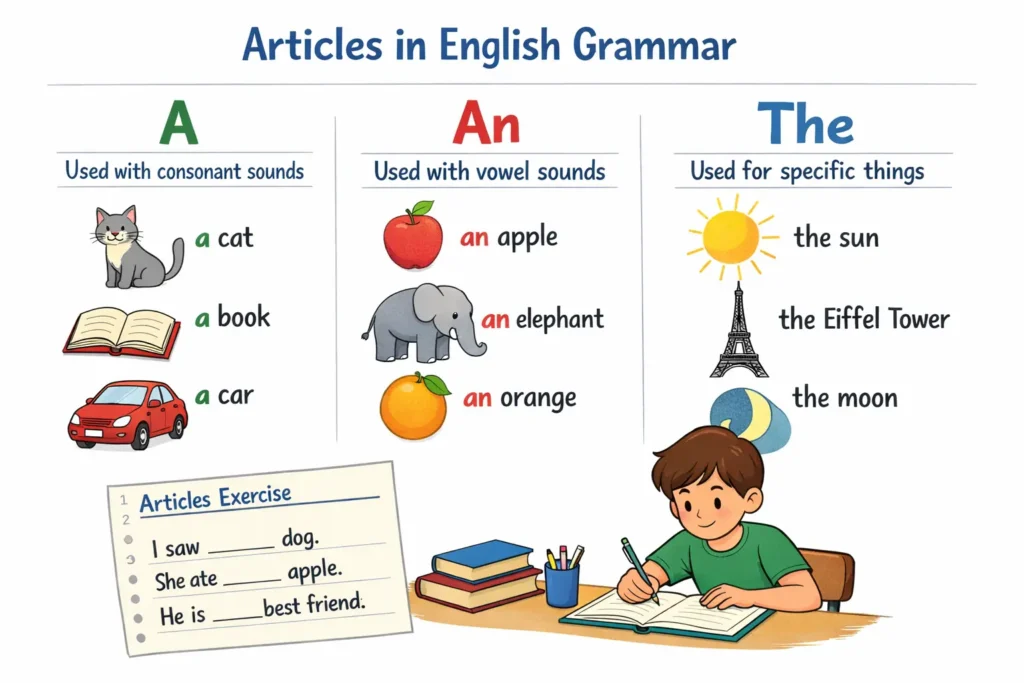
Table of Contents
What Are Articles in English Grammar?
Articles are words that come before nouns to define or specify them.
There are three articles in English:
- A
- An
- The
✍️ Examples of Articles in Sentences
- I saw a dog in the park.
- She ate an apple this morning.
- The sun rises in the east.
👉 This adds:
- Word count
- Keyword relevance
- Readability
Types of Articles
1. Indefinite Articles (A / An)
We use a and an when talking about something general or not specific.
Use “a” before consonant sounds:
- a cat
- a book
- a university (sounds like “yu”)
Use “an” before vowel sounds:
- an apple
- an hour (silent “h”)
- an umbrella
The Sound-First Rule (Consonant vs. Vowel Sounds)
A major reason students get penalized on exams is relying on sight rather than sound. The choice between a and an depends entirely on the initial phonetic sound of the following word, regardless of whether that word is a noun or an adjective modifying the noun.
- Words beginning with silent “H”: Use an (an hour, an honest mistake, an heir).
- Words beginning with voiced “H”: Use a (a house, a hospital, a historic event).
- Words beginning with “U” or “EU” sounding like “Y” (/juː/): Use a (a university, a European country, a uniform, a utensil).
- Abbreviations and Acronyms: Focus on how the first letter is pronounced out loud (a NASA satellite vs. an FBI agent—because “F” is pronounced “eff”).
👉 Learn more about countable and uncountable noun types here:
Countable vs Uncountable Nouns
2. Definite Article (The)
We use the when talking about something specific or already known.
Examples:
- The sun is very bright.
- I saw the movie you recommended.
- Please close the door.
3. The Zero Article (When to Use NO Article)
The “Zero Article” occurs when a noun requires no article at all. Skipping the article is required when speaking generally about plural countable nouns, uncountable abstract concepts, languages, academic subjects, and sports.
- General Plurals: “Cats make great pets.” (Not “The cats…”)
- Uncountable / Abstract Nouns: “Knowledge is power.” / “Honesty is appreciated.”
- Languages & Academic Subjects: “She is studying chemistry in French.”
- Sports & Daily Meals: “We play tennis after breakfast.”
4. Unique Entities and Superlatives
Always use the when there is only one of a specific object in existence, or when using superlative adjectives.
- Unique Objects: the sun, the moon, the internet, the equator.
- Superlatives: “He is the tallest student in the class.” / “This is the most efficient solar cooker design.”
👉 Related lesson:
subject-verb-agreement-examples/
When to Use Articles
✅ Use “a/an” when:
- Talking about something for the first time
- Talking about one of many
Example:
- I saw a dog in the park.
✅ Use “the” when:
- The listener knows what you mean
- It has been mentioned before
Example:
- I saw a dog. The dog was barking loudly.
❌ Do NOT use articles when:
- Talking about general ideas
- Using plural or uncountable nouns in general
Examples:
- Water is important.
- Cats are cute.
👉 You may also like:
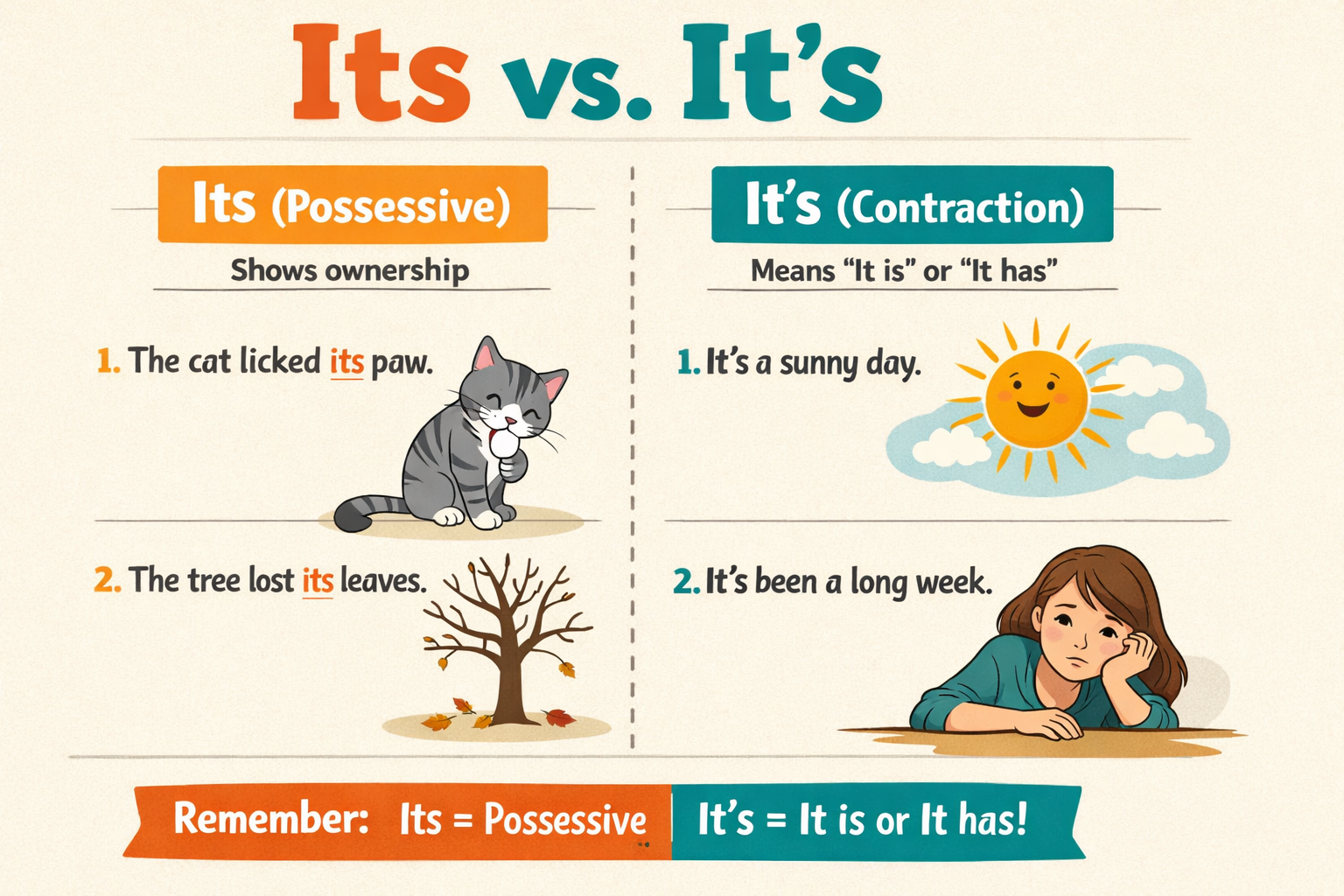
https://learnenglishgrammar.org/its-vs-its/
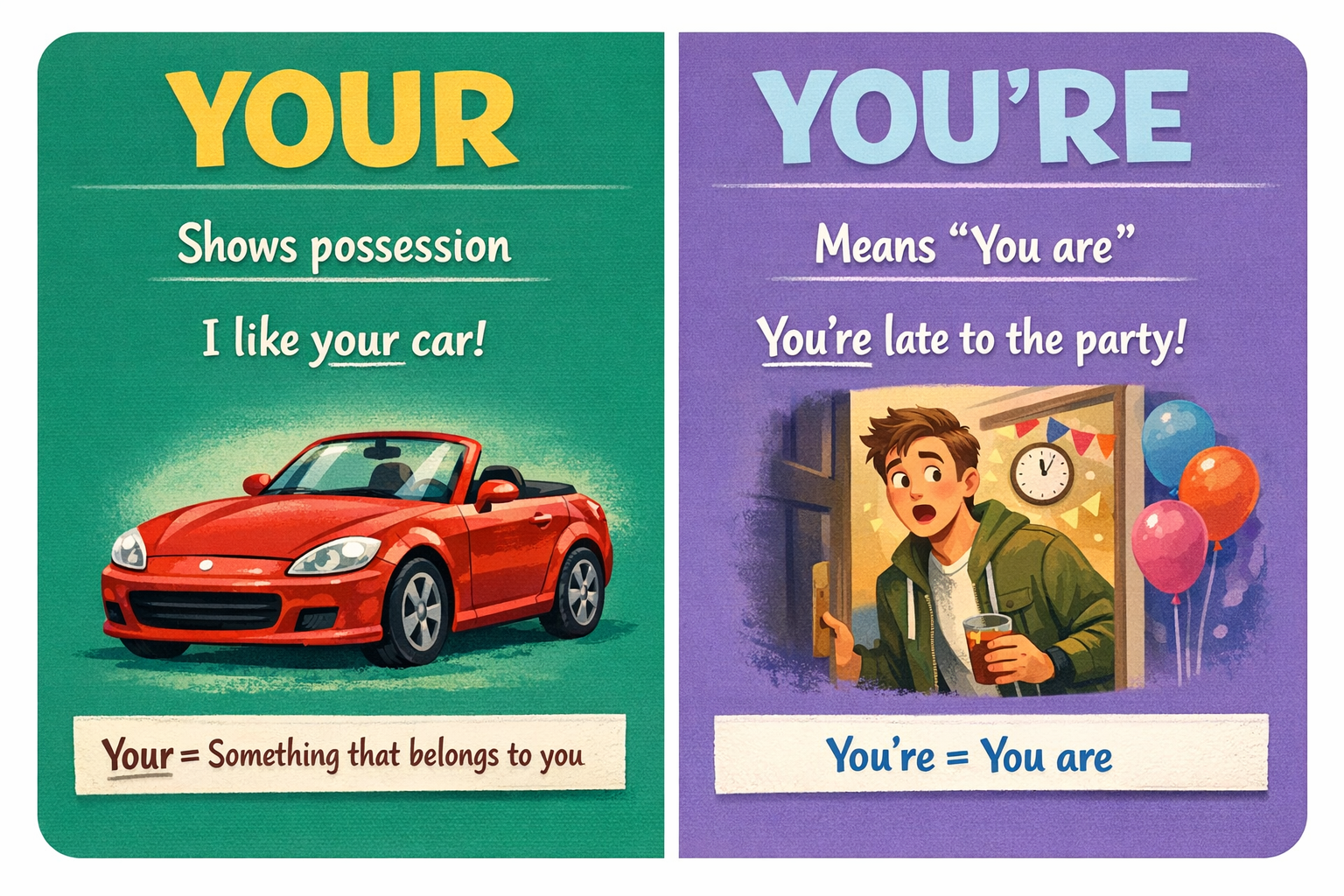
https://learnenglishgrammar.org/your-vs-youre/
Geographical Rules for “The” vs. “Zero Article”
Geographical names follow strict rules regarding the definite article. Understanding these patterns prevents some of the most visible writing mistakes in English.
| Category | Rule | Correct Example | Incorrect Example |
| Countries (Single) | No article | “She lives in Malaysia.” | “She lives in the Malaysia.” |
| Countries (Plural/Union) | Use The | “They visited the United States.” | “They visited United States.” |
| Mountain Ranges | Use The | “We hiked in the Himalayas.” | “We hiked in Himalayas.” |
| Single Mountains | No article | “They climbed Mount Everest.” | “They climbed the Mount Everest.” |
| Oceans, Seas, Rivers | Use The | “The ship crossed the Pacific Ocean.” | “The ship crossed Pacific Ocean.” |
| Lakes (Single) | No article | “We visited Lake Superior.” | “We visited the Lake Superior.” |
To learn the official rules for using articles with geographical names and places, check the British Council Grammar Reference.
10 Common Mistakes with Articles in English Grammar
Mistake 1: Relying on Vowel Spelling Instead of Vowel Sounds for “A” vs. “An”
- ❌ Incorrect: She is a honest person. / He attends an university.
- ✔️ Correct: She is an honest person. / He attends a university.
- Pedagogical Reason: The choice between a and an depends strictly on the initial sound, not the letter. Honest begins with a silent ‘h’ (vowel sound /ɒ/), requiring an, while university begins with a consonant sound (/j/), requiring a.
Mistake 2: Using the Definite Article “The” for Non-Specific Countable Nouns
- ❌ Incorrect: I need to buy the car this weekend. (when speaking generally)
- ✔️ Correct: I need to buy a car this weekend.
- Pedagogical Reason: Use a or an when referring to a non-specific item for the first time. Save the for cases where both the speaker and listener know the exact identity of the noun.
Mistake 3: Dropping Articles Before Singular Countable Nouns
- ❌ Incorrect: I bought new laptop yesterday.
- ✔️ Correct: I bought a new laptop yesterday.
- Pedagogical Reason: Singular, countable nouns in English cannot stand without a determiner. They must be preceded by an article (a, an, the) or a possessive pronoun (my, your).
Mistake 4: Inserting “The” into Fixed Prepositional Transport Phrases
- ❌ Incorrect: I go to work by the bus every morning.
- ✔️ Correct: I go to work by bus every morning.
- Pedagogical Reason: Fixed expressions pairing by with a method of transportation (by car, by train, by plane, by bus) omit articles completely.
Mistake 5: Omitting Indefinite Articles Before Professions and Job Titles
- ❌ Incorrect: My sister wants to be engineer.
- ✔️ Correct: My sister wants to be an engineer.
- Pedagogical Reason: Stating someone’s profession, role, or occupation strictly requires an indefinite article (a or an).
Mistake 6: Using “The” with Uncountable Nouns in General Statements
- ❌ Incorrect: The knowledge is essential for personal growth.
- ✔️ Correct: Knowledge is essential for personal growth.
- Pedagogical Rule: Do not use the when making general statements about uncountable abstract concepts (knowledge, love, patience) or mass materials (water, rice), unless qualifying them with a specific clause.
Mistake 7: Adding Articles Before Singular Proper Geographic Names
- ❌ Incorrect: She is traveling to the Japan next summer.
- ✔️ Correct: She is traveling to Japan next summer.
- Pedagogical Rule: Individual countries, cities, continents, and single mountains take no article. Use the only for plural countries (the Netherlands), republics/kingdoms (the United Kingdom), or mountain ranges (the Alps).
Mistake 8: Using Articles with Meal Names in General Contexts
- ❌ Incorrect: We had the lunch at noon.
- ✔️ Correct: We had lunch at noon.
- Pedagogical Reason: Names of routine daily meals (breakfast, lunch, dinner) do not take articles unless preceded by a descriptive adjective (e.g., “We had a wonderful lunch”).
Mistake 9: Misusing “The” Before Superlative Adjectives
- ❌ Incorrect: This is most efficient method for solar energy storage.
- ✔️ Correct: This is the most efficient method for solar energy storage.
- Pedagogical Reason: Superlative adjectives (most, best, tallest) modify a single, unique item in a group, so they must always take the definite article the.
Mistake 10: Using “A/An” with Plural Countable Nouns
- ❌ Incorrect: She gave me a valuable advice on my career.
- ✔️ Correct: She gave me valuable advice on my career. (or “a piece of valuable advice”)
- Pedagogical Reason: The indefinite articles a and an originate from the word one and can only modify singular countable nouns. Uncountable nouns (advice, information, furniture) cannot take a/an.
Tips to Master Articles
- Focus on sound, not spelling (a vs an)
- Ask yourself: Is it specific or general?
- Practice daily with simple sentences
You can also learn adverbs in English and adjective in English to improve your sentence structure.
Practice Exercises
Fill in the blanks with a, an, the, or Ø (zero article / no article required):
- I saw __________ elephant while walking through the national park.
- She bought __________ new phone yesterday.
- __________ moon looks exceptionally bright tonight.
- She has been working as __________ software engineer for three years.
- We went to __________ Amazon River during our trip to South America.
- __________ honesty is always the best policy.
- It took us over __________ hour to solve the technical issue.
- He is studying __________ architecture at __________ university in London.
- They usually travel to work by __________ train every morning.
- This is __________ most efficient solar panel design on the market today.
Answer Key & Detailed Pedagogical Explanations
- Answer 1: an — Use an before singular countable nouns starting with a vowel sound (elephant – starts with short e sound).
- Answer 2: a — Use a for a non-specific singular countable noun mentioned for the first time starting with a consonant sound (new – starts with n sound).
- Answer 3: The — Use the for unique celestial bodies and natural objects where only one exists (the moon).
- Answer 4: a — Use a when stating a general job title or profession starting with a consonant sound (software – starts with s sound).
- Answer 5: the — Definite article the is strictly required before names of rivers, oceans, mountain ranges, and deserts.
- Answer 6: Ø (Zero Article) — Do not use an article with abstract nouns (honesty) when making general statements.
- Answer 7: an — Use an because hour begins with a silent “h” (vowel sound).
- Answer 8: Ø / a — Use Ø (no article) for general academic subjects (architecture), and a before university because it begins with a consonant “y” sound.
- Answer 9: Ø (Zero Article) — Fixed prepositional expressions pairing by with a mode of transport (by train) omit articles completely.
- Answer 10: the — Superlative adjectives (most efficient) modify a specific top-tier item and must take the definite article the.
🎁 Free Printable Worksheet
Enjoyed this lesson on Articles? Reinforce what you’ve learned with our FREE printable worksheet. Perfect for students, teachers, parents, tutors, and self-learners.
✅ Printable PDF
✅ Detailed answer key with explanations
✅ Perfect for self-study or classroom use
Conclusion
Don’t be discouraged if you occasionally drop an article or swap a “the” for an “a.” Even advanced speakers occasionally trip over these, especially when speaking quickly. The secret to mastering them isn’t memorizing a textbook—it’s immersion. The more you listen to native podcasts or read English stories, the more your brain will start to “expect” the right sound. Keep practicing with the exercises below, and soon, these little words will become second nature.
Articles may seem small, but they are essential for speaking and writing correct English.
If you practice regularly and understand the difference between a, an, and the, your English will improve quickly.
📘 English Grammar Worksheets (Level 1–6)
Want to master articles in English grammar step by step?
Our structured worksheets help you improve faster with clear progression:
- ✔ Level 1 – Beginner
- ✔ Level 2 – Elementary
- ✔ Level 3 – Pre-Intermediate
- ✔ Level 4 – Intermediate
- ✔ Level 5 – Upper-Intermediate
- ✔ Level 6 – Advanced
- Get started and improve your English Grammar with our comprehensive lesson plans
Frequently Asked Questions About Articles in English Grammar
Why do we even need articles in English?
Articles act as “pointers.” They tell the reader whether you are talking about something general (a dog) or something specific (the dog). Without them, sentences can feel blunt or confusing, making it harder for the listener to follow which object or idea you are referring to.
Is it always “an” before a vowel?
Not necessarily! The rule is based on sound, not spelling. You use “an” before a vowel sound.
Example: We say “an hour” because the ‘h’ is silent, but we say “a university” because the ‘u’ sounds like a ‘y’ (a consonant sound). If it sounds like a vowel, use “an.”
When should I use “the” instead of “a” or “an”?
Use “the” when there is only one of something (the sun) or when you and the listener both know exactly which specific thing you are talking about.
Pro Tip: If you’ve already mentioned a noun once, use “the” every time you mention it again in that conversation.
Are there times when I should use no article at all?
Yes! This is called the “Zero Article.” We usually skip articles when talking about plural nouns in a general sense (“I love books”) or uncountable nouns like water, air, or happiness (“Creativity is important”).
What is the quickest way to stop making mistakes with articles?
The best way is to focus on noun phrases. Instead of just learning the word “apple,” learn it as “an apple.” Training your ears to hear the article and noun as one single unit will help you instinctively know when a word sounds “naked” without its article.
Why do we say “go to school” but “go to the hospital”?
In British and Commonwealth English, institutional places like school, church, bed, and prison drop the article when referring to their primary purpose (“He is in hospital” means he is sick). Adding the implies visiting the building as a location rather than using its service (“I went to the hospital to visit my friend”).
How do articles work with acronyms and initialisms?
If an acronym is pronounced as a single word (like NASA or UNESCO), omit the article (“NASA launched a rocket”). If it is an initialism pronounced letter-by-letter (like the UN or the UK), use the (“The UN hosted a meeting”).
English Grammar Worksheets with AutoTick™
✔ AutoTick™ Secure Answer Checking System
✔ Step-by-step instructions
✔ Answer keys with clear explanations
✔ Password-protected marking (prevents cheating)