Author: autotick@gmail.com

  • Adjectives in English: Rules, Types & Examples

    Adjectives in English: Rules, Types & Examples

    Imagine trying to describe your favorite meal, a memorable vacation, or even a rainy afternoon without using words like delicious, unforgettable, or gloomy. It is almost impossible! Without these words, our language becomes flat, plain, and entirely black-and-white. Adjectives are the colorful paintbrushes of the English language. They take ordinary, basic sentences and transform them into vivid pictures, allowing us to share exactly how we see, feel, and experience the world around us.

    Whether you are describing a small puppy, pointing out a specific house down the street, or expressing your opinion about a movie, you are relying entirely on adjectives. They don’t just add flair to your writing; they provide essential details that make your communication clear, precise, and interesting. Mastering them is one of the fastest ways to elevate your everyday English from simple to truly expressive.

    In this comprehensive guide, we will explore the wonderful world of adjectives together. You will discover the different types of adjectives, learn the secret rules behind stacking them in the correct order, and catch the common mistakes that trip up many learners. Let’s dive in and start bringing your English sentences to life!

    📌 What Is an Adjective?

    An adjective is a word that describes or gives more information about a noun or pronoun.

    👉 It tells us:

    • What kind
    • Which one
    • How many

    ✅ Examples:

    • She has a beautiful dress.
    • I bought a red car.
    • There are three apples.

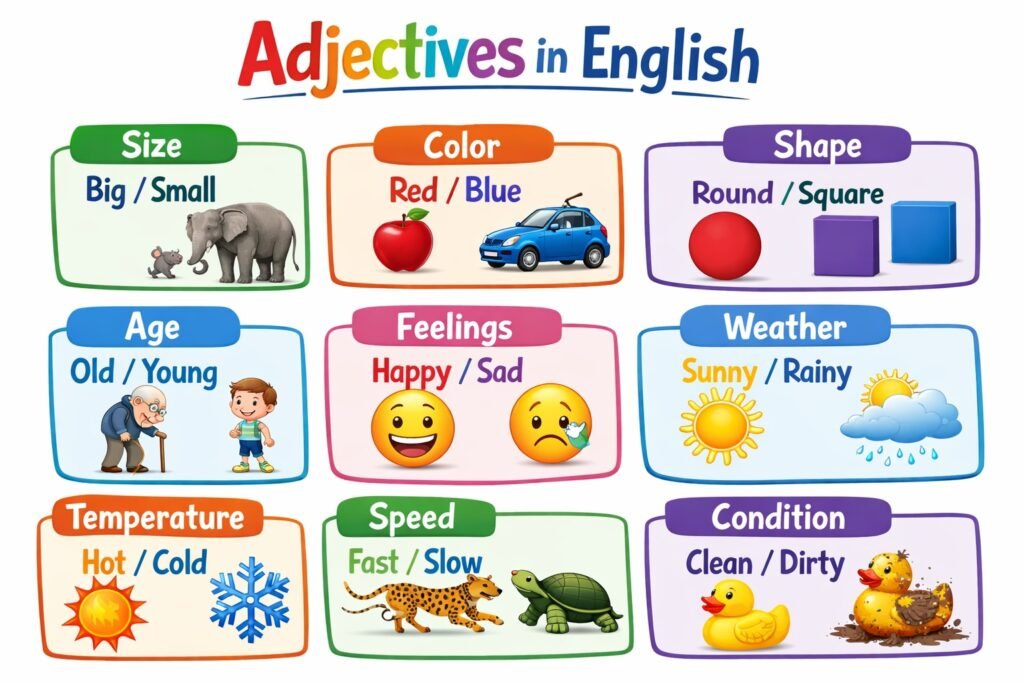
    adjectives in English examples

    🔗 Related Grammar Lessons

    To build a strong grammar foundation, you should also learn:

    💡 These lessons are linked together to help you learn faster and improve your grammar step by step.


    📊 Types of Adjectives in English

    1. Descriptive Adjectives

    These describe the quality of a noun.

    Examples:

    • a happy child
    • a tall building
    • a small dog

    2. Quantitative Adjectives

    • some water
    • many books
    • few students

    3. Demonstrative Adjectives

    • this book
    • that house
    • these apples

    4. Possessive Adjectives

    • my bag
    • your phone
    • their house

    5. Interrogative Adjectives

    • which color do you like?
    • what book are you reading?

    📏 Order of Adjectives in English(Important Rule)

    6

    📌 Correct Order:

    Opinion → Size → Age → Shape → Color → Origin → Material → Purpose

    ✅ Examples:

    • a beautiful small old wooden table
    • a big red ball

    ⚠️ Common Adjective Rules

    1. Adjectives do not change form

    • a big house
    • two big houses

    2. Adjectives usually come before nouns

    • a blue car
    • a fast runner

    3. Adjectives after linking verbs

    • She is happy
    • The food tastes delicious

    🔄 Comparative and Superlative Adjectives

    • big → bigger → biggest
    • happy → happier → happiest
    • beautiful → more beautiful → most beautiful

    ❌ Common Mistakes

    • ❌ She has a car red
    • ✅ She has a red car
    • ❌ He is more taller
    • ✅ He is taller

    📝 Practice Exercise

    Fill in the blanks:

    1. She has a ______ dress. (beautiful)
    2. I saw ______ dogs in the park. (three)
    3. This is the ______ building in town. (tall)

    📥 Free Adjective Worksheet (Download)

    👉 Get your free printable worksheet here:
    🔗 Download Free Adjective Worksheet

    ✔ Beginner-friendly
    ✔ Perfect for students and teachers
    ✔ Includes answers


    💎 Premium Grammar Worksheets (Recommended)

    Want more practice with auto-marking worksheets and structured lessons?

    👉 Check out the full collection here:
    🔗 English Grammar Worksheets (All Topics)

    ⭐ Includes:

    • Subject-Verb Agreement worksheets
    • Tenses practice sheets
    • Adjective & Adverb exercises
    • Ready-to-use classroom materials

    💡 Ideal for:

    • Teachers
    • Parents
    • Students preparing for exams

    💡 Tips for Using Adjectives in English

    • Use adjectives to make your writing more interesting
    • Avoid using too many adjectives in one sentence
    • Learn common adjective combinations (collocations)
    • Practise using adjectives in daily conversations

    👉 The more you practise adjectives in English, the more natural your sentences will become.


    ✅ Conclusion

    Adjectives in English are essential for clear and effective communication. By understanding their types, rules, and correct order, you can improve your grammar quickly.

    Start practising adjectives in English today using the free worksheet and explore more lessons to master English faster.

    Frequently Asked Questions (FAQs)

    What is the main purpose of an adjective in English?

    The primary purpose of an adjective is to modify, describe, or give more details about a noun or a pronoun. Adjectives answer specific questions about a noun, such as What kind? (a luxury hotel), Which one? (this laptop), or How many? (five students).

    Do English adjectives change form for plural nouns?

    No. One of the best rules in English grammar is that adjectives never change form. They remain exactly the same whether the noun is singular or plural. For example, you say “one smart student” and “three smart students.” You never add an “s” to an adjective.

    What is the correct order of adjectives?

    The correct order is:
    Opinion → Size → Age → Shape → Color → Origin → Material → Purpose
    Example: a beautiful small old wooden table

    What is the difference between a comparative and a superlative adjective?

    Use a comparative adjective to compare exactly two things (e.g., “This room is bigger than that one” or “He is more helpful).
    Use a superlative adjective to compare three or more things to show which one is at the absolute limit (e.g., “This is the biggest room in the house” or “She is the most helpful student”).

    Can an adjective come at the end of a sentence?

    Yes. While adjectives usually sit directly before a noun, they can also appear at the end of a sentence after a linking verb (such as be, seem, look, taste, feel). In the sentence “The sunset looks amazing,” the word amazing is a predicate adjective describing the sunset.
  • A, An, and The: How to Stop Tripping Over English Articles

    A, An, and The

    Articles (a, an, the) are small words, but they are one of the most common sources of mistakes in English grammar. Many learners struggle to know when to use “a,” “an,” or “the” correctly.

    Let’s be honest: articles—those tiny words a, an, and the—are the ultimate grammar trolls. They are incredibly small, yet they cause some of the biggest headaches for English learners worldwide. One minute you think you’ve mastered them, and the next, you’re wondering why someone said “a university” but “an hour.”

    If you constantly find yourself guessing which one to use, don’t sweat it. Even advanced speakers trip up here. The good news? You don’t need to memorize a million confusing laws. You just need to look out for these 7 common mistakes and learn the simple, real-world patterns behind them.


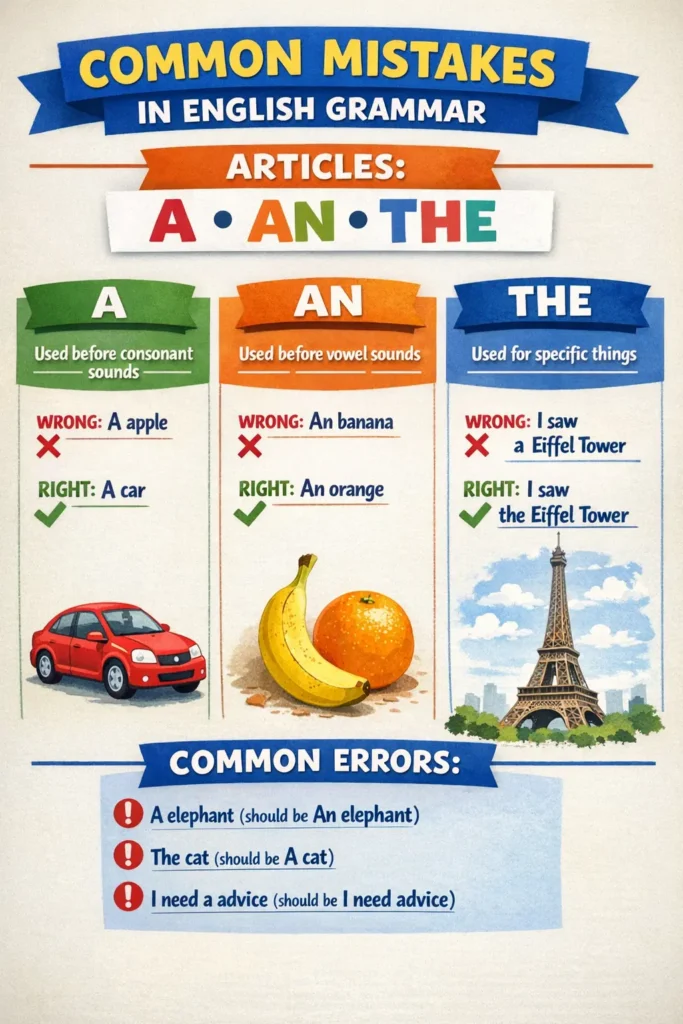
    common mistakes in english grammar articles a an the

    1. Using “A” and “An” Incorrectly

    Basic Rule:

    • Use “a” before words that start with a consonant sound
    • Use “an” before words that start with a vowel sound

    Examples:

    ✅ Correct:

    • a book
    • a car
    • an apple
    • an egg

    ❌ Incorrect:

    • an book
    • a apple

    👉 Important Tip:
    It depends on the sound, not the letter.

    ✅ Correct:

    • an hour (silent “h”)
    • a university (sounds like “you”)

    2. Using “The” When It’s Not Needed

    Many learners overuse “the.”

    ❌ Incorrect:

    • The happiness is important.
    • The life is beautiful.

    ✅ Correct:

    • Happiness is important.
    • Life is beautiful.

    👉 Use “the” only when talking about something specific.


    3. Missing Articles Completely

    Sometimes learners forget to use articles where they are required.

    ❌ Incorrect:

    • I bought car yesterday.

    ✅ Correct:

    • I bought a car yesterday.

    👉 Singular countable nouns usually need an article.


    4. Confusing General vs Specific Meaning

    This is one of the biggest mistakes.

    General:

    • I want to buy a phone. (any phone)

    Specific:

    • I want to buy the phone you recommended. (specific phone)

    5. Using “The” for First Mention

    ❌ Incorrect:

    • I saw the dog yesterday.

    ✅ Correct:

    • I saw a dog yesterday.
    • The dog was barking loudly.

    👉 Rule:

    • First mention → a/an
    • Second mention → the

    6. Using Articles with Uncountable Nouns

    Uncountable nouns usually do not use “a/an.”

    ❌ Incorrect:

    • a water
    • an information

    ✅ Correct:

    • some water
    • some information

    👉 You can still use “the” if it is specific:

    • The water in this bottle is clean.

    7. Using Articles with Proper Nouns

    Most proper nouns do not need articles.

    ❌ Incorrect:

    • The Malaysia is a beautiful country.

    ✅ Correct:

    • Malaysia is a beautiful country.

    👉 Exceptions:

    • the United States
    • the Netherlands

    8. Common Article Mistakes Summary

    MistakeIncorrectCorrect
    Wrong articlean cara car
    Missing articleI bought bookI bought a book
    Overusing “the”the life is hardlife is hard
    Uncountable nounsan informationinformation

    📝 Practice with Worksheets

    Want more practice?

    👉 Download structured exercises here:
    https://learnenglishgrammar.org/english-grammar-worksheets/

    👉 Or start with a Free Sample:
    https://learnenglishgrammar.org/free-sample/


    Quick Practice

    Choose the correct answer:

    1. I saw ___ elephant at the zoo.
    2. She is reading ___ book you gave her.
    3. He wants to drink ___ water.

    ✅ Answers:

    1. an
    2. the
    3. (no article)

    Why Articles Are Difficult

    Articles are tricky because:

    • Rules depend on sound, not spelling
    • Some nouns don’t use articles
    • Context changes meaning

    That’s why even advanced learners make mistakes.


    FAQ: A, An, and The

    1. When do I use “a” or “an”?

    Use “a” before consonant sounds and “an” before vowel sounds.

    2. When should I use “the”?

    Use “the” when the noun is specific or already known.

    3. Can I skip articles?

    Sometimes yes, but not always.

    4. What is the easiest way to learn articles?

    Practice regularly using worksheets and real examples.


    Final Tip

    If you are unsure:

    • Use “a/an” for general ideas
    • Use “the” for specific things

    With consistent practice, article usage will become natural.


    🔗 Read more:-

    External Resources

    https://dictionary.cambridge.org/grammar/

    Frequently Asked Questions

    When do I use “a” vs. “an”? I still get confused.

    Think of it as a smooth transition for your voice. English hates clunky pauses. Try saying “a apple” out loud—your throat has to awkwardly stutter between the two “ah” sounds. To fix this, we drop an “n” in there as a bridge: “an apple.”
    Because this is all about making speech sound smooth, always follow your ears, not your eyes. If a word sounds like it starts with a vowel (like the silent-H in hour), use an. If it sounds like it starts with a consonant (like the “yoo” sound in university or euro), use a.

    Is there an easy shortcut to know when to use “the”?

    The absolute easiest shortcut is the “Point Test.” Imagine you are speaking to someone in a room. Can you physically point your finger at the exact thing you are talking about, and will they know exactly which one you mean?
    If you say, “Pass me the phone,” you are pointing at one specific device on the table.
    If you say, “I need to buy a phone,” you are talking about the abstract concept of a phone—you can’t point to it because it’s still sitting in a warehouse somewhere.

    What happens if I just skip articles completely? Will people understand me?

    Yes, 99% of the time, people will still understand exactly what you mean! If you say, “I want buy car,” no one is going to be confused about your goal.
    However, skipping them makes your English sound a bit like a broken telegram or a robot. If you are writing an exam, applying for a job, or trying to sound natural and fluent in a conversation, using articles correctly is like adding polish to a car—it makes the whole sentence ride smoothly.

    Why are there so many random exceptions? It feels impossible to memorize!

    t feels that way because English is a living language built by people, not by computer programmers. Many “exceptions” exist simply because they sound better to native speakers over centuries of talking.
    Don’t try to memorize a massive list of rules all at once. The best way to learn is through pattern recognition. Instead of memorizing why the United States uses “the” but Malaysia doesn’t, just focus on noticing them when you read or watch videos. Your brain is incredibly good at picking up these rhythms naturally over time!

  • Articles in English Grammar: A Complete Guide

    Articles in English Grammar: A Complete Guide

    Many English learners overlook articles because they seem like tiny, insignificant filler words. However, think of articles as the directional signs of a sentence. They tell your listener exactly where to look: are we talking about any old “apple” in the bowl, or are we talking about “the apple” you’ve been saving for lunch? Getting this right doesn’t just make you sound more fluent; it prevents those small “wait, which one?” moments that can stall a good conversation.

    Articles in English grammar are small but important words that help define nouns. The three main articles are a, an, and the. In this guide, you will learn how to use articles in English grammar correctly with simple rules and clear examples.

    In this guide, you’ll learn what articles are, how to use them, and see plenty of examples to help you understand easily.


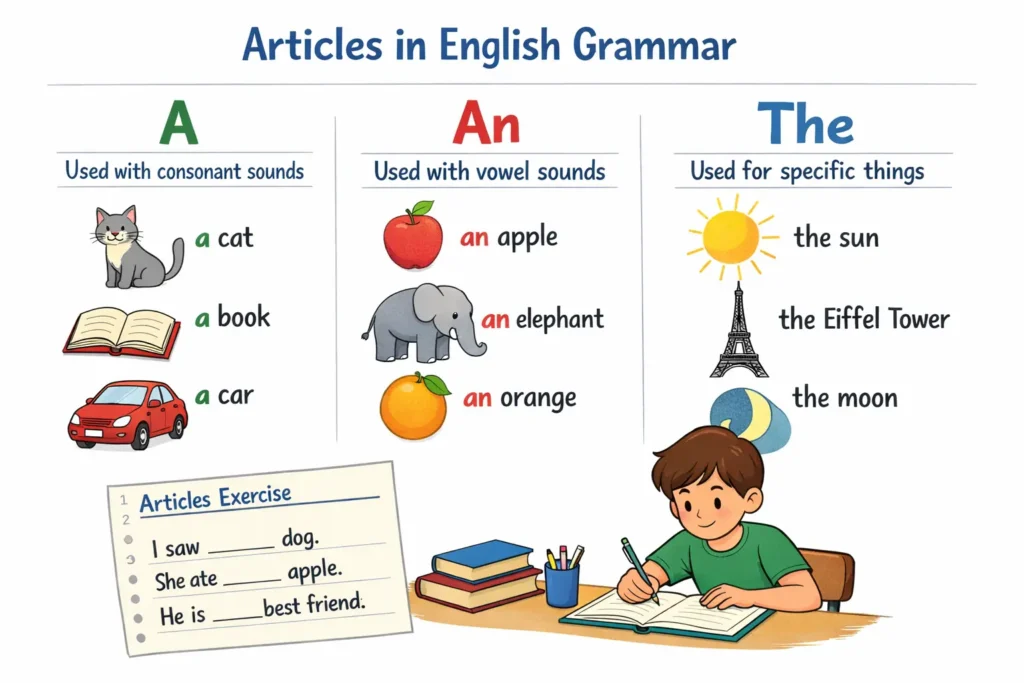
    articles-in-english-grammar-a-an-the

    What Are Articles in English Grammar?

    Articles are words that come before nouns to define or specify them.

    There are three articles in English:

    • A
    • An
    • The

    ✍️ Examples of Articles in Sentences

    • I saw a dog in the park.
    • She ate an apple this morning.
    • The sun rises in the east.

    👉 This adds:

    • Word count
    • Keyword relevance
    • Readability

    Types of Articles

    1. Indefinite Articles (A / An)

    We use a and an when talking about something general or not specific.

    Use “a” before consonant sounds:

    • a cat
    • a book
    • a university (sounds like “yu”)

    Use “an” before vowel sounds:

    • an apple
    • an hour (silent “h”)
    • an umbrella

    👉 Learn more about countable and uncountable noun types here:
    https://learnenglishgrammar.org/countable-vs-uncountable-nouns/


    2. Definite Article (The)

    We use the when talking about something specific or already known.

    Examples:

    • The sun is very bright.
    • I saw the movie you recommended.
    • Please close the door.

    👉 Related lesson:
    subject-verb-agreement-examples/


    When to Use Articles

    ✅ Use “a/an” when:

    • Talking about something for the first time
    • Talking about one of many

    Example:

    • I saw a dog in the park.

    ✅ Use “the” when:

    • The listener knows what you mean
    • It has been mentioned before

    Example:

    • I saw a dog. The dog was barking loudly.

    ❌ Do NOT use articles when:

    • Talking about general ideas
    • Using plural or uncountable nouns in general

    Examples:

    • Water is important.
    • Cats are cute.

    👉 You may also like:
    https://learnenglishgrammar.org/its-vs-its/
    https://learnenglishgrammar.org/your-vs-youre/


     If you want structured practice, check out our Level 1–6 English grammar worksheets designed for step-by-step learning.

    Common Mistakes with Articles in English Grammar

    The biggest hurdle most of us face isn’t the rule itself, but the exceptions. We’re taught “A, E, I, O, U,” but English loves to play by the ear, not the alphabet. That’s why we say “an hour” but “a university.” If you’re ever in doubt, say the phrase out loud. If the transition between the article and the noun feels like a “clunk” or a “glitch” in your throat, you probably need the other one. Your ears are often better grammarians than your eyes!

    ❌ Incorrect:

    • She is a honest person.

    ✅ Correct:

    • She is an honest person.

    ❌ Incorrect:

    • I have the car. (if not specific)

    ✅ Correct:

    • I have a car.

    Tips to Master Articles

    • Focus on sound, not spelling (a vs an)
    • Ask yourself: Is it specific or general?
    • Practice daily with simple sentences

    You can also learn adverbs in English and adjective in English to improve your sentence structure.


    Practice Exercises

    Fill in the blanks:

    1. I saw ___ elephant at the zoo.
    2. She bought ___ new phone yesterday.
    3. ___ moon looks beautiful tonight.

    Answers:

    1. an
    2. a
    3. The

    Free Worksheet & Practice (Download Now)

    Want to master articles faster?

    👉 Get your FREE grammar worksheet


    Conclusion

    Don’t be discouraged if you occasionally drop an article or swap a “the” for an “a.” Even advanced speakers occasionally trip over these, especially when speaking quickly. The secret to mastering them isn’t memorizing a textbook—it’s immersion. The more you listen to native podcasts or read English stories, the more your brain will start to “expect” the right sound. Keep practicing with the exercises below, and soon, these little words will become second nature.

    Articles may seem small, but they are essential for speaking and writing correct English.

    If you practice regularly and understand the difference between a, an, and the, your English will improve quickly.


    External Reference

    For deeper understanding, you can also read:
    https://www.britannica.com/topic/article-gram

    📘 English Grammar Worksheets (Level 1–6)

    Want to master articles in English grammar step by step?

    Our structured worksheets help you improve faster with clear progression:

    • ✔ Level 1 – Beginner
    • ✔ Level 2 – Elementary
    • ✔ Level 3 – Pre-Intermediate
    • ✔ Level 4 – Intermediate
    • ✔ Level 5 – Upper-Intermediate
    • ✔ Level 6 – Advanced
    • Get started and improve your English Grammar with our comprehensive lesson plans

    Frequently Asked Questions About Articles in English Grammar

    Why do we even need articles in English?

    Articles act as “pointers.” They tell the reader whether you are talking about something general (a dog) or something specific (the dog). Without them, sentences can feel blunt or confusing, making it harder for the listener to follow which object or idea you are referring to.

    Is it always “an” before a vowel?

    Not necessarily! The rule is based on sound, not spelling. You use “an” before a vowel sound.
    Example: We say “an hour” because the ‘h’ is silent, but we say “a university” because the ‘u’ sounds like a ‘y’ (a consonant sound). If it sounds like a vowel, use “an.”

    When should I use “the” instead of “a” or “an”?

    Use “the” when there is only one of something (the sun) or when you and the listener both know exactly which specific thing you are talking about.
    Pro Tip: If you’ve already mentioned a noun once, use “the” every time you mention it again in that conversation.

    Are there times when I should use no article at all?

    Yes! This is called the “Zero Article.” We usually skip articles when talking about plural nouns in a general sense (“I love books”) or uncountable nouns like water, air, or happiness (“Creativity is important”).

    What is the quickest way to stop making mistakes with articles?

    The best way is to focus on noun phrases. Instead of just learning the word “apple,” learn it as “an apple.” Training your ears to hear the article and noun as one single unit will help you instinctively know when a word sounds “naked” without its article.

  • Nouns in English Grammar(With Examples, Types & Worksheets)

    Nouns in English Grammar

    Think of nouns as the anchor points of the English language. Without them, we wouldn’t be able to talk about who we are, where we are going, or what we are thinking. Whether you are texting a friend, writing an essay, or ordering food, you are using nouns constantly. They are, quite literally, the building blocks of communication.

    👉 Want full practice? Explore our complete Level 1–6 Grammar Worksheets:
    English Grammar Worksheets (Level 1–6) – 150+ Printable Exercises with Answers

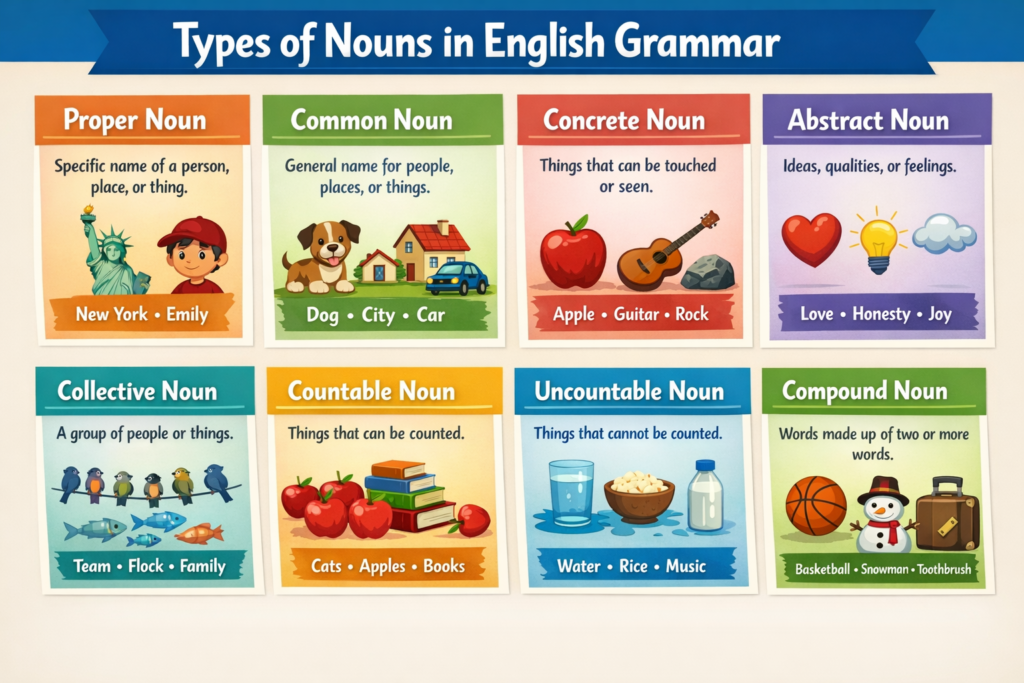
    Types of Nouns in English grammar

    What Is a Noun?

    A noun is a word that names a person, place, thing, or idea.

    Examples:

    • Person: teacher, John, doctor
    • Place: school, Malaysia, park
    • Thing: book, car, phone
    • Idea: happiness, freedom, love

    👉 Example sentence:
    The teacher gave the student a book.


    Types of Nouns

    1. Common Nouns

    These are general names of people, places, or things.
    Examples: dog, city, teacher

    2. Proper Nouns

    These are specific names and always start with a capital letter.
    Examples: Ali, Kuala Lumpur, Malaysia

    3. Concrete Nouns

    Things you can see, touch, hear, smell, or taste.
    Examples: apple, chair, music

    4. Abstract Nouns

    Ideas, feelings, or concepts you cannot touch.
    Examples: love, happiness, courage

    5. Countable Nouns

    Nouns you can count.
    Examples: one book, two cars

    6. Uncountable Nouns

    Nouns you cannot count individually.
    Examples: water, sugar, information

    👉 Learn more here:
    https://learnenglishgrammar.org/parts-of-speech/


    Examples of Nouns in Sentences

    • The boy is playing in the park.
    • She has a beautiful voice.
    • Malaysia is a wonderful country.
    • Honesty is the best policy.

    How to Identify a Noun

    Ask yourself:

    • Is it a person? (teacher, doctor)
    • Is it a place? (school, city)
    • Is it a thing? (table, phone)
    • Is it an idea? (love, happiness)

    If yes, it is probably a noun.


    Common Mistakes with Nouns

    • Incorrect plural forms (childs → children)
    • Missing capital letters for proper nouns
    • Confusing countable and uncountable nouns

    👉 Improve further:
    https://learnenglishgrammar.org/adverbs-in-english-grammar/


    Free Noun Worksheet (Practice Now)

    Want to improve your English grammar with real practice?

    You can download a FREE sample worksheet to see how our system works:

    👉 Get your free worksheet here:
    https://learnenglishgrammar.org/free-sample/

    • Easy-to-follow exercises
    • Instant AutoTick answers
    • Perfect for students, parents, and self-learning

    Upgrade to Full Grammar Worksheets (Level 1–6)

    Ready to take your English to the next level?

    Our complete worksheet package includes Level 1 to Level 6, designed step-by-step for learners of all levels.

    • Structured learning from beginner to advanced
    • Hundreds of practice questions
    • Instant AutoTick answers
    • Ideal for students, parents, and teachers

    👉 View full worksheet package:
    English Grammar Worksheets (Level 1–6) – 150+ Printable Exercises with Answers


    Why Learning Nouns Is Important

    Understanding nouns helps you:

    • Write better sentences
    • Speak more clearly
    • Improve overall grammar accuracy

    Consistent practice is the key to mastering English grammar.


    External Reference

    For more detailed explanations, you can also visit:
    https://www.grammarly.com/blog/nouns/

    At the end of the day, mastering nouns isn’t about being perfect—it’s about building confidence. When you know your nouns, your writing flows better, your speech becomes clearer, and you can express exactly what is on your mind. Grammar doesn’t have to feel like a chore, and with a little bit of steady practice, it actually becomes second nature.


    FAQ About Nouns

    What is a noun in simple words?
    Think of a noun as a “naming word.” If you can see it, touch it, visit it, or even just feel it in your heart, it’s a noun! It’s simply the word we use to identify any person, place, thing, or idea.

    What are 5 everyday examples of nouns?
    ou use them constantly without even realizing it! Five great examples are teacher (a person), Malaysia (a place), book (a thing), and happiness or honesty (ideas).

    What are the main types of nouns?
    Nouns wear a few different hats depending on how they are used. The main ones you will run into are common and proper, concrete and abstract, and countable and uncountable nouns. Don’t worry—they sound fancy, but they are very easy to spot once you get the hang of it!

    Why are nouns important?
    Without nouns, our sentences would completely fall apart. They act as the anchor of your sentence, telling the listener exactly who or what is doing the action. Simply put, you can’t tell a good story without them!

  • Adverbs in English (Types, Examples & Rules)

    Adverbs in English Grammar

    Adverbs in English are words that describe verbs, adjectives, or other adverbs. They help explain how, when, where, or how often something happens. In this guide, you will learn the types of adverbs, clear examples, and simple rules to improve your grammar.

    If you want to improve your English, learning adverbs is essential. They make your sentences clearer, more detailed, and more natural.

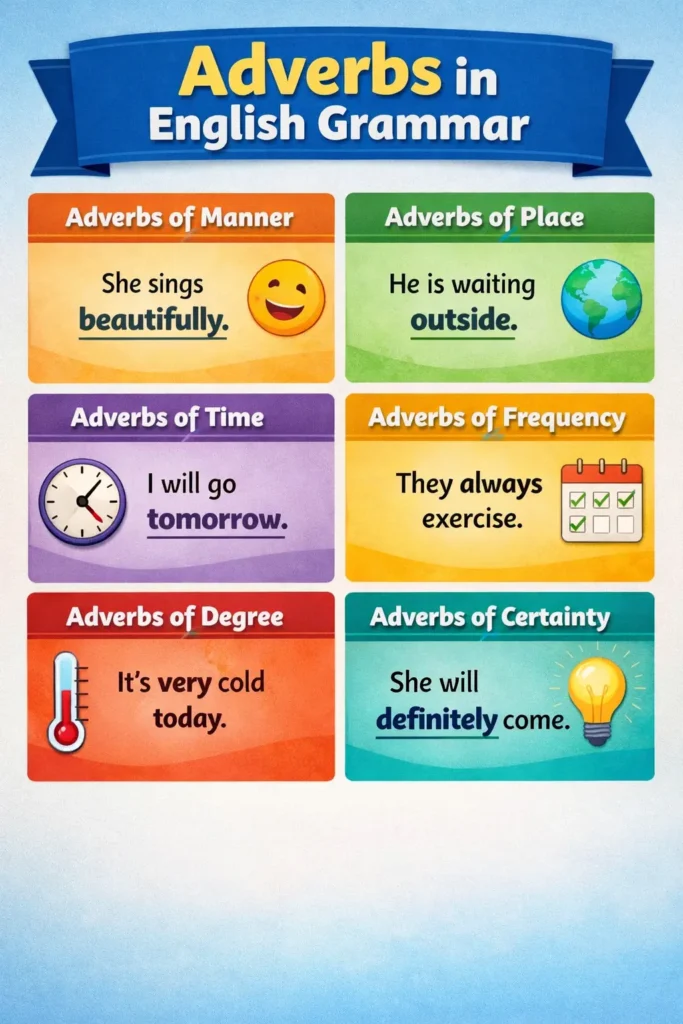
    adverbs in English grammar examples

    Think of adverbs as the seasoning of the English language. Without them, our sentences get the job done, but they can feel a bit bland and robotic. If you say, “I walked into the room,” your listener gets the basic facts, but they miss out on the actual story. Did you stomp in angrily, slip in quietly, or rush in excitedly? By adding just one well-chosen adverb, you instantly change the entire mood of the sentence, painting a vivid picture in the reader’s mind without needing a whole string of extra words.

    📥 Get Your Free Grammar Worksheet Sample

    Download your FREE grammar worksheet sample here:
    https://learnenglishgrammar.org/free-sample

    ✔ Easy-to-follow exercises
    ✔ Auto-marking answers
    ✔ Perfect for students and self-learning


    What is an Adverb in English Grammar?

    An adverb in English grammar is a word that describes or modifies:

    • a verb
    • an adjective
    • another adverb

    👉 Examples of adverbs:

    • She runs quickly.
    • He is very tall.
    • She speaks quite softly.

    📘 Related topic:


    Types of Adverbs in English Grammar

    Understanding the types of adverbs helps you use them correctly in sentences.


    1. Adverbs of Manner (How)

    Adverbs of manner describe how an action happens.

    Examples:

    • He drives carefully.
    • She sings beautifully.
    • They worked hard.

    👉 Most adverbs of manner end in -ly


    2. Adverbs of Time (When)

    Adverbs of time tell us when something happens.

    Examples:

    • I will call you later.
    • She arrived yesterday.
    • We are leaving soon.

    3. Adverbs of Place (Where)

    Adverbs of place show where something happens.

    Examples:

    • The children are playing outside.
    • Come here.
    • He looked everywhere.

    4. Adverbs of Frequency (How Often)

    Adverbs of frequency describe how often something happens.

    Examples:

    • I always wake up early.
    • She often reads books.
    • They rarely go out.

    👉 Common adverbs of frequency:
    always, usually, often, sometimes, rarely, never


    5. Adverbs of Degree (How Much)

    Adverbs of degree show intensity or level.

    Examples:

    • I am very happy.
    • The movie was too long.
    • She almost finished her work.

    Position of Adverbs in English Sentences

    The position of adverbs in English grammar depends on their type.

    After the verb

    • She sings beautifully

    Before the main verb

    • He always eats breakfast

    Beginning of the sentence

    • Yesterday, we went shopping

    How to Form Adverbs

    Most adverbs are formed by adding -ly to adjectives.

    Examples:

    • quick → quickly
    • happy → happily
    • slow → slowly

    Spelling rules:

    • easy → easily
    • careful → carefully
    • good → well (irregular)

    It is also incredibly easy to get tripped up by adverbs, even for native speakers. We have all heard someone say they did “good” on a test when they really meant they did “well,” or struggled with exactly where to drop a word like “always” or “almost” in a sentence so it does not sound awkward. If you have ever felt a bit confused by these subtle placement rules, you are definitely not alone—it is one of the most common hurdles in English grammar.


    Common Adverb Mistakes

    ❌ He runs quick
    ✅ He runs quickly

    ❌ She did good
    ✅ She did well

    ❌ I very like it
    ✅ I really like it


    Adverbs vs Adjectives

    Understanding adverbs vs adjectives is very important.

    • Adjective → describes a noun
    • Adverb → describes a verb

    Examples:

    • She is a fast runner
    • She runs fast

    You can also learn about adjectives in English to better understand how words describe nouns.

    Practice Exercise on Adverbs

    Choose the correct answer:

    1. She speaks (soft / softly)
    2. He is a (quick / quickly) learner
    3. They (always / are always) late
    4. The baby is sleeping (quiet / quietly)

    👉 Answers:

    1. softly
    2. quick
    3. are always
    4. quietly


    📘 English Grammar Worksheets (Full Collection)


    Get Free Sample


    By learning adverbs in English, you can make your sentences clearer, more detailed, and more natural.

    The good news is that mastering adverbs is mostly about recognizing patterns rather than memorizing endless lists of exceptions. Once you get a feel for how they change the speed, tone, and direction of your thoughts, using them becomes second nature. Whether you are writing a professional email or just trying to sound more natural in casual conversation, getting a solid grip on these flexible little words is one of the fastest ways to level up your English skills.

    Frequently Asked Questions (FAQs)

    What exactly does an adverb do in a sentence?

    Think of an adverb as a helper word that gives more color and context. It modifies (describes) a verb, an adjective, or even another adverb. It answers the questions that keep a story interesting: How did it happen? When did it happen? Where did it happen? How often? Or to what degree?

    Do all adverbs end in “-ly”?

    Not at all! While many adverbs of manner are formed by adding “-ly” to an adjective (like quickly or happily), some of the most common adverbs look completely different. Words like fast, hard, well, yesterday, always, and very are all adverbs, but they don’t have an “-ly” in sight.

    How can I tell the difference between an adjective and an adverb?

    It all comes down to what word they are whispering secrets about. Adjectives only describe nouns (people, places, or things—like a “beautiful song”). Adverbs describe actions, states, or intensities (like singing “beautifully“). If it tells you what kind of object it is, it’s an adjective. If it tells you how an action is being done, it’s an adverb.

    Where should I put an adverb in a sentence?

    Adverbs are highly flexible, which is why they can be tricky! Their position usually depends on their type. Adverbs of manner usually go after the action verb (She ran quickly). Adverbs of frequency usually sit before the main verb (He always forgets his keys). If you want to emphasize when or where something happened, you can even pop them right at the beginning of the sentence ( Yesterday, we went to the beach).

    What are the 5 types of adverbs?

    The 5 main types of adverbs are:
    Adverbs of manner
    Adverbs of time
    Adverbs of place
    Adverbs of frequency
    Adverbs of degree

  • Conjunctions in English Grammar (Complete Guide with Examples)

    Conjunctions in English Grammar

    Think of conjunctions as the unsung heroes of smooth communication. Without them, our speech and writing would feel incredibly choppy—like a robot reading a dry list of facts. In this guide, we are going to break down exactly how these little words act as bridges between your thoughts, making your English sound natural, fluid, and confident.

    Conjunctions in English grammar are words that connect ideas, sentences, or clauses. In this guide, you will learn the different types of conjunctions, including coordinating, subordinating, and correlative conjunctions, with clear examples.

    Conjunctions are one of the most important parts of English grammar. They help us connect words, phrases, and sentences smoothly.

    In this guide, you will learn what conjunctions are, their types, and how to use them correctly with simple examples.

    Present Continuous Tense

    To understand how conjunctions connect ideas in real sentences, you can also learn the present continuous tense, which is used to describe actions happening now.

    A great way to see these grammar bridges in action is by looking at the Present Continuous Tense (the tense we use for actions happening right now). When you are describing live actions, conjunctions allow you to connect multiple things happening at the exact same time. For example, you can say, “I am studying English while my brother is playing video games.” Seeing how conjunctions function within specific tenses makes it much easier to use them correctly in everyday conversations.


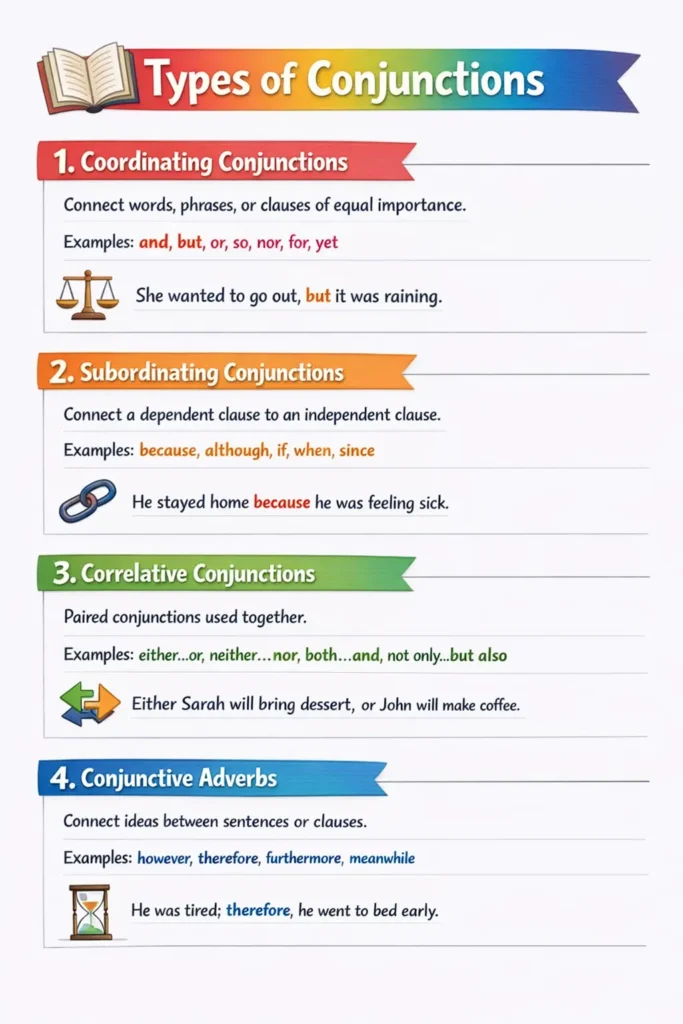
    types of conjunctions chart with examples

    📘 What Are Conjunctions in English Grammar?

    A conjunction is a word that joins two or more words, phrases, or sentences.

    Examples:

    • I like tea and coffee.
    • She was tired but she continued working.
    • I stayed home because it was raining.

    👉 Words like and, but, because, or are conjunctions.


    📚 Types of Conjunctions in English Grammar

    Correlative conjunctions (either…or, neither…nor)There are three main types of conjunctions in English:

    Coordinating conjunctions (and, but, or)

    Subordinating conjunctions (because, although, if)


    1️⃣ Coordinating Conjunctions (With Examples)

    These join words or sentences of equal importance.

    Common coordinating conjunctions:

    • For
    • And
    • Nor
    • But
    • Or
    • Yet
    • So

    👉 (Tip: Remember FANBOYS)

    Examples:

    • I want to go out, but it is raining.
    • She likes apples and oranges.
    • You can stay here or leave now.

    2️⃣Subordinating Conjunctions (With Examples)

    These connect a main clause with a dependent clause.

    Common subordinating conjunctions:

    • Because
    • Although
    • If
    • When
    • While
    • Since

    Examples:

    • I stayed home because I was sick.
    • Although he was tired, he finished his work.
    • Call me when you arrive.

    3️⃣ Correlative Conjunctions

    These work in pairs to join words or phrases.

    Common pairs:

    • Either…or
    • Neither…nor
    • Both…and
    • Not only…but also

    Examples:

    • Either you come now or you stay here.
    • Both John and Mary are coming.
    • Not only is he smart, but also hardworking.

    Present Simple Tense

    You should also review the present simple tense to see how conjunctions are used in everyday sentences and routines.

    Once you have the basics down, try spotting them in the Present Simple Tense. Because we use the present simple to talk about facts, daily routines, and habits, it relies heavily on conjunctions to keep things flowing. Instead of saying, “I wake up at 7 AM. I drink coffee.”, you can use a conjunction to sound much more natural: “I wake up at 7 AM and I immediately make a cup of coffee.”


    ⚠️ Common Mistakes with Conjunctions

    Avoid these mistakes:

    ❌ Using too many conjunctions in one sentence
    ✔ Keep sentences clear and simple

    ❌ Incorrect pairing
    ✔ Use correct pairs (e.g., either…or)

    ❌ Missing commas
    ✔ Use comma before coordinating conjunction when joining sentences

    Correct: I was tired, but I continued working.

    ❌ I like tea and also coffee
    ✅ I like tea and coffee

    ❌ Because he was tired, so he slept
    ✅ Because he was tired, he slept


    ✍️ Practice Exercises

    Fill in the blanks with the correct conjunction:

    1. I was hungry, ___ I ate dinner.
    2. She stayed home ___ she was sick.
    3. You can choose tea ___ coffee.

    👉 (Answers: so, because, or)


    🎯 Quick Summary

    • Conjunctions connect words and sentences
    • There are 3 main types:
      • Coordinating
      • Subordinating
      • Correlative
    • They improve sentence flow and clarity

    🎁 Want to Practice More?

    Improve faster with structured worksheets:

    👉 [Download English Grammar Worksheets]
    👉 [Try Free Sample]


    📘 Learn More

    👉 Start from the main guide:[Complete English Grammar Guide]
    👉 Learn basics: [Parts of Speech]


    🧠 Why Conjunctions Are Important in English Grammar

    Conjunctions play an important role in English grammar because they help connect ideas and make sentences more natural and fluent. Without conjunctions, sentences would sound short, repetitive, and unnatural.

    For example:

    • I like tea. I like coffee. ❌
    • I like tea and coffee. ✅

    By using conjunctions correctly, you can:

    • Combine short sentences into longer, meaningful ones
    • Show relationships between ideas (contrast, cause, choice)
    • Improve both writing and speaking skills

    Learning how to use conjunctions effectively will make your communication clearer and more professional.

    ❓ Frequently Asked Questions

    What are conjunctions in English grammar?
    They are words used to connect sentences or ideas.

    What are the main types of conjunctions?

    What actually counts as a conjunction in English?

    Simply put, conjunctions are “bridge words.” Their entire job is to glue words, phrases, or whole sentences together so your thoughts flow smoothly instead of sounding choppy and broken up.

    Why are conjunctions important?

    They help make sentences clearer and more connected..

    What is an example of a conjunction?

    Examples of conjunctions include and, but, or, because, although, and if.

    What are the three main types I need to know?

    You can break them down into three easy categories:
    Coordinating (The Linkers): Words like and, but, and or that connect equal ideas.
    Subordinating (The Explainers): Words like because, although, and since that introduce a reason, time, or condition.
    Correlative (The Pairs): Two-word tag teams like either…or and neither…nor.

    Do I always need a comma before a conjunction?

    Not always! You only need a comma before a coordinating conjunction (FANBOYS) if it is connecting two complete sentences that could stand alone. For example: “I wanted to go, but it was raining.” If you are just joining two words, leave the comma out: “I like tea and coffee.”

    What is the most common mistake to avoid?

    “Double-booking” your conjunctions! People often accidentally use two in the same sentence when they only need one. For example, never say: Because it was raining, so I stayed home.” Pick one and stick to it: Because it was raining, I stayed home.”

    !

  • its vs it’s : Simple Explanation, Examples & Easy Rules

    its vs it’s

    IIts vs it’s is one of the most common grammar mistakes in English. Many learners confuse these words because they look similar and sound the same.

    If you’ve ever stared at your screen for a full minute, hovering your thumb over the backspace key while trying to figure out which one to use, please don’t feel bad. You are definitely not alone. Even native English speakers who write for a living find themselves pausing at this exact spot. It’s one of those tiny quirks of the language that is designed to trick our brains.

    However, its vs it’s have completely different meanings and uses. Understanding the difference will help you write more clearly and avoid common errors. Once you get the hang of it, you’ll feel a lot more confident every time you hit send on an email or turn in an essay.

    👉 Download your free grammar worksheets here:
    https://learnenglishgrammar.org/free-sample/


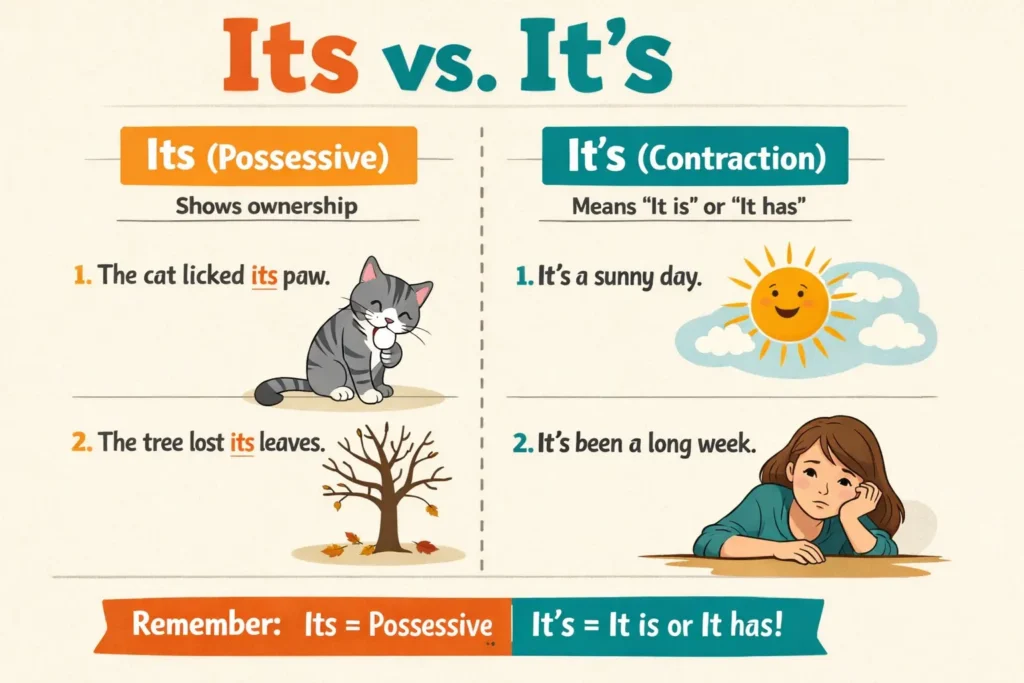
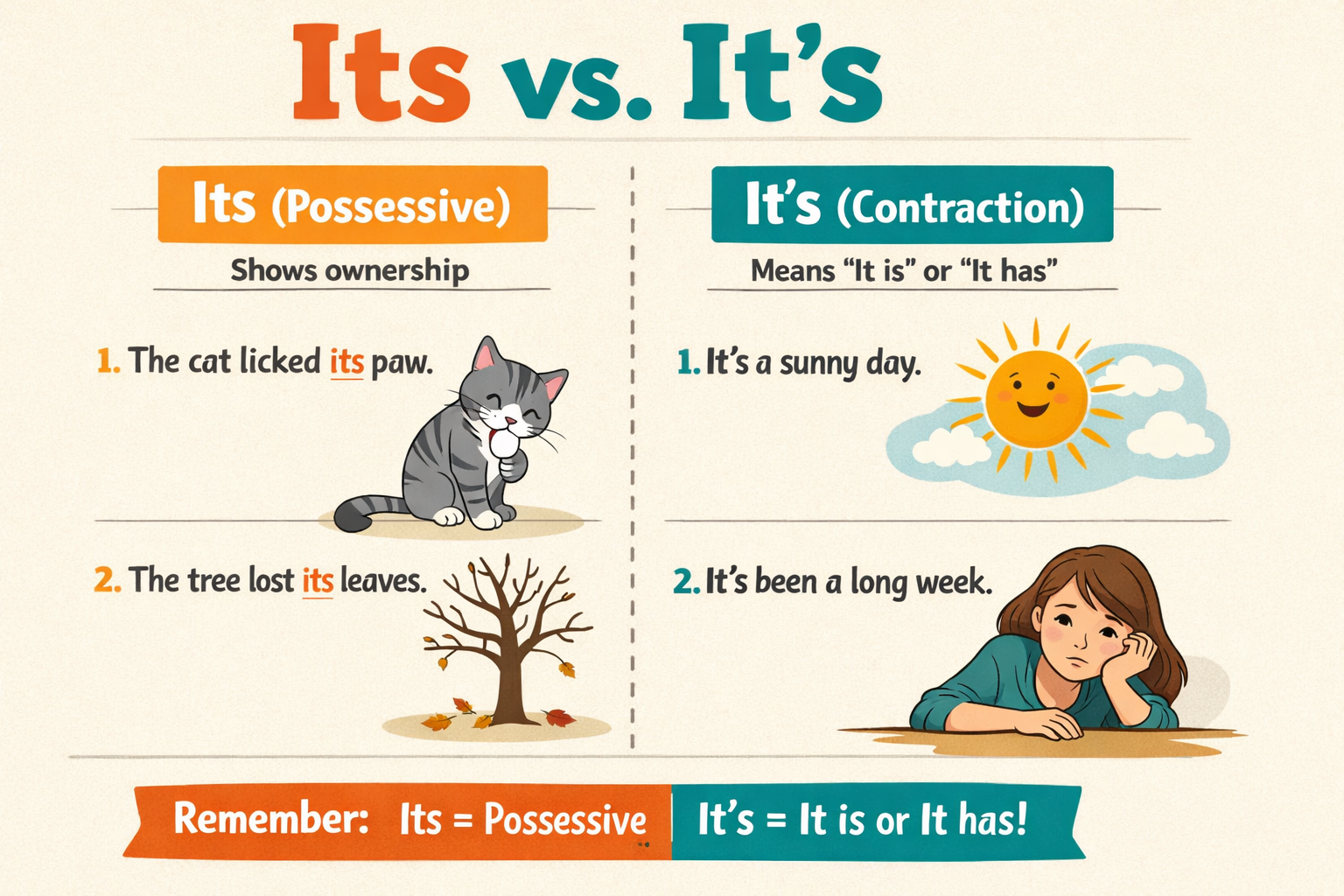
    Its vs It's example


    🟢 Table of Contents

    • What Is Its?
    • What Is It’s?
    • Its vs It’s Examples
    • Simple Trick to Remember
    • Key Differences
    • Common Mistakes
    • Why This Mistake Happens
    • Frequently Asked Questions

    🟢 What Is “Its”?

    Its is a possessive adjective. It shows that something belongs to a thing, animal, or idea.

    Think of it as the word “his” or “her,” but for objects, nature, or animals. Just like you would say “his jacket,” you use “its” to show ownership for things that aren’t human.

    Examples:

    • The dog wagged its tail.
    • The company changed its policy.
    • The tree lost its leaves.

    In these sentences, its shows possession.


    🟢 What Is “It’s”?

    IIt’s is a contraction of:

    • It is
    • It has

    This is simply a shortcut. In spoken English, we naturally smash words together to save time and breath. “It’s” is just the written version of that quick, everyday speech.

    Examples:

    It’s a beautiful place. (It is a beautiful place)

    It’s raining today. (It is raining)

    It’s been a long day. (It has been a long day


    🟢 Its vs It’s Examples

    Its:

    • The car lost its color.
    • The bird built its nest.

    It’s:

    • It’s very hot today.
    • It’s going to rain later.

    🟢 Simple Trick to Remember

    Use this easy test:

    👉 Replace it’s with “it is” or “it has.”

    ✔ If the sentence still makes sense → use it’s
    ❌ If not → use its

    Example:

    It’s cold today
    → It is cold today ✔

    The cat licked its paws
    → The cat licked it is paws ❌

    So the correct word is its.


    🟢 Key Differences Between Its and It’s

    ItsIt’s
    Possessive adjectiveContraction
    Shows ownershipMeans “it is” or “it has”
    No apostropheHas an apostrophe

    Common Mistakes in Its vs It’s

    Many learners confuse its vs it’s because possessive nouns usually use an apostrophe. However, “its” does not use an apostrophe, while “it’s” is a contraction of “it is” or “it has.” Remembering this rule can help you avoid mistakes.

    ❌ The dog wagged it’s tail
    ✔ The dog wagged its tail

    ❌ Its raining outside
    ✔ It’s raining outside


    🟢 Why This Mistake Happens

    The confusion between its vs it’s happens because they are homophones—words that sound the same but have different meanings and spellings.

    Also, many possessive words use an apostrophe (like John’s), but its does not, which makes it confusing. Our brains are hardwired to see an apostrophe and think “ownership,” so it takes a little bit of conscious effort to unlearn that specific habit for this one word. Be patient with yourself while your brain adjusts to the rule!

    Honestly, the fact that you are here reading this and putting in the effort to improve says a lot about your dedication. Grammar isn’t about being inherently perfect; it’s just about building muscle memory. Think of these rules like riding a bike—at first, you have to consciously think about every single balance adjustment, but eventually, your brain just handles it automatically. Give yourself permission to make a few mistakes along the way. Every writer you admire has stumbled over these exact same three letters at some point in their journey, and mastering it is just a matter of a little bit of mindful practice.


    🟢 Practice Exercise

    Choose the correct word:

    1. ___ going to be a great day.
    2. The cat cleaned ___ fur.

    👉 Answers:

    1. It’s
    2. Its

    🟢 Improve Faster (Worksheets)

    👉 Get full grammar worksheets here:
    https://learnenglishgrammar.org/worksheets/

    These include:

    • Practice exercises
    • Answer keys
    • Simple explanations

    🟢 Learn More Grammar Topics

    👉 Your vs You’re
    https://learnenglishgrammar.org/your-vs-youre/

    👉 Their vs There vs They’re
    https://learnenglishgrammar.org/their-vs-there-vs-theyre/

    👉 Subject-Verb Agreement Rules
    https://learnenglishgrammar.org/subject-verb-agreement-rules/


    🟢 External Reference

    For more explanation, visit:
    https://www.grammarly.com/blog/its-vs-its/


    🟢 Conclusion

    The difference between its vs it’s is simple:

    • Its shows possession
    • It’s means it is or it has

    By using the “it is” test, you can easily avoid this common grammar mistake.


    🟢

    👉 Download your free sample worksheets now:
    https://learnenglishgrammar.org/free-sample


    Frequently Asked Questions

    What is the primary difference between “its” and “it’s”?

    The easiest way to tell them apart is to look at their jobs in a sentence. “Its” (without an apostrophe) is a possessive word used to show that something belongs to an animal, object, or concept (e.g., “The smartphone lost its charge”). On the flip side, “it’s” (with an apostrophe) is a contraction, which is just a grammar shortcut for writing “it is” or “it has” (e.g., “It’s starting to make sense now”).

    Why doesn’t possessive “its” have an apostrophe?

    This is exactly why so many people get confused! Normally, we use an apostrophe to show ownership, like “Sarah’s car” or “the dog’s bone.” However, “its” is a personal pronoun, just like his, hers, yours, ours, and theirs. Notice how none of those words use an apostrophe to show possession? “Its” follows that exact same rule. The apostrophe is saved exclusively for contractions.

    Is “its’” ever a correct word?

    No, “its’” (with an apostrophe at the very end) is completely incorrect and is not a real word in the English language. People sometimes mistakenly write it because they are trying to apply the rule for plural possessive nouns (like “the boys’ basketball”). Because “it” is singular and already has a dedicated possessive form (“its”), adding an apostrophe at the end is never necessary.

    How can I double-check my writing to ensure I used the right one?

    The absolute best method is the “Read-Aloud Test.” Whenever you see the word in your sentence, read it out loud as “it is.”
    If you write, “It’s a beautiful afternoon,” and read it as “It is a beautiful afternoon,” it sounds perfectly correct. Keep the apostrophe!
    If you write, “The camera broke it’s lens,” and read it as “The camera broke it is lens,” it sounds awkward and wrong. Remove the apostrophe!

    When should I avoid using “it’s” in my writing?

    While “it’s” is perfectly fine for text messages, emails, blog posts, and everyday conversation, you should generally avoid using it (and other contractions) in formal academic essays, professional research papers, or legal documents. In formal writing, it is usually better to write out the full words “it is” or “it has” to maintain a professional tone. However, the possessive “its” is perfectly fine to use anywhere!

  • Countable vs Uncountable Nouns (Easy Guide + Examples)

    Countable vs Uncountable Nouns

    Countable vs uncountable nouns are an important part of English grammar that help you use words correctly in sentences.

    In English grammar, nouns are divided into countable nouns and uncountable nouns. Understanding the difference helps you use articles, quantities, and verbs correctly.

    This guide explains countable vs uncountable nouns with clear rules, examples, and common mistakes.


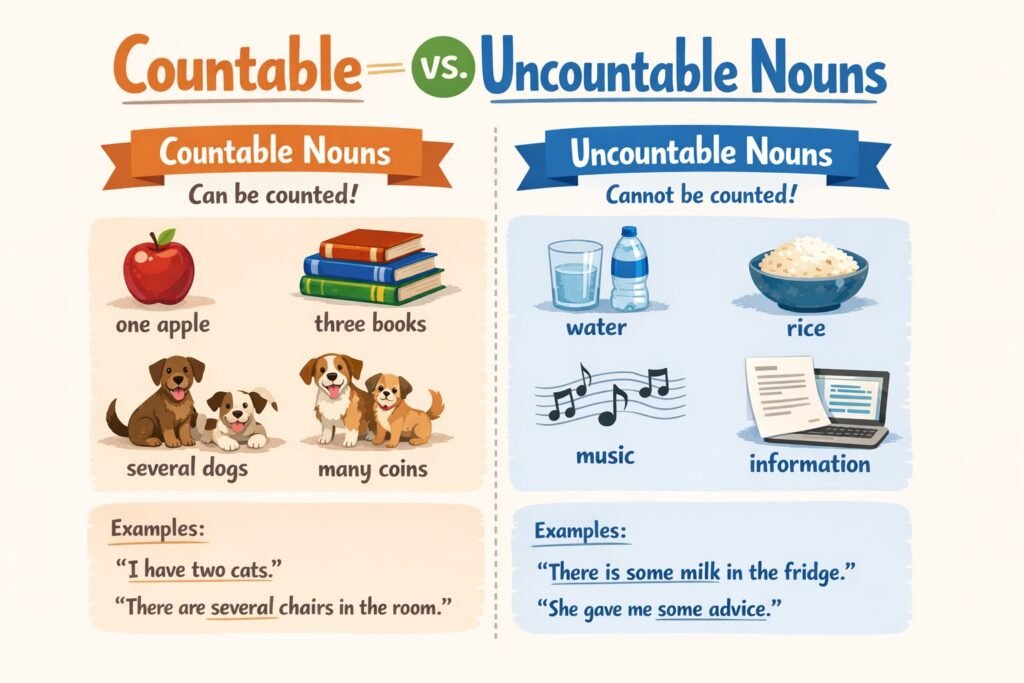
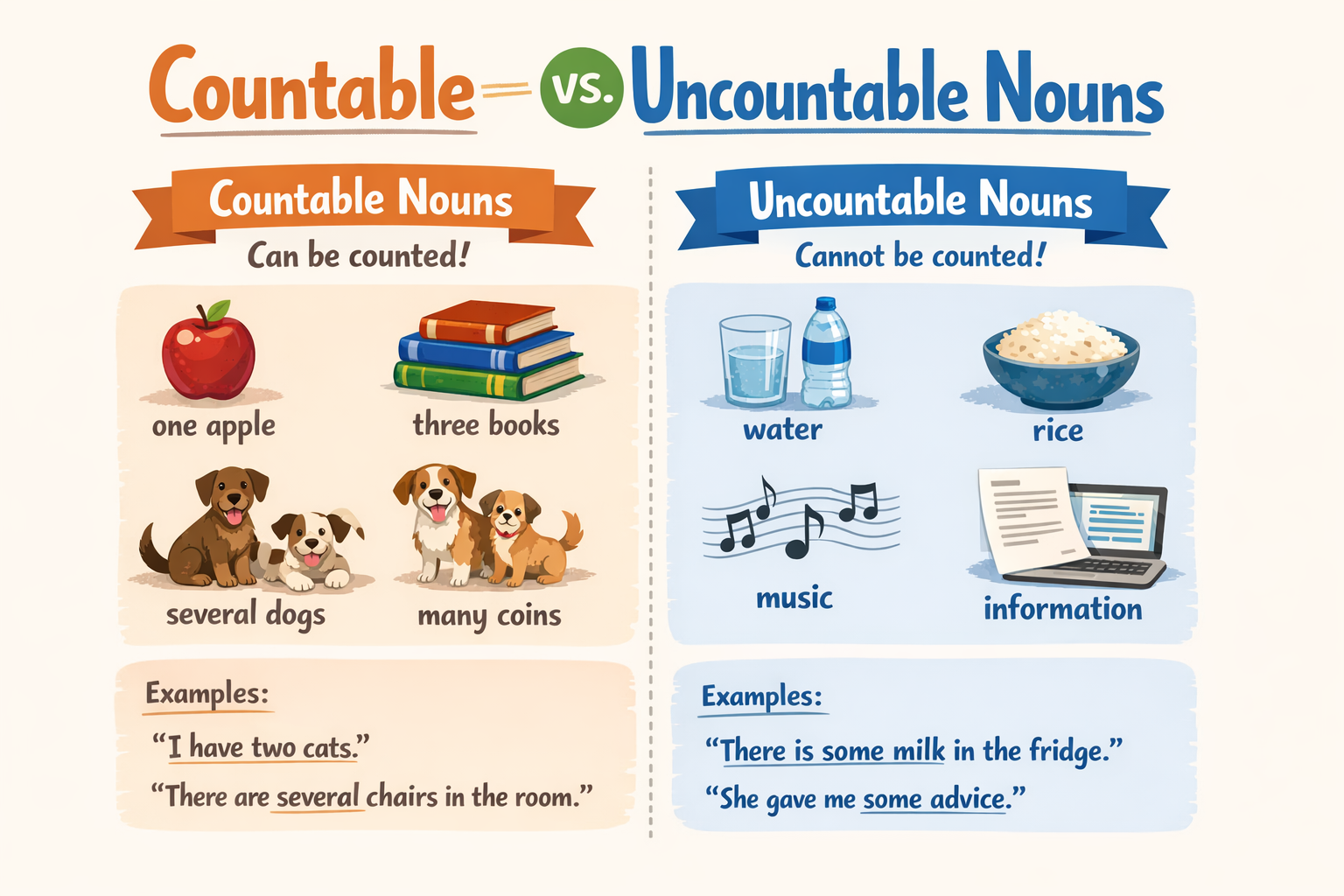
    countable vs uncountable nouns examples chart

    What Are Countable Nouns?

    Countable nouns are nouns that you can count. They have singular and plural forms.

    Examples:

    • one book → two books
    • one apple → three apples
    • one car → many cars

    Countable nouns can be used with:

    • Numbers (one, two, three)
    • Articles (a, an)

    Example Sentences:

    • I have a book.
    • She bought three apples.

    What Are Uncountable Nouns?

    Uncountable nouns are nouns that cannot be counted individually. They usually do not have a plural form.

    Examples:

    • water
    • sugar
    • information
    • furniture

    ❌ Incorrect:

    • two waters
    • three informations

    ✅ Correct:

    • a glass of water
    • a piece of information

    Key Differences Between Countable vs Uncountable Nouns

    Countable NounsUncountable Nouns
    Can be countedCannot be counted
    Singular & plural formsUsually no plural
    Use a/anDo not use a/an
    Example: books, applesExample: water, rice

    Using Quantifiers

    With Countable Nouns

    Use:

    • many
    • few
    • a few

    Examples:

    • There are many books on the table.
    • She has a few friends in school.

    With Uncountable Nouns

    Use:

    • much
    • little
    • a little

    Examples:

    • There is much water in the bottle.
    • He has a little money left.

    With Both Types

    Some quantifiers can be used with both:

    • some
    • a lot of
    • plenty of

    Examples:

    • I have some books.
    • I have some water.

    Common Examples

    Countable Nouns

    • books
    • students
    • chairs
    • dogs

    Uncountable Nouns

    • milk
    • rice
    • advice
    • information

    Common Mistakes (Very Important!)

    ❌ Incorrect:
    I have many water

    ✅ Correct:
    I have much water


    ❌ Incorrect:
    She gave me an advice

    ✅ Correct:
    She gave me some advice


    Tips to Identify Countable and Uncountable Nouns

    Here are some simple tips to help you quickly identify countable and uncountable nouns:

    • Countable nouns can be counted (one apple, two books) and have plural forms.
    • Uncountable nouns cannot be counted individually and do not have plural forms (water, rice, information).
    • Use “many” and “a few” with countable nouns.
    • Use “much” and “a little” with uncountable nouns.

    Tips to Remember

    ✔ Use a/an only with countable nouns
    ✔ Use many/few with countable nouns
    ✔ Use much/little with uncountable nouns


    Practice Sentences

    Choose the correct option:

    There are (many / much) students here.

    I need (many / much) water.

    She bought (a / some) furniture.


    🚀 Upgrade Your English Faster (Premium Worksheets)

    If you want more structured practice:

    👉 Get the full Grammar Worksheet Pack here

    Perfect for:

    • Students
    • ESL learners
    • Self-study

    🔗 Related Grammar Lessons (Internal Links)

    Continue learning:


    🌐 External Resources (Authority Links)

    For deeper understanding:


    Common Mistakes with Countable and Uncountable Nouns

    Many learners confuse countable and uncountable nouns when using quantifiers. For example, saying “many information” is incorrect because information is an uncountable noun. Instead, you should say “much information” or “a piece of information.”

    Another common mistake is using plural forms for uncountable nouns, such as “advices” or “furnitures.” These words do not have plural forms and should always be used as uncountable nouns.


    Conclusion

    Understanding countable vs uncountable nouns is essential for correct grammar.

    • Countable nouns → can be counted and have plural forms
    • Uncountable nouns → cannot be counted

    With practice, you will use them naturally in everyday English

    .❓ Frequently Asked Questions (FAQ)

    What is the difference between countable and uncountable nouns?

    Countable nouns can be counted and have plural forms (e.g., books, apples).
    Uncountable nouns cannot be counted and usually do not have plural forms (e.g., water, information).

    Can uncountable nouns be counted?

    Not directly. You need measurement phrases such as:
    a piece of advice
    a glass of water

    Can I use “a” with uncountable nouns?

    No. You cannot say a water or an information.
    Instead, use:
    some water
    a piece of information

    What quantifiers are used with countable nouns?

    Use:
    many
    few
    a few

    What quantifiers are used with uncountable nouns?

    Use:
    much
    little
    a little

  • Active Voice vs. Passive Voice: The Secret to Stronger Sentences

    🟢Active Voice vs Passive Voice

    Active voice vs. passive voice is one of those grammar topics that sounds incredibly intimidating—like something straight out of a dusty textbook. But in reality, it’s just about energy and focus. Understanding the difference isn’t just about passing a grammar test; it is the ultimate secret weapon for making your writing clearer, more punchy, and way more interesting to read.

    Think of it like a movie director choosing where to point the camera. In any sentence, you have someone doing something, and you have the thing getting affected. Active voice puts the camera right on the hero taking action. Passive voice panics, turns the camera around, and focuses on the object instead. If you’ve ever felt like your English sentences are a bit too long, sluggish, or robotic, there is a massive chance you are leaning on the passive voice without even realizing it.

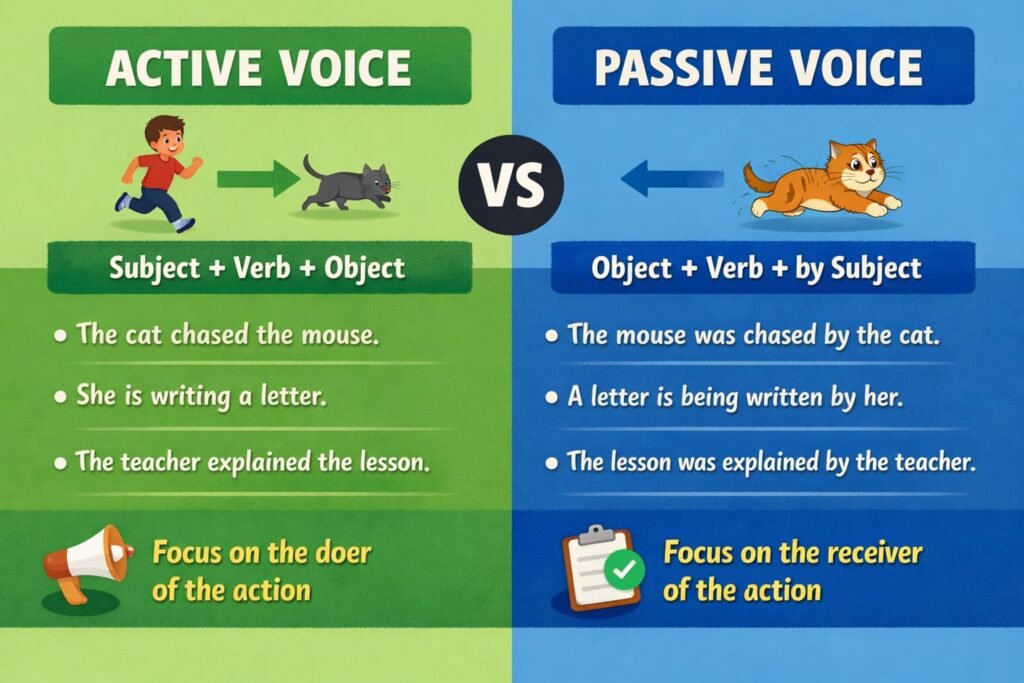
    In simple terms, it all comes down to direction:

    Active voice: The subject performs the action.

    Passive voice: The subject receives the action.

    The Classic Example:
    Active: The cat ate the food. (Energetic, direct, clear.)

    Passive: The food was eaten by the cat. (A bit slow and upside-down.)


    🎁 Start with a Free Grammar Sample

    Want to practice active and passive voice?

    👉 🎁 Download Free Grammar Worksheets Sample

    Active vs passive voice comparison

    Active vs Passive Voice Examples

    What Is Active Voice?

    In active voice, the subject does the action.

    Structure:
    Subject + Verb + Object

    Examples:

    • She writes a letter
    • The teacher explains the lesson
    • They built a house

    👉 Active voice is clear, direct, and easier to understand.


    What Is Passive Voice?

    In passive voice, the subject receives the action.

    Structure:
    Object + “be” + past participle (+ by + subject)

    Examples:

    • A letter is written by her
    • The lesson is explained by the teacher
    • A house was built by them

    Passive voice is used when:

    • The doer is unknown
    • The action is more importan

    Here is the honest truth: passive voice gets a bad reputation. Teachers often tell you to never use it, but that’s not entirely fair. Passive voice isn’t “wrong”—it’s just a tool for specific moments. We naturally use it when we genuinely don’t know who did the action (e.g., “My keys were stolen”), or when the action itself is way more important than the person doing it. The trick isn’t to banish the passive voice completely; it’s learning how to use it intentionally instead of accidentally.

    🔥 Key Differences (Easy Comparison)

    Active VoicePassive Voice
    Subject does the actionSubject receives the action
    Clear and directLonger and less direct
    More commonUsed in formal situations

    Subject-Verb Agreement Rules

    Adverbs in English Grammar

    When to Use Active Voice

    Use active voice when you want:

    • Clear and strong sentences
    • Easy understanding
    • Direct communication

    👉 Example:
    ✔ The company launched a new product


    When to Use Passive Voice

    Use passive voice when:

    • You don’t know the doer
    • The action is more important
    • You want a formal tone

    👉 Example:
    ✔ The product was launched last year


    🚀 Practice with Worksheets

    Reading is not enough — practice helps you improve faster.

    Our worksheets include:

    • Active & passive voice exercises
    • Step-by-step difficulty (Level 1–6)
    • Autotick Cheat-Proof Answers

    👉 🚀 Get Instant Access to All Worksheets (Levels 1–6)


    Common Mistakes in Active Voice vs Passive Voice

    Many learners confuse active voice vs passive voice by placing the object in the wrong position. Always remember that in active voice, the subject performs the action, while in passive voice, the subject receives the action.

    Common Mistakes to Avoid

    • ❌ Using passive voice too often
    • ❌ Forgetting “by” in passive sentences
    • ❌ Wrong past participle

    👉 Fix more mistakes here:
    /common-mistakes/


    Practice Exercise

    Choose the correct sentence:

    1. The cake was eaten by John.
    2. John ate the cake.

    👉 Which one is active voice?

    💡 Related Lessons


    🎁 Try a Free Sample

    Not ready yet?

    👉 🎁 Get Free Grammar Worksheets Sample

    Frequently Asked Questions

    Is passive voice grammatically “wrong”? My teacher always crosses it out!

    Absolutely not! Passive voice is $100\%$ grammatically correct. The reason teachers and Microsoft Word or Google Docs editors constantly flag it is because it can make your writing feel sleepy and slow.
    If you write, “The ball was kicked by the boy, and then the window was broken by the ball,” it sounds exhausting. But if you write, “The boy kicked the ball and broke the window,” it has instant energy. Use passive voice when you need it, but use active voice when you want to keep your reader awake!

    How can I easily tell if a sentence is passive just by looking at it?

    Look for the “By Zombies” trick! It’s a hilarious but flawless shortcut. If you can add the words “by zombies” to the end of your sentence after the verb, and it still makes perfect grammatical sense, you are looking at a passive sentence.
    “The homework was eaten…” (by zombies) $\rightarrow$ Passive!
    “The house was built…” (by zombies) $\rightarrow$ Passive!
    “John ate the pizza…” (by zombies? No, that sounds crazy because John is already doing the eating) $\rightarrow$ Active!

    What is the trick to changing a passive sentence into an active one?

    It’s a three-step flip.
    Find the person or thing hiding at the end of the sentence (usually after the word “by”).
    Drag them right to the very front to make them the star of the show.
    Change the verb from the long form (was eaten) to the simple action form (ate).
    For example, take: “The grammar lesson was explained by the teacher.” Find the doer (the teacher), put them first, and snap the verb into action: “The teacher explained the grammar lesson.” Boom—instant active voice.

    Why does scientific and business writing love the passive voice so much?

    In science and corporate updates, the creators want to sound completely unbiased, objective, and formal. They want to hide the “human factor” to show that the facts speak for themselves.
    Instead of writing, “I mixed the chemicals and I accidentally caused an explosion,” a scientist will write, “The chemicals were mixed, and an explosion was caused.” It removes personal blame and keeps the focus entirely on the experiment itself.