
8 Parts of Speech in English (Definition & Examples)
The parts of speech in English are the basic categories of words used to form sentences. Every word belongs to a specific group depending on how it is used.
Understanding parts of speech is one of the most important first steps in learning English. It helps you:
- Build correct sentences
- Improve your writing
- Speak more clearly
- Understand how English works
🎁 Start with a Free Grammar Sample
Want to practice what you learn?
Try our worksheets for free:
👉 🎁 Download Free Grammar Worksheets Sample with Answers and Explanation
What Are the Parts of Speech in English?
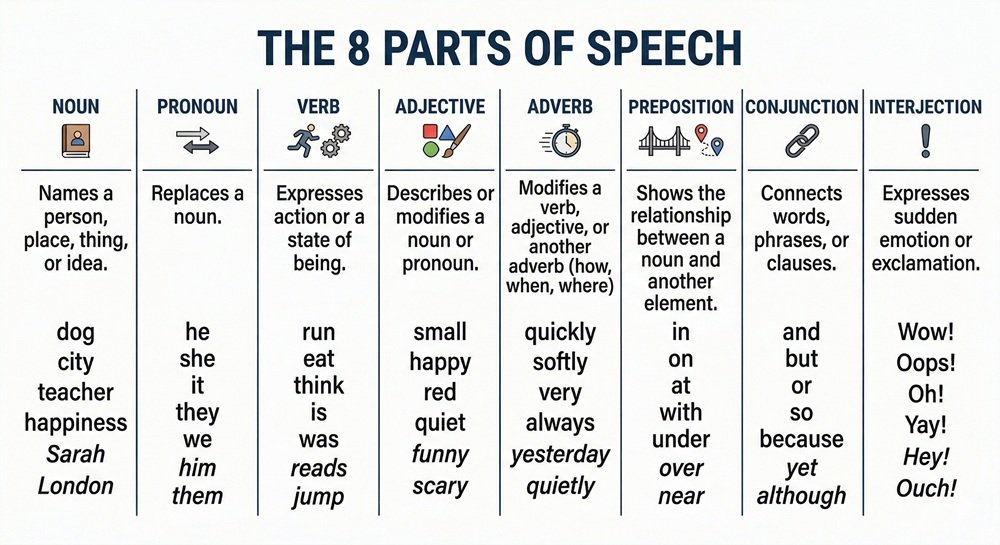
The 8 parts of speech in English include nouns, verbs, adjectives, and more.
Here are eight main parts of speech in traditional English grammar:
1. Nouns
A noun names a person, place, thing, or idea.
Examples:
- teacher
- city
- book
- happiness
👉 Learn more: Nouns and their types
2. Pronouns
A pronoun replaces a noun to avoid repetition.
Examples:
- he
- she
- they
- it
Pronouns make sentences smoother and easier to read.
👉 Learn more: Pronouns
3. Verbs
A verb shows an action, occurrence, or state of being.
Examples:
- run
- eat
- write
- is
Verbs are essential because every sentence needs one.
👉 Learn more: Verbs
4. Adjectives
An adjective describes a noun or pronoun.
Examples:
- beautiful
- tall
- red
- happy
Adjectives add detail and make sentences more interesting.
👉 Learn more: Adjectives
5. Adverbs
An adverb modifies a verb, adjective, or another adverb.
It often tells:
- how
- when
- where
- how often
Examples:
- quickly
- slowly
- very
- yesterday
6. Prepositions
A preposition shows the relationship between words in a sentence.
Examples:
- in
- on
- at
- under
Prepositions often describe time, place, or direction.
👉 Learn more: Prepositions in English Grammar
7. Conjunctions
A conjunction connects words, phrases, or clauses.
Examples:
- and
- but
- or
- because
Conjunctions help combine ideas smoothly.
👉 Learn more: Conjunctions
8. Interjections
An interjection expresses strong emotion.
Examples:
- wow!
- oh!
- hey!
- ouch!
They are often followed by an exclamation mark.
🚀 Practice What You Learn
Reading is helpful — but practice makes real improvement.
Our grammar worksheets help you apply all 8 parts of speech step by step.
What You Get:
- Worksheets for Levels 1–6
- Covers nouns, verbs, tenses, and more
- Autotick Cheat-Proof Answer Sheets
- Perfect for students and teachers
👉 Get Instant Access to All Worksheets (Levels 1–6) with Answers & Explanations
Why Parts of Speech Are Important
Learning parts of speech helps you understand how sentences are built.
Once you master them, it becomes much easier to learn:
- Sentence structure
- English tenses (/tenses/)
- Grammar rules (/grammar-rules/)
- Common mistakes (/common-mistakes/)
💡 Recommended Next Step
If you’re just starting, recommended Next Step
- Master Parts of Speech
- Learn Basic Tenses (/tenses/)
- Study Grammar Rules (/grammar-rules/)
- Practice with Worksheets
🎁 Try a Free Sample First
Not ready yet? Start with a free sample:
👉 🎁 Get Free Grammar Worksheets Sample with Answers and Explanation