
prepositions of time
Prepositions of time (in, on, at) are used to describe when something happens. In this guide, you will learn simple rules and examples to use them correctly.
Each of these prepositions is used with different types of time expressions. Learning how to use them correctly helps you form clear and accurate sentences.
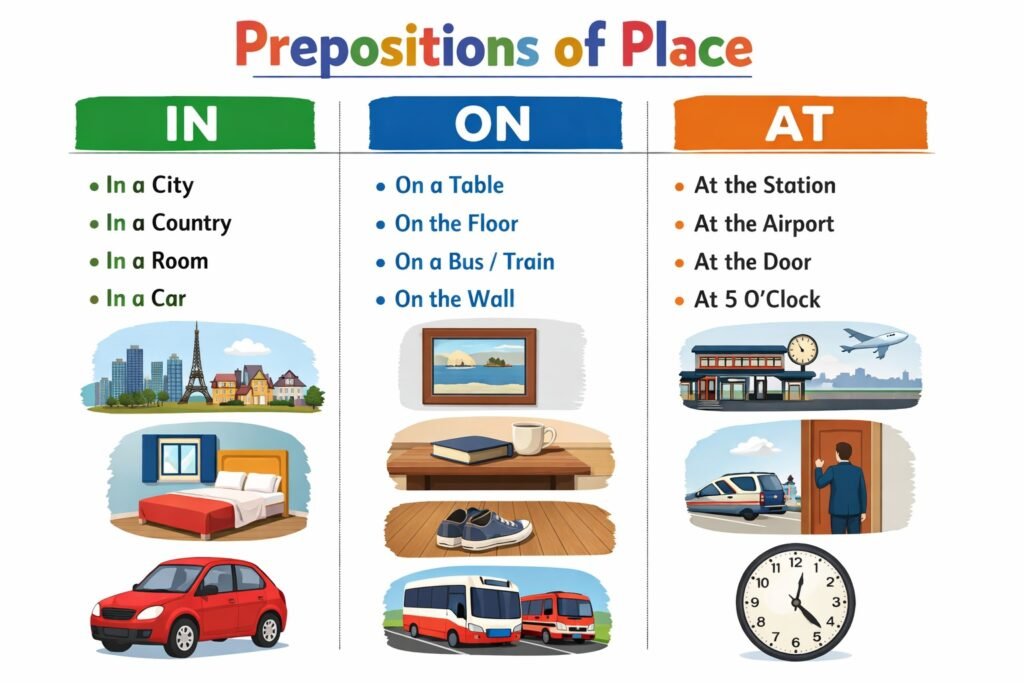
Using “In”
The preposition in is used for longer periods of time such as months, years, seasons, and parts of the day.
Examples:
- She was born in 2005.
- The flowers bloom in spring.
- I usually study in the evening.
- We moved here in July.
Rule:
Use in for months, years, seasons, and longer periods.
Using “On”
The preposition on is used for specific days and dates.
Examples:
- I have a meeting on Monday.
- Her birthday is on 15 June.
- We will travel on Saturday morning.
Rule:
Use on for days of the week and specific dates.
Using “At”
The preposition at is used for exact times or specific moments.
Examples:
- The class starts at 9 a.m.
- We will meet at noon.
- The movie begins at 7:30 p.m.
Rule:
Use at for precise times.
Quick Comparison
Here is a simple comparison of the three prepositions:
| Preposition | Usage | Example |
|---|---|---|
| In | Months, years, seasons, long periods | in 2024, in July |
| On | Days and dates | on Monday, on 15 June |
| At | Exact times | at 8 a.m., at noon |
🎁 Try a Free Grammar Worksheet Sample
Want to practise what you’ve learned?
Our free sample worksheet lets you experience how the exercises work before you decide.
✔ Instant answers with auto-marking
✔ Clear explanations for every question
✔ Beginner-friendly and easy to follow
✔ Suitable for students, teachers, and ESL learners
👉 🎁 Download Free Grammar Worksheets Sample
Common Mistakes
Incorrect:
- I will see you in Monday.
Correct:
- I will see you on Monday.
Incorrect:
- The meeting is on 7 p.m.
Correct:
- The meeting is at 7 p.m.
❌ I will see you in Monday
✅ I will see you on Monday
❌ She was born on 1990
✅ She was born in 1990
Tips for Learning Prepositions of Time
To remember these prepositions easily:
- Use in for longer time periods.
- Use on for days and dates.
- Use at for exact times.
Practicing with examples will help you understand how these prepositions work in everyday English.
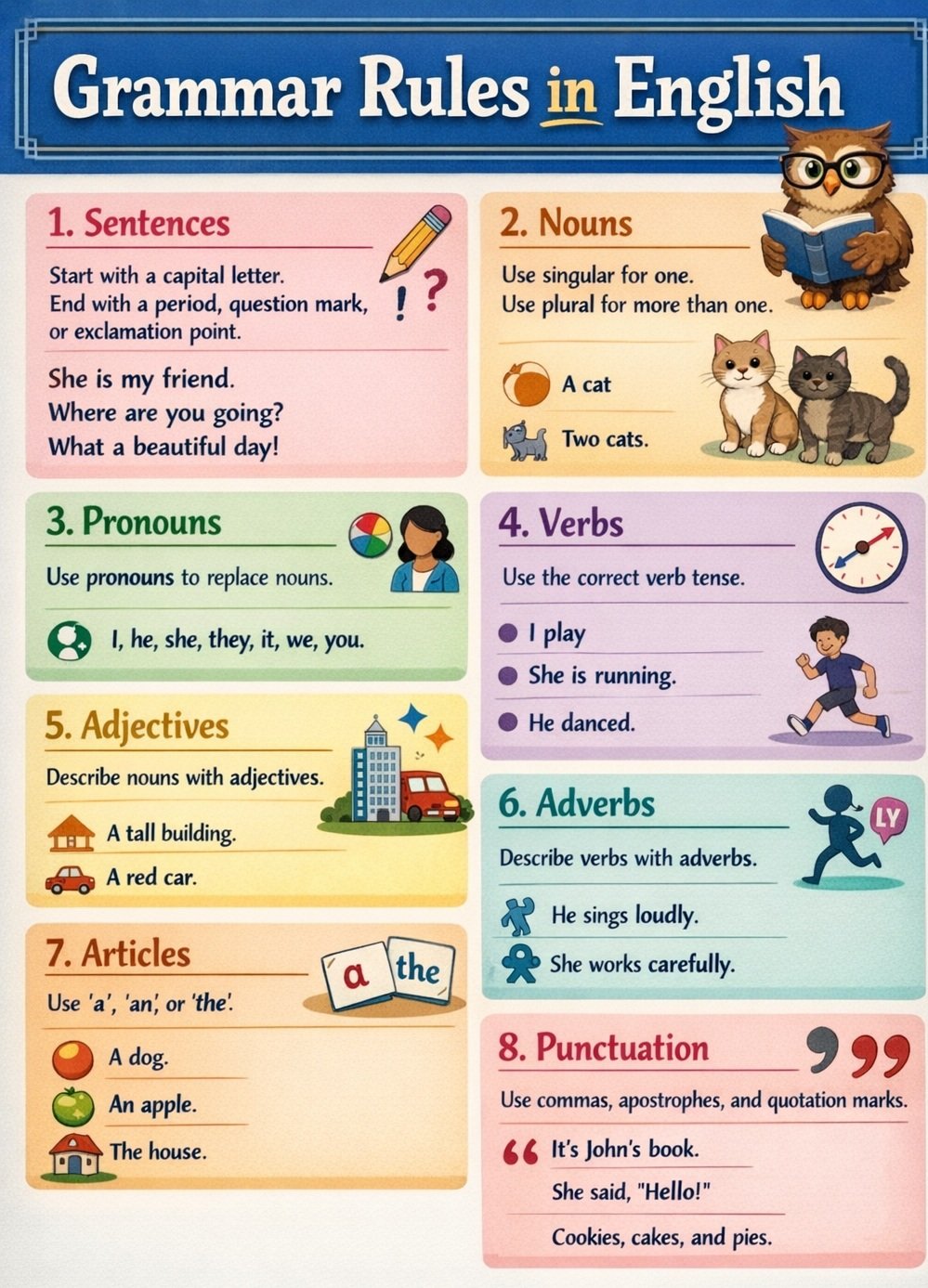
- Learn more about English grammar rules to improve your understanding.
- You can also study parts of speech to build strong basics.
👉 Link to:
❓ FAQ
What are prepositions of time?
They are words like in, on, and at used to describe when something happens.
When do we use “in”?
Use “in” for months, years, seasons, and long periods.
When do we use “on”?
Use “on” for days and dates.
When do we use “at”?
Use “at” for exact times.
Conclusion
Prepositions of time such as in, on, and at help describe when something happens. By understanding the rules and practicing with examples, you can use these prepositions correctly in your sentences.
🚀 Improve Faster with Structured Grammar Worksheets
If you want to build strong grammar skills, consistent practice is key.
Our full worksheet set is designed to guide learners from basic to advanced levels in a simple and structured way.
✅ What’s Included:
✔ Worksheets for Levels 1–6 (beginner to intermediate)
✔ Covers all key grammar topics (tenses, parts of speech, sentence structure, and more)
✔ Auto-marking answer sheets (instant score and feedback)
✔ Clear explanations to help you learn from mistakes
✔ Easy-to-use format for home learning or classroom use
🎯 Who Is It For?
- Students who want to improve step by step
- Teachers looking for ready-to-use materials
- ESL learners who need clear and simple explanations