
Table of Contents
Introduction
The Past Perfect Continuous Tense is one of the advanced English tenses that many students find difficult at first. However, once you understand its purpose and structure, it becomes much easier to use in both speaking and writing.
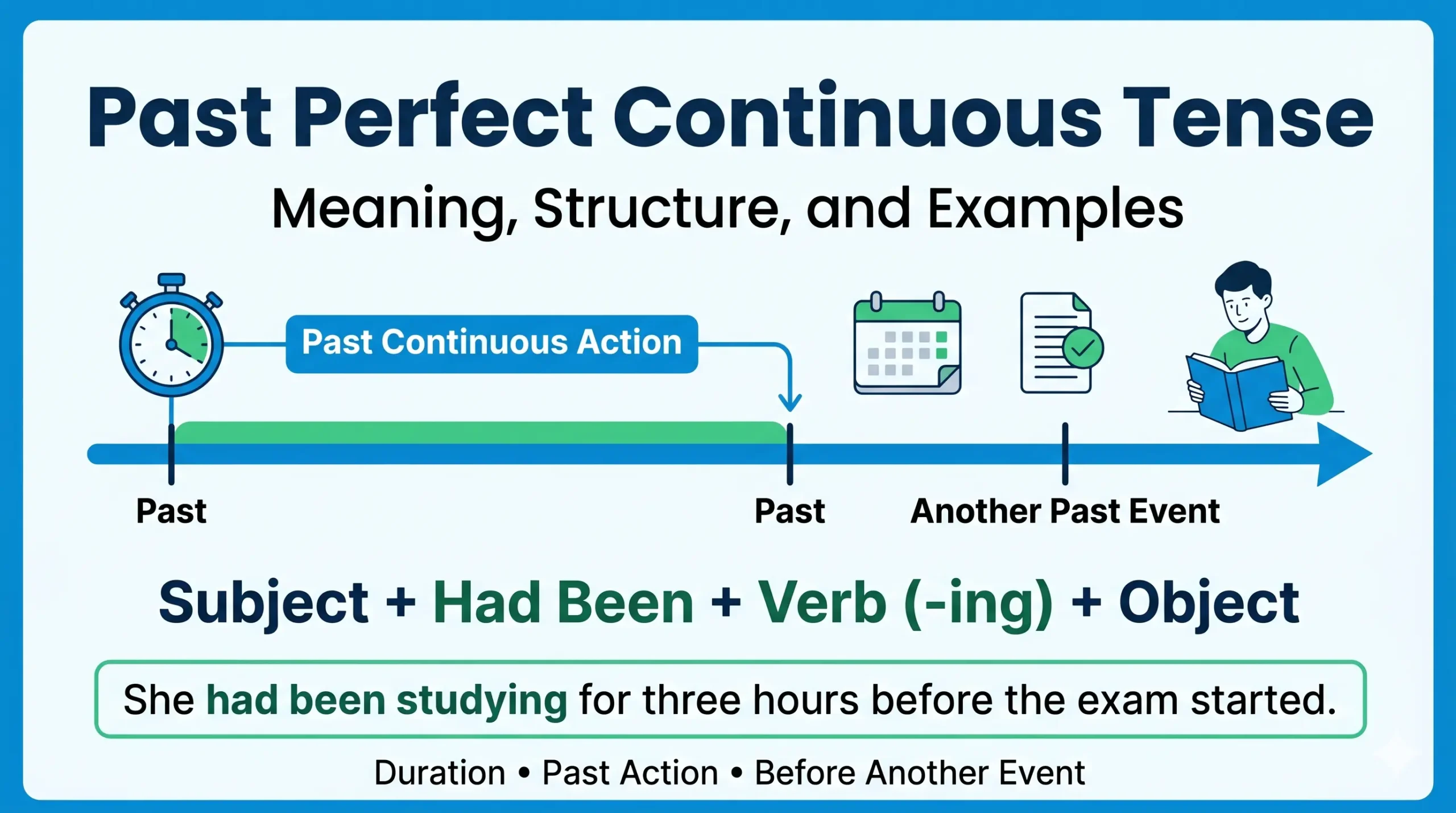
This tense is used to describe an action that started in the past, continued for some time, and stopped before another action or point in the past. In simple words, it emphasizes the duration of an activity before something else happened.
I like to think of this as the “Detective” tense. It’s the grammar we use when we want to look at the evidence left behind by a long process. When you walk into a room and see someone out of breath, sweaty, and red-faced, you don’t just say “they ran.” You say, “They had been running.” It tells the story of the effort that led up to that moment. For me, mastering this tense was a “lightbulb” moment because it allowed me to explain the why behind the scenes I was seeing in the past. It’s less about a single point on a timeline and more about the “movie” playing before the photo was taken.
For example:
“She had been studying for three hours before the exam started.”
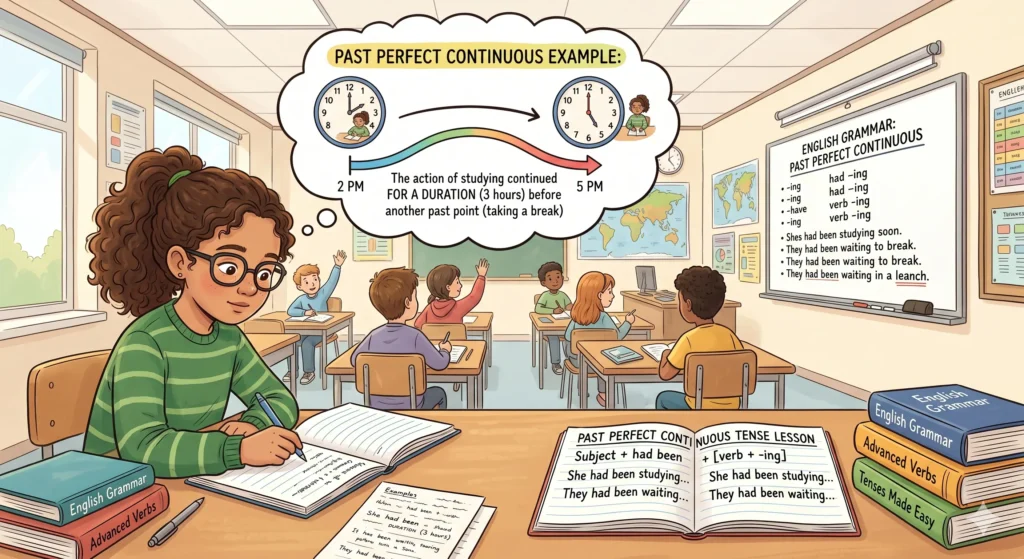
This sentence tells us that the studying began earlier, continued for a period of time, and ended before the exam began.
The Past Perfect Continuous Tense is useful because it helps show the relationship between two past events clearly and naturally.
Past Tenses Comparison Table
| Tense Name | Formula | Primary Focus | Example Sentence |
| Simple Past | Subject + Past Verb | Completed action at a specific time | “I studied last night.” |
| Past Continuous | Subject + was/were + Verb-ing | Action in progress at a specific past moment | “I was studying at 8:00 p.m.” |
| Past Perfect | Subject + had + Past Participle | Action completed before another past event | “I had studied before the test started.” |
| Past Perfect Continuous | Subject + had been + Verb-ing | Duration of action leading up to a past event | “I had been studying for hours before the test started.” |
Structure of the Past Perfect Continuous Tense
The formula is:
Subject + had been + verb-ing
Examples:
- I had been working all day.
- They had been waiting for two hours.
- She had been practicing piano before dinner.
The helping verb “had been” is used for all subjects, whether singular or plural.
When Do We Use the Past Perfect Continuous Tense?
1. To Show Duration Before Another Past Event
This is the most common use of the tense.
We use it when an action continued for a period of time before another action happened in the past.
Examples:
- He had been driving for five hours before he reached home.
- The children had been playing outside before it started raining.
- We had been talking for a long time before the teacher arrived.
In these examples, the focus is on how long the activity continued.
2. To Explain the Cause of a Past Situation
Sometimes the tense helps explain why something happened in the past.
Examples:
- She was tired because she had been working late.
- His clothes were dirty because he had been fixing the car.
- They were hungry because they had been hiking all morning.
Here, the tense shows the reason behind a condition or result.
3. To Emphasize Ongoing Past Activity
The Past Perfect Continuous Tense can also highlight repeated effort or continuous action in the past.
Examples:
- The scientist had been researching the topic for many years.
- My grandfather had been teaching at the same school since 1980.
- The company had been developing new products before the market changed.
This usage adds depth and detail to storytelling and writing.
Common Time Expressions
The tense is often used with words and phrases such as:
- for
- since
- before
- all day
- all morning
- by the time
Examples:
- She had been waiting for an hour before the bus arrived.
- By the time I called him, he had been sleeping for several hours.
These expressions help indicate duration and sequence.
Positive, Negative, and Question Forms
Positive Sentences
Examples:
- I had been reading for two hours.
- They had been traveling around Europe.
- She had been cooking since early morning.
Negative Sentences
To make a negative sentence, add not after “had.”
Structure:
Subject + had not been + verb-ing
Examples:
- He had not been feeling well.
- We had not been studying very hard.
- She had not been sleeping enough.
The contraction hadn’t is commonly used in everyday English.
Examples:
- I hadn’t been paying attention.
- They hadn’t been working long.
Question Form
Structure:
Had + subject + been + verb-ing?
Examples:
- Had you been waiting long?
- Had she been studying before dinner?
- Had they been living there for many years?
Stative Verbs Exception in the Past Perfect Continuous
Just like other continuous tenses, the Past Perfect Continuous cannot be used with stative verbs (verbs describing mental states, emotions, possession, or senses). When dealing with stative verbs, you must revert to the Past Perfect Simple.
| Stative Category | Incorrect (Past Perfect Continuous) | Correct (Past Perfect Simple) | Pedagogical Reason |
| Mental States | “I had been knowing him for years.” | “I had known him for years.” | Knowing is a state of mind, not a continuous physical action. |
| Possession | “The company had been owning the building.” | “The company had owned the building.” | Possession represents a legal state rather than an active process. |
| Emotions | “She had been liking the design.” | “She had liked the design.” | Emotions do not take continuous -ing forms in formal grammar. |
| Senses / Perception | “We had been hearing a strange noise.” | “We had heard a strange noise.” | Perceptual states use simple forms for completed past perception. |
Common Mistakes to Avoid
1. Forgetting “been”
Incorrect:
- She had working all day.
Correct:
- She had been working all day.
2. Using the Wrong Verb Form
The main verb must always end in -ing.
Incorrect:
- They had been study for hours.
Correct:
- They had been studying for hours.
3. Confusing It with Past Perfect Tense
Compare these sentences:
- Past Perfect Tense:
“He had finished the project before Friday.” - Past Perfect Continuous Tense:
“He had been working on the project for weeks before Friday.”
The first sentence focuses on completion. The second focuses on duration and ongoing effort.
Many English learners confuse the Past Perfect Continuous Tense with the Present Perfect Continuous Tense because both focus on ongoing actions and duration. However, the main difference is the time frame. The Present Perfect Continuous Tense connects an action to the present, while the Past Perfect Continuous Tense describes an activity that happened before another event in the past. Learning both tenses together can improve your understanding of English grammar structures.
It is also important to understand the difference between the Past Perfect Tense and the Past Perfect Continuous Tense. The Past Perfect Tense focuses on completed actions, while the continuous form emphasizes the duration of an activity. For example, “She had finished her homework” highlights completion, whereas “She had been doing her homework for two hours” focuses on the ongoing effort before another event happened.
Real-Life Examples
Grammar becomes easier when connected to everyday life.
Imagine a student preparing for exams:
“She had been revising every night before the final test.”
Or think about a football player:
“The team had been training hard before the championship match.”
Parents may also say:
“We had been living in Kuala Lumpur for ten years before moving.”
These examples sound natural because they reflect real situations.
Why Is the Past Perfect Continuous Tense Important?
Although this tense is considered advanced grammar, it is very useful in both spoken and written English. It helps speakers explain events more clearly and makes writing more detailed and professional.
The tense is commonly used in:
- storytelling
- academic writing
- essays
- novels
- business English
- conversations about past experiences
For example:
“The engineers had been testing the machine for months before launching it.”
This sentence gives more information and context than a simple past tense sentence.
Beyond just being “correct” for an exam, this tense is a gift for anyone who loves storytelling. When I’m catching up with old friends, I find myself using this tense more than almost any other because it honors the time we spent doing things. If I say, “I lived in London,” it’s just a fact. But if I say, “I had been living in London for months before I finally found a good cup of coffee,” I’m sharing a struggle and a journey. It invites the listener into my past world. It shows that you aren’t just memorizing words; you are layering your history with emotion and persistence.
Tips for Learning the Past Perfect Continuous Tense
Practice with Personal Experiences
Try creating sentences about your own life.
Examples:
- I had been studying English before I moved schools.
- My parents had been working in the same company for years.
- We had been waiting at the airport before the flight was delayed.
Personal examples are easier to remember.
Remember the Formula
Memorize:
had been + verb-ing
Once you remember this structure, forming sentences becomes much easier.
Compare with Other Tenses
Understanding the differences between:
- Past Continuous Tense
- Past Perfect Tense
- Present Perfect Continuous Tense
can help you avoid confusion.
Interactive Practice Exercise: Test Your Mastery
Complete each sentence by putting the verb in brackets into the correct tense (Past Perfect Continuous or Past Perfect Simple):
- By the time the sun went down, we __________ (work) in the garden for over six hours.
- She was out of breath because she __________ (run) to catch the morning train.
- Prior to the merger, the company __________ (own) three separate manufacturing plants.
- How long __________ you __________ (wait) at the station before the delayed train arrived?
- The roads were dangerously slick because it __________ (snow) all night.
- He failed the test because he __________ (not / pay) attention during the revision lectures.
Answer Key & Detailed Explanations:
- had been working — Focuses on duration (for over six hours) leading up to a past event (sun went down).
- had been running — Explains the physical cause/evidence of a past condition (out of breath).
- had owned — Own is a stative verb of possession, requiring Past Perfect Simple.
- had / been waiting — Interrogative form measuring continuous duration before a past arrival.
- had been snowing — Describes an ongoing weather process causing a subsequent past condition (slick roads).
- had not been paying — Negative continuous effort leading to a negative past result (failed the test).
Final Thoughts
The Past Perfect Continuous Tense may seem difficult at first, but it is actually very useful once you understand its purpose. It allows us to describe actions that continued over a period of time before another event in the past.
By practicing regularly, reading examples, and using real-life situations, you can become more confident using this tense in both speaking and writing.
Remember, learning grammar is not about memorizing complicated rules. It is about learning how to communicate ideas clearly and naturally. With enough practice, the Past Perfect Continuous Tense will gradually become a normal part of your English skills.
If you want to improve your grammar further, trusted educational websites such as British Council LearnEnglish and Cambridge Dictionary Grammar provide useful explanations, exercises, and examples for English learners of all levels.
Frequently Asked Questions
What is the main difference between Past Perfect and Past Perfect Continuous?
The difference is focus. Past Perfect focuses on the completion of a task (the result), while Past Perfect Continuous focuses on the duration or the process of the action.
Result: “I had finished my homework before dinner.”
Process: “I had been doing my homework for three hours before dinner.”
Can I use the Past Perfect Continuous with all verbs?
No. You should avoid using stative verbs (verbs that describe a state or feeling rather than an action). Words like know, want, love, believe, understand, and belong do not usually take the “-ing” form.
Incorrect: “I had been knowing him for years.”
Correct: “I had known him for years.”
How is it different from the Present Perfect Continuous?
It all depends on where you are standing on the timeline.
Present Perfect Continuous connects the past to now (“I have been waiting for twenty minutes”).
Past Perfect Continuous connects one point in the past to another point in the past (“I had been waiting for twenty minutes before the bus finally arrived”).
Is “had been” always followed by an “-ing” verb?
In this specific tense, yes. If you see “had been” followed by an adjective (e.g., “He had been sick”) or a past participle (e.g., “The car had been stolen”), you are looking at the Past Perfect of the verb “to be” or the Passive Voice, not the Past Perfect Continuous.
Why is the word “before” or “by the time” so common with this tense?
Because this tense describes an action that happened up to a certain point, you need a “marker” to show when that period ended. “Before” and “by the time” act as the wall that the continuous action hits in the past.
How can I quickly convert a Present Perfect Continuous sentence into a Past Perfect Continuous sentence?
It is a simple one-word shift! Just change the present helper verb (have / has) to the past helper verb (had).
Present Perfect Continuous (Connects to NOW): “I have been studying for two hours.” (I am still studying now).
Past Perfect Continuous (Ended in the PAST): “I had been studying for two hours.” (Before dinner served as a stopping point in the past).