
Table of Contents
Introduction
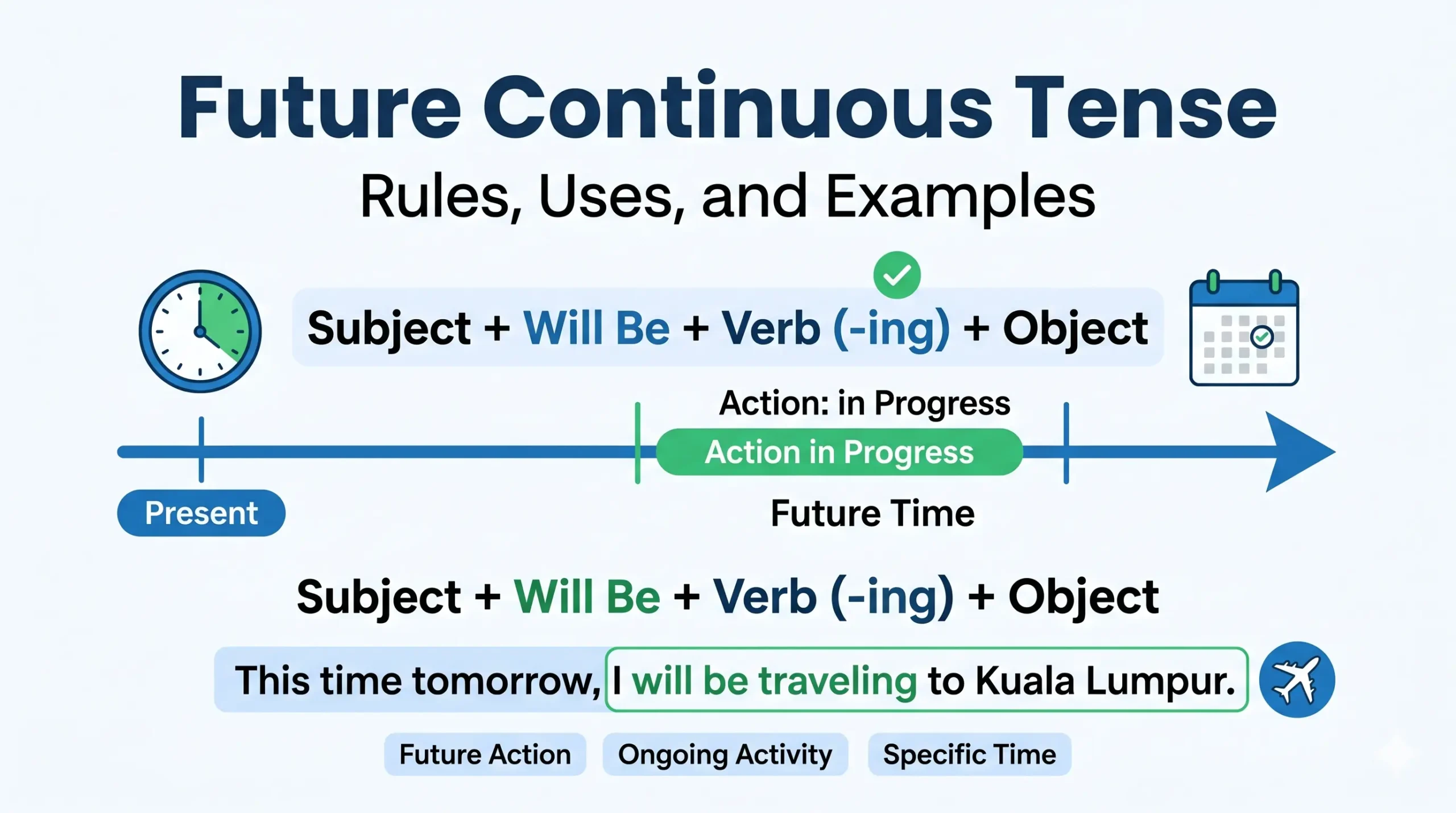
The Future Continuous Tense is used to describe an action that will be happening at a specific time in the future. It is one of the most useful English grammar tenses because it helps speakers talk about future plans, ongoing activities, and predictions naturally.
In everyday conversations, native English speakers often use the future continuous tense to sound polite and realistic. Learning this tense can improve both your speaking and writing skills.
What Is the Future Continuous Tense?
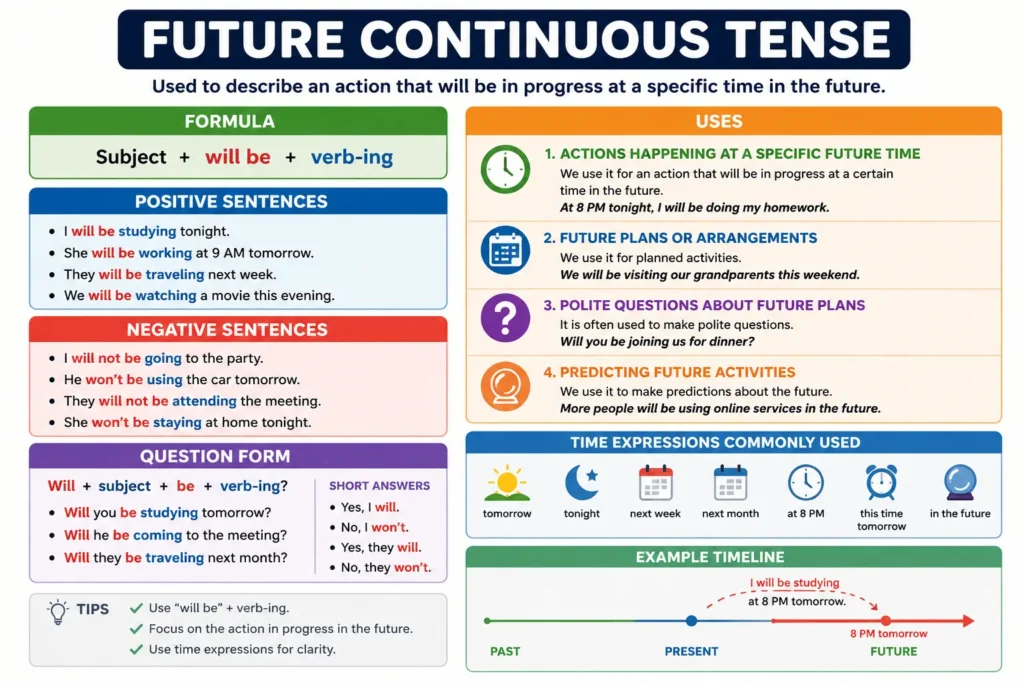
The future continuous tense describes an action that will be in progress at a certain time in the future.
Structure of Future Continuous Tense
The formula is:
Subject+will be+verb-ing
Examples
- I will be studying tonight.
- She will be working at 8 PM.
- They will be traveling next week.
- We will be watching a movie tomorrow evening.
In all these examples, the actions are continuing for a period of time in the future.
Positive Sentences
Positive sentences show that something will happen continuously in the future.
Examples
- I will be reading a book tomorrow.
- He will be playing football after school.
- We will be having dinner at 7 PM.
- The children will be sleeping by midnight.
- Sarah will be preparing for her exam tonight.
The verb always uses the -ing form.
Negative Sentences
To make negative sentences, add not after “will”.
Structure
Subject+will not be+verb-ing
Examples
- I will not be going out tonight.
- He will not be watching TV later.
- They will not be traveling this weekend.
- She will not be using the computer tomorrow morning.
You can also use the contraction:
- will not = won’t
Example:
- I won’t be attending the meeting.
Free Sample
Looking for extra practice? Download our Free Grammar Worksheets Sample to improve your English grammar skills with easy exercises, sentence practice, and beginner-friendly activities. Perfect for students, teachers, and self-learners.
Grammar Worksheets
Improve your English faster with our premium Grammar Worksheets Collection. These printable worksheets include grammar rules, sentence exercises, quizzes, and practice activities for students of all levels.
Question Form
To ask questions in the future continuous tense, place will before the subject.
Structure
Will+subject+be+verb-ing?
Examples
- Will you be studying tonight?
- Will she be driving tomorrow?
- Will they be staying at the hotel?
- Will we be meeting the manager later?
Short Answers
- Yes, I will.
- No, she won’t.
- Yes, they will.
- No, we won’t.
Future Tenses Master Comparison Matrix
| Tense Name | Formula | Primary Focus | Example Sentence |
| Simple Future | Subject + will + Base Verb | Completed future action or instant decision | “I will study tonight.” |
| Future Continuous | Subject + will be + V-ing | Action in progress at a specific future moment | “I will be studying at 8:00 PM tonight.” |
| Future Perfect | Subject + will have + V3 | Action completed prior to a future point | “I will have studied before the test starts.” |
| Future Perfect Continuous | Subject + will have been + V-ing | Duration of action leading up to a future point | “I will have been studying for three hours by 10:00 PM.” |
When to Use the Future Continuous Tense
There are several important uses of the future continuous tense.
1. Actions Happening at a Specific Future Time
Use this tense for actions that will be ongoing at a certain moment in the future.
Examples
- At 9 PM tonight, I will be doing my homework.
- This time tomorrow, we will be flying to Japan.
- At midnight, many people will be celebrating the New Year.
These sentences focus on the action in progress during a future time.
2. Future Plans or Arrangements
The future continuous tense is often used to talk about planned future activities.
Examples
- We will be visiting our grandparents this weekend.
- She will be attending the conference next month.
- I will be meeting my teacher tomorrow afternoon.
This usage sounds more natural and polite than the simple future tense.
3. Polite Questions About Future Plans
English speakers commonly use future continuous tense for polite questions.
Examples
- Will you be using the car tonight?
- Will you be joining us for dinner?
- Will he be coming to the party?
These questions sound softer and less direct.
4. Predicting Future Activities
Use future continuous tense to predict something that will probably happen.
Examples
- People will be using more solar energy in the future.
- Scientists will be developing better technology.
- Students will be learning online more often.
Time Expressions Commonly Used
Future continuous tense often uses time expressions such as:
- tomorrow
- tonight
- next week
- next month
- at 8 PM
- this time tomorrow
- in the future
Examples
- This time next week, I will be relaxing on the beach.
- Tomorrow morning, she will be jogging in the park.
Stative Verbs Exception in the Future Continuous
The Future Continuous Tense can only be used with dynamic action verbs (e.g., working, running, studying, building). Stative verbs—which express mental states, emotions, perception, or possession—cannot take continuous -ing forms. When talking about a ongoing state in the future, revert to the Simple Future Tense
| Category | Incorrect (Future Continuous) | Correct (Simple Future) | Pedagogical Reason |
| Mental States | “This time tomorrow, I will be knowing the exam results.” | “This time tomorrow, I will know the exam results.” | Knowledge is a mental state, not an ongoing physical process. |
| Possession | “Next year, they will be having a custom solar cooker.” | “Next year, they will have a custom solar cooker.” | Possession represents ownership rather than an active process. |
| Emotions | “She will be liking her new workplace.” | “She will like her new workplace.” | Emotional states do not take continuous -ing forms. |
| Perception | “We will be understanding the system soon.” | “We will understand the system soon.” | Comprehension takes simple future forms. |
.
Difference Between Simple Future and Future Continuous
Many learners confuse these two tenses.
Simple Future
Used for a future action.
Example:
- I will study tonight.
Future Continuous
Used for an action that will be in progress in the future.
Example:
- I will be studying tonight.
The future continuous tense emphasizes the duration or ongoing nature of the activity.
Common Mistakes to Avoid
Mistake 1: Forgetting “Be” in the Verb Phrase
- ❌ Incorrect: She will working at the office tomorrow morning.
- ✔️ Correct: She will be working at the office tomorrow morning.
- Pedagogical Reason: The auxiliary verb be is mandatory to connect the modal will to the active participle (-ing).
- Mistake 2: Using “Will Be” in Time Clauses Starting with “When” or “If”
- ❌ Incorrect: When you will be arriving tomorrow, I will be waiting at the station.
- ✔️ Correct: When you arrive tomorrow, I will be waiting at the station.
- Pedagogical Rule: Subordinate time clauses introduced by when, while, before, or if require the Present Simple Tense, even when the main clause uses the Future Continuous.
- Mistake 3: Using Base Verbs Instead of Present Participles
- ❌ Incorrect: They will be travel around Asia next month.
- ✔️ Correct: They will be traveling around Asia next month.
- Pedagogical Reason: The main verb following will be must always end in -ing.
- Mistake 4: Confusing Future Continuous with Present Continuous for Scheduled Events
- ❌ Incorrect: At 3:00 PM tomorrow, I am meeting the project owner. (Focuses on fixed schedule, not ongoing activity)
- ✔️ Correct: At 3:00 PM tomorrow, I will be meeting the project owner.
- Pedagogical Focus: Use the Future Continuous specifically to emphasize an action that will be mid-progress at that precise moment.
- Mistake 5: Misplacing Mid-Position Adverbs (“Still”, “Definitely”, “Already”)
- ❌ Incorrect: I will be still working when you get home.
- ✔️ Correct: I will still be working when you get home.
- Pedagogical Rule: Position mid-sentence adverbs directly between will and be.
- Mistake 6: Using Stative Verbs in Continuous Forms
- ❌ Incorrect: He will be needing your help with the contract review.
- ✔️ Correct: He will need your help with the contract review.
- Pedagogical Reason: Stative verbs like need cannot take continuous forms.
Tips for Learning Future Continuous Tense
Here are some simple ways to master this tense:
- Practice writing daily future plans.
- Use time expressions like “this time tomorrow”.
- Speak using real-life examples.
- Listen to English conversations and notice how native speakers use it.
- Compare it with simple future tense.
Learn More About Related Tenses
To understand how future actions are expressed differently, read our guide on the Simple Future Tense. Want to compare ongoing actions in the present and future?
Check out our complete explanation of the Present Continuous Tense.
Learn how ongoing actions in the past work with our easy Past Continuous Tense examples and rules.
Improve your sentence structure by studying the different Verb Forms in English used in grammar.
For more helpful lessons, explore our complete collection of English Grammar Rules for beginners and advanced learners.
- To learn more about English sentence structures and grammar usage, explore Cambridge Dictionary Grammar
- Students and beginners can find useful English learning materials on British Council Learn English.
Free Sample
Looking for extra practice? Download our Free Grammar Worksheets Sample to improve your English grammar skills with easy exercises, sentence practice, and beginner-friendly activities. Perfect for students, teachers, and self-learners.
Grammar Worksheets
Improve your English faster with our premium Grammar Worksheets Collection. These printable worksheets include grammar rules, sentence exercises, quizzes, and practice activities for students of all levels.
Interactive Practice Exercise: Test Your Mastery
Complete each sentence by putting the verb in brackets into the correct form (Future Continuous or Simple Future):
- At 8:00 PM tonight, we __________ (watch) the live sports broadcast.
- Don’t call her at midnight; she __________ (sleep).
- ( Will ) __________ you __________ (use) the laptop later this evening, or can I borrow it?
- By next year, scientists __________ (develop) more efficient solar technology. (Hint: Completed state vs process)
- This time next week, I __________ (relax) on the beach in Penang.
- When the manager arrives tomorrow morning, the team __________ (conduct) their daily briefing.
- I promise I __________ (help) you edit the grammar worksheet tomorrow.
- What __________ you __________ (do) at 10:00 AM tomorrow?
- They __________ (not / travel) during the monsoon season.
- If it rains, we __________ (not / hold) the outdoor demonstration.
Answer Key & Detailed Explanations:
- will be watching — Emphasizes continuous action in progress at a specific time (8:00 PM).
- will be sleeping — Ongoing state at a specific future moment (midnight).
- Will / be using — Polite question inquiring about future availability and plans.
- will develop — Simple Future used for general future predictions.
- will be relaxing — Classic this time next week temporal anchor emphasizing ongoing action.
- will be conducting — Main clause takes Future Continuous; time clause (when the manager arrives) stays in Present Simple.
- will help — Instant personal promise requires Simple Future (will help).
- will / be doing — Interrogative form split by the subject (you).
- will not be traveling (won’t be traveling) — Negative Future Continuous action.
- will not hold (won’t hold) — Conditional result clause.
Conclusion
The future continuous tense is an important part of English grammar. It helps describe actions that will be happening in the future over a period of time. By learning its structure, uses, and common examples, you can communicate more clearly and naturally in English.
Remember the basic formula:
Subject+will be+verb-ing
With regular practice, using the future continuous tense will become easy and natural in both speaking and writing.
Frequently Asked Questions (FAQ)
What is the Future Continuous Tense?
The Future Continuous Tense is used to describe an action that will be happening at a specific time in the future.
Example:
I will be studying at 8 PM tonight.
What is the formula for the Future Continuous Tense?
The formula is:
Subject+will be+verb-ing
Example:
She will be working tomorrow morning.
When do we use the Future Continuous Tense?
We use the Future Continuous Tense to talk about:
ongoing future actions
future plans
actions happening at a certain future time
polite future questions
Can we use “will” in Future Continuous Tense?
Yes. The Future Continuous Tense always uses “will be” before the verb-ing form.
Example:
They will be traveling next week.
Which words are commonly used with Future Continuous Tense?
Common time expressions include:
tomorrow
tonight
next week
at 5 PM
this time tomorrow
Is Future Continuous Tense important in English grammar?
Yes. It is commonly used in spoken and written English to describe future activities and ongoing actions naturally.
What is the Future Continuous Tense in simple terms?
The Future Continuous Tense describes an action that will be in the middle of happening at a specific moment in the future. Think of it like taking a snapshot of the future—rather than showing when an action starts or finishes, it highlights the ongoing effort in progress at that exact point in time (e.g., “At 3:00 PM, I will be writing”).
What is the standard formula for the Future Continuous Tense?
The formula remains identical across all subjects:
Affirmative: Subject + will be + verb-ing (e.g., “She will be studying“)
Negative: Subject + will not (won’t) be + verb-ing (e.g., “They won’t be attending“)
Question: Will + Subject + be + verb-ing? (e.g., “Will you be using the car?”)
Why is the Future Continuous considered more polite than the Simple Future?
When asking about someone’s plans, the Simple Future can sound demanding or intrusive (“Will you finish the report today?”). The Future Continuous softens the inquiry by asking about ongoing schedules without pressuring the listener (“Will you be working on the report today?”).
Can I use “shall” instead of “will” in the Future Continuous?
While shall be was historically used with I and we, modern standard English uses will be for all subjects. Shall now sounds overly legal or archaic in everyday writing and speaking.
How is the Future Continuous different from the Future Perfect Continuous?
Use Future Continuous to show an action in progress at a future moment (e.g., “At 5:00 PM, I will be working”).
Use Future Perfect Continuous to measure the total duration of an action up to a future moment (e.g., “By 5:00 PM, I will have been working for eight hours”).