
Table of Contents
Introduction
The Future Perfect Tense is used to describe an action that will be completed before a certain time or event in the future. It helps show that something will already be finished at a specific point in time.
This tense is very useful in both writing and speaking because it allows you to talk clearly about future plans, goals, deadlines, and completed actions.
What Is the Future Perfect Tense?
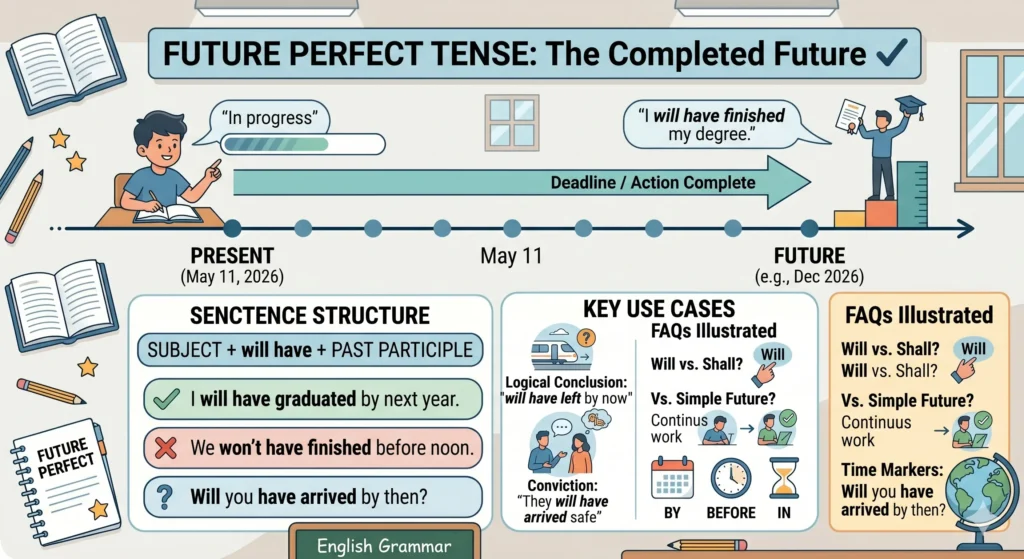
The Future Perfect Tense describes an action that will have been completed before another future action or time.
For example:
- By next week, I will have finished my project.
- She will have arrived before 8 PM.
- They will have completed the work by tomorrow.
In each sentence, the action will already be done before a future moment.
Structure of the Future Perfect Tense
The Future Perfect Tense uses:
Subject + will have + past participle
Formula
Subject+will have+past participle
Examples
- I will have eaten dinner by 7 PM.
- He will have left the office before noon.
- We will have completed the assignment by Friday.
The past participle is usually the third form of the verb.
Examples:
- go → gone
- eat → eaten
- finish → finished
- write → written
Positive Sentences
Positive sentences tell us that an action will be completed in the future.
Examples
- She will have studied for the exam by tonight.
- They will have built the new bridge by next year.
- I will have saved enough money by December.
- The train will have departed before we arrive.
Negative Sentences
To make negative sentences, add not after will.
Structure
Subject+will not have+past participle
Examples
- I will not have finished the book by tomorrow.
- She won’t have completed the work before the deadline.
- They will not have arrived by 9 PM.
- We won’t have solved the problem by then.
The short form of will not is won’t.
Questions in the Future Perfect Tense
To form questions, place will before the subject.
Structure
Will+subject+have+past participle ?
Examples
- Will you have completed the report by Monday?
- Will she have arrived before dinner?
- Will they have finished the game by then?
- Will we have reached the airport before 6 PM?
When to Use the Future Perfect Tense
1. To Show Completion Before a Future Time
This is the most common use of the Future Perfect Tense.
Examples
- By 10 PM, I will have completed my homework.
- The movie will have ended by the time we get there.
- She will have graduated by next summer.
The action will be fully completed before a future point.
2. To Describe Achievements or Goals
The tense is often used to talk about future accomplishments.
Examples
- By next year, he will have worked here for ten years.
- I will have learned basic Spanish by the end of the course.
- They will have launched the new product by July.
3. To Make Predictions About the Future
Sometimes we use the Future Perfect Tense to guess that something has already happened.
Examples
- She will have reached home by now.
- They will have heard the news already.
- The teacher will have checked our assignments.
Time Expressions Commonly Used
The Future Perfect Tense often appears with time expressions such as:
- by tomorrow
- by next week
- by then
- before
- by the time
- by 2030
- before noon
Examples
- By tomorrow morning, I will have finished the task.
- We will have left before sunset.
- By the time you arrive, they will have eaten dinner.
Future Perfect Tense vs Simple Future Tense
Many learners confuse these two tenses.
Simple Future Tense
The Simple Future Tense talks about future actions.
- I will finish my homework tomorrow.
Future Perfect Tense
The Future Perfect Tense focuses on completion before a future time.
- I will have finished my homework by 8 PM tomorrow.
The second sentence emphasizes that the action will already be complete.
To understand this tense better, you can also read our guide on the Simple Future Tense.
Common Mistakes to Avoid
1. Using the Wrong Verb Form
Incorrect:
- She will have finish the work.
Correct:
- She will have finished the work.
Always use the past participle after “have.”
2. Forgetting “Have”
Incorrect:
- They will completed the task.
Correct:
- They will have completed the task.
3. Confusing Future Perfect with Present Perfect
Incorrect:
- By tomorrow, I have finished the work.
Correct:
- By tomorrow, I will have finished the work.
You may also compare this tense with the Present Perfect Tense to understand how perfect tenses work in English grammar.
Practice Sentences
Fill in the blanks with the correct Future Perfect form.
- By next month, she __________ the course.
- They __________ the building by next year.
- We __________ dinner before the guests arrive.
- I __________ the book by tomorrow.
Answers
- will have completed
- will have finished
- will have prepared
- will have read
You can also learn the Future Continuous Tense to improve your understanding of future actions in English.
Conclusion
The Future Perfect Tense is an important part of English grammar. It helps describe actions that will be completed before a future time or event. The tense uses the structure:
Subject+will have+past participle
By learning how to form positive sentences, negatives, and questions, you can communicate future plans and completed actions more clearly. Regular practice with examples and exercises will help you master the Future Perfect Tense confidently.
You can also improve your grammar by learning related topics such as the Simple Future Tense, Present Perfect Tense, and Future Continuous Tense.
Learning English tenses is an important part of mastering English Grammar Rules.
For more grammar explanations, visit the Cambridge Dictionary Grammar
Frequently Asked Questions (FAQ)
Is there a difference between “will have” and “shall have”?
While “shall” was traditionally used for the first person (I and we), it has largely fallen out of modern usage in everyday English. In most professional and casual contexts, “will have” is the standard for all subjects. “Shall” is now primarily reserved for very formal legal documents or for offering suggestions (e.g., “Shall we dance?”).
Can I use the Future Perfect for people?
Absolutely. It is frequently used to describe a person’s achievements or life stages.
Example: “By the time he is thirty, he will have visited every continent.”
What is the difference between the Future Perfect and the Simple Future?
The Simple Future (I will finish) simply states an intent or a fact about the future. The Future Perfect (I will have finished) emphasizes the completion of the task before a specific cutoff point.
Simple Future: “I will do my homework tomorrow.” (A general plan).
Future Perfect: “I will have done my homework by 6:00 PM.” (A deadline-oriented statement).
Is the Future Perfect used in conversation, or just in writing?
It is used in both! While it might seem “heavy,” it is actually very common in workplace conversations regarding project management and deadlines. In casual speech, it is often contracted to sound more natural: “I’ll’ve finished it by then.” (Though “I’ll’ve” is rarely written, it is frequently heard).
Can I use “be going to” instead of “will”?
Yes, you can replace “will” with the appropriate form of “be going to” to express the same idea, though it is slightly wordier.
Standard: “I will have graduated by May.”
With ‘going to’: “I am going to have graduated by May.” The “will” version is much more common because it is more concise.
What if I don’t have a specific time or deadline?
The Future Perfect generally requires a time reference (like “by then” or “before Monday”) to make sense. Without an “anchor” in time, the sentence usually feels incomplete. If you don’t have a deadline, the Simple Future or Future Continuous is likely a better fit.
What is the “Future Perfect Continuous”?
That is a closely related tense used for actions that will be ongoing up until a certain point.
Future Perfect: “By midnight, I will have slept for two hours.” (Focuses on the 2-hour total).
Future Perfect Continuous: “By midnight, I will have been sleeping for two hours.” (Focuses on the duration and the fact that I am still sleeping).