
Table of Contents
Introduction
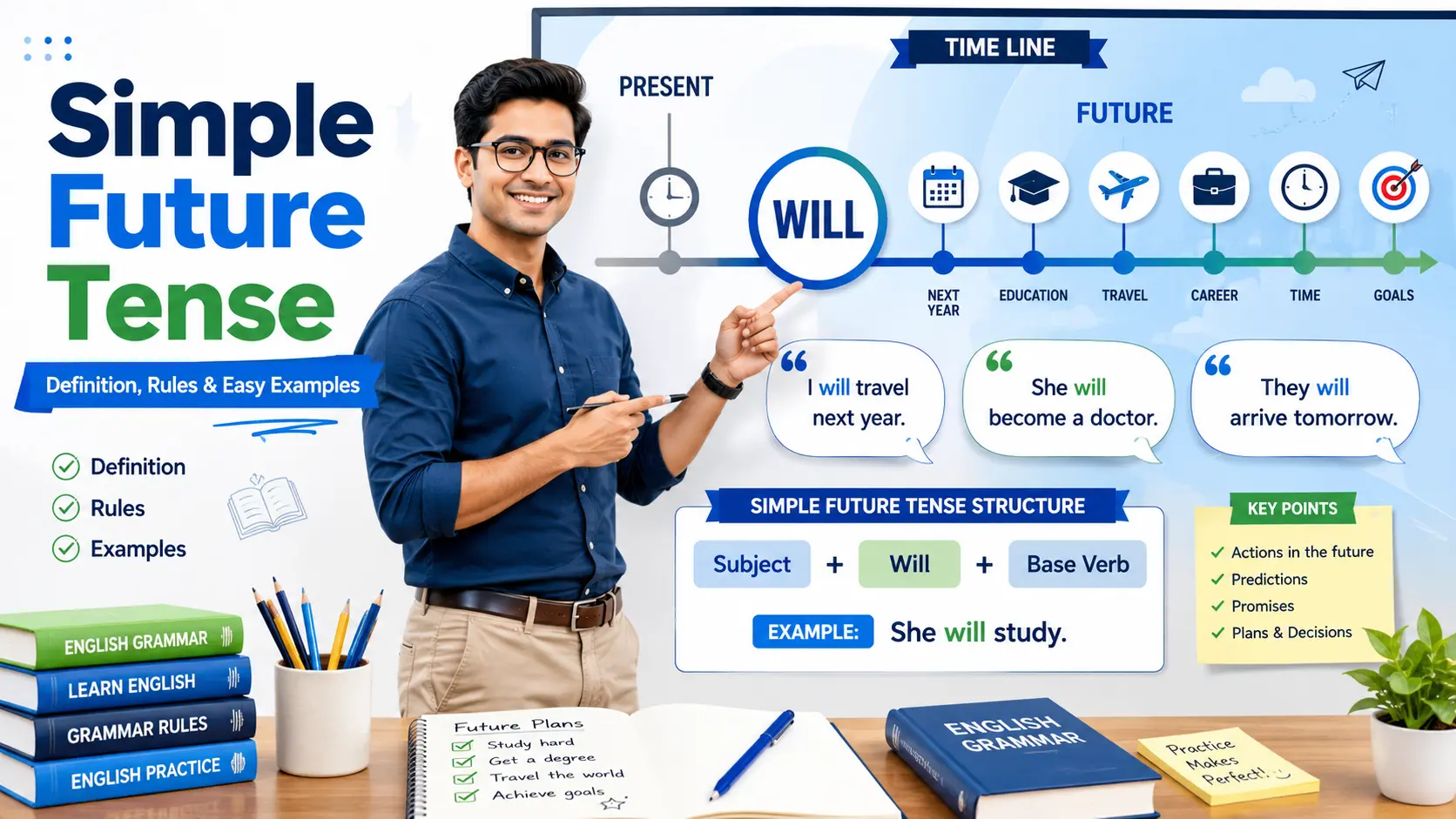
The English Grammar Simple Future Tense is used to describe actions that will happen in the future. It helps us talk about plans, predictions, promises, decisions, and future events. This tense is very important in daily communication because we often speak about what we will do tomorrow, next week, or in the future.
Think about how often you look ahead. Whether you are planning a weekend getaway, guessing tomorrow’s weather, or promising a friend that you will grab coffee soon, you are constantly living in tomorrow. In English, sharing these dreams, plans, and split-second decisions all comes down to mastering one vital tool: the Simple Future Tense. It is the ultimate bridge between where you are right now and where you want to be.
What Is the Simple Future Tense?
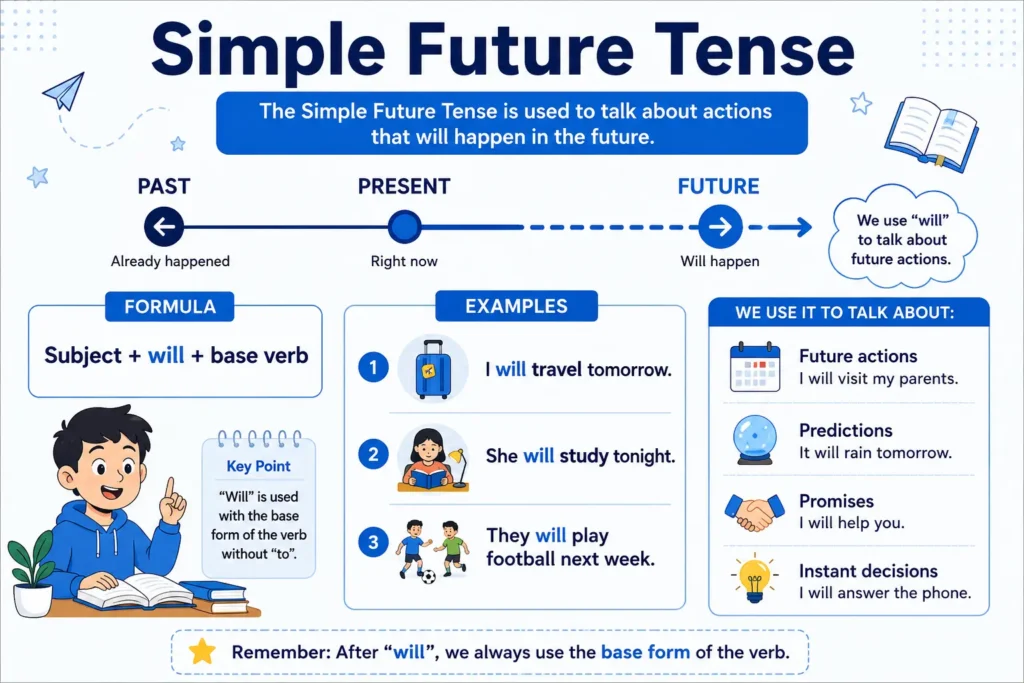
The Simple Future Tense is used to describe actions that will happen in the future. It is formed using “will + base verb.”
This can help rank for:
- “What is simple future tense?”
- “Simple future tense definition”
Structure of Simple Future Tense
The basic structure is:
Subject + will + base verb + object
Examples:
- I will travel to Japan next year.
- She will study tonight.
- They will play football tomorrow.
Negative sentences use will not or won’t.
Structure:
Subject + will not + base verb + object
Examples:
- I will not be late.
- He won’t watch the movie.
- We will not forget your birthday.
Questions are formed by placing will before the subject.
Structure:
Will + subject + base verb + object?
Examples:
- Will you help me?
- Will they come tomorrow?
- Will she join the meeting?
Simple Future Tense Master Formula Chart
| Sentence Type | Formula | Singular Example (I, He, She, It) | Plural Example (You, We, They) |
| Affirmative | Subject + will + Base Verb | “She will submit the report tomorrow.” | “They will install the solar cookers.” |
| Negative | Subject + will not (won’t) + Base Verb | “He won’t miss the morning train.” | “We will not delay the project review.” |
| Yes/No Question | Will + Subject + Base Verb? | “Will it rain later this afternoon?” | “Will you attend the lecture?” |
| Wh- Question | Wh- Word + will + Subject + Base Verb? | “When will she arrive at the station?” | “Where will they build the facility?” |
When to Use the Simple Future Tense
1. To Talk About Future Actions
We use the Simple Future Tense for actions that will happen later.
Examples:
- I will visit my grandmother this weekend.
- The train will arrive at 8 p.m.
- They will move to a new house next month.
2. To Make Predictions
The tense is also used to predict future events.
Examples:
- It will rain tomorrow.
- Technology will improve rapidly.
- Malaysia will continue to grow economically.
These predictions may or may not happen, but the speaker believes they are possible.
3. To Express Promises or Offers
We often use “will” when making promises or offering help.
Examples:
- I will help you with your homework.
- Don’t worry. I will call you later.
- We will support your decision.
4. For Instant Decisions
Sometimes we decide something at the moment of speaking.
Examples:
- The phone is ringing. I will answer it.
- I’m thirsty. I will buy a drink.
- This bag looks heavy. I will carry it for you.
| Sentence Type | Structure | Example |
|---|
| Positive | Subject + will + verb | She will travel |
| Negative | Subject + will not + verb | She will not travel |
| Question | Will + subject + verb? | Will she travel? |
Will vs. Going To vs. Present Continuous (Future Meanings)
English speakers use three main structures to talk about future events depending on their level of planning and certainty:
- 1. “Will” (Spontaneous Decisions, Predictions, Promises):Used when a decision is made right at the moment of speaking, or for general predictions about the distant future.
- Example: “I am hungry. I will order some food.” (Instant decision)
- 2. “Be Going To” (Prior Plans & Immediate Evidence):Used for plans or intentions decided before the moment of speaking, or when clear physical evidence points to an immediate event.
- Example: “Look at those dark clouds! It is going to rain.” (Visual evidence)
- 3. Present Continuous for Fixed Arrangements:Used when a future event is already confirmed on a calendar or itinerary.
- Example: “We are meeting the project owner at 10:00 AM tomorrow.” (Fixed schedule)
Common Time Expressions
The Simple Future Tense is often used with future time expressions such as:
- tomorrow
- next week
- next month
- next year
- soon
- later
- in the future
Examples:
- She will start college next year.
- We will meet again soon.
- I will finish the project later.
Difference Between “Will” and “Going To”
Both “will” and “going to” talk about the future, but they are used differently.
“Will”
Used for:
- spontaneous decisions
- promises
- predictions
Example:
- I will help you.
“Going To”
Used for:
- planned actions
- intentions
- events that seem certain
Example:
- I am going to visit my cousin this weekend.
Although both forms refer to the future, “going to” usually suggests a plan already made.
More Simple Future Tense Examples
Here are more examples to help you understand:
- My brother will start a new job next month.
- The students will take their exams soon.
- We will travel during the school holidays.
- She will cook dinner tonight.
- I will never forget your kindness.
- Will you attend the event?
- They won’t agree with the proposal.
Common Mistakes
6 High-Frequency Simple Future Mistakes & How to Fix Them
Pedagogical Reason: English does not allow two modal auxiliary verbs side by side. Replace can with be able to when projecting ability into the future.
Mistake 1: Adding Infinitive “To” After “Will”
❌ Incorrect: She will to attend the afternoon meeting.
✔️ Correct: She will attend the afternoon meeting.
Pedagogical Reason: Will is a modal auxiliary verb and must be followed directly by a bare infinitive (base verb) without to.
Mistake 2: Adding Third-Person “-s” Suffixes After “Will”
❌ Incorrect: He will comes to visit us next week.
✔️ Correct: He will come to visit us next week.
Pedagogical Reason: Modal verbs like will do not conjugate for third-person singular subjects (he, she, it).
Mistake 3: Using “Will” in Time Clauses Starting with “When” or “If”
❌ Incorrect: When the client will arrive tomorrow, we will start the meeting.
✔️ Correct: When the client arrives tomorrow, we will start the meeting.
Pedagogical Rule: In subordinate time or conditional clauses (starting with when, if, before, after, as soon as), use the Present Simple Tense, even when referring to future events.
Mistake 4: Using “Shall” Inappropriately in Everyday English
❌ Incorrect: They shall complete the project by Friday. (Sounds overly legal or archaic)
✔️ Correct: They will complete the project by Friday.
Pedagogical Reason: While shall was traditionally used with I and we, modern standard English uses will across all subjects for general future statements. Reserve shall primarily for polite first-person offers (“Shall I open the window?”).
Mistake 5: Using Past Participles Instead of Base Verbs
❌ Incorrect: I will bought a new textbook tomorrow.
✔️ Correct: I will buy a new textbook tomorrow.
Pedagogical Reason: Never pair modal verbs like will with V2 or V3 verb forms in active simple future constructions.
Mistake 6: Double Modals (“Will Can”)
❌ Incorrect: If you help me, I will can finish faster.
✔️ Correct: If you help me, I will be able to finish faster.
Why the Simple Future Tense Is Important
The Simple Future Tense is essential for everyday English. People use it when discussing goals, plans, predictions, and future events. Whether speaking, writing emails, or having conversations, this tense helps communicate clearly about the future.
Students learning English should practice making positive sentences, negative sentences, and questions using this tense. With regular practice, using the Simple Future Tense becomes easy and natural.
Learn More About the Following Tenses
The Present Tense is used to describe actions happening now, daily routines, and general facts. Understanding the Present Tense helps learners build a strong foundation in English grammar before learning future forms.
The Past Tense explains actions that already happened in the past. Learning the differences between past, present, and future tenses helps improve sentence construction and writing skills.
The Future Continuous Tense describes actions that will be happening at a specific time in the future. It is useful for talking about ongoing future activities and future plans.
Interactive Practice Exercise: Test Your Knowledge
Complete each sentence by filling in the correct form of the verb using the Simple Future Tense (will + base verb) or choosing the appropriate future structure:
- Don’t worry about the heavy boxes; I __________ (help) you carry them to the car.
- The weather forecast predicts that it __________ (be) sunny all weekend.
- As soon as the lesson ends, the students __________ (leave) the classroom.
- ( Will / Are ) __________ you attend the grammar workshop next Saturday?
- By 2030, technology __________ (transform) how we study online.
- She __________ (not / agree) to the proposal without reviewing the terms first.
- The phone is ringing! I __________ (answer) it right away.
- What time __________ the train __________ (depart) tomorrow morning?
- I promise I __________ (not / forget) to send you the worksheet PDF.
- If it rains tomorrow, we __________ (cancel) the outdoor solar cooking demonstration.
Answer Key & Detailed Explanations:
- will help — Expresses a spontaneous offer of assistance made at the moment of speaking.
- will be — Indicates a prediction about future weather conditions.
- will leave — Main clause takes will leave; subordinate clause (as soon as the lesson ends) stays in Present Simple.
- Will — Interrogative Simple Future question asking about future attendance.
- will transform — Prediction about future technological progress over time.
- will not agree (won’t agree) — Negative Simple Future for a future condition.
- will answer — Instant decision made at the moment of hearing the phone.
- will / depart — Question form split by the subject (the train).
- will not forget (won’t forget) — Expresses a direct personal promise.
- will cancel — Main clause calculation following a conditional if clause.
Conclusion
The Simple Future Tense is one of the most useful tenses in English grammar. It is formed using will + base verb and is used for future actions, promises, predictions, and quick decisions. Learning this tense improves both speaking and writing skills.
By practicing simple examples every day, learners can become more confident in using English to talk about the future.
Frequently Asked Questions
What is the Simple Future Tense with an example?
The Simple Future Tense is used to talk about actions or states that haven’t happened yet but will take place later. For example: “We will celebrate your birthday next week.” It is one of the easiest tenses to learn because the helper word “will” never changes, no matter who you are talking about.
What is the basic formula for the Simple Future Tense?
The standard formula is Subject + will + base form of the verb.
Positive: He will cook dinner.
Negative: He will not (won’t) cook dinner.
Question: Will he cook dinner?
Remember to always use the natural base verb. You should never add “-ed,” “-ing,” or “-s” to the verb after “will.”
When should I use “will” instead of “going to”?
Use “will” for instant, unplanned decisions made at the moment of speaking (e.g., “The phone is ringing. I will answer it”), promises, or general predictions. Use “going to” when you are talking about a firm plan or intention that you already decided on before speaking (e.g., “I am going to visit my cousin this weekend”).
Can I use “will” with any verb?
Yes! “Will” works perfectly with all action verbs and state verbs in their base form (like go, run, think, be, have). Unlike the present tense, you don’t need to worry about changing the helper word for singular or plural subjects—it is always “will” whether you are saying I, you, he, she, it, we, or they.
What are common time markers used with this tense?
Because this tense looks forward, it pairs naturally with time words like tomorrow, next week, next year, soon, later, tonight, and in the future. Placing these at the beginning or end of your sentence helps make your timeline crystal clear to the listener.