
Learning English grammar can sometimes feel confusing, especially when you come across long tense names like the Future Perfect Continuous Tense. At first glance, the name may sound difficult, but once you understand its structure and purpose, it becomes much easier to use in everyday communication.
I remember the first time I saw this tense in a textbook. I stared at the four-word verb phrase—“will have been working”—and thought, “Does anyone actually talk like this?” It felt like a linguistic puzzle rather than a way to communicate. But then I realized that we use this logic all the time in our own minds. When we daydream about our future successes or count down the days until a big anniversary, we are subconsciously using the Future Perfect Continuous. It’s the “marathon” tense—it’s not about the finish line; it’s about the sweat and effort it took to get there.
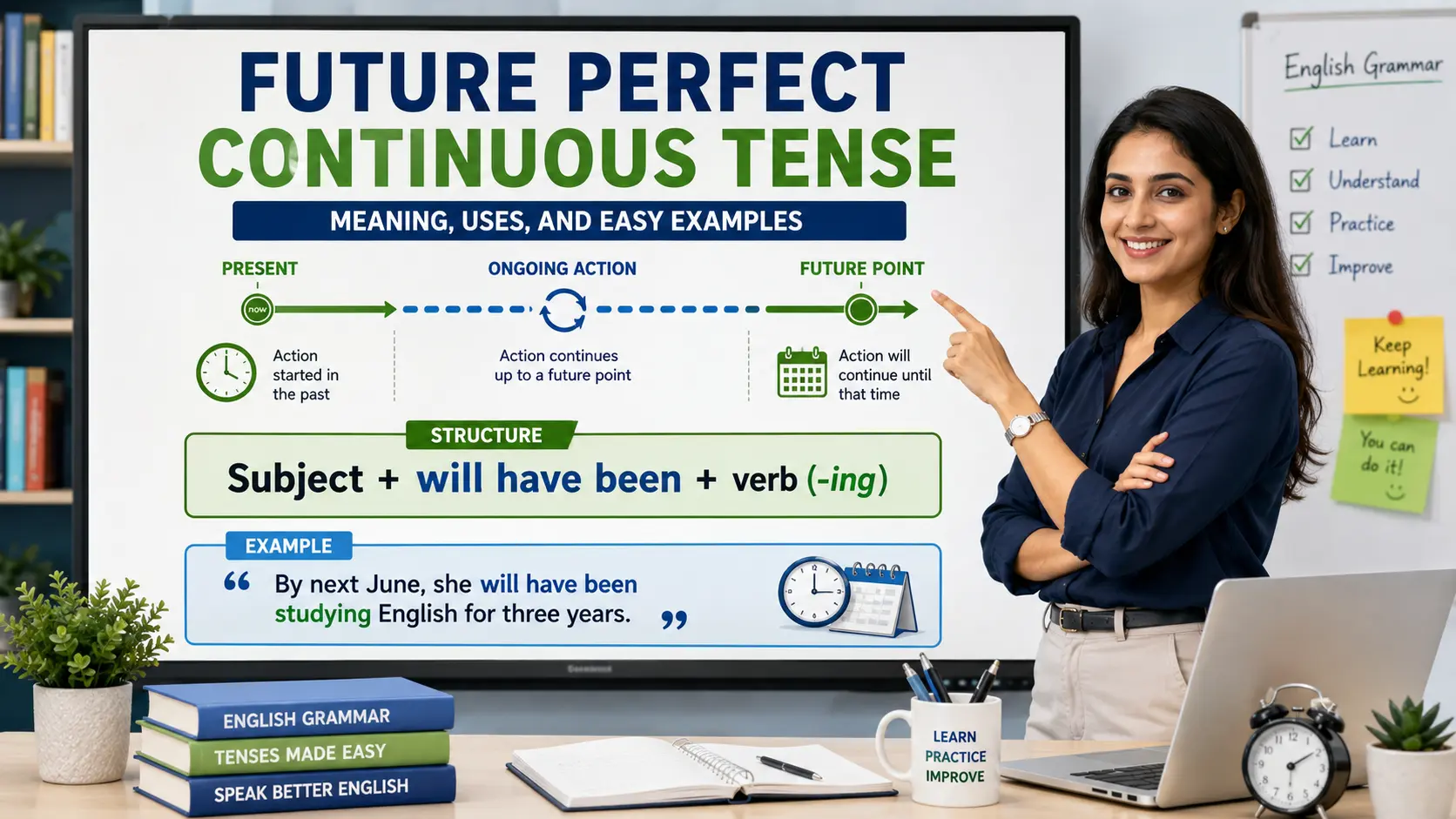
The Future Perfect Continuous Tense is used to describe an action that will continue for a period of time before a specific moment in the future. In simple words, it talks about something that will have been happening continuously up to a certain future time.
For students, teachers, and English learners, mastering this tense can improve both writing and speaking skills. Although it is not used as often as simpler tenses, it is still important for formal writing, exams, and advanced English communication.
Table of Contents
Structure of the Future Perfect Continuous Tense
Future Perfect Continuous constructions follow standard academic rules for verbal aspect and future duration
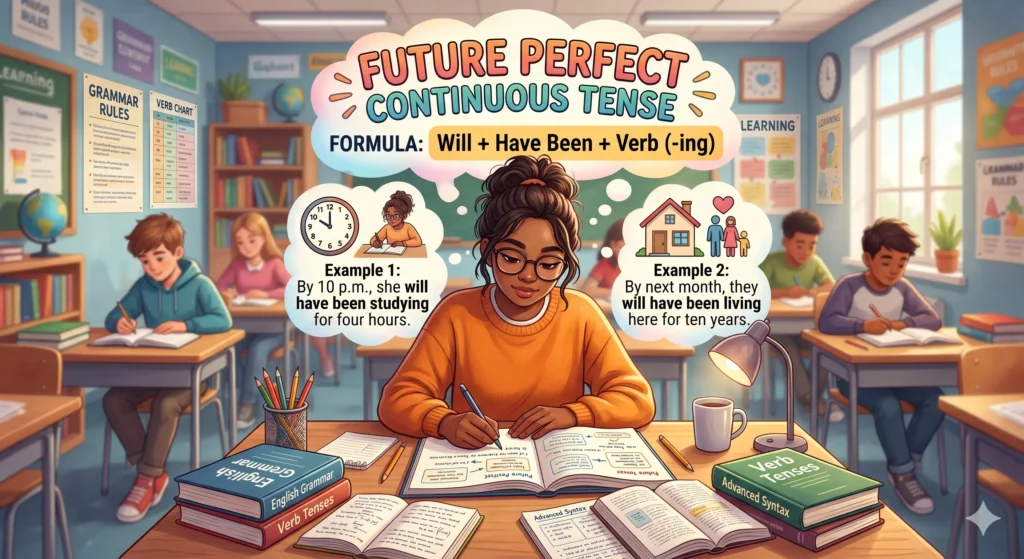
The formula is:
Subject + will have been + verb (-ing) + time reference
Examples:
- I will have been studying for three hours by 10 p.m.
- She will have been teaching for ten years next June.
- They will have been traveling around Asia for six months by December.
The helping verbs “will have been” remain the same for all subjects.
Future Tenses Master Comparison Table
| Tense Name | Structural Formula | Primary Focus | Example Sentence |
| Simple Future | Subject + will + Base Verb | Single future action or prediction | “I will study tonight.” |
| Future Continuous | Subject + will be + V-ing | Action in progress at a future moment | “I will be studying at 8:00 PM.” |
| Future Perfect | Subject + will have + Past Participle | Action completed before a future time | “I will have studied before the test.” |
| Future Perfect Continuous | Subject + will have been + V-ing | Duration of action up to a future point | “I will have been studying for 3 hours by 10:00 PM.” |
When Do We Use the Future Perfect Continuous Tense?
1. To Show Duration Before a Future Time
This is the most common use.
We use the tense to emphasize how long an action will continue before a specific future point.
Examples:
- By next week, my father will have been working in this company for 25 years.
- At midnight, we will have been driving for eight hours.
The focus is on the duration of the action, not just the action itself.
2. To Describe Ongoing Future Activities
Sometimes we use it to imagine what will still be happening in the future.
Examples:
- This time tomorrow, I will have been flying for nearly twelve hours.
- In 2030, scientists will have been researching renewable energy for decades.
This use helps create a picture of continuous activity over time.
3. To Emphasize Effort or Continuity
The tense can also highlight dedication, persistence, or repeated effort.
Examples:
- By the end of this year, she will have been practicing piano every day for ten years.
- The volunteers will have been helping the community for many months before the project ends.
This often adds emotional depth and personal meaning to a sentence.
Time Expressions Commonly Used
The Future Perfect Continuous Tense usually appears with time expressions such as:
- for
- by
- by the time
- before
- since
Examples:
- By 5 p.m., I will have been waiting for two hours.
- By the end of the semester, the students will have been studying English for six months.
These phrases help show the connection between duration and future time.
Positive, Negative, and Question Forms
Positive Sentences
- She will have been reading for three hours.
- We will have been living here for five years next month.
Negative Sentences
To make a negative sentence, add not after “will.”
Structure:
Subject + will not have been + verb-ing
Examples:
- He will not have been working long enough to qualify.
- They will not have been staying at the hotel for very long.
The contraction won’t is also common:
- I won’t have been studying for long.
Question Form
Structure:
Will + subject + have been + verb-ing?
Examples:
- Will you have been working here for ten years by 2026?
- Will she have been waiting long?
Common Mistakes to Avoid
1. Forgetting “been”
Incorrect:
- She will have working here for years.
Correct:
- She will have been working here for years.
2. Using the Wrong Verb Form
The main verb must always end in -ing.
Incorrect:
- They will have been travel for months.
Correct:
- They will have been traveling for months.
3. Confusing It with Future Perfect Tense
Compare these two sentences:
- Future Perfect:
“I will have finished the project by Friday.” - Future Perfect Continuous:
“I will have been working on the project for five days by Friday.”
The first focuses on completion. The second focuses on duration.
Many students confuse this tense with the Present Perfect Continuous Tense, so it is helpful to compare both structures carefully.
You can also learn the difference between the Future Perfect Tense and the Future Perfect Continuous Tense.
Real-Life Examples
Understanding grammar becomes easier when connected to daily life.
Imagine a university student preparing for exams:
“By next Monday, I will have been revising for two weeks.”
Or think about someone training for a marathon:
“By the race day, she will have been training every morning for six months.”
Parents may also say:
“By next year, we will have been living in this neighborhood for a decade.”
These examples show how the tense naturally appears in real conversations.
Why Is This Tense Important?
Many English learners avoid advanced tenses because they seem complicated. However, learning the Future Perfect Continuous Tense can make your English sound more fluent and natural.
It is especially useful in:
- academic writing
- business English
- storytelling
- presentations
- formal speaking exams
Even native speakers use this tense when discussing long-term plans, careers, projects, or ongoing situations.
For example:
“By 2035, researchers will have been developing solar energy technologies for many years.”
This sentence sounds more professional and precise than using a simple future tense.
Tips to Master the Future Perfect Continuous Tense
Practice with Real Situations
Think about your own life:
- How long will you have been studying English next year?
- How long will your parents have been working?
- How long will you have been living in your town?
Personal examples make grammar easier to remember.
Learn the Formula
Memorize:
will have been + verb-ing
Once you remember this pattern, building sentences becomes simple.
Read and Listen More
Pay attention to movies, books, news articles, and conversations. You may notice this tense in formal speech or advanced writing.
Interactive Practice Exercise: Test Your Understanding
Complete each sentence by putting the verb in brackets into the correct form (Future Perfect Continuous or Future Perfect Simple):
Want to practice offline or test your knowledge in real-time? Download the FREE Sample featuring our AutoTick instant-marking system!
- By 11:00 PM, the technicians __________ (repair) the server for eight hours straight.
- Next December, our consulting firm __________ (operate) in Kuala Lumpur for thirty years.
- By the time you arrive, I __________ (not / sleep) for more than twenty-four hours.
- How long __________ she __________ (work) on her thesis by the end of this term?
- By next summer, he __________ (own) his custom solar cooking setup for five years.
- The orchestra __________ (rehearse) for three weeks before the opening concert takes place.
Answer Key & Detailed Explanations:
- will have been repairing — Measures ongoing physical effort up to a specific time (11:00 PM).
- will have been operating — Continuous business operation leading to a future anniversary milestone.
- will not have been sleeping — Negative continuous state measured up to a future event (your arrival).
- will / have been working — Interrogative form calculating cumulative duration.
- will have owned — Own is a stative verb of possession, requiring Future Perfect Simple.
- will have been rehearsing — Duration of continuous practice preceding a future event (opening concert).
Master All Future Tenses with Automated Grading:
“Take your tense mastery to the next level with our full collection of English Grammar Lessons with Autotick Marking Facilities. Gain access to hundreds of interactive practice sets, instant automated grading, and detailed answer explanations for every English tense!
Final Thoughts
The Future Perfect Continuous Tense may look long and complicated, but its purpose is actually straightforward. It helps us describe actions that will continue over a period of time before a future moment.
By understanding the structure, practicing regularly, and using real-life examples, you can confidently use this tense in your speaking and writing.
Remember, learning grammar is not about memorizing endless rules. It is about learning how to express ideas clearly and naturally. With patience and practice, even advanced tenses like the Future Perfect Continuous Tense will eventually feel comfortable and easy to use.
If you’re still feeling a bit overwhelmed, take a breath. Language isn’t a race. Even native speakers occasionally trip over these long structures! The goal isn’t to be a walking grammar book; the goal is to be understood. Start by using it to describe your own dreams. For me, I like to think that by this time next year, I will have been growing as a writer and a learner every single day. What about you? Once you start applying this tense to your own journey, those four little words—“will have been doing”—won’t feel like a burden anymore; they’ll feel like a badge of honor.
Frequently Asked Questions
Is there a difference between “will have been” and “shall have been”?
In modern English, “will” is the standard choice for all subjects. While “shall” was historically used with “I” and “we,” it now sounds very formal or even outdated in most contexts. For your everyday writing and speaking, stick with “will have been” to sound more natural.
Can I use the Future Perfect Continuous without a time reference?
Technically, no. This tense specifically measures the duration of an action leading up to a point in the future. Without a time marker (like “by next year” or “for two hours”), the sentence loses its purpose because there is no “finish line” to measure against.
Why not just use the Future Continuous (e.g., “I will be working”)?
The difference is all about the starting point.
Future Continuous: Simply tells us what you will be doing at a certain moment (e.g., “At 5 p.m., I will be working”).
Future Perfect Continuous: Tells us how long that activity has been going on at that moment (e.g., “At 5 p.m., I will have been working for eight hours“).
What happens if the action is finished before the future time?
If the action is completely finished, you should use the Future Perfect Simple.
Finished: “By dinner, I will have cooked the meal”.
Ongoing/Duration: “By dinner, I will have been cooking for three hours”.
Are there any verbs I should never use with this tense?
Yes! Avoid using stative verbs, which describe states or feelings rather than physical actions (e.g., know, love, hate, want, seem, believe).
Wrong: “I will have been knowing him for a year.”
Right: “I will have known him for a year”.